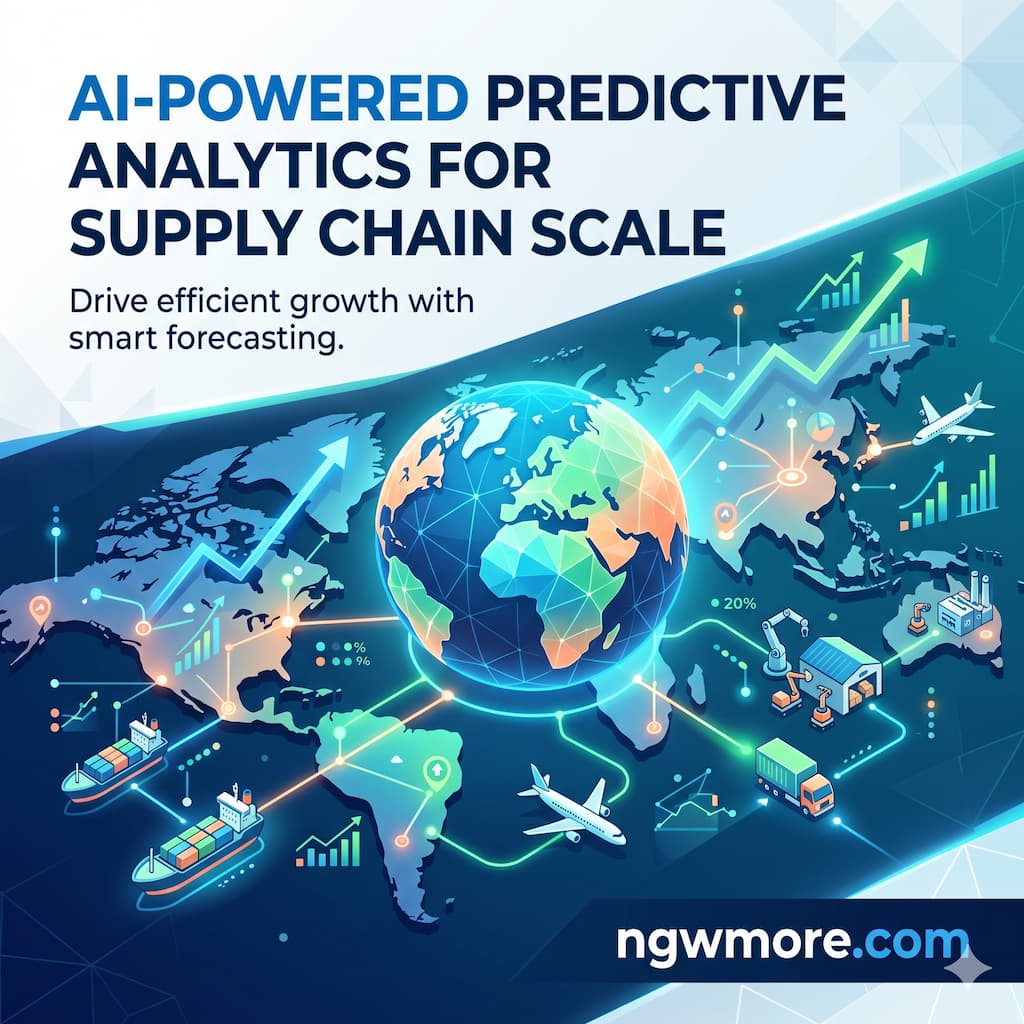
AI-Powered Predictive Analytics for Supply Chain Scale
The global logistics and distribution framework has collided with an absolute efficiency mandate. As we navigate 2026, international supply chains are operating under unprecedented pressure characterized by volatile macro-regional trade corridors, tightening carbon compliance frameworks, and hyper-compressed consumer delivery loops. The traditional methods of supply chain management—defined by historical statistical averages, localized inventory spreadsheets, and siloed ERP records—have transitioned from standard administrative practices into direct operational liabilities.
The core challenge confronting modern B2B networks, e-commerce platforms, and global manufacturing syndicates isn’t a lack of data; it is computational latency.
Enterprises capture millions of telemetry points from transit sensors, warehouse slotting monitors, and retail checkout nodes. However, when this data is analyzed retroactively, the resulting insights are obsolete long before modifications can be deployed to the production floor. If your logistics infrastructure takes days to recalculate inventory allocations or fails to predict a component shortage weeks before it stops a production line, your business model is structurally fragile.
For the digital entrepreneurs, full-stack developers, and technology growth leads anchoring their operations to the insights of ngwmore.com, speed to deployment is the defining variable of market survival. The standard driving elite supply chain performance this year is the deployment of Agentic Predictive Analytics Infrastructure.
By unifying multi-source global telemetry into an automated, AI-driven prediction and orchestration layer, modern enterprises are eliminating operational blind spots, optimizing working capital efficiency, and scaling fulfillment velocity exponentially with zero human data-entry drag.
1. The 2026 Predictive Shift: From Linear Models to Autonomous Intelligence Networks
To successfully exploit the power of predictive analytics at scale today, you must first dismantle legacy assumptions regarding enterprise demand forecasting. The evolution of supply chain planning can be categorized into three distinct historical generations:
- The Descriptive Era (The Past): Retrospective analysis. Systems recorded what had already occurred—such as a quarterly inventory depletion report—forcing human procurement managers to look backward to guess future ordering requirements.
- The Segmented Predictive Era (The Transition): Isolated machine learning forecasting. Algorithms ingested specific, structured historical sales logs to forecast localized product demands. While automated, these models remained completely blind to external real-world variables, leading to intense inventory imbalances during sudden macro market shifts.
- The Agentic Predictive Era (2026): The modern global standard. Supply chains function as a Continuous, Autonomous Intelligence Network. Powered by multimodal foundation models and decentralized edge processing, the system continuously monitors the physical world, runs real-time global simulations, isolates prospective logistics friction points, and executes automated routing and purchasing corrections autonomously.
  LEGACY DEMAND PLANNING (Passive & Episodic)
  [Historical Sales Data] ──► [Manual CSV Compilation] ──► [Static Forecast Model] ──► [Rigid, Delayed Procurement]

  2026 AGENTIC PREDICTIVE GRID (Continuous & Omniscient)
  [Continuous Ingestion: Web, Weather, Ports, ERP]
                        │
                        ▼
   ┌────────────────────────────────────────┐
   │   AI Predictive Analytics Engine       │ ──► [Dynamic Multi-Echelon Inventory Optimization]
   ├────────────────────────────────────────┤
   │ * Autonomous Multi-Agent Simulation    │ ──► [Sub-Second Alternative Logistics Routing]
   │ * Ambient External Variable Sync       │ ──► [Predictive Supplier Risk Quarantine]
   └────────────────────────────────────────┘
According to global supply chain execution benchmarks, organizations utilizing fully integrated AI predictive analytics platforms experience a 45% reduction in stock-out events and a 30% compression in total carrying costs, completely outperforming competitors who rely on manual, spreadsheet-bound forecasting loops.
2. Core Pillars of AI-Native Predictive Supply Chain Analytics
Scaling an international distribution footprint requires integrating four foundational technological pillars directly into your software and operational stacks.
I. Multi-Modal Environmental Data Ingestion
Traditional forecasting systems are fundamentally crippled by data formatting boundaries—they can only parse clean, internal database rows.
- The 2026 Architecture: Modern predictive engines utilize Multi-Source Open-Data Meshes.
- The Execution: The AI continuously ingests and evaluates a massive array of unstructured external variables simultaneously. It monitors satellite imagery of maritime shipping port congestion, reads real-time weather pattern variations across critical transport corridors, parses global geopolitical policy changes, and evaluates labor strike indicators across international manufacturing centers. By blending these external macro indicators with internal historical sales velocities, the system transforms raw global context into actionable predictive clarity.
II. Multi-Echelon Inventory Optimization (MEIO)
Managing inventory levels across a multi-tiered distribution network—spanning international raw material suppliers, regional manufacturing plants, central fulfillment hubs, and localized micro-warehouses—presents an immense mathematical optimization challenge.
- The Algorithmic Balance: 2026 predictive platforms run continuous Dynamic MEIO Loops. Instead of enforcing uniform safety stock levels across all locations, the AI continuously evaluates changing lead times, regional storage costs, and local demand surges.
- The Optimization: The system calculates the mathematically optimal distribution of individual SKUs across your entire physical surface, programmatically pushing inventory to the edge ahead of projected consumer purchase triggers to maximize fulfillment speed while minimizing idle capital lockup.
III. Autonomous Alternative Logistics Routing
When a critical supply line ruptures—such as an unexpected customs blockage, an extreme weather shutdown, or a rail line disruption—human logistics coordinators often spend hours frantically calling alternative couriers to find cargo space, while supply-chain drag compounds.
- The Sub-Second Countermeasure: Under an agentic predictive framework, the AI system continuously tracks every active transit asset via real-time GPS and IoT sensors. The moment the system predicts an impending delay along a primary transit line, it automatically spins up a localized simulation enclave, evaluates thousands of alternative intermodal shipping paths, assesses real-time rate quotes across digital freight networks, and books alternative shipping space programmatically before the original delay impacts downstream production targets.
IV. Predictive Supplier Risk Assessment and Self-Healing Procurement
Relying on vendor promises or retrospective scorecard performance reviews introduces unacceptable operational vulnerability into your supply chain.
- The Sensing Shield: Modern predictive engines monitor real-time supplier behavior patterns. The AI audits a supplier’s historical component delivery latencies, invoice accuracy deviations, raw material acquisition costs, and local financial indicators.
- The Self-Healing Loop: If a vendor’s behavioral telemetry alerts the system to an elevated probability of an impending delivery default, the platform activates a self-healing procurement routine. It automatically scales down ordering volumes with the high-risk provider and diverts the procurement tranches to pre-vetted, secondary fallback vendors, insulating your assembly pipelines from upstream disruptions completely.
3. The 2026 Predictive Analytics Stack: Premier Enterprise Systems
To transition your logistics footprint from a reactive, cost-heavy operational layer into an agile, predictive competitive moat, your enterprise must connect its database perimeters to specialized, context-aware analytics networks. The current marketplace features highly advanced options:
| Platform Category | Leading 2026 Platforms | Core Enterprise Utility | Standout Predictive Feature |
| Enterprise Supply Chain Twins | Palantir Foundry / Kinaxis Maestro | Multi-tiered logistics simulation, asset mapping, & pipeline visibility | Ontological Synthesis: Constructs an interactive digital twin of global physical supply lines and material dependencies. |
| Autonomous Fulfillment Sync | Blue Yonder / o9 Solutions | Multi-echelon demand forecasting & programmatic purchasing | Cognitive Underwriting: Autonomously links variable market trends with real-time manufacturing and parts supply lines. |
| Real-Time Visibility Portals | FourKites / Project44 | Continuous global freight tracking & predictive ETAs | Dynamic Transit Telemetry: Generates hyper-accurate, sub-minute arrival projections utilizing localized IoT data streams. |
4. Tactical Roadmap: Operationalizing Predictive AI for Supply Chain Scale
Transitioning your tech-driven brand or international enterprise away from manual planning paradigms and constructing a resilient, automated predictive supply engine requires a systematic, architecturally sound roadmap.
Step 1: Maximize End-to-End Enterprise Data Liquidity
An AI predictive engine’s analytical precision is fundamentally bounded by the transparency of its data streams. You must eliminate your internal operational silos. Establish direct API connections and real-time open-telemetry webhooks connecting your e-commerce storefront checkout pages, internal ERP engines (SAP, Oracle), warehouse slotting trackers, and primary server deployment logs on ngwhost.com into a centralized, unified Revenue and Logistics Data Lake. This provides your predictive AI models with an unobstructed, 360-degree view of your operating reality.
Step 2: Configure the “Agentic-to-Human” Authorization Boundary
Do not attempt to remove human strategic judgment entirely from high-stakes corporate procurement and logistics contracts. While predictive agents are unmatched at processing millions of unstructured external variables, running complex simulations, and isolating pipeline leaks, final risk accountability and relationship building require human intervention. Implement an optimized, high-velocity operational gate:
[Telemetry Tracks Impending Delays] ──► [AI Simulated Solutions & Rate Quotes] ──► [AI Populates Completed Action Dossier] ──► [Human Director One-Click Execution]
Configure your platform’s configuration settings to push high-conviction predictive alerts and automated mitigation options straight into a centralized Live Operational Feed. The AI handles the heavy lifting—calculating risks, sourcing alternative routes, and pre-populating order forms—while the human director retains absolute veto power, authorizing the strategy with a single click before the system executes the alternative procurement contract.
Step 3: Implement Privacy-First Data Anonymization Guardrails
Because an advanced predictive supply chain engine requires sharing real-time data payloads—such as inventory depletion rates, factory output capacities, and shipping itineraries—with a broad network of external third-party suppliers and third-party logistics (3PL) vendors, protecting proprietary data boundaries is an absolute compliance requirement.
- The Data Shield: Deploy Sovereign Metadata Encryption Guards at your API parameters.
- The Isolation: The system encrypts and anonymizes sensitive internal identifiers before transmitting tracking metrics to external vendor nodes, ensuring your proprietary product margins, trade secrets, and supplier network structures remain 100% insulated from external data parsing or competitor intelligence aggregation.
5. Critical Risk Management: Navigating the 2026 Supply Chain Pitfalls
Operating a highly automated, predictive distribution layer requires continuous, data-backed governance to protect your enterprise from unique digital and operational liabilities:
- The Hazard of the “Bullwhip Effect” Acceleration: If your predictive AI engine over-indexes on an anomalous, short-term spike in consumer purchase trends—such as an viral internet trend or a localized panic-buying event—and automatically places massive, long-term component orders with global manufacturing partners, the system can rapidly accelerate the classic “bullwhip effect.” This can flood your warehouses with unmanageable, low-margin inventory during subsequent market corrections. Technical leads must enforce strict Operational Guardrail Boundaries and inventory ceiling parameters to constrain automated ordering loops.
- The Threat of Upstream API Spoofing and Cyber Sabotage: As supply chain networks become deeply interconnected via open APIs, cybercriminal syndicates target vendor networks to compromise primary enterprise systems. Malicious actors can access a secondary supplier’s data portal and inject falsified intent or inventory metrics into your predictive analytics engine, tricking your systems into cancelling vital orders or rerouting freight to unsecure locations. Implement Zero-Trust Token Verifications and strict cryptographic data hygiene rules across all incoming supplier telemetry lines.
- Managing Algorithmic Bias and Training Drifts: Machine learning models trained on historical shipping profiles can experience Model Drift as macro climates change. If an algorithm continuously calculates shipping transit times utilizing data collected prior to major international port upgrades or changes in carrier lanes, its predictive ETAs will degrade, corrupting downstream fulfillment planning. Your data science team must execute automated, monthly backtesting loops to verify that your prediction metrics remain perfectly calibrated to real-world floor conditions.
6. The Systems Synergy: High-Availability Redundancy for Physical Assets
For the advanced cloud systems developers, full-stack database architects, and technology visionaries who scale their digital platforms on the backbone of ngwhost.com, the structural logic of a predictive supply chain grid is deeply native.
When you configure an enterprise corporate server architecture, build an international e-commerce web layout, or scale an enterprise application database, you do not tolerate single points of failure. You don’t leave your system architecture vulnerable to an isolated hardware crash, a single database corruption point, or a localized power failure. You engineer comprehensive, mathematical redundancy: you utilize load balancers to distribute data traffic smoothly, deploy isolated container instances across multiple geographic data zones to handle processing spikes effortlessly, and maintain secure, multi-region database mirrors to ensure that if a critical server cluster drops offline, the broader network continues to perform flawlessly without data loss.
Deploying an integrated AI-Powered Predictive Supply Chain Analytics Architecture is simply extending that exact same systemic, multi-layered structural redundancy to your company’s physical distribution and asset frameworks:
- Your Multi-Modal Environmental Data Sensors and Real-Time IoT Freight Trackers operate as your high-velocity edge nodes, managing day-to-day incoming market insights and transportation bottlenecks with absolute fluid execution.
- Your Multi-Agent Simulation Networks and MEIO Optimization Core act as your resilient core database systems, instantly compounding, testing, and protecting your active inventory allocations, completely insulated from individual human operational blind spots.
- Your Self-Healing Procurement Loops and Automated Alternative Routing Actions behave as your secure, enterprise-grade system firewalls, silently optimizing your operating margins, shielding your physical operations from throughput blockages, and ensuring absolute corporate velocity against changing global market demands.
By mastering this technical configuration, you strip away balance sheet vulnerabilities, eliminate operational cash drag, and position your digital brand to scale at terminal velocity while maintaining total financial and physical sovereignty over the global enterprise you built.
Read More⚡ AI for Revenue Operations: Scaling B2B Growth in 2026
Conclusion: Securing the Predictive Scale Victory
The era of manual, reactive supply chain planning has run its course. In a hyper-competitive global marketplace defined by rapid technological adaptation and instant customer fulfillment requirements, forcing modern logistics and procurement personnel to rely on click-by-click manual data entry and historical guessing games is a recipe for operational failure and margin erosion.
The path to sustainable supply chain scalability requires an absolute embrace of autonomous, predictive, and data-liquid software architecture. By unifying your multi-source data feeds via high-performance cloud networks, linking your prediction telemetry directly into your central ERP and WMS core, enforcing rigorous data anonymization protocols, and prioritizing continuous algorithmic backtesting, you completely remove risk, friction, and human operational latency from your expansion loops.
The physical assets of the global digital economy are moving at unprecedented velocities. Is your distribution architecture engineered to track and direct them at the speed of thought?