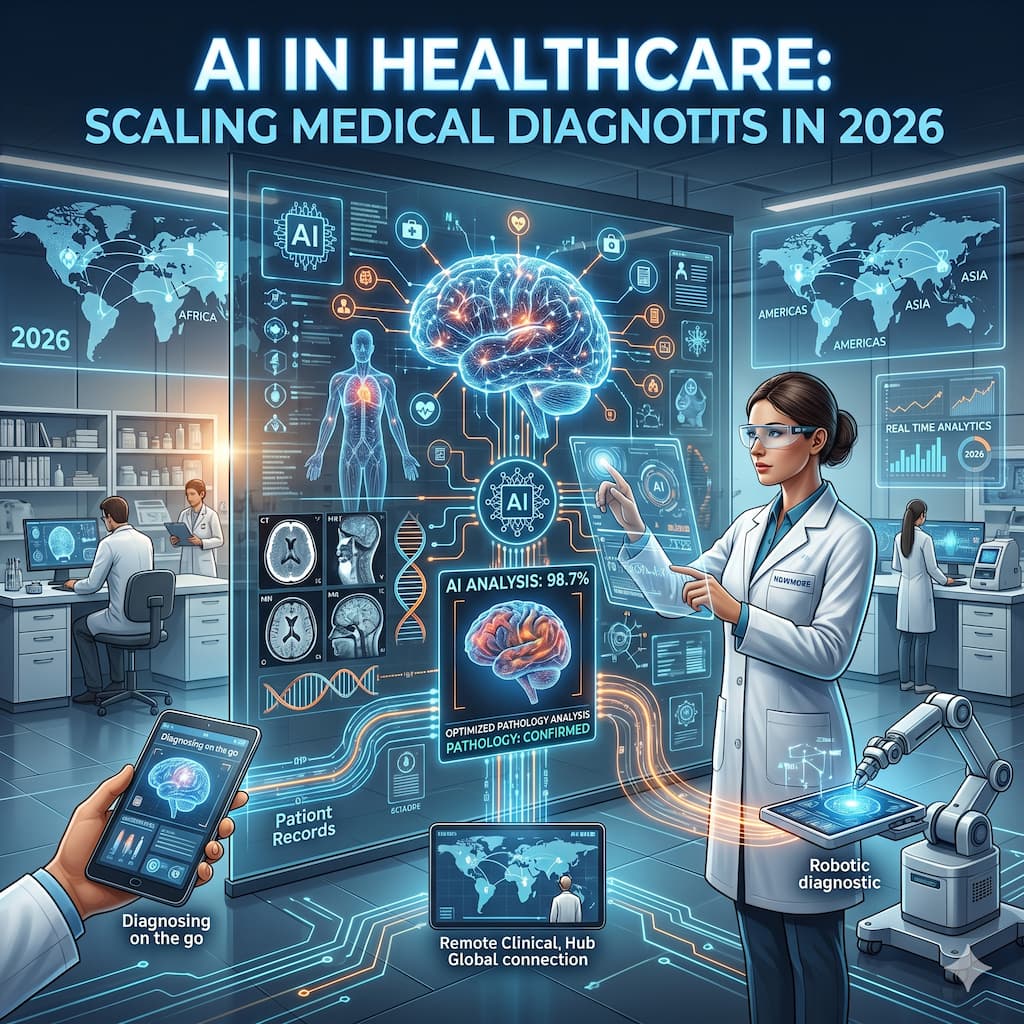
AI in Healthcare: Scaling Medical Diagnostics in 2026
As we navigate through May 2026, the healthcare sector is undergoing a profound transformation. The “AI Revolution” in medicine has moved past the phase of experimental pilot programs and into the era of Massive Diagnostics Scaling. On ngwmore.com, we focus on how technology accelerates business and improves lives; nowhere is this more evident than in the current state of AI-driven medical diagnostics.
In 2026, the global AI in medical diagnostics market has surged to approximately $3.79 billion, growing at a staggering compound annual rate of over 40%. This isn’t just about faster software; it’s about a fundamental shift in how we detect, predict, and treat illness.
1. The 2026 Shift: From “Aiding” to “Orchestrating”
Just two years ago, AI in diagnostics was primarily used as a second pair of eyes for radiologists. Today, we have entered the age of Agentic Diagnostic Systems.
Autonomous Triage and Reasoning
In May 2026, Large Language Models (LLMs) like the OpenAI o1 series and Google Gemini Health have eclipsed most benchmarks for clinical reasoning. Recent studies published in The BMJ and Science highlight that AI models are now outperforming human doctors in emergency triage management reasoning by nearly 42 percentage points. These systems don’t just flag a fracture; they synthesize patient history, current symptoms, and real-time lab data to provide a comprehensive differential diagnosis in seconds.
Multi-Omics Integration
The breakthrough of 2026 is Integrated Multi-Omics. AI now scales diagnostics by looking at the “whole person”:
- Imaging: Analyzing MRIs and CT scans for patterns invisible to the human eye.
- Genomics: Cross-referencing imaging with a patient’s genetic predisposition.
- Proteomics: Detecting early protein markers of Alzheimer’s or kidney disease years before clinical symptoms appear.
2. Scaling Healthcare: Top AI Diagnostic Tools of 2026
The market is no longer dominated by one or two players. A diverse ecosystem of “clinical co-pilots” is now standard across global health systems.
| Tool | Focus Area | 2026 Impact |
| DxGPT / iatroX | Differential Diagnosis | Used by over 500,000 clinicians to generate real-time diagnostic pathways. |
| Siemens Healthineers AI-Rad | Radiology Scaling | Automates the routine screening of chest X-rays and mammograms with 99% accuracy. |
| HeartFlow Inc. | Cardiovascular | Creates 3D models of blood flow to detect coronary artery disease non-invasively. |
| Digital Diagnostics (IDx-DR) | Ophthalmology | The first FDA-authorized autonomous AI system to detect diabetic retinopathy without a doctor’s input. |
| Butterfly Network | Handheld Imaging | AI-guided portable ultrasound that allows nurses and students to perform expert-level scans. |
The Rise of “Ambient Scribes”
Scaling diagnostics isn’t just about the diagnosis itself; it’s about the data entry. Tools like DeepScribe and Microsoft’s Nuance DAX now autonomously record and summarize patient visits, reducing the administrative load by 60% and allowing physicians to focus entirely on diagnostic decision-making.
3. The 2026 Regulatory Landscape: The EU AI Act and FDA 2.0
As of August 2026, the regulatory environment has finally caught up with the technology.
- The EU AI Act (Regulation 2024/1689): This is the most significant regulatory hurdle this year. AI-powered medical devices are now classified as “High-Risk.” Manufacturers must prove their systems allow for human oversight and are resilient against “performance drift.”
- FDA’s Unified Construct: In early 2026, the FDA consolidated its expectations for AI design, cybersecurity, and post-market monitoring into a single regulatory construct.
- ARPA-H “ADVOCATE” Initiative: This 2026 program announced the first initiative to develop FDA-authorized agentic AI capable of providing continuous cardiovascular disease management, moving beyond one-time snapshots.
4. How AI is Solving the “Radiologist Shortage”
Global healthcare is currently facing a critical shortage of skilled specialists. AI is the only tool capable of bridging this gap at scale.
In 2026, Triage AI acts as a filter. Instead of a radiologist looking at 1,000 “normal” scans a day, the AI autonomously clears 800 healthy patients and presents the 200 “complex” cases to the specialist. This “Hybrid Workflow” has enabled health systems to handle a 30% increase in patient volume without hiring additional staff.
5. Strategic Roadmap: Implementing AI Diagnostics
For the hospital administrators and healthcare entrepreneurs reading ngwmore.com, here is the 2026 implementation guide:
Phase 1: Data Modernization (Current)
AI cannot scale on legacy, siloed databases. You must migrate to FHIR-based (Fast Healthcare Interoperability Resources) systems that allow AI agents to “read” data across different departments.
Phase 2: Pilot “Administrative” AI (Next 3 Months)
Start by automating the low-risk areas: prior authorizations, appointment scheduling, and ambient documentation. This builds “AI Literacy” within your medical staff before moving to clinical decision support.
Phase 3: Specialized Clinical Integration (Months 6-12)
Deploy AI for specific, high-volume diagnostic areas like cardiology or oncology. Use the “Human-in-the-Loop” model mandated by the 2026 EU AI Act to ensure legal compliance and patient trust.
6. Ethical Guardrails: The Risks of 2026
Scaling too fast comes with dangers. In May 2026, we are specifically watching:
- Diagnostic Bias: AI models trained primarily on Western datasets can have lower accuracy for diverse ethnic populations.
- Opacity (The Black Box): If an AI suggests a radical treatment plan, it must be able to “explain” its logic in a way a human clinician can verify.
- Performance Drift: As new medical research emerges, “frozen” AI models can become outdated. Continuous learning and re-validation are now mandatory.
Read More⚡ AI CRM Platforms: Boosting Sales Conversion 2026
Conclusion: The New Standard of Care
In 2026, AI in Healthcare is no longer a futuristic concept—it is the bedrock of a scalable, efficient, and precise medical system. By automating the routine and superhumanizing the complex, AI is finally allowing us to deliver “Precision Medicine” to millions, not just the elite few.
For ngwmore.com readers, the message is clear: the future of healthcare is a partnership. The AI provides the scale, but the human provides the soul.
The diagnostic engines are running. Is your practice ready to scale?