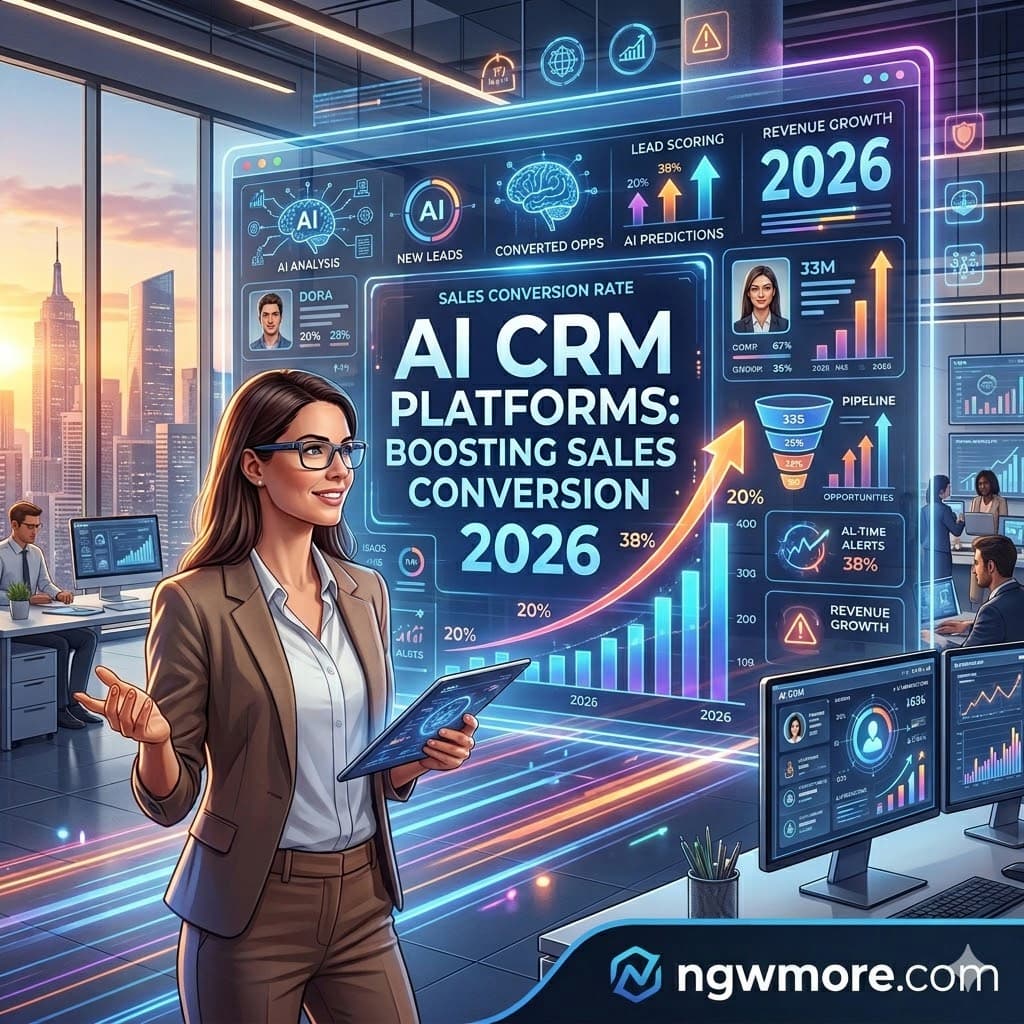
AI CRM Platforms: Boosting Sales Conversion 2026
The era of the “passive database” is officially dead. As we move through 2026, the Customer Relationship Management (CRM) landscape has undergone a radical transformation. No longer just a digital filing cabinet for contact names and deal stages, the modern CRM is an active participant—an “agentic” engine—designed specifically to maximize one metric above all others: Sales Conversion.
For the readers of ngwmore.com, staying ahead of the curve means moving beyond standard automation. In 2026, the winners are those leveraging “AI-Native” platforms that don’t just store data, but interpret it, act on it, and close the loop.
1. The 2026 Shift: From “Copilots” to “Agents”
In 2024 and 2025, we saw the rise of the “Copilot”—sidebar assistants that helped draft emails or summarize meetings. In 2026, the industry has pivoted to Agentic AI.
What is an Agentic CRM?
Unlike traditional software that waits for a user to click a button, an Agentic CRM acts on signals. If a prospect visits your pricing page three times in an hour, the AI doesn’t just send you a notification; it autonomously:
- Enriches the lead’s profile with the latest LinkedIn activity.
- Drafts a hyper-personalized outreach message based on that specific behavior.
- Updates the deal stage and adjusts the revenue forecast accordingly.
According to 2026 revenue operations benchmarks, organizations integrating these autonomous agents are seeing productivity gains of up to 40% and a 300% increase in conversion rates due to the sheer speed and relevance of follow-ups.
2. Top AI CRM Platforms Leading the Market in 2026
The market has branched into two categories: the “Legacy Giants” that have successfully integrated AI, and the “AI-Native” newcomers that are redefining the workflow.
| Platform | Best For | Standout 2026 Feature |
| DenchClaw | Solo & Small Teams | AI-Native Interface: No dashboard; you talk to the agent via WhatsApp/Telegram to run your CRM. |
| Salesforce (Agentforce) | Enterprise | Autonomous Decision-Making: Agents that make pre-approved tactical decisions without human oversight. |
| HubSpot (Breeze AI) | Mid-Market / Marketing | Unified Identity: Combines marketing, sales, and service data into a single, AI-curated “Human Graph.” |
| Coffee | Sales Productivity | Ambient Intelligence: Eliminates manual data entry by automatically logging every call and email context. |
| Attio | Modern Startups | Dynamic Relationship Mapping: Automatically visualizes the strongest path to a decision-maker. |
3. Key AI Features Boosting Conversion Today
To maximize your yield in 2026, you need to ensure your CRM stack includes these four non-negotiable capabilities:
A. Predictive Intent Scoring
In 2026, lead scoring is no longer static. Predictive models analyze “dark social” signals, hiring trends, and even technology stack shifts at a prospect’s company. The AI flags when a prospect is likely preparing to buy before they even reach out to your team, allowing for “first-mover” advantage.
B. Conversation Intelligence (Real-Time)
Tools like Gong and Read AI have moved beyond simple transcription. During a live sales call, the AI now acts as a Real-Time Whisperer, providing “Speaker Coach” feedback on your talk-to-listen ratio and suggesting the best response to an objection based on successful historical outcomes.
C. Generative Personalization at Scale
Generic mass emails are effectively blocked by 2026 email filters. Modern CRMs use Hyper-Personalization. The AI researches a prospect’s recent podcast appearance or a specific whitepaper they shared and weaves that context into a 1-to-1 outreach email that feels entirely human.
D. Autonomous Pipeline Management
The “Friday afternoon pipeline update” is a thing of the past. AI agents now perform “Pipeline Compare,” highlighting week-over-week changes and proactively identifying deals at risk. If a deal has “stalled,” the AI suggests a “Break-up” email or a different stakeholder to engage.
4. The ROI of AI CRM: By the Numbers
Data from early 2026 indicates that the financial case for AI-enabled CRM is stronger than ever:
- Average Return: $8.71 for every $1 spent on CRM.
- Sales Cycle Reduction: Modern platforms are shortening the average sales cycle by 8 to 14 days.
- Customer Acquisition Cost (CAC): 91% of businesses report a reduction in CAC, with many seeing drops of up to 20% through better targeting.
- Productivity: Most sales employees save between 5 and 10 hours per week by eliminating manual record updates.
5. Implementation: Building Your 2026 Sales Stack
If you are looking to upgrade your sales motion on ngwmore.com, follow this implementation roadmap:
Step 1: Clean Your Data Foundation
AI is only as good as the data it consumes. Before enabling Agentic AI, use tools like Clay or Tami AI to enrich your current database and eliminate “data decay” (which currently runs at 30% annually).
Step 2: Establish Ethical Guardrails
With the EU AI Act fully active in 2026, transparency is mandatory. Ensure your CRM provider documents how their AI makes decisions. “Trust” is now a competitive advantage; being able to tell your customers why they are receiving an automated message builds long-term loyalty.
Step 3: Shift from “Storage” to “Action”
Configure your CRM to trigger workflows based on signals, not just time-based reminders. Set up your AI to act when a prospect downloads a specific case study or when their company receives a new round of funding.
6. Challenges to Watch Out For
Despite the benefits, the 2026 landscape has its pitfalls:
- AI Fragmentation: Using too many “point solutions” (one bot for email, one for calls, one for LinkedIn) can lead to a disjointed customer experience. Aim for a unified platform like Salesforce or an integrated agent like Coffee.
- Human Oversight: The “Set it and Forget it” trap is dangerous. Humans are still needed to refine the AI’s “voice” and handle the high-level negotiation that a bot cannot yet master.
- Cost Realities: While some platforms like DenchClaw are open-source and free, enterprise-grade AI features in HubSpot or Salesforce can run upwards of $1,500/month per team.
Read More⚡ Predictive AI for Retail: Optimizing Your Online Shop
Conclusion: The Future belongs to the “Active” Sales Team
In 2026, the competitive edge is no longer who has the most leads, but who can convert those leads with the most precision. AI CRM platforms have turned the sales process into a high-speed, data-driven machine that works while you sleep.
For ngwmore.com readers, the mandate is clear: Audit your CRM today. If it isn’t predicting your next deal, automating your data entry, or coaching your reps in real-time, it is an anchor on your growth.
The era of the “smart” salesperson has arrived. Is your CRM helping you lead the way?