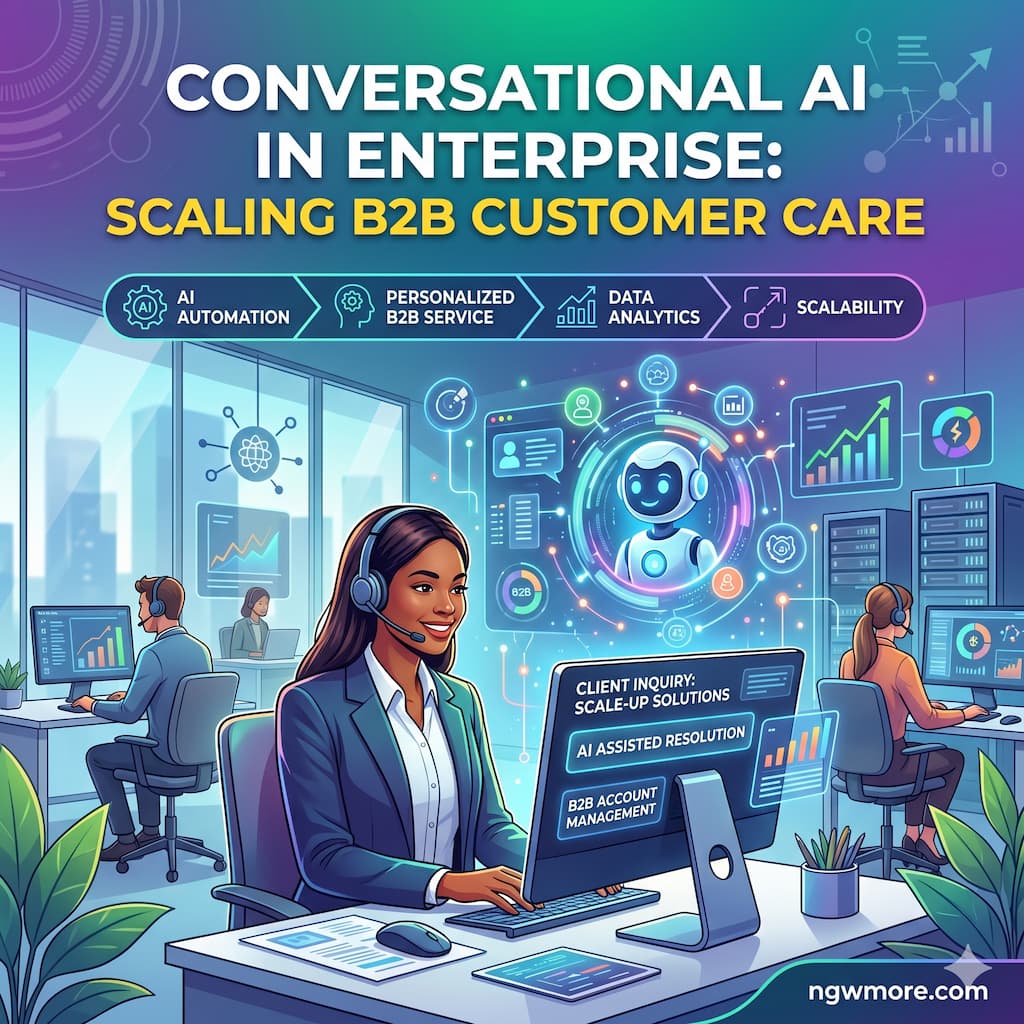
Conversational AI in Enterprise: Scaling B2B Customer Care
The execution landscape of business-to-business (B2B) operational scaling has reached an absolute threshold. As we navigate through May 2026, the historic customer care framework—characterized by multi-tiered human helpdesks, slow ticketing response windows, rigid email threads, and episodic account account management cycles—has transitioned from a baseline corporate chore into a catastrophic operational liability. In a globalized digital marketplace powered by instant on-chain transactions, dynamic server orchestration, and programmatic API integrations, B2B buyers no longer tolerate operational latency.
Historically, corporate enterprises attempted to handle service scaling through a binary choice: either inflate their customer support headcount at an unsustainable financial margin drag, or implement primitive, rule-based “chatbot” trees that frustrated high-value corporate clients with circular, un-contextualized responses.
Today, that dichotomy has been permanently dismantled. The standard driving elite enterprise retention and revenue velocity is the integration of Agentic Conversational AI Systems.
By embedding multi-layered, autonomous, and deep-reasoning conversational architectures natively into your B2B enterprise service layer, customer care transforms from an administrative cost-center into a predictive retention engine. For the digital entrepreneurs, enterprise architects, and technology growth leaders within the ngwmore.com community, mastering this intelligence grid is the ultimate framework to eliminate time-to-resolution friction, protect high-ticket account health, and scale global account management with zero administrative drag.
1. The 2026 B2B Support Paradigm: Speed, Context, and Agency
To successfully deploy conversational architectures within an enterprise environment today, you must first distinguish between simple retail-grade customer text assistants and Institutional B2B Agentic Support Platforms.
In the consumer (B2C) sector, support interactions are typically simple, linear, and isolated—such as tracking a package parcel destination or processing a standard return credit. In the B2B enterprise domain, however, interactions are inherently complex, multi-layered, and critical to core business continuity. A single inbound support ticket from an enterprise account might involve diagnosing an API authentication conflict, cross-referencing localized database permissions, reviewing a custom service-level agreement (SLA) contract parameter, and executing real-time system adjustments across disparate cloud configurations.
  LEGACY B2B SUPPORT PIPELINE (High Friction & Account Attrition)
  [Critical System Conflict] ──► [Web Ticket Ingest] ──► [Tier-1 Human Triage (24h)] ──► [Tier-2 Escalate (48h)] ──► [Account Churn Risk]

  2026 AGENTIC CUSTOMER SERVICE (Sub-Second Cognitive Containment)
  [System Anomaly Spotted] ──► [AI Conversational Agent Ingestion]
                                            │
                                            ▼
   ┌────────────────────────────────────────────────────────────────┐
   │             Agentic Conversational Service Engine              │ ──► [Instant Cross-API Context Synthesis]
   ├────────────────────────────────────────────────────────────────┤
   │ * Autonomous Multimodal Reasoner                               │ ──► [Sub-Second Core System Patching]
   │ * Custom SLA Entitlement Verification                          │ ──► [Hyper-Personalized Executive Briefing]
   └────────────────────────────────────────────────────────────────┘
According to 2026 B2B account retention metrics, modern enterprises utilizing fully integrated conversational AI systems spend 45% less time on manual ticket resolution while expanding their net revenue retention (NRR) benchmarks by over 22%. By treating language as an executable software interface layer, the modern enterprise compresses time-to-resolution toward absolute zero.
2. Core Pillars of AI-Native B2B Conversational Architecture
Scaling your enterprise customer service grid this year requires integrating four primary technological pillars directly into your software and operations infrastructure.
I. Multi-Modal Open-Reasoning and Live Semantic Analysis
Primitive chatbots operated on exact keyword matching; if a user deviated from a pre-written script, the system collapsed into a generic “I didn’t understand that” response loop.
- The 2026 Mechanical Reality: Modern conversational agents utilize advanced Reasoning and Chain-of-Thought (CoT) Foundation Models.
- The Processing Leap: When an enterprise client inputs an issue—via text, code snippet logs, or an audio call stream—the conversational agent doesn’t merely generate a probabilistic word completion. It creates an internal, hidden logical planning tree. It analyzes the underlying semantic intent of the customer’s text, isolates the structural technical variables, evaluates the urgency index, and references real-time system state files before formulating its initial response path.
II. Real-Time Retrieval-Augmented Generation (RAG) and Semantic Knowledge Graphs
An AI customer care agent is only as safe and effective as the data parameters grounding its intelligence. Forcing a model to answer enterprise queries without strict boundaries leads to severe hallucinations and legal liability exposure.
- The Ingestion Layer: Enterprise architectures deploy Dynamic, Real-Time RAG Layers tied directly to unified internal Knowledge Graphs.
- The Execution: When a client inquires about a highly specific, localized configuration parameter or billing arrangement, the conversational agent instantly queries your encrypted repository channels—including product wikis, engineering post-mortems, historical contract documents, and active API documentation. The AI synthesizes an answer completely grounded in your internal source of truth, appending direct source citations to its output so the corporate client can verify the accuracy of the path instantly.
III. Autonomous Tool Orchestration and Function Calling
True customer care in 2026 has moved past passive information delivery; conversational agents must possess the structural capability to execute actions on behalf of the customer.
- The Action Autopilot: Through secure, tokenized function-calling architectures, your conversational agent acts as an autonomous administrator. If an authorized enterprise client asks the agent, “Our staging cluster needs an immediate memory expansion to handle an un-scheduled traffic surge; can you scale our instances?” the AI doesn’t output a guide on how to do it. It programmatically checks the client’s account permission tier, cross-references their SLA contract bounds, interacts directly with your enterprise cloud infrastructure API endpoints, executes the instance expansion, verifies the successful deployment loop, and confirms the resolution inside the chat window—all within a sub-minute execution window.
IV. Predictive Churn Interception and Sentiment Tuning
The most effective way to handle a critical customer care crisis is to prevent it from ever occurring. Modern conversational architectures function as a continuous, ambient behavioral monitoring shield across your entire client roster.
- The Sentiment Radar: The AI continuously audits the unstructured text and tone parameters of every incoming client communication, support ticket, and API error log sequence.
- The Interception Gateway: By benchmarking this live telemetry against historical customer attrition models, the AI detects subtle indicators of enterprise client dissatisfaction weeks before an account executive would spot them. The system automatically tags the account, pre-populates an optimized retention account expansion playbook, and routes a high-priority alert straight to your human Customer Success Directors to secure the client’s long-term lifetime value.
3. The 2026 Enterprise Conversational Stack: Premier Engines
To transform your support operations from an administrative bottleneck into a high-velocity, automated customer care machine on ngwmore.com, your organization must connect its database perimeters to specialized, context-aware conversational networks. The 2026 marketplace features highly advanced options:
| Platform Category | Leading 2026 Platforms | Ideal Corporate Core Use Case | Standout Conversational Advantage |
| Enterprise Conversational Core | Intercom Fin / Salesforce Service Cloud Einstein | Multi-channel enterprise customer triage & dynamic workflow orchestration | Autonomous Copilot Routing: Automatically builds custom resolution steps on the fly utilizing live enterprise RAG graphs. |
| Deep-Domain Cognitive Support | Sierra AI / Paradox Growth | Autonomous function-calling, enterprise API integration, & high-stakes B2B workflows | Zero-Hallucination Safe Execution: Enforces deterministic guardrails ensuring agents execute tasks exactly inside system bounds. |
| Conversational Analytics Hub | Gong.io Learning / Cresta | Live voice & text interaction tracking, sentiment synthesis, & real-time human agent coaching | Semantic Outcome Mapping: Automatically correlates customer satisfaction metrics directly with specific technical resolution tracks. |
4. Tactical Roadmap: Operationalizing Enterprise Conversational AI
Transitioning your enterprise away from legacy, human-constrained support patterns and constructing a predictive, data-driven B2B customer care engine requires a systematic, architecturally sound roadmap.
Step 1: Establish Complete Internal Data Liquidity and Registry Synchronization
An autonomous conversational engine’s instructional capability is fundamentally capped by the visibility and cleanliness of its informational pool. Before deploying conversational nodes, you must eliminate your internal operational data silos.
Establish direct API connections and real-time webhooks connecting your product internal wikis, engineering logs, customer CRM environments, contract parameters, and cloud hosting parameters on ngwhost.com into a centralized, highly secure Enterprise Revenue and Operations Data Lake. This provides your conversational models with an unobstructed, 360-degree view of your customer relationships and technical parameters.
Step 2: Configure the “Agent-to-Human” Escalation Gate
Do not attempt to remove human strategic judgment entirely from your high-value enterprise B2B support loops. While conversational agents are unmatched at data collection, multi-file synthesis, and handling routine technical integrations, closing seven-figure corporate account disputes or navigating hyper-nuanced contract negotiations requires deep human empathy and relationship building. Implement a highly fluid communication loop:
[Inbound Client Interaction] ──► [AI Synthesizes Context & Resolves Base Conflict] ──► [High-Complexity Edge Case Detected] ──► [AI Formulates Comprehensive Hand-off Dossier] ──► [Human Account Executive Steps in Live]
Configure your platform settings so that if the conversational AI detects an elite enterprise client exhibiting intense negative sentiment or presenting an edge-case configuration conflict that steps outside its autonomous tool boundaries, the system executes a seamless, real-time hand-off to a live human representative. The AI handles the exhaustive heavy lifting—pre-populating the full historical chat summary, isolating the root technical issue, and structuring the resolution options—leaving your human team perfectly armed to step into the live conversation and deliver an authentic, highly impactful solution.
Step 3: Implement Privacy-First Data Anonymization Guardrails
Because an advanced B2B conversational system requires deep tracking of database logs and workspace outputs to deliver hyper-personalized coaching and resolution steps, protecting internal data privacy and security frameworks is an absolute requirement. Under the strict global enforcement of updated data protection codes and AI deployment acts in 2026, your team must enforce absolute Data Isolation Parameters:
- Ensure all individual client communications and private system context graphs are processed within strict, hardware-isolated enclaves.
- Implement real-time Token Redaction Shields at your API parameters to automatically strip out sensitive personal credentials, private cryptographic hashes, or non-essential biometric identifiers before the raw text logs enter third-party model processing streams.
- Maintain absolute compliance visibility, allowing your enterprise clients to audit exactly what historical data parameters feed into their dedicated organizational RAG vectors.
5. Critical Risk Management: Navigating the 2026 Conversational Pitfalls
Operating a highly automated, conversational service infrastructure requires continuous, data-backed governance to protect your enterprise from unique digital liabilities:
- The Hazard of Indirect Prompt Injection and Jailbreaks: If your customer-facing conversational agent is directly connected to underlying execution APIs, sophisticated attackers can feed carefully crafted semantic phrases into support input windows. These phrases are designed to trick the model into overriding its internal system prompts, forcing it to leak sensitive database information, skip billing verification walls, or execute unauthorized infrastructure commands. Organizations must deploy continuous semantic sanitization filters at both input and output layers.
- The Hallucination Liability Precedent: In 2026, legal courts have firmly established that a corporation is 100% legally and financially bound by the claims, commitments, and errors generated by its autonomous conversational agents. If an AI customer care assistant accidentally commits your platform to an un-authorized 90% enterprise discount or provides inaccurate architectural configurations that lead to a client system drop, your business is legally bound to honor that output or face severe consumer protection penalties. Continuous adversarial testing remains mandatory.
- The Trap of Sterile Mechanical Interactions and Engagement Decay: If your platform’s conversational interface feels completely mechanical, hyper-optimized by machine parameters, and stripped of brand authenticity, your corporate partners will struggle to form a genuine emotional connection with your enterprise. Use AI to eliminate technical friction, speed up data routing, and handle administrative overhead so that when your clients interact with your brand, they experience a supportive, empowering partnership that strengthens long-term enterprise allegiance.
6. The Systems Synergy: High-Availability Infrastructure for Corporate Care
For the advanced cloud developers, full-stack database architects, and technology visionaries who scale their digital platforms on the backbone of the ngwmore.com ecosystem, the structural logic of a conversational enterprise system is deeply native.
When you configure an enterprise server architecture, build an international web application layout, or manage a high-traffic database network on ngwhost.com, you do not tolerate single points of failure. You don’t leave your system architecture vulnerable to an isolated computing crash, a localized network drop, or an un-monitored processing leak. You design with comprehensive, mathematical redundancy: you utilize load balancers to distribute data traffic smoothly, deploy isolated container instances across multiple geographic data zones to handle processing spikes effortlessly, and maintain secure, multi-region database mirrors to ensure that if a critical server cluster drops offline, the broader network continues to perform flawlessly without data loss.
Deploying an integrated Enterprise Conversational AI Customer Care Architecture is simply extending that exact same systemic, multi-layered structural redundancy to your company’s client success and human infrastructure networks:
- Your Multi-Modal Reasoning Engines and Real-Time In-Line Guardrails operate as your high-velocity edge nodes, parsing, filtering, and resolving incoming client service challenges with absolute fluid precision.
- Your Real-Time RAG Layers and Unified Knowledge Graphs act as your resilient core database systems, instantly compounding, validating, and protecting your active corporate information streams, completely insulated from human operational latency or individual memory blind spots.
- Your Autonomous Function-Calling Rails and Seamless Human Escalation Gates behave as your secure, enterprise-grade system firewalls, silently optimizing your operating margins, shielding your physical brand from account attrition risks, and ensuring absolute corporate velocity against changing global market demands.
By mastering this integrated configuration, you strip away operational support drag, eliminate human infrastructure vulnerabilities, and position your digital brand to scale at terminal velocity while maintaining total financial and operational sovereignty over the global enterprise you built.
Read More⚡ Autonomous AI Agents for Market Forecasting in 2026
Conclusion: Securing the B2B Service Victory
The traditional welcome wizard and slow ticketing desks have run their course. In a hyper-competitive global marketplace defined by rapid technological adaptation and instant corporate fulfillment requirements, forcing modern B2B clients to rely on click-by-click manual data entry and multi-day support queues is a recipe for operational failure and margin erosion.
The path to sustainable enterprise scalability requires an absolute embrace of autonomous, conversational, and data-liquid software architecture. By unifying your corporate knowledge bases via secure APIs, configuring automated function-calling workflows, enforcing rigorous data anonymization protocols, and prioritizing seamless human escalation gates, you completely remove risk, friction, and human operational latency from your expansion loops entirely.
The global digital audience is clicking your enterprise links every single second. Is your customer care architecture built to resolve their challenges instantly, or are you letting your high-value accounts slip away?