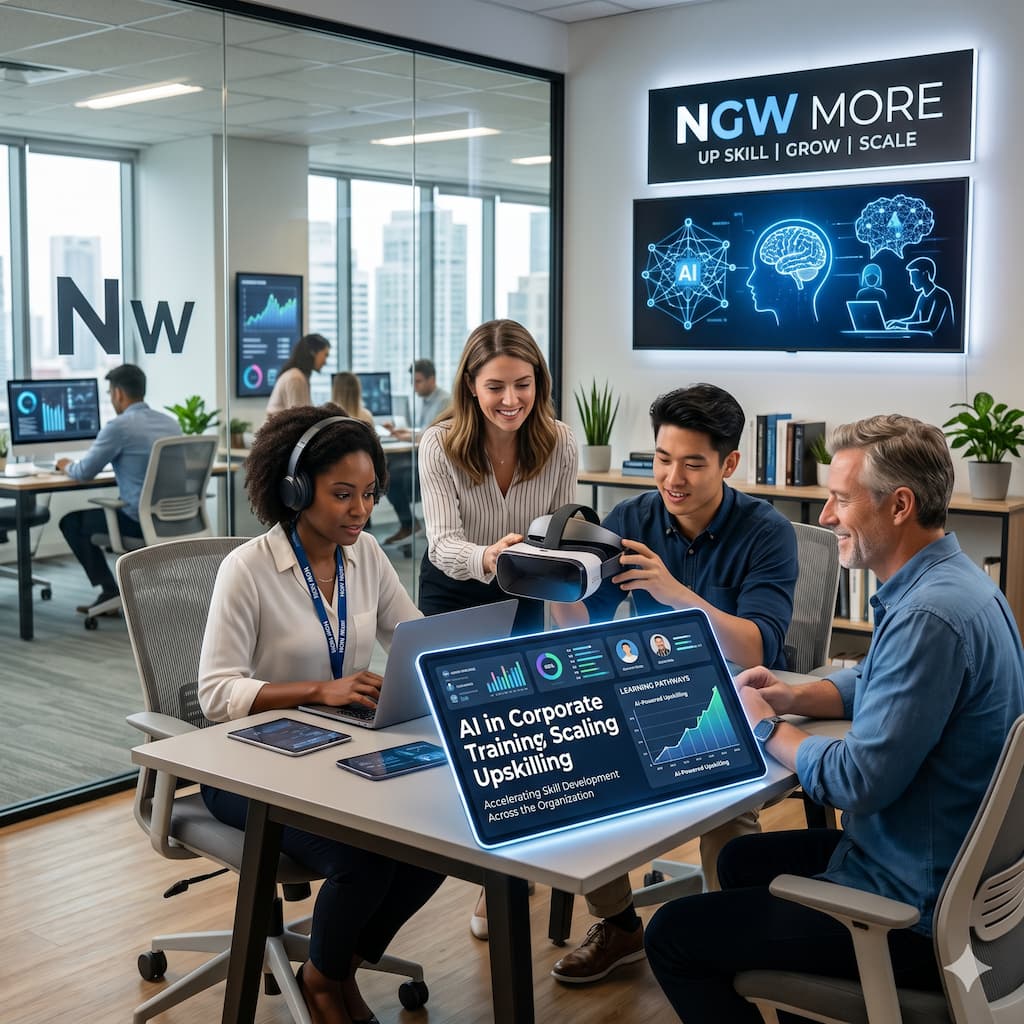
AI in Corporate Training: Scaling Employee Upskilling
The velocity of technological obsolescence has reached an unprecedented scale. As we navigate through 2026, enterprise leaders are realizing that the traditional corporate training handbook—characterized by static learning management systems (LMS), generic annual compliance videos, and episodic classroom-style seminars—has become a form of structural operational failure. In an era defined by the continuous integration of agentic AI workflows, hyper-automated data systems, and rapidly shifting market verticals, human capital decay is the ultimate silent bottleneck to growth.
The historical playbook of waiting for skills gaps to manifest and then addressing them with a one-size-fits-all training program has broken down completely. Today, a software engineer’s primary framework, a digital marketer’s optimization tool, or a product manager’s compliance code can change in a matter of weeks. If an organization takes six months to manually draft, approve, and deploy an internal upskilling course, the target skill is often obsolete by the time the first employee completes the module.
For the digital entrepreneurs, enterprise architects, and technology growth leaders within the ngwmore.com community, operational efficiency is an absolute philosophy. We design software and server systems to eliminate bottlenecks and optimize resource deployment.
Applying this exact same architectural logic to human infrastructure requires a total transition from rigid, reactive training to Continuous, Autonomous, and Context-Aware AI Corporate Training Platforms.
By deploying adaptive AI upskilling architectures, modern enterprises are achieving what was once an institutional paradox: scaling corporate training to thousands of employees simultaneously while delivering a 100% individualized, deeply contextualized learning experience that cuts time-to-mastery in half, sky-rockets knowledge retention, and directly impacts bottom-line performance.
1. The 2026 Paradigm Shift: From Passive Consumption to Active Cognitive Partnership
To successfully scale employee upskilling today, you must first dismantle the concept of linear, passive learning. The evolution of corporate education can be mapped across three distinct structural waves:
- The Linear LMS Era (The Past): The compliance checklist. Employees were forced through static modules containing pre-recorded videos and rigid multiple-choice quizzes. It ignored the employee’s existing knowledge baseline, cognitive speed, and real-world daily challenges, resulting in near-zero engagement and minimal long-term skill retention.
- The Recommendation Era (The Transition): Content aggregation. Platforms utilized basic machine learning algorithms to suggest relevant articles or courses based on an employee’s job title or self-selected interests. While it offered more variety, it remained fundamentally passive, requiring the user to manually sift through thousands of hours of generic content.
- The Adaptive Agentic Era (2026): The current global benchmark. Corporate training operates as a Living, Ambient Cognitive Partnership. Powered by large multimodal models and continuous behavioral telemetry integrated natively into the employee’s daily workspace (Slack, GitHub, CRM modules), the training engine doesn’t wait to be initiated. It senses real-world skill friction in real-time, autonomously generates micro-learning interventions, and coaches the employee through complex tasks while they work.
   LEGACY TRAINING PIPELINE (Passive & Low-Retention)
   [Identify Skill Gap] ──► [6-Month Course Dev] ──► [Mandatory Video Lectures] ──► [90% Knowledge Forgotten]

   2026 AI UPSKILLING GRID (Ambient & Continuous)
   [Workspace Activity Telemetry Ingestion]
                    │
                    ▼
   ┌────────────────────────────────────────┐
   │    AI Corporate Training Core          │ ──► [Instant Synthetic Sandbox Generation]
   ├────────────────────────────────────────┤
   │ * Real-Time Workspace Friction Sensing │ ──► [Hyper-Personalized Cognitive Coaching]
   │ * Dynamic Contextual Curriculum Tuning │ ──► [Predictive Skill Matrix Mapping]
   └────────────────────────────────────────┘
According to 2026 enterprise talent development metrics, organizations utilizing fully integrated AI upskilling engines experience a 40% reduction in employee onboarding ramp times and a 60% increase in cross-functional internal mobility, completely outperforming competitors who rely on legacy, human-curated training cycles.
2. Core Pillars of AI-Native Employee Upskilling
Scaling an enterprise learning infrastructure in 2026 requires integrating four primary technological pillars into your corporate data and operations stack.
I. Workspace Telemetry and Real-Time Friction Sensing
Traditional training requires an employee to step away from their actual work to learn. AI-native upskilling integrates training directly into the operational workflow via Workspace Telemetry.
- The Mechanism: The AI training layer securely and anonymously monitors an employee’s daily outputs—such as a developer’s code commits, a sales representative’s CRM communication strings, or a customer success agent’s support tickets.
- The Execution: If the system detects an employee struggling with a specific new implementation (e.g., an engineer encountering persistent execution errors in a new Rust codebase or a marketer misconfiguring a complex multi-platform data funnel), the AI doesn’t wait for a quarterly review. It instantly surfaces a highly targeted, 3-minute interactive micro-lesson right inside their IDE or communication dashboard, solving the immediate operational friction while embedding a permanent new skill.
II. Dynamic, Hyper-Personalized Curriculum Tuning
Every human brain processes information differently, possesses a unique professional baseline, and learns at a distinct velocity. Forcing a senior system architect and a junior developer through the same cloud-computing course is a massive waste of corporate capital.
- The AI Adaptive Layer: 2026 training platforms utilize generative AI engines to construct Fluid Knowledge Trees. The system evaluates the user’s initial capability matrix through interactive conversational diagnostics. As the user progresses, the AI dynamically recalculates the curriculum structure in real-time. If the employee masters data structures rapidly but stumbles on API security compliance, the platform instantly pivots, generating custom text explanations, real-world analogies, and multi-media visual guides tailored precisely to their cognitive style.
III. Generative Synthetic Sandboxes and AI Roleplaying
True skill acquisition requires active, repeated execution, not passive observation. In 2026, AI training suites have replaced standard text quizzes with Live, On-Demand Synthetic Sandboxes.
- For Technical Teams: The AI can instantly spin up a completely isolated, containerized server enclave replicating a highly complex, broken legacy architecture, challenging a systems administrator to diagnose and patch a zero-day vulnerability in real-time while providing interactive, step-by-step cognitive feedback.
- For Commercial Teams: The platform deploys advanced Conversational AI Roleplayers. A B2B account executive can practice navigating a high-stakes contract renewal with a hyper-realistic, deep-domain AI agent trained to perfectly mimic a skeptical, cost-conscious Fortune 500 Chief Technology Officer. The AI tests the sales representative’s objection-handling capabilities, scoring their performance and providing immediate, tactical rhetorical adjustments.
IV. Predictive Skill Matrix Mapping and Strategic Forecasting
For Chief Human Resources Officers (CHROs) and Chief Operating Officers (COOs), the biggest blind spot in corporate governance is not knowing the true capabilities of their workforce.
- The Corporate Mirror: AI upskilling engines run continuous, ambient validation analytics across the entire organization, compiling a live, dynamic Predictive Skill Matrix.
- The Strategic Value: Instead of relying on self-reported resume metrics or outdated annual tests, leadership teams have real-time visibility into the aggregate capabilities of their human capital stack. If the executive board plans a major strategic pivot into decentralized ledger integrations or autonomous multi-agent systems six months down the line, the AI engine can audit the current workforce, identify the specific delta between current and required capabilities, and automatically deploy targeted corporate-wide upskilling pathways to ensure the enterprise is fully prepared before the official rollout begins.
3. The 2026 Enterprise Learning Stack: Premier Platforms
To transform your corporate training from an administrative box-checking chore into an automated, high-velocity growth engine, your team must move away from rigid, legacy content aggregators and deploy unified, context-aware platforms. The current 2026 marketplace features highly specialized providers:
| Platform Category | Leading 2026 Platforms | Core Corporate Use Case | Standout AI Advantage |
| Enterprise Adaptive Learning | Docebo Shape / Cornerstone Galaxy | Multi-department corporate upskilling & compliance tracking | Generative Content AI: Instantly turns raw company internal documentation into micro-learning courses in seconds. |
| SaaS & CRM In-App Coaching | Whatfix AI / WalkMe DeepAI | On-the-fly software adoption & workflow optimization | Context-Aware Overlays: Tracks real-time cursor friction inside corporate tools to guide employees through complex tasks. |
| Conversational AI Roleplaying | Gong.io Learning / SecondNature | High-volume sales, support, & leadership simulation | Dynamic Behavioral Feedback: Simulates real-time vocal, semantic, and emotional customer objections. |
| Technical Sandboxing Engines | Katacoda AI / KodeKloud Enterprise | Automated software engineering & cloud infrastructure training | On-Demand Enclaves: Spins up containerized, safe developer sandboxes with automated code validation scripts. |
4. Operationalizing AI Corporate Training: A 3-Step Deployment Blueprint
Transitioning an enterprise away from passive, un-optimized training habits and constructing a fully integrated, AI-driven upskilling engine requires a systematic, architecturally sound roadmap.
Step 1: Centralize Internal Intelligence and Knowledge Bases
An AI training model’s instructional accuracy is fundamentally bounded by the depth and cleanliness of its information pool. Before turning on autonomous upskilling agents, you must systematically eliminate your internal data silos.
Connect your company’s product wikis (Confluence, Notion), technical documentation pools, past engineering post-mortems, compliance handbooks, and successful sales call recordings directly into a centralized, secure Enterprise Knowledge Graph. This provides the AI training engine with an un-obstructed, 360-degree stream of truth, allowing it to generate training content that is 100% aligned with your explicit internal corporate parameters.
Step 2: Establish the “Learning-to-Execution” Workflow Bridge
Do not segment your training initiatives away from your daily operational platforms. Force your AI upskilling tools to operate natively inside the communication channels where your teams spend their actual working hours.
Configure your engineering workflows so that if a developer’s code fails a CI/CD pipeline check twice due to an insecure library implementation, the AI training agent automatically messages them inside Slack or Teams with an interactive, 5-minute sandboxed exercise showing how to remediate that exact vulnerability. By bridging learning directly with execution, you turn training from an unwanted chore into an essential, real-time performance enhancer.
[Workspace Action Fails Validation] ──► [AI Identifies Core Conceptual Skill Gap] ──► [AI Delivers 5-Min Sandboxed Micro-Lesson] ──► [Employee Instantly Applies Hotfix to Production]
Step 3: Implement Privacy-First Data Governance Guardrails
Because an AI upskilling engine requires deep tracking of employee outputs and workspace behaviors to deliver hyper-personalized coaching, protecting internal data privacy and worker psychological safety is a non-negotiable legal and ethical mandate. Under the strict global enforcement of updated employee privacy rights and AI deployment acts in 2026, organizations must enforce absolute Data Transparency Parameters:
- Ensure all individual workspace monitoring data is processed within strict, isolated enclaves.
- Explicitly decouple the personal learning pacing and micro-mistakes an employee makes inside the training sandboxes from their primary HR performance reviews.
- Cultivate a culture of high-trust, safe experimentation, allowing employees to view the AI as a supportive, non-punitive cognitive coach dedicated to accelerating their career growth.
5. Critical Risk Management: Navigating the 2026 Upskilling Pitfalls
Scaling an enterprise learning layer with autonomous software networks requires continuous, data-backed governance to insulate your brand from unique operational and psychological liabilities:
- The Hazard of Halicinated Instructional Data: While generative models possess incredible synthesis capabilities, they can still occasionally hallucinate technical steps, misinterpret subtle company policies, or output outdated framework syntax. If an internal training agent teaches a junior developer an un-vetted, insecure coding practice, the business faces structural security exposures. Organizations must implement strict Expert Human-in-the-Loop Validation protocols for all core generated knowledge tracks.
- The Trap of Gamification Fatigue and Token Burnout: In an effort to maximize platform engagement, many digital upskilling platforms over-index on competitive leaderboards, digital badges, and automated ranking metrics. This can inadvertently induce an environment of intense anxiety, turning learning into a gamified chore focused on farming points rather than genuine cognitive comprehension. Prioritize intrinsic value over artificial metrics—design your training systems to reward real-world problem-solving velocity and creative execution.
- The Skill Multiplier Disconnect: Automated systems are exceptional at teaching hard, technical skills (such as mastering a new programming language, configuring an advanced analytics pipeline, or understanding a regulatory tax update). However, they can fall short when navigating highly nuanced, emotionally complex Soft Skills—such as handling team conflict, cultivating executive empathy, or executing high-stakes human leadership. Ensure your training framework balances AI-powered execution with fractional, expert-led human-to-human mentoring cohorts.
6. The Digital Synergy: Engineering the Resilient Enterprise
For the advanced cloud systems engineers, software developers, and forward-thinking technology leaders who scale their digital footprints on the backbone of ngwhost.com, the architecture of a continuous AI upskilling platform is deeply intuitive.
When you configure an enterprise server cluster, build an international e-commerce web network, or manage an enterprise application database, you do not tolerate single points of failure. You don’t leave your system architecture vulnerable to an isolated computing crash or a sudden localized data corruption. You design with structural, mathematical redundancy: you utilize load balancers to distribute processing loads smoothly, deploy isolated cloud instances across multiple geographic zones to handle processing spikes effortlessly, and maintain secure, multi-region database mirrors to ensure that if a critical server cluster drops offline, the broader platform continues to perform flawlessly.
Deploying an integrated AI Corporate Training Engine is simply extending that exact same systemic, multi-layered architectural redundancy to your company’s human capital stack:
- Your Workspace Telemetry Sensors and Real-Time Friction Trackers operate as your high-velocity edge nodes, managing day-to-day incoming human skill gaps and performance bottlenecks with absolute fluid execution.
- Your Generative Synthetic Sandboxes and Multi-Agent Roleplaying Enclaves act as your resilient core database clusters, instantly compounding, simulating, and validating your workforce’s capabilities, completely insulated from individual human educational blind spots.
- Your Predictive Skill Matrix Analytics and Strategic Planning Dashboards behave as your secure, enterprise-grade firewalls, silently protecting your operating margins, shielding your corporate talent from technological obsolescence, and ensuring absolute corporate velocity against changing global market demands.
By mastering this technical configuration, you strip away operational talent drag, eliminate human infrastructure vulnerabilities, and position your digital brand to scale at terminal velocity while maintaining total financial and operational sovereignty over the global enterprise you built.
Read More⚡ Generative AI for Developers: Coding at Scale in 2026
Conclusion: The Ultimate Upskilling Victory
The division between daily operational execution and corporate talent cultivation has been permanently dismantled by the 2026 agentic revolution. Continuous, automated employee upskilling is no longer a luxury exclusive to fortune 500 conglomerates with multi-million dollar corporate administrative human resource payrolls; the technology has decentralized the capability, placing predictive, hyper-personalized educational power directly into the hands of agile digital founders.
Managing the risks within this globally distributed, high-density environment is not a matter of luck; it is an exact discipline of precise data liquidity, continuous expert human validation, and zero-trust employee data governance. By unifying your corporate knowledge bases via secure APIs, configuring automated in-app coaching workflows, enforcing absolute privacy transparency across your training models, and prioritizing deep cognitive comprehension over raw gamified metrics, you completely eliminate structural talent drag from your expansion equation.
The corporate landscape of 2026 rewards velocity, data integrity, and capital-efficient execution. Build your learning stack with absolute precision, protect your human capital stack fiercely, and let your enterprise scale to global heights on your own terms.