Generative AI in Cybersecurity: Protecting Enterprise Data
The digital perimeter has completely dissolved. As we navigate the complex threat matrix of 2026, the traditional cybersecurity playbooks—defined by static firewall configurations, reactive signature-based malware detection, and manual log analysis—have become obsolete. The integration of advanced, autonomous computing environments has unleashed unprecedented productivity, but it has simultaneously armed cybercriminal syndicates with sophisticated, automated capabilities.
We are no longer defending against human actors typing exploits into terminals in linear time. Today, modern organizations face continuous, polymorphic cyber assaults orchestrated by adversarial AI models. These malicious engines execute multi-vector penetrations, craft hyper-personalized social engineering campaigns at internet scale, and exploit zero-day vulnerabilities within milliseconds of discovery.
For the developers, full-stack creators, and technology-driven entrepreneurs anchoring their digital infrastructure to the insights of ngwmore.com, speed to mitigation is the definitive metric of operational survival. If your security operations center (SOC) relies on human analysts manually triaging alerts across disconnected logs, your enterprise data is structurally vulnerable.
To achieve absolute resilience, organizations must fight fire with fire, transitioning from passive defense frameworks to Agentic Generative AI Cybersecurity Architectures.
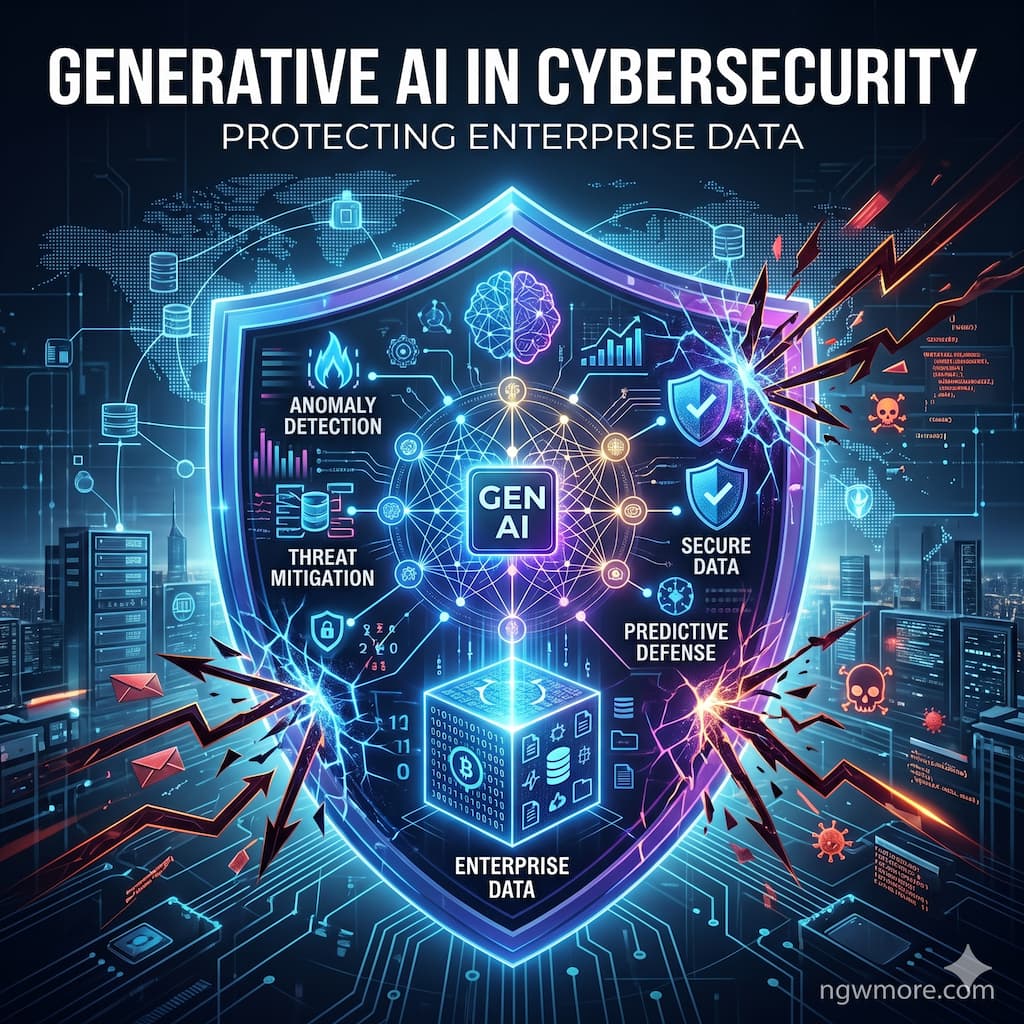
By integrating autonomous, context-aware defensive AI models natively into your enterprise data fabric, your security layer transitions from a back-office administrative bottleneck into a proactive shield. This shift allows you to predict incoming attack vectors, execute sub-second threat containment, and maintain absolute compliance across your entire cloud perimeter without adding massive overhead to your engineering payroll.
1. The 2026 Threat Horizon: The Rise of Adversarial AI
To successfully deploy an AI-driven defensive strategy today, you must first understand the sheer sophistication of the weapons being wielded by modern threat actors. The cybercriminal ecosystem has undergone a profound technical evolution:
- Polymorphic Exploit Generation: Malicious actors deploy generative models that modify an exploit’s underlying source code in real-time as it traverses a network. By altering signature hashes while preserving the core functional payload, these attacks effortlessly bypass legacy intrusion detection systems (IDS).
- Automated Social Engineering at Scale: The era of the easily spotted, poorly worded phishing email is over. Threat actors use advanced large language models (LLMs) to scrape public corporate directories, repository logs, and social footprints. The AI instantly synthesizes hyper-realistic, context-aware spear-phishing campaigns tailored to specific executive personas, complete with matching writing styles and deepfake voice or video authentication clips.
- Autonomous Vulnerability Fuzzing: Adversarial agents continuously probe enterprise public IP spaces and cloud API endpoints. They don’t just execute basic port scans; they interact with services semantically, testing input behaviors and automatically generating targeted zero-day exploits the moment a memory-management bug or configuration drift is exposed.
  LEGACY SOC RESPONSE (Reactive & Human-Dependent)
  [Attack Penetrates Perimeter] ──► [Log Alert Triggered] ──► [Manual Human Triage (Hours)] ──► [Delayed Containment]

  2026 ADAPTIVE DEFENSE (Autonomous & Agentic)
  [Polymorphic Threat Arrives] ──► [AI Graph Sensor Detects Anomaly] ──► [Instant Sandbox Execution] ──► [Sub-Second Patching]
According to global cybersecurity velocity benchmarks recorded this year, the average time required for an adversarial AI to compromise an un-vetted cloud perimeter has dropped below 15 minutes. Relying on human-dependent mitigation cycles is no longer just a risk—it is an absolute guarantee of systemic data breach.
2. Core Pillars of AI-Native Data Protection
Scaling your security posture in 2026 requires integrating four foundational technological pillars directly into your software and network infrastructure.
I. Hyper-Graph Behavioral Anomaly Detection
Signature-based tracking is a dead paradigm. Modern security stacks deploy Graph Neural Networks (GNNs) that construct a living, breathing multi-dimensional map of your entire enterprise perimeter.
- The Ingestion: The defensive AI ingests continuous telemetry from database access patterns, cloud server interactions, developer code repository commits, and employee device authentication states.
- The Sub-Second Audit: Instead of checking individual actions against a rigid rule list, the AI analyzes the behavioral context of the system. If a validated database administrator account suddenly attempts to query thousands of encrypted user records at 3:00 AM from an unfamiliar micro-region, while simultaneously executing minor code modifications in an unrelated repository branch, the GNN flags the interaction as an anomalous path. The system quarantines the node instantly, long before the threat actor can execute an exfiltration sequence.
II. Automated Reverse-Engineering and Patch Synthesis
When a novel exploit maneuvers past your initial network defenses, discovering the underlying vulnerability manually can take days of grueling forensic code review.
- The AI Countermeasure: 2026 defensive platforms utilize specialized Generative Code Agents operating inside isolated execution enclaves.
- The Execution: The moment an anomalous execution thread is captured, the AI isolates the target binary, reverse-engineers the payload syntax, identifies the explicit memory leak or logical flaw being exploited, and automatically writes, tests, and deploys a secure hotfix patch to your production containers. The entire cycle occurs within a sub-minute window, effectively neutralizing the zero-day threat without forcing an un-scheduled platform shutdown.
III. In-Line LLM Guardrails and Semantic Data Loss Prevention (DLP)
The massive corporate adoption of generative tools has created an existential data leakage vector. Employees frequently upload confidential proprietary source codes, unreleased financial roadmaps, or protected customer logs into public AI interfaces to speed up their personal workflows, inadvertently leaking trade secrets into public training models.
- The Semantic Interception: Modern security frameworks deploy In-Line Semantic Compliance Shields. Every outbound prompt and API request flowing from your enterprise network to an external model is intercepted and analyzed in real-time. The AI guardrail doesn’t just block specific keywords; it evaluates the underlying semantic intent of the data payload. If it detects an employee attempting to transmit protected personally identifiable information (PII) or proprietary algorithm code, it automatically redacts the sensitive fragments or halts the transmission entirely, preserving compliance mandates smoothly.
IV. Defensive LLM Red-Teaming and Continuous Simulation
To guarantee that your production systems are un-breachable, you must aggressively stress-test your own infrastructure before adversaries do.
- Autonomous Penetration Testing: 2026 enterprise security strategies rely on continuous Autonomous AI Red-Teaming Engines. These internal agents are programmed to attack your company’s network perimeters 24/7/365 using the latest advanced threat tactics. By constantly attempting to jailbreak your internal customer-facing chatbots, poison your data pipelines, or exploit minor cloud configurations, the AI exposes hidden vulnerabilities early, delivering actionable remediation scripts to your infrastructure team long before an external breach can manifest.
3. The 2026 Defensive Security Stack: Leading Enterprise Platforms
To transition your security perimeter from a passive logging database into a hyper-velocity automated shield, your team must deploy specialized, context-aware platforms. The current 2026 landscape features highly advanced options:
| Platform Category | Leading 2026 Tools | Core Enterprise Use Case | Standout AI Feature |
| XDR & Network Autopilot | CrowdStrike Falcon AI / SentinelOne Purple | Complete endpoint tracking, threat hunting, & automated containment | Natural Language Ingestion: Allows analysts to hunt complex cross-network threats instantly via conversational text prompts. |
| AI In-Line Guardrails | Lasso Security / CalypsoAI | Securing corporate LLM interactions & preventing shadow AI leakage | Real-Time Redaction Engines: Semantic filtering of incoming and outgoing model tokens to prevent data poisoning and leaks. |
| Cloud Infrastructure Shield | Wiz Lightyear / Palo Alto Prisma AI | Cloud security posture management & compliance monitoring | Graph-Based Attack Path Mapping: Autonomously charts and blocks hidden paths connecting minor vulnerabilities to crown-jewel assets. |
| Autonomous SecOps | Copilot for Security (Microsoft) / Splunk AI | SOC alert triaging, incident summarization, & automated patching | Agentic Incident Playbooks: Autonomously builds comprehensive forensic timelines and drafts secure remediation code during live attacks. |
4. Tactical Blueprint: Operationalizing Generative AI Security
Transitioning your enterprise away from reactive security habits and constructing an automated, AI-driven data defense grid requires a systematic, architecturally sound roadmap.
Step 1: Establish Complete Architectural Data Liquidity
An AI security model’s protective accuracy is fundamentally bounded by the visibility of its telemetry stream. You must eliminate your internal data silos. Establish unified logging pipelines connecting your primary server network configurations on ngwhost.com, database access ledgers, employee IAM (Identity and Access Management) systems, and multi-channel communication networks into a centralized, highly secure Security Data Lake (utilizing frameworks like Snowflake or native XDR data layers). This provides your defensive AI agents with an un-obstructed, 360-degree view of your operating reality.
Step 2: Configure the “Agentic Quarantine” Operational Flow
Do not force your AI security tools to remain passive alert-generating widgets. If a platform merely fires an warning notification to an inbox when an active data exfiltration event is detected, the damage will be fully executed long before a human analyst wakes up to read the message. Grant your defensive models Autonomous Containment Authority under an optimized agentic workflow:
[Anomalous Action Detected] ──► [AI Isolates Target IP & Container Node] ──► [Token Session Revoked] ──► [Forensic Briefing Pushed to Security Lead]
Configure your system parameters so that when a high-conviction security deviation occurs, the AI instantly cuts the network connection to the compromised node, revokes the user’s active API tokens, and isolates the target database container inside a secure virtual sandbox. The AI handles the immediate containment in milliseconds, then structures a comprehensive forensic briefing and pushes it straight to your human Chief Information Security Officer (CISO) for strategic review.
Step 3: Implement Rigid Model Lineage Auditing
As your team integrates fine-tuned or open-weight models to automate internal data analytics, you must aggressively guard the integrity of the models themselves. Under the full regulatory enforcement of updated global digital compliance frameworks this year, practicing Model Provenance Ledgering is mandatory.
Ensure that every single dataset used to train or adjust your internal models is cryptographically stamped, securely stored within isolated networks, and scanned for adversarial data poisoning vectors to prevent bad actors from subtly corrupting your AI’s decision-making frameworks.
5. Critical Risks: Navigating the 2026 Security Blind Spots
Scaling an enterprise infrastructure with autonomous software networks requires continuous, data-backed governance to protect your brand from unique digital liabilities:
- The Threat of Prompt Injection and Chatbot Exploits: If your platform deploys customer-facing generative assistants or internal data-query agents connected directly to private databases, you face the critical vector of Indirect Prompt Injection. Sophisticated attackers can feed carefully crafted semantic phrases into customer input fields or bury malicious text strings inside public web documents that your RAG systems scrape. These strings can trick the model into overriding its internal system prompts, forcing it to leak sensitive database logs or execute unauthorized API commands. Constant semantic sanitization is required.
- Managing Algorithmic Alert Fatigue: Because generative models possess exceptional analytical sensitivity, poorly calibrated security agents can over-index on minor, harmless operational anomalies—such as a developer executing code updates from an unusual travel location—generating thousands of urgent false-positive containment actions. This over-automation creates intense internal operational friction and can blind security teams to real, highly targeted threats. Weekly baseline model calibrations remain a necessity.
- The Liability of Model Hallucinations in Forensic Scans: When a security director asks a generative agent to summarize a massive, multi-gigabyte network breach log during an emergency board meeting, the model can occasionally hallucinate specific IP addresses or mistake a legitimate system service for a malicious actor. Human security leads must always verify the raw log parameters before presenting a forensic case to regulatory bodies or committing massive financial resources to remediation strategies.
6. The Systems Synergy: High-Availability Redundancy for Corporate Assets
For the advanced cloud systems developers, database architects, and technology innovators who build and maintain their digital enterprise applications on the backbone of ngwhost.com, the structural design of an integrated AI security grid is deeply intuitive.
When you configure an enterprise hosting layout or scale an international database network, you do not tolerate single points of failure. You don’t leave your system architecture vulnerable to a single compromised password or a localized power failure. You engineer comprehensive structural redundancy: you utilize load balancers to distribute data traffic smoothly, deploy isolated container instances across multiple geographic data zones to handle processing spikes effortlessly, and maintain secure, multi-region database mirrors to ensure that if a critical server cluster drops offline, the broader network continues to perform flawlessly without data corruption.
Deploying an integrated Generative AI Cybersecurity Grid is simply extending that exact same systemic, multi-layered architectural redundancy to your company’s information assets:
- Your Hyper-Graph Behavioral Sensors and In-Line Guardrails operate as your high-velocity edge nodes, parsing, filtering, and neutralizing incoming data threats and prompt leaks with absolute fluid precision.
- Your Automated Reverse-Engineering Sandboxes and Red-Teaming Engines act as your resilient core database systems, instantly compounding, simulating, and validating your system patches, completely insulated from human operational latency.
- Your Autonomous Quarantine Automations and Provenance Ledgers behave as your secure, offline, un-hackable off-site backups, certifying to your external regulators, investors, and board members that your sovereign data capital is completely protected from adversarial corruption.
By mastering this technical configuration, you strip away balance sheet vulnerabilities, eliminate structural cash drag, and position your digital brand to scale at terminal velocity while retaining absolute, sovereign control over the global enterprise you built.
Read More⚡ Ethical AI Governance: Managing Corporate Risks in 2026
Conclusion: The Era of Algorithmic Defense
The division between manual network tracking and automated software execution has been permanently erased by the 2026 agentic revolution. High-speed, generative cybersecurity is no longer a luxury exclusive to Fortune 500 defense conglomerates with multi-million dollar security budgets; the technology has decentralized the capability, placing enterprise-grade cryptographic protection directly into the hands of agile digital founders.
Managing the risks within this globally distributed, high-density environment is not a matter of luck or chasing market hype; it is an exact discipline of precise data liquidity, continuous algorithmic validation, and zero-trust data governance. By unifying your transactional and hosting pipelines via secure APIs, configuring automated containment workflows, enforcing absolute token transparency across your guardrail models, and prioritizing data quality over raw alert volume, you completely eliminate risk and structural drag from your expansion equation.
The commercial landscape of 2026 rewards velocity, data integrity, and capital-efficient execution. Build your security stack with absolute precision, protect your cap table fiercely, and let your enterprise scale to global heights on your own terms.