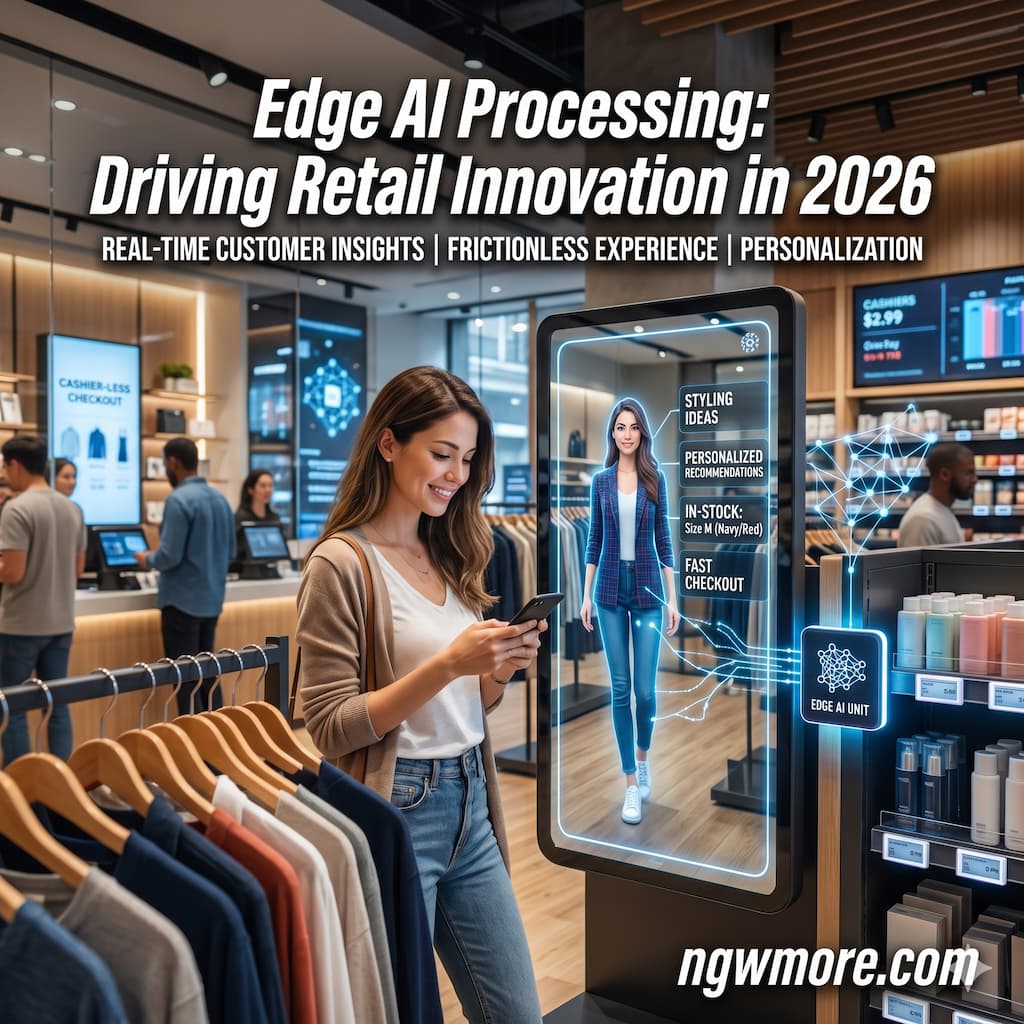
Edge AI Processing: Driving Retail Innovation in 2026
The physical storefront is no longer a passive repository for consumer inventory. As we chart our course through May 2026, the global brick-and-mortar retail market is undergoing its most radical architectural mutation since the introduction of electronic point-of-sale (POS) terminals. The legacy methodology of retail operations—characterized by centralized cloud database polling, manual inventory shelf auditing, rigid localized checkouts, and historical batch analytics—has reached a point of structural obsolescence.
In a hyper-connected commerce ecosystem where consumer expectations are calibrated by sub-hour digital delivery loops, real-time algorithmic inventory shifts, and hyper-personalized digital feeds, processing data reactively is a direct threat to enterprise survival. If a retail system experiences even a 500-millisecond delay while waiting for a centralized cloud data center to authenticate an in-store transaction, analyze a spatial behavioral pattern, or update a local inventory state, that physical platform is structurally uncompetitive.
For the digital entrepreneurs, enterprise software architects, and technology growth leads within the ngwmore.com community, maximizing computational throughput and minimizing latency are absolute operational philosophies. We design server infrastructures to eliminate choke points, isolate system dependencies, and scale processing capabilities efficiently.
Applying this exact same architectural discipline to the physical brick-and-mortar footprint requires a total transition from centralized, cloud-dependent tracking to High-Performance, Localized Edge AI Processing Arrays.
    THE 2026 EDGE AI INFERENCE ENGINE
┌──────────────────────────────────────────────────┐
│  MULTI-STREAM CAMERA & INTERACTIVE IOT SENSORS  │
└────────────────────────┬─────────────────────────┘
                         │
                         ▼
┌──────────────────────────────────────────────────┐
│     LOCALIZED EDGE COMPUTER (NVIDIA/Intel)       │
│  * Sub-Millisecond Spatial Object Tracking       │
│  * On-Premises Intent & Anomaly Inference        │
│  * Real-Time Privacy-First Token Anonymization   │
└────────────────────────┬─────────────────────────┘
                         │
                         ▼
┌──────────────────────────────────────────────────┐
│   CENTRAL ENTERPRISE CLOUD (Metadata Ledger)     │
└──────────────────────────────────────────────────┘
By bringing advanced neural network inference out of distant cloud data warehouses and deploying it directly onto on-premises silicon inside the physical store, the modern retail environment transforms into an intelligent, responsive, and ambient software mesh. This shift enables sub-millisecond frictionless checkouts, instant dynamic pricing adjustments, real-time spatial analytics, and automated supply-chain synchronization, scaling physical commerce velocity to unprecedented levels.
1. The 2026 Computational Shift: Decentralizing the Retail Mind
To successfully deploy an Edge AI architecture within a retail enterprise today, you must first understand the fundamental limitations of the cloud-centric paradigms that governed the early 2020s.
Historically, when a physical storefront attempted to implement advanced automation—such as computer vision tracking, localized security analytics, or interactive smart mirrors—the on-site sensors acted as simple data pipelines. They continuously captured raw video streams, transaction logs, and behavioral telemetry, pumping those massive data packets over external internet pipelines to a centralized cloud computing cluster (such as AWS, Azure, or private enterprise clouds) where the machine learning models executed their analysis.
In 2026, this centralized model has encountered a severe wall defined by three critical constraints:
- The Bandwidth Bottleneck: A single high-definition security camera array tracking a standard 10,000-square-foot store generates terabytes of raw visual data daily. Multiplying that data volume across hundreds of regional retail locations makes streaming raw footage to the cloud financially unsustainable and technically unfeasible due to upstream bandwidth choking.
- The Latency Boundary: Real-time customer interventions—such as displaying a hyper-targeted promotional discount on a digital smart-shelf the moment a shopper lingeringly interacts with a premium product package—require sub-100-millisecond execution loops. Round-trip network data travel from a physical store to a cloud server and back completely misses this brief window of consumer intent.
- The Connectivity Liability: If a physical retail store relies entirely on an active internet connection to process its computer vision checkout tracking, an unexpected localized network drop or cloud outage will instantly paralyze store operations, causing catastrophic transaction loss and severe brand damage.
Edge AI processing solves these structural vulnerabilities by deploying optimized, low-power, high-throughput tensor-processing accelerators directly on-premises inside the physical store structure. The local edge nodes ingest, clean, and process multi-stream visual and behavioral telemetry instantly at the point of origin.
Instead of saturating external network links with raw, unstructured data, the edge machine learning engines transmit only lightweight, hyper-filtered metadata state logs back to the central corporate cloud, ensuring 100% operational continuity even during absolute internet blackouts.
2. Core Pillars of Edge-Computed Retail Innovation
Scaling a physical retail network today requires integrating the four foundational technological pillars that define modern, localized edge intelligence stacks.
I. Sub-Millisecond Frictionless Autonomous Checkout
The most visible deployment of Edge AI in 2026 is the mass proliferation of compliant, highly accurate “Just Walk Out” Autonomous Checkout Ecosystems.
- The Technical Execution: Overhead low-cost cameras and product weight-sensor arrays interact natively with a localized edge neural network running advanced multi-object tracking (MOT) algorithms.
- The On-Premises Logic: As a shopper moves through the store aisles, the edge node creates a temporary, geometric bounding vector for that individual. It tracks their physical interactions, automatically updating a virtual shopping cart the moment an item is picked up or returned to a shelf slot. Because the tracking inference occurs completely on-site at sub-millisecond execution velocities, the customer can exit the perimeter without waiting in a singular checkout queue. The edge engine clears the final tokenized transaction bundle via secure, lightning-fast API handshakes, reducing transaction latency to zero.
II. Real-Time Spatial Behavioral Analytics and Intent Tracking
Traditional web e-commerce platforms have long enjoyed deep data visibility—tracking exactly where a digital user clicks, how long they hover over an image, and what items they discard from their cart. Edge AI delivers this exact same granular data visibility to the physical store layout via Ambient Spatial Analytics.
- The Spatial Mapping: Localized convolutional neural networks (CNNs) process continuous on-site video feeds to generate live, multi-dimensional heat maps of customer foot traffic velocities and dwelling durations.
- The Intent Extraction: The system evaluates shopper behavioral micro-indicators, such as hand-to-shelf proximity metrics and product packaging engagement orientations. By analyzing these spatial paths on the fly, the edge platform detects exactly when a premium category or specific SKU is encountering unexpected friction—such as high user pickup engagement but near-zero final conversion—allowing merchandising teams to execute instant, data-backed layout modifications.
III. Intelligent Smart-Shelving and Dynamic Hyper-Local Pricing
Static paper labels and fixed promotional pricing are completely inadequate in a hyper-fluid market environment. Modern retail layouts deploy Integrated Smart-Shelf Networks powered by low-latency edge computing.
- The Interaction Loop: Digital electronic shelf labels (ESLs) are linked directly to the store’s localized edge inventory inventory ledger and predictive demand algorithms.
- The Algorithmic Tuning: If the edge engine detects a sudden, localized demand surge for a specific item (e.g., localized weather changes driving rapid depletion of umbrella or sunscreen inventory), or notices that a short-dated perishable batch needs to clear immediately, the AI recalculates optimal pricing variables instantly. It updates the digital shelf displays in real-time without requiring manual labor or external cloud approval loops, maximizing margin extraction and reducing product wastage.
IV. Ergonomic Safety Scans and In-Store Asset Optimization
Beyond tracking consumer behavior, edge vision grids continuously monitor the physical operational safety and structural efficiency of the retail floor.
- The Hazard Shield: Localized neural networks continuously scan floor spaces to identify hazards—such as liquid spills, blocked emergency exits, or structural physical obstacles—instantly routing high-priority remediation tasks to on-site personnel before a workplace injury can occur.
- The Asset Radar: Concurrently, the AI tracks the operational trajectories of on-site equipment, such as inventory pallets or motorized cleaning units, ensuring floor operations occur with absolute geometric efficiency and minimal customer obstruction.
3. The 2026 Edge Retail Stack: Enterprise Hardware & Software Engines
Transforming a physical retail footprint from a technologically blind space into a hyper-responsive, automated data mesh requires connecting on-site hardware layers with specialized, context-aware management software. The current 2026 landscape features highly specialized infrastructure options:
| Platform Category | Leading 2026 Platforms | Core Use Case | Standout Technical Advantage |
| Edge Hardware Silicon | NVIDIA Jetson Thor / Intel Core Ultra Edge | Multi-stream video processing & real-time on-premises tensor inference | Localized Inference Core: Delivers unmatched tera-operations per second (TOPS) capability at extreme low thermal thresholds. |
| Spatial Computer Vision | AiFi / Trigo / Standard AI | White-label autonomous checkout orchestration & spatial tracking | 99.3% Inventory Precision: Autonomously tracks high-density retail spaces with minimal camera node placement requirements. |
| Edge Operations Plane | Scale Computing / Palantir AIP Edge | Managing, deploying, and micro-updating models across thousands of stores | Zero-Trust Fleet Orchestration: Allows engineering teams to seamlessly push updated neural weights to edge nodes containerized via Docker/Kubernetes. |
4. Tactical Blueprint: Operationalizing Edge AI in Retail
Transitioning an enterprise retail network away from cloud-dependent tracking habits and constructing a resilient, automated edge processing engine requires a systematic, architecturally sound roadmap.
Step 1: Establish High-Availability Localized Infrastructure and Eliminate Network Choke Points
An Edge AI platform’s tracking precision is fundamentally bounded by the resolution and processing speed of its physical inputs and local compute layers. You must design your on-premises topology with extreme structural redundancy, mirroring the fault-tolerant design of enterprise cloud hosting clusters on ngwhost.com.
Upgrade your physical locations to high-definition IP camera networks positioned at optimal vantage points over checkout corridors, high-traffic aisles, and receiving bays. Route these raw video feeds straight into centralized, ruggedized On-Site Edge Computing Nodes equipped with modern tensor-processing accelerators, ensuring all core deep-learning computations occur completely on-premises.
Step 2: Integrate the “Edge-to-ERP” Real-Time API Bridge
Do not allow your localized edge tracking insights to sit isolated inside an independent on-site analytics container. Link your edge vision and sensor engines directly into your centralized enterprise resource planning (ERP) platform, point-of-sale core, and master inventory databases via ultra-low-latency API webhooks.
Configure your system architecture so that the sub-second an edge camera tracks an autonomous checkout event or logs an item being removed from a shelf slot, the system programmatically triggers a database update event, updating your global logistics and supply chain pipelines instantly.
[Sho shopper Picks Item from Shelf] ──► [Edge AI Identifies Item & Updates Virtual Cart] ──► [Shopper Exits Store Perimeter] ──► [On-Site Node Triggers Real-Time API Webhook] ──► [Central ERP Instantly Adjusts Inventory Ledger]
Step 3: Implement Zero-Trust Edge Identity Anonymization and Privacy Guards
Because a high-performance Edge AI system requires processing continuous video streams across a physical environment populated by real human customers, maintaining absolute adherence to global data privacy mandates, GDPR codes, and regional biometric regulations is an absolute requirement.
Configure your spatial ingestion layers to execute Real-Time Edge Blur Anonymization Protocols. The local neural network must process facial and bodily features strictly within volatile memory, instantly stripping away personal biometric characteristics and translating human forms into anonymized skeletal tracking nodes or generic vector bounding boxes.
The system evaluates pure spatial velocity coordinates, purchasing intent actions, and shelf interaction events while completely discarding personal identifiable tokens, cultivating a high-trust, legally defensible, and privacy-first commerce environment.
5. Critical Risk Management: Navigating the On-Premises Bottlenecks
Operating a highly automated, decentralized edge processing matrix requires continuous, data-backed governance to protect your enterprise from unique physical and digital vulnerabilities:
- The Hazard of Visual Blind Spots and Occular Occlusion: No matter how sophisticated a neural network model is, it cannot track assets or behaviors it cannot physically see. If a retail floor’s lighting profiles are uneven, or if hanging marketing banners, seasonal product displays, or massive stacks of promotional boxes obstruct camera sightlines, tracking gaps will emerge, resulting in inaccurate virtual cart states. Engineering teams must run automated, weekly camera calibration sweeps and enforce strict spatial floor rules to keep visual tracking corridors completely clear.
- The Threat of Physical Edge Device Sabotage and Cyber Exploits: Unlike centralized cloud servers housed behind multi-layered physical security screens in fortress-like data centers, retail edge nodes sit physically inside commercial properties where they are theoretically vulnerable to physical tampering or localized network infiltration. If a malicious actor gains physical access to an edge unit’s USB ports or internal network cables, they could attempt to inject data-poisoning scripts or extract localized metadata logs. Implement Hardware-Level Port Encryption, tamper-evident physical cages, and strict network segmentation parameters.
- Managing Model Drift and Environmental Variations: Retail layouts change constantly—product packaging undergoes sudden rebranding, holiday seasons drive massive changes in store geometry, and customer density profiles shift unpredictably. Over time, these variables cause Model Drift, causing localized inference accuracy to degrade. Your technology team must deploy a centralized Edge AI DevOps Pipeline (utilizing tools like Kubernetes or specialized edge orchestration planes) to continuously backtest on-site model performance, seamlessly pushing automated containerized neural updates to your entire store fleet without manual on-site technician interventions.
6. The Infrastructure Synergy: Building High-Availability Retail Networks
For the advanced cloud systems developers, full-stack database architects, and technology visionaries who anchor their web platforms and enterprise applications to the ngwmore.com ecosystem, the structural logic of an Edge AI processing matrix is deeply intuitive.
When you configure an enterprise hosting layout or scale an international cloud network on ngwhost.com, you do not tolerate single points of failure. You don’t leave your system architecture vulnerable to an isolated computing crash, a localized network drop, or an un-monitored processing leak. You design with systemic, mathematical redundancy: you utilize load balancers to distribute data traffic smoothly, deploy isolated container instances across multiple geographic data zones to handle processing spikes effortlessly, and maintain secure, multi-region database mirrors to ensure that if a critical server cluster drops offline, the broader network continues to perform flawlessly without data loss or corruption.
Deploying an integrated Enterprise Retail Edge AI Architecture is simply extending that exact same systemic, multi-layered structural redundancy to your company’s physical storefronts and commerce footprints:
- Your On-Premises Tensor Accelerators and Edge Vision Modules operate as your high-velocity edge nodes, managing day-to-day incoming visual tracking and spatial calculations with absolute fluid, low-latency execution.
- Your Real-Time API Webhooks and Automated Inventory Bridges act as your resilient core database systems, instantly compounding, tracking, and protecting your active transaction ledgers across your entire store fleet, completely insulated from individual cloud network blind spots or connection failures.
- Your Edge Blur Anonymization Guards and Hardware-Isolated Enclaves behave as your secure, enterprise-grade system firewalls, silently protecting your operating margins, shielding your physical brand from compliance liabilities, and ensuring absolute corporate velocity against changing global market demands.
By mastering this integrated configuration, you strip away operational tracking drag, eliminate retail human data-entry vulnerabilities, and position your brand to scale at terminal velocity while maintaining total financial and operational sovereignty over the global enterprise you built.
Read More⚡ AI in Corporate Training: Scaling Employee Upskilling
Conclusion: Securing the Retail Edge Victory
The era of the silent, data-blind retail box has run its course. In a hyper-competitive global marketplace defined by rapid technological adaptation, omni-channel fluid commerce, and instant customer fulfillment requirements, forcing modern physical retail locations to rely on click-by-click manual checkout processes and reactive batch analysis is a recipe for operational failure and margin erosion.
The path to sustainable brick-and-mortar scalability requires an absolute embrace of autonomous, edge-computed spatial design. By unifying your on-site camera networks via high-performance edge computing nodes, linking your localized prediction and tracking telemetry directly into your central ERP and POS cores, enforcing rigorous real-time data anonymization protocols, and prioritizing automated edge fleet orchestration, you completely remove risk, friction, and computational latency from your operational expansion loops entirely.
The physical storefronts of the global economy are transforming into high-speed intelligent applications. Is your retail architecture engineered to process reality at the speed of thought?