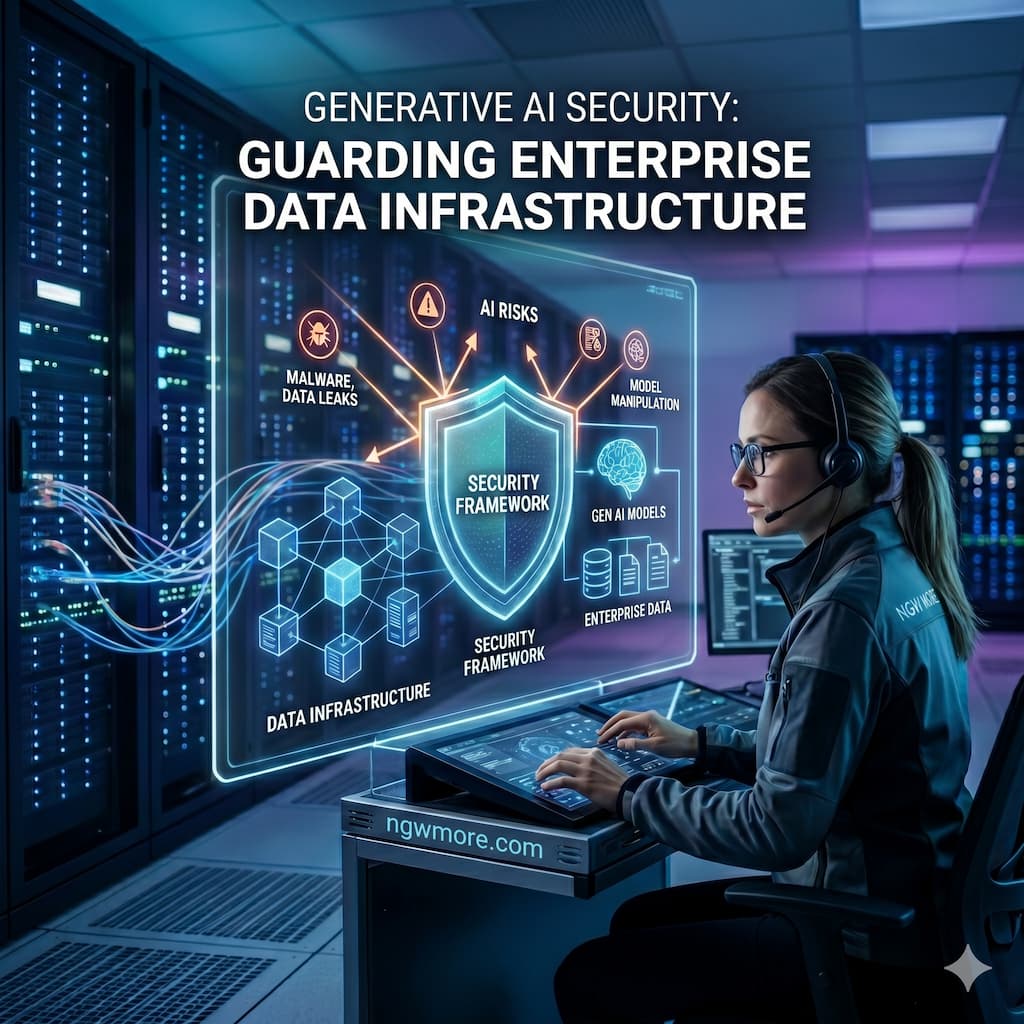
Generative AI Security: Guarding Enterprise Data Infrastructure
The integration of Generative Artificial Intelligence (GenAI) into corporate architecture has transitioned from an experimental innovation initiative to a core operational necessity. Enterprise organizations across every industry sector are aggressively deploying Large Language Models (LLMs), retrieval-augmented generation (RAG) frameworks, and autonomous multi-agent systems. These systems optimize customer experience workflows, accelerate engineering code pipelines, and extract real-time intelligence from unstructured corporate repositories.
However, this rapid wave of deployment has outpaced traditional cybersecurity frameworks. Generative AI models introduce a fundamentally unique data interaction paradigm. Unlike traditional software applications that process structured queries through rigid, predictable logic gates, GenAI models rely on probabilistic execution engines that digest fluid, multi-variable natural language inputs.
This shifting computational baseline shatters the classic corporate security perimeter, turning advanced AI infrastructure into a highly lucrative vector for adversarial exploitation, corporate espionage, and catastrophic data spillages.
 [Legacy Software Pipeline]: Predictable Queries ➔ Rigid Logic Gates ➔ Known Output Vectors
 [Generative AI Architecture]: Fluid Prompts     ➔ Probabilistic Core➔ Dynamic, Unpredictable Outputs
For Chief Information Security Officers (CISOs), data architects, and enterprise technology leaders, securing a Generative AI footprint requires looking past standard network-layer firewall adjustments and signature-based threat detection systems. Organizations must architect a comprehensive, multi-layered security infrastructure engineered explicitly to address the unique behavioral risks of probabilistic AI models.
To safely leverage GenAI capabilities without compromising corporate intellectual property, risking regulatory non-compliance, or exposing internal data stores to malicious manipulation, enterprises must implement an advanced, end-to-end AI Data Infrastructure Protection Framework.
1. The Threat Matrix: Mapping the Vulnerabilities of Enterprise GenAI
Constructing an enterprise-grade defense begins with a rigorous, technical evaluation of the specialized attack surfaces introduced by large-scale AI orchestration layers. Security architects classify these emergent threats into three distinct, high-impact operational attack vectors.
Threat Vector A: Prompt Injection and Algorithmic Override
Prompt injection represents the foundational exploit vector within natural language computing interfaces. Attackers craft highly specialized, adversarial text inputs designed to bypass the embedded alignment instructions of an LLM, tricking the model’s neural network into overriding its initial system safety prompts.
- Direct Prompt Injection (Jailbreaking): An internal employee or external user inputs explicit instructions that manipulate the model into ignoring its corporate boundary constraints—such as demanding the model bypass licensing rules or output restricted code structures.
- Indirect Prompt Injection: A significantly more dangerous threat vector where a malicious actor implants hidden, adversarial instructions within external data files, such as public web pages, PDF business reports, or customer support emails. When an enterprise RAG system reads and parses these compromised documents to answer a routine user query, the hidden instruction executes silently, hijacking the model’s runtime behavior. This override can compel the system to extract proprietary database connections, scrape internal access keys, or exfiltrate private customer records to unauthorized external endpoints.
Threat Vector B: Proprietary Data Infiltration and Model Poisoning
The true competitive advantage of an enterprise AI deployment sits entirely within its proprietary data training data sets and local vector knowledge bases. Protecting the structural integrity of this underlying data fabric is vital.
- Data Leaking via Training and Ingestion Loops: If a company routes sensitive corporate intellectual property, unreleased financial ledgers, or protected personal data directly into third-party public cloud models for generalized training loops, that proprietary knowledge can be permanently absorbed into the model’s weights. Adversaries can subsequently craft clever, reverse-engineered prompts to extract that sensitive intellectual property, triggering severe market disruptions and regulatory compliance failures.
- Data Poisoning (Training Set Corruption): Malicious actors compromise the initial data pipelines or vector repositories used to fine-tune corporate models, purposefully inserting corrupted data entries, logical anomalies, or hidden backdoors into the system. This structural tampering forces the model to manufacture flawed outputs, introduce catastrophic bias into critical decision engines, or systematically fail to detect explicit corporate security vulnerabilities during runtime audits.
Threat Vector C: Over-Reliance and Autonomous Cascade Failures
As enterprises move past basic text generation to deploy fully autonomous AI agents capable of invoking external APIs, executing database writes, and interacting directly with corporate legacy systems, the risk of unmonitored cascade failures expands exponentially.
If an AI agent suffers a prompt injection attack or processes corrupted internal data, it can output destructive commands—such as executing bulk database drops, triggering fraudulent financial transactions, or mass-distributing sensitive documentation to unauthorized external user groups.
2. Core Pillars of a Resilient Enterprise GenAI Security Fabric
Securing decentralized enterprise AI applications demands a shift away from disconnected, ad-hoc safety patches. Technology teams must establish an integrated protection fabric constructed across four core technical pillars.
Pillar I: Intelligent Input/Output Firewall Guardrails
The first line of operational defense sits directly at the interface where users interact with the AI model layer. Enterprises must insert a dedicated, low-latency AI Gateway Guardrail Layer between all inbound user requests and the underlying core model engine.
- The Security Blueprint: Organizations deploy specialized, open-source and enterprise guardrail frameworks (such as NeMo Guardrails, Llama Guard, or custom programmatic regex parsers) that act as real-time, bidirectional firewalls. Every inbound user prompt is inspected for known prompt injection signatures, semantic anomalies, and toxic inputs before it ever reaches the LLM. Concurrently, the model’s generated output is scanned in real time to intercept and redact unintended data drops, proprietary code snippets, and protected personal data before the response is served to the end user.
Pillar II: Secure Retrieval-Augmented Generation (RAG) Architecture
Retrieval-Augmented Generation (RAG) is the dominant architecture used to ground AI models in precise corporate facts, linking LLMs directly to high-performance vector databases (such as Pinecone, Milvus, or Qdrant). However, if the RAG architecture ignores corporate access controls, it creates a massive data governance vulnerability.
- The Security Blueprint: Security architects implement Document-Level Access Control (ACL) directly within the vector storage layer. When a user submits a natural-language query, the RAG orchestration pipeline must cryptographically verify that user’s specific identity credentials via corporate Identity and Access Management (IAM) systems. The vector database filtering logic ensures that the model only extracts and synthesizes data segments from documents that the specific user has explicit permission to read, preventing a low-level employee from using an internal AI chat interface to scrape the executive leadership compensation database or unreleased M&A files.
Pillar III: Confidential Computing and Model Cryptography
Shielding enterprise AI architectures from infrastructure operators, hosting facility administrators, or malicious hypervisor layers within shared cloud networks demands advanced cryptographic protection.
- The Scale Blueprint: Enterprises deploy their core LLM inference engines and vector data instances entirely within Confidential Computing Enclaves equipped with hardware-level memory encryption (such as AMD SEV-SNP or Intel SGX technologies). This ensures that corporate training weights, prompt payloads, and vector data blocks remain mathematically encrypted inside the physical system memory even while being actively processed by the CPU or GPU, keeping corporate intellectual property secure from unauthorized eyes.
Pillar IV: Advanced Behavioral Observability and Cross-Model Telemetry
Maintaining complete runtime operational visibility across thousand of decentralized AI pipelines requires capturing dense behavioral telemetry.
- The Scale Blueprint: Organizations implement a comprehensive AI observability layer built on open standards like OpenTelemetry, piping continuous performance logs into centralized Security Information and Event Management (SIEM) systems. This pipeline monitors specific AI anomalies, including prompt-to-token distribution ratios, sudden spikes in semantic latency, unexpected drops in model alignment scores, and abnormal access patterns to sensitive vector fields, allowing security response teams to rapidly isolate compromised models before an exploit spreads globally.
3. Operational Optimization: The Data Lifecycle Security Matrix
Optimizing a Generative AI security framework requires system designers to make intentional risk trade-offs across every stage of the data lifecycle based on financial, operational, and regulatory requirements.
| AI Implementation Pattern | Primary Security Risk Profile | Definitive Architectural Safeguard Strategy |
| Public Multi-Tenant APIs | Absolute data exposure; vendor data leakage; zero custody control. | Complete Data Sanitization: Deploy strict local tokenization proxies that permanently strip all proprietary data and personal records from payloads before outbound transmission. |
| Private Single-Tenant Clouds | Infrastructure-level access; hypervisor-layer data compromises. | Confidential Computing Enclaves: Run all model inference and vector stores inside dedicated hardware-encrypted server blocks with strict zero-trust parameters. |
| On-Premises Bare-Metal Hosting | High initial CapEx; continuous hardware maintenance overhead. | Absolute Data Sovereignty: Isolate the entire model environment inside a physical air-gapped data facility to ensure complete data custody control. |
| Retrieval-Augmented Generation | Unauthorized lateral data access; indirect prompt injection vectors. | Document-Level IAM Access Control: Bind strict user identity tokens to every vector query to guarantee the model only parses permitted documents. |
4. The Engineering Blueprint: Implementing a Zero-Trust AI Gateway
To bridge the gap between abstract security principles and concrete infrastructure execution, enterprise teams construct a centralized, programmatic Zero-Trust AI Gateway Pipeline.
This software-defined gateway decouples application logic from specific model vendor endpoints, operating as a strict, multi-step inspection gate for all enterprise AI interactions:
- Identity and Entitlement Verification: The gateway accepts an inbound user request, validates the user’s corporate OAuth2/OIDC identity token, and determines their exact document access tier.
- Input Sanitization and Regex Scrubbing: The prompt passes through a high-velocity data sanitization layer that automatically tokenizes and hashes phone numbers, social security records, and credit card strings, substituting them with secure placeholders.
- Semantic Anomaly Classification: The prompt is converted into a vector embedding and run through an ultra-fast classifier model trained explicitly to detect adversarial jailbreak patterns and hidden prompt injections.
- Enclave Inference Routing: If the prompt passes all security checks, the gateway securely routes the sanitized payload over an mTLS encrypted tunnel to the core model executing inside a secure confidential enclave.
- Output Redaction Filter: The raw response generated by the model is evaluated by an output parser that cross-references the text against the enterprise’s regulatory compliance matrices, blocking any unintended leaks of restricted source code or intellectual property before final delivery.
5. Overcoming Pitfalls: Eradicating AI Security Blind Spots
Even highly sophisticated cybersecurity organizations frequently fall victim to deep structural blind spots when scaling their artificial intelligence infrastructure.
The Shadow AI Proliferation Trap
One of the most immediate threats to enterprise data integrity is the emergence of Shadow AI—employees utilizing unauthorized, public consumer-grade AI web tools to summarize private corporate documents, draft legal contracts, or debug proprietary code blocks. Because these consumer platforms routinely log all user inputs to train future public models, corporate data is leaked outside the enterprise firewall daily without management’s knowledge.
- The Infrastructure Remedy: Implement aggressive, network-wide Cloud Access Security Broker (CASB) rules and Next-Generation Firewall (NGFW) policies that systematically block all employee outbound connections to unapproved consumer AI applications. Concurrently, provide staff with a secure, sanctioned internal corporate alternative integrated directly into the organization’s zero-trust gateway fabric to preserve operational productivity safely.
The Myth of Absolute Static Alignment
Many enterprise teams assume that because an LLM has undergone intensive Reinforcement Learning from Human Feedback (RLHF) or alignment tuning by its creator, the model is natively secure against malicious misuse. In practice, determined adversaries continuously discover innovative semantic pathways, language bypasses, and multi-step logic configurations that break static alignment rules instantly.
- The Operational Remedy: Transition to a model of Continuous Adversarial Red Teaming. Treat model security as a highly dynamic, evolving battlefield. Deploy automated, adversarial evaluation scripts to continuously attack internal models with thousands of novel prompt injection permutations inside isolated staging environments, logging vulnerabilities and patching gateway guardrail parameters before exploits hit production systems.
6. Regulatory Convergence: Adhering to Global AI Governance Directives
As artificial intelligence technologies achieve global scale, international regulatory bodies are implementing sweeping governance frameworks that impose severe financial penalties for data security failures.
- The EU AI Act: This landmark framework categorizes AI deployments by risk tier, imposing strict data governance mandates, mandatory security logging systems, and rigorous validation audits for all high-risk applications operating within the European market.
- NIST AI Risk Management Framework (RMF): Providing a comprehensive, structured blueprint for enterprise entities within the United States, the NIST framework outlines explicit guidelines to improve the trustworthiness, resilience, and security of corporate AI deployments throughout their operational lifecycles.
- Global Data Sovereignty Laws: Emerging mandates across multiple international jurisdictions require that any data used to train or optimize artificial intelligence models must reside entirely within the physical geographic boundaries of the nation-state, requiring organizations to implement decentralized, multi-region hybrid cloud fabrics.
Read More⚡ Computer Vision Tech: Automating Modern Manufacturing
Conclusion: Securing the Future of Enterprise Intelligence
The integration of Generative AI represents the most powerful operational catalyst available to the modern digital enterprise. Yet, the immense business advantages of programmatic intelligence cannot be realized if the underlying data infrastructure remains vulnerable to adversarial corruption, data leakage, and algorithmic exploitation.
By moving away from superficial, reactive security patches and constructing a unified AI security fabric built on intelligent gateway guardrails, identity-bound secure RAG architectures, hardware-level confidential computing enclaves, and continuous adversarial red teaming, enterprise technology leaders do far more than just protect their networks. They forge a highly resilient, deeply secure, and endlessly scalable ecosystem for autonomous corporate innovation.
The ultimate competitive edge in the global economy belongs entirely to the agile enterprises that can scale their intelligence without sacrificing their security—mastering advanced AI security fabrics to drive predictable, secure expansion across any digital horizon.
Deploying computationally intensive AI gateway guardrails, high-performance confidential computing enclaves, zero-trust vector data lakehouses, and real-time behavioral observability pipelines requires state-of-the-art, zero-downtime server infrastructure. Secure your organization’s digital AI engine on an unassailable foundation by exploring the premium enterprise hosting architectures at ngwmore.com.