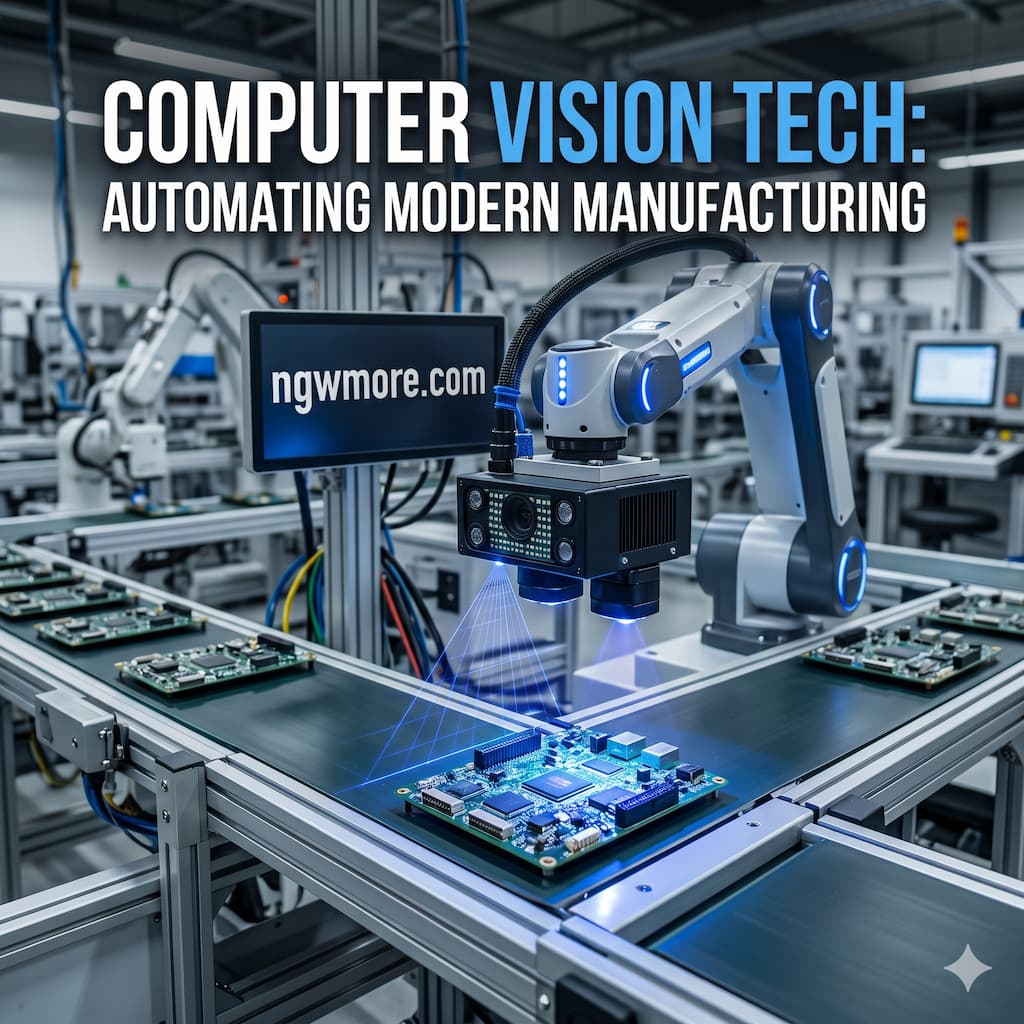
Computer Vision Tech: Automating Modern Manufacturing
The industrial manufacturing landscape is experiencing a profound architectural shift. For decades, automation on the factory floor relied on blind mechanical precision. Robotic arms, conveyor networks, and CNC arrays executed pre-programmed, deterministic coordinate pathways with pinpoint repeatability. However, these systems lacked situational awareness. If a workpiece was slightly misaligned, a component arrived with a microscopic structural fracture, or a human operator stepped into a robotic sweep path, the legacy machine layer would continue its trajectory—resulting in catastrophic equipment damage, expensive production line stoppages, or severe safety breaches.
Modern manufacturing demands an intelligent, adaptive operational layer. The catalyst for this transformation is industrial computer vision technology.
By embedding high-resolution optical matrices, hyperspectral imaging sensors, and localized deep learning inference engines directly onto the production line, manufacturers are giving machines the ability to see, interpret, and act in real time.
From sub-millimeter automated optical inspection (AOI) to dynamic robotic guidance and proactive safety geofencing, computer vision is changing manufacturing from a series of rigid, blind processes into a self-correcting, fully automated ecosystem.
[Legacy Manufacturing]: Blind Mechanical Execution ──> Manual Sample Auditing ──> High Defect Escapes
[Modern Vision-Driven]: Real-Time Optical Streams ──> Edge AI Neural Processing ──> Closed-Loop Defect Rejection
1. The Architectural Framework: High-Velocity Industrial Vision Pipelines
To implement computer vision successfully within an enterprise-grade factory environment, infrastructure architects must design a robust data orchestration pipeline. Industrial vision networks cannot tolerate the latency profiles or data transmission costs associated with standard cloud computing. Processing multi-stream, high-frame-rate uncompressed video requires a dedicated Edge-to-Cluster topology.
[GigE Vision / CoaXPress Cameras] ➔ [Localized Edge Frame Grabber] ➔ [Industrial AI Accelerator (FPGA/GPU)] ➔ [Deterministic PLC Actuation via Industrial Ethernet]
Sensor Selection: Beyond the Visible Spectrum
The pipeline begins at the ingestion layer. While standard CMOS sensors are sufficient for basic barcode reading or object presence verification, modern intelligent automation utilizes specialized optical hardware:
- Hyperspectral and Multispectral Imaging: These sensors capture electromagnetic wavelengths outside the human visible spectrum, such as Short-Wave Infrared (SWIR) or Ultraviolet (UV). This allows the system to analyze chemical compositions, detect hidden moisture pockets, or see subsurface material stress points in real time.
- 3D Time-of-Flight (ToF) and Structured Light Scanners: Instead of flat 2D images, these devices project modulated infrared light grids to construct high-density 3D point clouds, enabling micrometric spatial depth validation.
Data Transmission Interfaces: GigE Vision and CoaXPress
Industrial cameras generate immense bandwidth requirements. A single 12-megapixel camera streaming at 120 frames per second (FPS) produces over 1.4 gigabytes of raw data every second. To transmit these payloads without packet loss or jitter, factories deploy dedicated physical interfaces like GigE Vision (over Cat6A copper or fiber) and CoaXPress (CXP), routing raw frame buffers directly into specialized industrial PCs equipped with high-throughput frame grabbers.
The Edge Inference Layer
Once ingested, the image matrices are processed immediately by localized hardware accelerators—typically NVIDIA Jetson platforms, custom ASICs, or field-programmable gate arrays (FPGAs) programmed with custom convolutional neural network (CNN) execution graphs. By executing inference locally at the edge, the system achieves sub-10ms deterministic response times, allowing it to interface directly with Programmable Logic Controllers (PLCs) via ultra-low-latency protocols like EtherNet/IP or PROFINET.
2. Automated Optical Inspection (AOI): Zero-Defect Manufacturing
Quality control has traditionally been a major bottleneck in manufacturing. Human inspection is inherently flawed; it is subject to fatigue, cognitive drift, and visual limitations, especially when auditing microscopic surface deviations on a line moving at high speeds. Computer vision systems running automated optical inspection (AOI) provide a continuous, indefatigable solution for 100% inline quality assurance.
Input Image ➔ Feature Extraction (CNN) ➔ Anomaly Segmentation Mask ➔ Automated PLC Defect Rejection
Deep Learning Anomaly Segmentation
Traditional AOI relied on rigid, rule-based pixel matching. Engineers had to manually define explicit boundaries, golden image templates, and contrast thresholds. If the factory lighting shifted by a few lumens, the system would generate false positives.
Modern vision systems deploy unsupervised generative models and Semantic Segmentation CNNs (such as U-Net or Mask R-CNN architectures). The network is trained on datasets containing exclusively pristine, defect-free items. It learns the multi-dimensional geometric and structural variations of a perfect product.
When a component passes under the camera inspection node, the network executes a pixel-level reconstruction. If a microscopic crack, surface contamination, or soldering irregularity exists, the model flags it instantly as an anomaly, generating an automated segmentation mask detailing the exact spatial coordinate of the structural variance:
JSON
{
  "inspection_node": "LINE_3_STAGE_4",
  "component_uuid": "8a3f-91b2-77c1",
  "verdict": "FAIL",
  "anomaly_type": "micro_fissure_structural",
  "confidence_score": "0.9942",
  "pixel_coordinates": {"x_start": 1402, "y_start": 784, "x_end": 1415, "y_end": 789},
  "plc_action_trigger": "activate_pneumatic_rejection_arm_chute_2"
}
The component is immediately blown or pushed off the active conveyor into a rework bin, eliminating the risk of a defective part escaping into the wider downstream assembly loop or reaching an end customer.
3. Dynamic Robotic Guidance: Giving Sight to the Machine Layer
When robotic units operate without vision, they require highly structured environments. Workpieces must be presented in exact, static jigs or custom-machined plastic trays. If a parts bin arrives with components jumbled randomly inside, a legacy robot cannot interface with it. Computer vision introduces spatial intelligence and adaptive kinematics.
3D Bin Picking and Pose Estimation
Using 3D structured light cameras mounted directly above a parts hopper, the computer vision engine processes a spatial point cloud of the disordered items. The system runs 6-DoF (Six Degrees of Freedom) Pose Estimation algorithms (such as PointNet++ or PoseCNN), calculating the exact $X, Y, Z$ spatial position alongside the roll, pitch, and yaw angles of individual components within the bin.
Disordered Parts Bin ➔ 3D ToF Scan ➔ 6-DoF Pose Calculation ➔ Real-Time Robot Path Planning
The vision system computes the most accessible part, checks for structural collision paths with the bin walls, and streams the optimized coordinate vectors directly to the industrial robot’s controller. The arm adjusts its approach angles fluidly, picks the part cleanly out of the clutter, and aligns it precisely onto the processing dock.
Real-Time Solder and Weld Seam Tracking
In heavy industrial assembly, such as automotive frame welding, thermal deformation can warp metal seams slightly during production. Vision-guided robotic welders use specialized high-frame-rate laser triangulation sensors mounted just millimeters ahead of the plasma torch.
As the weld progresses, the vision system measures the physical seam geometry at 200 Hz, identifying sub-millimeter tracking errors caused by material distortion. The robot adjusts its trajectory in real time, maintaining consistent weld penetration and structural integrity across every unit, regardless of raw material variability.
4. Spatial Intelligence: Revolutionizing Plant Safety and Operations
The utility of industrial computer vision extends far beyond checking components and guiding robotic claws. It can be deployed as an overarching spatial intelligence layer to protect the factory’s most valuable assets: its human workforce.
Proactive AI Geofencing and Hazard Mitigation
Traditional factory safety relies on physical light curtains or pressure mats around heavy equipment. If a human crosses a beam, the machine cuts power instantly—often ruining the active workpiece and requiring lengthy system recalibration cycles.
AI-driven safety vision utilizes intelligent overhead camera matrices running deep learning Object Detection and Pose Tracking networks (such as YOLOv8 or MediaPipe). The system continuously maps the factory floor, defining dynamic, concentric safety zones around active heavy machinery:
[ machinery core ] <─── ( Zone 1: Stop ) <─── ( Zone 2: Slow Down ) <─── [ safe open floor ]
- Zone 2 (Cautionary Buffer): If an operator approaches the perimeter to inspect a component, the system flags their presence and triggers a warning beacon, instructing the robotic unit to reduce its operating speed to $25\%$.
- Zone 1 (Critical Danger): If the operator reaches directly into the machine’s active operational envelope, the system executes an immediate, controlled safe-stop protocol.
This layered approach maximizes both human safety and operational uptime by avoiding unnecessary total system shutdowns for minor spatial boundary crossings.
5. Predictive Metrology and Digital Twin Integration
By logging data continuously across every stage of production, computer vision transitions from a localized verification tool into a core driver of Predictive Metrology and closed-loop feedback control.
Closed-Loop Process Optimization
Consider an injection molding system producing precision plastic enclosures. The computer vision engine measures every component as it emerges from the mold tool, tracking dimensional values down to the micron level. If the system detects a subtle, linear contraction trend across consecutive units—signaling tool wear or thermal fluctuations within the polymer feed—the AI model doesn’t just flag the drift.
It calculates a predictive correction algorithm and feeds it directly back to the machine’s control loop, adjusting the mold temperature or injection pressure settings automatically to bring production back into spec before a single actual scrap part is generated.
[Machine Execution] ➔ [Optical Micron Scan] ➔ [AI Drift Analysis] ➔ [Automated Parameter Adjustment Loop]
Feeding the Enterprise Digital Twin
Every image matrix, structural anomaly log, and spatial measurement data point is tagged with a unique component serial number and pushed to the enterprise Digital Twin framework. This creates an unalterable, continuous historical record of the physical state of every item that moves through the factory door. If a product suffers a field failure months later, quality engineers can retroactively open its digital twin, examine the precise high-resolution inline visual data captured during assembly, and isolate the exact upstream root cause of the structural failure.
6. Financial and Operational ROI: The Industrial Metrics Matrix
Deploying an enterprise-scale computer vision ecosystem requires capital expenditure for high-speed optics, localized GPU clusters, and custom algorithmic validation. However, the direct impact on operational metrics yields a swift and quantifiable return on investment:
| Operational Metric | Legacy Infrastructure Baseline | Optimized Vision-Driven Paradigm | Enterprise Economic Impact |
| Defect Detection Latency | Hours to Days (Discovered during end-of-line manual batch testing) | Sub-10ms Inline (Identified at the exact second of creation) | Prevents further value-add operations on structurally compromised scrap units |
| Defect Escape Rate | $2.0\% – 5.0\%$ standard industry human error escape rate | $< 0.01\%$ verified algorithmic escape threshold | Eliminates product recall expenses, warranty liabilities, and brand degradation |
| Changeover Configuration Time | 1 to 4 Hours (Requires physical realignment of mechanical jigs) | $< 1\text{ Second}$ (Automated software software recipe rotation via code) | Unlocks high-mix, low-volume agile manufacturing profitability |
| Robotic System Uptime | Dependent on perfectly structured input presentation channels | Adaptive Autonomous Kinematics (Handles raw, unstructured material arrays) | Drastically compresses upstream material handling and presentation costs |
7. The Horizon: Synthetic Data and Edge-to-Cloud Collective Intelligence
As computer vision matures, its data architecture is evolving to leverage advanced machine learning models that address traditional implementation pain points.
Bypassing the Data Scarcity Bottleneck via Synthetic Data Generative AI is solving one of the historically hardest challenges in industrial machine learning: training models to spot rare defects. High-efficiency factories may only produce a specific structural flaw once in every ten million cycles, meaning it can take years to collect enough real-world images of a defect to train a standard neural network.
Modern systems use Generative Adversarial Networks (GANs) and physics-based rendering engines to synthesize photorealistic images of flaws (such as internal metal voids, paint blisters, or micro-fractures) directly onto CAD models. This allows developers to train and validate highly accurate PQC vision models synthetically before a single physical component ever rolls off the assembly line.
Collective Swarm Intelligence via Distributed Edge Models
By linking distributed edge vision nodes running across multiple global manufacturing facilities through secure cloud infrastructure frameworks, enterprises can implement Collective Industrial Intelligence.
When a vision node in a facility in Germany encounters a completely novel material variant or lighting anomaly and successfully learns to categorize it, the local model weight updates are aggregated, audited through centralized optimization engines, and pushed back out over-the-air (OTA) to edge nodes in factories across the globe. The entire global manufacturing infrastructure grows collectively smarter with every shift.
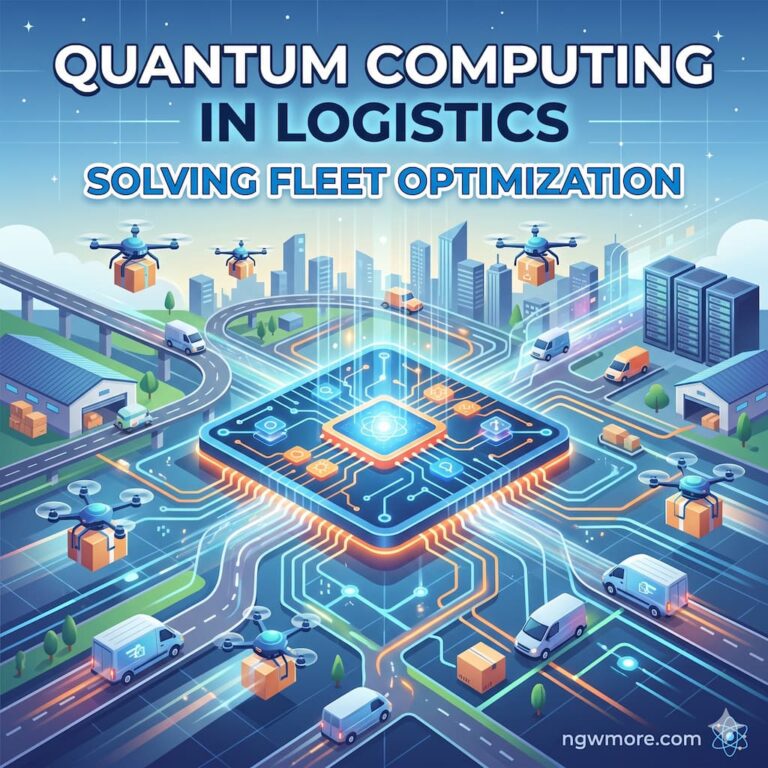
Read More⚡ Quantum Computing in Logistics: Solving Fleet Optimization
Conclusion: Orchestrating the Sentient Factory Floor
Computer vision technology has advanced beyond simple barcode scanning and proximity detection; it has become the fundamental neural architecture of modern automated manufacturing. By shifting away from rigid, blind automation paradigms and investing in real-time edge processing pipelines, high-density 3D spatial intelligence, and adaptive closed-loop controls, forward-thinking manufacturers can build exceptionally resilient ecosystems.
The integration of advanced optical technology doesn’t simply reduce defects—it unlocks a new era of highly flexible, agile, and self-optimizing industrial automation.
In a hyper-competitive global marketplace where material costs are volatile and product lifecycles are compressing, the enterprise leaders who give their machines the ability to see, interpret, and adapt will command the structural high ground—driving maximum yield, absolute quality precision, and unmatched operational scale across the emerging global digital economy.
For regular technical insights on industrial edge computing, post-quantum network security configurations, and advanced cloud-scale infrastructure blueprints, visit ngwmore.com.