Zero Trust Architecture: Securing Distributed Remote Workers
The traditional paradigms governing enterprise network engineering, workforce mobilization, and organizational data security are confronting an unprecedented operational crisis. For decades, corporate security departments, network administrators, and Chief Information Security Officers (CISOs) built network protection around a static, localized perimeter defense model. Perimeters were constructed like physical fortresses: security groups deployed centralized on-premises firewalls, established rigid Demilitarized Zones (DMZs), and forced remote business branches or occasional off-site workers to backhaul internal data traffic through heavy, centralized Virtual Private Network (VPN) hardware hubs. Under this legacy framework, security orchestration was fundamentally descriptive, relying on trailing log audits, static signature-based intrusion detection systems (IDS), and manual firewall rule adjustments executed over long change-management cycles.
However, the rapid transition to highly distributed, remote corporate environments, edge computing topologies, and multi-cloud software-as-a-service (SaaS) infrastructures has permanently shattered this traditional boundary defense model.
Modern enterprise data no longer resides behind an isolated physical firewall; it is constantly in motion, accessed by distributed remote workforces operating from heterogeneous home networks, public access points, and unmanaged personal endpoints.
In this hyper-connected ecosystem, an enterprise network must process massive user validation loads and dynamic data paths while facing sophisticated persistent threat actors, advanced credential phishing networks, and zero-day perimeter exploits.
Relying on legacy manual validation gates, broad internal network trust, and static VPN backhauling under this high-velocity reality introduces severe, non-negotiable systemic vulnerabilities. Once a threat actor compromises a single endpoint or steals a single employee’s credentials, the legacy boundary model allows them unrestricted lateral movement across internal subnets, core production databases, and intellectual property repositories. This tracking latency results in catastrophic data breaches, extended threat dwell times, and crippling compliance failures that expose sensitive corporate intelligence to total exploitation.
To eliminate this operational friction, lower administrative overhead, and secure an absolute data-protection moat, progressive technology and security leaders are overhauling their defensive perimeters. They are abandoning ad-hoc transactional access models and embedding automated, continuous Zero Trust Architecture (ZTA) and Automated Remote Workforce Security Frameworks straight into the structural core of their networks.
Far from a basic software extension, a marketing buzzword, or an incremental dashboard plug-in, a production-grade Zero Trust architecture combines high-throughput multi-source identity telemetry ingestion, non-linear machine learning behavioral risk classification ensembles, software-defined Policy-as-Code control engines, and hardware-insulated confidential data processing perimeters into a unified, autonomous defense plane.
1. The Core Paradigm Shift: From Implicit Boundary Trust to Continuous Cryptographic Verification
To build an unassailable data-protection shield capable of scaling safely across multi-jurisdictional cloud environments, home offices, and distributed regional branches, enterprise network architects must fundamentally shift their underlying security management philosophy. The enterprise must migrate away from passive, location-based boundary trust and focus entirely on continuous, real-time cryptographic verification and contextual authorization.
 [Legacy Boundary Model]: Untrusted External ──>[VPN / Static Firewall]──> Trusted Internal Zone (High Lateral Drift Risk)
 [Zero Trust Automation]: Continuous Identity Ingestion ──> Contextual Risk Engine ──> Adaptive Micro-Perimeter Execution
- Legacy Boundary Defense Models: Function within a reactive, binary topology. Systems evaluate data packets and user access permissions strictly at the front edge of the network or at the VPN gateway. Once an entity clears the initial validation gate, it is granted broad, persistent trust inside the internal corporate network, leaving the core vulnerable to rapid lateral threat propagation if a single endpoint or account is compromised.
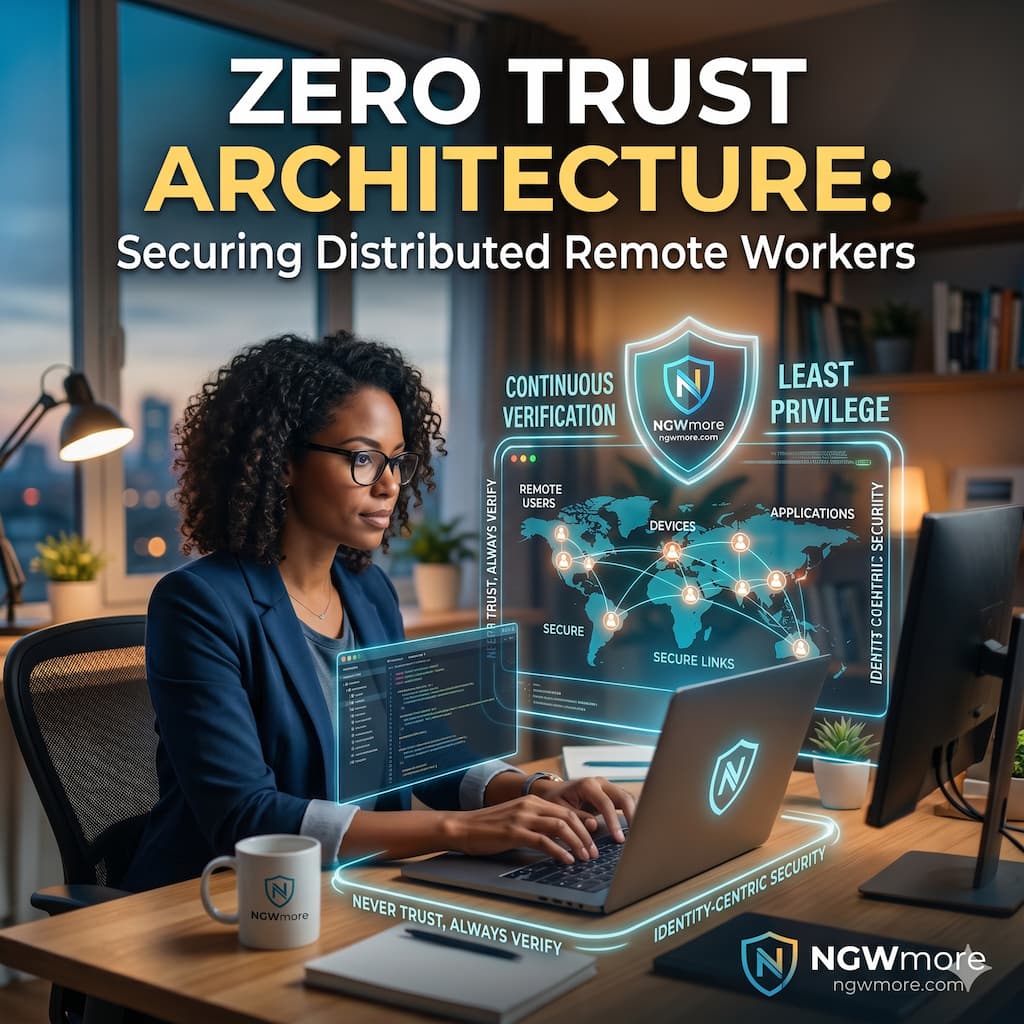
- The Hardened Zero Trust Fabric: Reconfigures this framework entirely. It enforces a strict philosophy of “Never Trust, Always Verify.” No user, device, cloud service, or data packet is granted implicit trust based on its physical or logical network location. Every single access request, internal data transit, and application call must clear continuous, real-time cryptographic authentication, device posture mapping, and behavioral risk scoring right at the execution boundary.
By executing real-time automated identity scanning, micro-segmentation enforcement, and programmatic policy validation right at the application and data level, intelligent security networks permanently eliminate threat visibility lag. The security operation center (SOC) moves past its historical role as a lagging investigative checkpoint. The underlying software infrastructure evolves into an active strategic shield designed to identify network degradation, isolate insider threats, and execute automated threat containment routines weeks before a vulnerability can be fully exploited by external threat groups.
2. Core Pillars of a Scaled Remote Workforce Zero Trust Infrastructure
Constructing an enterprise-grade automated network protection and data security platform capable of scaling safely across thousands of distributed remote endpoints requires a robust technology layer anchored by four foundational engineering pillars.
Pillar I: High-Throughput Contextual Telemetry Ingestion Factories
The ultimate predictive accuracy of any automated Zero Trust model and its capacity to prevent run-away identity exploitation depend entirely on the volume, consistency, and real-time ingestion velocity of the data pipelines feeding its processing loops.
Systems architects deploy automated real-time data orchestration pipelines connected straight to enterprise directory services, Unified Endpoint Management (UEM) clients, identity providers (IdPs), Cloud Access Security Brokers (CASBs), and network flow logs via secure connectors. The ingestion factory normalizes unstructured, multi-format telemetry—including real-time login location coordinates, network connection latencies, endpoint operating system patch states, and application interaction timestamps—into a standardized, low-latency data schema. This continuous data harvest feeds a centralized, enterprise-grade Security Feature Store that unifies raw tracking events into a single, uncorrupted source of truth for both online real-time access inference and offline model retraining loops, completely preventing data skew vulnerabilities.
Pillar II: Non-Linear Machine Learning Behavioral Risk Classification Ensembles
Traditional enterprise access controls evaluate user permissions and identify account compromises using basic, rigid static rules (such as matching a user’s country code), frequently failing to map complex, non-linear relationships across thousands of alternative operational variables, behavioral variations, or advanced credential cloning attacks.
Security data science teams deploy optimized User and Entity Behavior Analytics (UEBA) Classification Ensembles built on advanced gradient-boosting machines paired with deep neural network architectures and explainable machine learning frameworks. The anomaly detection core processes thousands of distinct input features simultaneously—including an active employee’s data consumption volume variance, atypical keyboard interaction mechanics, unusual API execution frequencies, active resource query velocities, and real-time external global threat intelligence feeds. The engine applies ensemble learning models to calculate an adaptive, dynamic behavioral risk score that updates programmatically as new user sessions interact with corporate applications, allowing the system to isolate subtle account compromises that easily bypass traditional rule screens.
Pillar III: Software-Defined Policy-as-Code Micro-Segmentation
Modern multi-cloud corporate operations and remote work topologies require navigating an intricate maze of overlapping department cost centers, decentralized application endpoints, and dynamic geographic scaling zones that change dynamically across cloud environments and remote networks.
Enterprise technology teams deploy optimized Policy-as-Code Security Engines built on advanced logical validation frameworks and programmatic micro-segmentation controls. The network core utilizes centralized policy repositories (such as Open Policy Agent or specialized zero-trust edge controllers) to translate organizational security rules into machine-readable definitions. The system checks infrastructure blueprints, live remote device profiles, and active data connections programmatically to ensure that every remote user session is isolated inside an independent micro-perimeter, data stores reject unmapped access attempts, and network boundaries block unauthorized public routing paths, eliminating human calculation errors across complex enterprise applications.
Pillar IV: Continuous Device Posture Assessment and Autonomous Remediation
Waiting for traditional quarterly endpoint compliance checks or manual security analyst intervention to revoke compromised certificates, block high-risk connections, or isolate infected remote machines exposes the enterprise to massive, unhedged data exposure windows during periods of rapid network exploitation.
Operations groups deploy an automated Continuous Device Posture Engine connected straight to live network routing planes, identity fabrics, and automated endpoint containment mechanisms across all distributed remote worker nodes. The framework monitors corporate connection behaviors continuously against adaptive risk-threshold parameters.
If the analytical engine isolates an uncharacteristic anomaly—such as a non-linear spike in regional data download metrics from a remote endpoint combined with an uncharacteristic modification in a core application configuration path—it triggers an immediate automated intervention playbook.
The framework bypasses manual validation queues and executes an automated response: it programmatically triggers an automated API call to revoke the compromised session tokens, injects real-time micro-segmentation blocks to sever the connection, and forces the remote device into an isolated quarantine network plane while alerting the security operations team for direct diagnostic remediation, minimizing the operational blast radius of a potential breach in seconds.
3. High-Performance Optimization: The Zero Trust Metric Ledger
Transitioning an enterprise technology framework from uncoordinated manual VPN configurations to an automated, scaled corporate Zero Trust architecture fundamentally redefines an organization’s defensive efficiency and structural data resilience metrics.
| Performance Parameter | Legacy Perimeter & VPN Defense | Scaled Automated Zero Trust Core |
| Identity Verification Loop | Static; validated once at initial perimeter entry point | Continuous; real-time cryptographic token verification |
| Access Enforcement Precision | Broad perimeter trust; high exposure to lateral threat drift | Absolute micro-segmentation; contextual application validation |
| Policy Adaptability Window | Slow manual firewall or VPN configuration changes every month | Continuous; real-time automated Policy-as-Code sweeps |
| Mean Time to Remediation (MTTR) | Hours or days; requires manual infrastructure cleanup | Seconds; autonomous session revocation and device isolation |
| Data Ingestion Overhead | Opaque; lacks granular telemetry across remote networks | Total; real-time streaming identity and device feature stores |
4. Operational Implementations: Zero Trust in Active Remote Ecosystems
Evaluating how advanced Zero Trust platforms and automated data security architectures perform under complex, real-world corporate engineering scenarios highlights their vital importance in preserving institutional trust and protecting core data assets.
Defusing Advanced Persistent Threat Credential Hijacking in Fintech Architectures
Consider a premier international financial technology corporation that coordinates automated banking applications, digital checkout APIs, and high-value clearing networks serving millions of global consumers daily. The underlying microservices architecture handles highly sensitive transaction details and operates under rigid compliance directives. To maintain peak software development velocities, the company utilizes a highly distributed, remote team of senior software developers operating across multiple continental regions. During an off-hours cycle, a malicious threat group leverages a sophisticated spear-phishing campaign to compromise a senior engineer’s workstation and steal valid multi-factor authentication (MFA) session cookies, attempting to gain initial access to a peripheral internal staging subnet.
Under traditional, boundary-focused security models, once the threat actor clears the front gate by deploying the stolen session cookies via a standard remote VPN, they are treated as an internal trusted entity. The attacker can begin scanning the internal network, performing lateral movements across subnets, and executing recursive database queries to target core transactional processing registries. By the time the security operations team manually isolates the intrusion logs days later, the threat actor has harvested and encrypted vast tranches of core customer balance databases, triggering massive financial damage and permanent loss of organizational trust.
The enterprise completely neutralizes this catastrophic risk by anchoring its network core to an automated, real-time Zero Trust protection plane. The platform monitors machine behavior telemetry, device posture configurations, and user interaction mechanics continuously.
The moment the threat actor attempts to execute an unmapped database query from the engineer’s remote session, the machine learning classification engine registers the non-linear feature divergence instantly—detecting atypical query velocities and a sudden change in device telemetry characteristics.
The platform bypasses traditional administrative delays and executes an automated containment playbook: it programmatically severs the active session tokens via an automated API command to the central identity provider, invalidates the associated authentication certificates, and places the remote connection into an isolated network quarantine. This sub-second response halts the lateral threat movement in its tracks, keeping the core transactional database insulated from the exploit, preventing data filtration, and ensuring complete compliance with financial protection mandates.
Eradicating Configuration Drift and Endpoint Exfiltration in Distributed Corporate Networks
A hyper-scale digital infrastructure and data distribution conglomerate operates thousands of automated data repositories and dynamic document management platforms across multi-tenant public cloud environments to serve business consumers globally. To maintain maximum operational flexibility, the organization allows its distributed remote administrative staff to manage critical storage configurations via web-based management consoles. During a complex resource migration event, an administrative employee working from a remote home network experiences a local routing misconfiguration on their personal router, while simultaneously attempting to configure a cloud access policy—introducing an anomaly known as Configuration Drift.
The enterprise stabilizes its network perimeter and eliminates exfiltration risks by anchoring its infrastructure to an automated Cloud Security Posture Management (CSPM) and zero-trust identity layer. The automated network protection engine monitors active multi-cloud environments continuously, comparing live user configuration actions against baseline infrastructure definitions.
Within minutes of the user account drift, the processing engine identifies the unauthorized change as a high-severity policy violation. Concurrently, an external malicious scanning script attempts to exploit the administrative employee’s active session to initiate a high-velocity data download loop from a private object store, triggering a non-linear spike in network egress traffic metrics.
The automated protection plane identifies the anomaly instantly and executes an automated remediation playbook: it programmatically tears down the insecure public access path, resets the bucket firewall configuration back to the approved policy-as-code blueprint, terminates the compromised remote session, and blocks the attack source IP addresses across the global content delivery network (CDN) edge. This real-time defense prevents further information filtration, securing core corporate assets and maintaining unassailable network visibility.
5. Security Architecture for Hardened Zero Trust Automation Planes
Centralizing global access policy configuration, integrating live identity orchestration pipelines, tracking device vulnerability metrics, and automating API-driven session remediation pathways introduces intense data privacy and infrastructure security requirements. Because a centralized Zero Trust protection platform commands the absolute authority to modify access structures, alter routing policies, and interface with sensitive authentication logs, the automation control framework represents a primary target for advanced persistent threat networks, software supply chain syndicates, and corporate espionage operations.
Implementing Anonymized Feature Tokenization across Monitoring Pipelines
To train predictive risk models, evaluate factor analysis, and execute large-scale lookalike threat clustering safely without violating global data privacy directives (such as GDPR or CCPA) or exposing proprietary corporate trade secrets to public network observers, organizations must implement a robust data perimeter.
Systems architects deploy an automated data tokenization proxy directly at the front edge of the zero-trust identity ingestion pipeline. Before any authentication log, flow record, or connection log is written to the central predictive data lakehouse, all sensitive personal fields, specific user identifiers, and internal corporate IP addresses are automatically extracted, cryptographically hashed, and replaced with secure tokens. The quantitative models and risk-attribution engines execute their pattern-recognition calculations over completely anonymized operational metadata, maintaining total monitoring utility while ensuring absolute corporate data privacy across all regional entities.
Hardening the Processing Core via Zero-Trust Isolation and Confidential Enclaves
Because the centralized identity and access security optimization core commands the absolute authority to analyze code vulnerabilities, modify routing policies, alter automation thresholds, and execute automated account changes via API links, accessing this administrative engine requires extreme security constraints.
- Zero-Trust Network Access (ZTNA): Isolate the entire network protection server structure, orchestration controllers, identity databases, and policy build agents inside a strict Zero-Trust Network Access envelope. Every developer account, system administrator terminal, and internal software integration must undergo continuous multi-factor authentication, rigorous behavioral risk screening, and endpoint device posture assessments before gaining access to the automation console.
- Confidential Enclaves: Critical policy compilation steps, cryptographic token generation tasks, and policy-as-code evaluation engines must execute exclusively within hardware-isolated Confidential Computing Enclaves equipped with hardware-level memory encryption. This structural arrangement keeps your underlying proprietary configuration blueprints, compilation logs, and cryptographic access keys completely insulated from host-level interception, internal insider threats, or external data exploitation throughout the execution lifecycle.
6. Regulatory Convergence: Adhering to Global Remote Security Mandates
Scaling a comprehensive automated network protection and data security architecture across international borders requires absolute compliance with an evolving web of international corporate governance, privacy preservation directives, and data tracking standards.
- The Executive Order on Improving the Nation’s Cybersecurity (United States): Federal mandates dictate that public and private enterprise operators managing critical infrastructure or interfacing with government networks must transition away from legacy boundary defense, execute comprehensive cryptographic asset inventories, and deploy formal Zero Trust architectures to secure operational environments from advanced cyber-warfare initiatives.
- The AICPA Trust Services Criteria (SOC 2 Type II): Rigorous international auditing frameworks demand that high-growth digital organizations, cloud infrastructure providers, and software-as-a-service entities implement and present verifiable operational safety metrics, continuous log tracking pipelines, and automated access governance histories across all active computing environments.
- Global Data Sovereignty Regulations: Hardening regional data isolation acts require that any enterprise user telemetry or analytical metadata collected via enterprise platform tools must reside and be processed strictly within the physical borders of that nation-state, forcing network defense platforms to deploy highly secure, multi-region network architectures to avoid crippling statutory enforcement penalties.
Read More⚡ Corporate Agility: Scaling Enterprise Workflow Architecture
Conclusion: Engineering the Unassailable Secure Workforce Engine
The integration and scaling of a comprehensive, automated Zero Trust architecture and remote workforce security framework is not a discretionary luxury for modern enterprise IT; it is a fundamental technological requirement to achieve long-term corporate resilience, data infrastructure integrity, and continuous operational uptime. The historical strategy of managing highly distributed remote cloud networks through slow, human-centric validation gates and trailing manual firewall audits—while tolerating severe calculation latencies, configuration drift exposures, and high operational security costs—is an unsafe operational approach that invites market displacement, massive data leaks, and balance-sheet erosion.
By engineering an integrated, forward-looking software fabric built on high-throughput real-time identity telemetry ingestion pipelines, advanced machine learning behavioral classification ensembles, software-defined policy-as-code micro-segmentation controls, and real-time automated orchestration playbooks, progressive enterprise leaders transform their security centers from a compliance cost center into a high-performance strategic weapon.
Ultimately, the definitive advantage in the global digital ecosystem belongs entirely to the visionary enterprises that can compile code, optimize systems, and deploy secure application environments as fast as the market moves—mastering advanced network protection infrastructure frameworks to drive secure, highly predictable, and market-leading global scale across any operational horizon.
Deploying computationally intensive identity telemetry normalization engines, hosting high-throughput behavioral classification ensembles, processing real-time policy-as-code compliance layers, and managing ultra-secure confidential computing build enclaves requires world-class, zero-downtime server infrastructure. Secure your company’s intelligent Zero Trust core on an unassailable infrastructure foundation by exploring the premium enterprise hosting configurations at ngwmore.com.