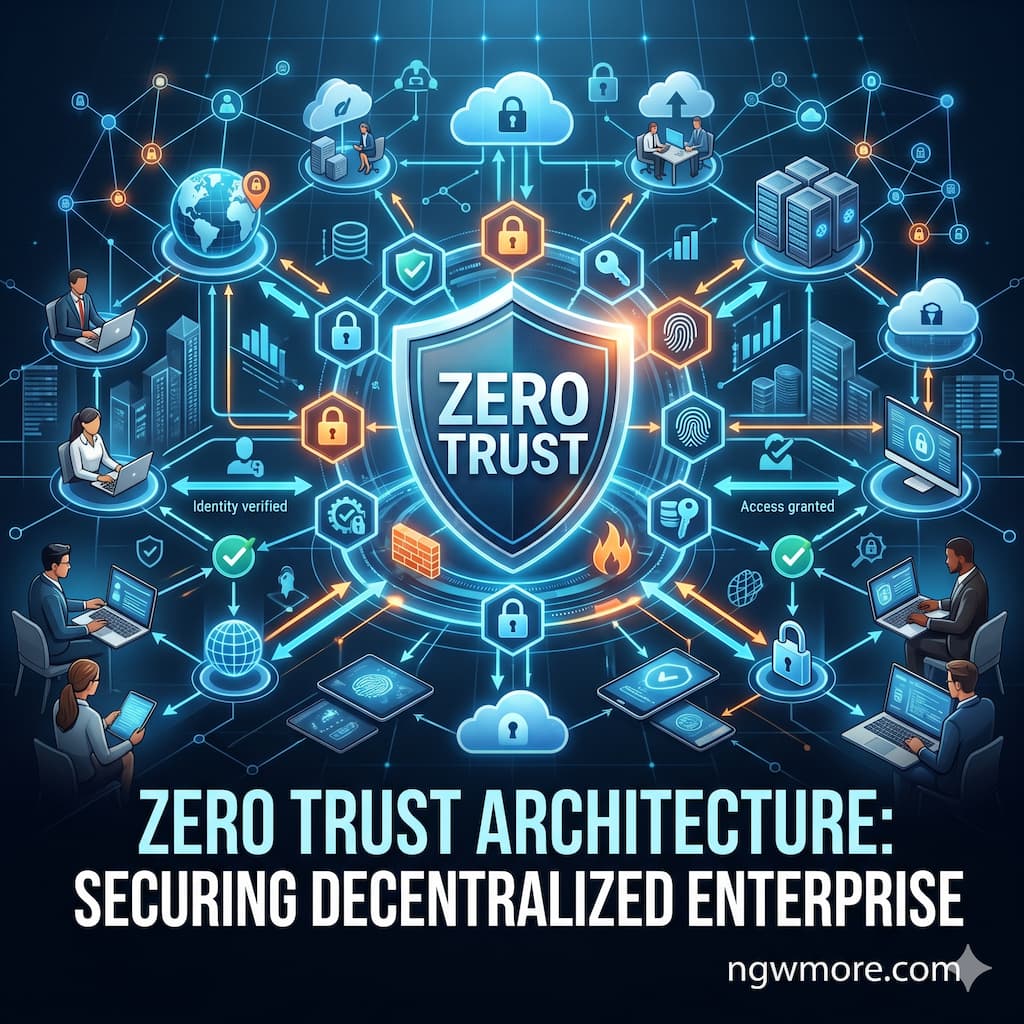
Zero Trust Architecture: Securing Decentralized Enterprise
The traditional network perimeter is dead. For decades, enterprise cybersecurity relied on a “castle-and-moat” security philosophy. Organizations constructed thick digital walls around their data centers—using firewalls, Virtual Private Networks (VPNs), and intrusion detection systems—assuming that anyone inside the castle walls was inherently safe and trustworthy, while everyone outside was a threat.
Today, that castle has been completely dismantled. The modern corporate environment is fully decentralized. Corporate data no longer resides exclusively inside a physical data center; it is distributed across multiple public clouds, private infrastructure nodes, and Software-as-a-Service (SaaS) environments.
Similarly, the corporate workforce is no longer sitting inside centralized office headquarters. Employees, contractors, and third-party vendors connect to corporate systems from remote locations, using untrusted home Wi-Fi networks and a mix of corporate and personal mobile devices.
[Traditional Perimeter] ──> Trust anyone inside corporate walls (Castle-and-Moat)
[Zero Trust Architecture] ──> Never Trust, Always Verify, regardless of location
In this highly fragmented landscape, relying on network location as a proxy for trust is an existential security flaw. If a malicious actor compromises a single remote worker’s VPN credentials, they gain unfettered lateral access to the entire corporate network.
To survive in this decentralized ecosystem, enterprises must adopt a radical new paradigm: Zero Trust Architecture (ZTA). Built on the foundational principle of “Never Trust, Always Verify,” Zero Trust shifts the security boundary from the network edge directly to individual users, assets, and workloads.
1. The Core Philosophy of Zero Trust
Zero Trust is not a specific software suite, appliance, or tool. It is an end-to-end framework based on three non-negotiable architectural principles established by security bodies like the National Institute of Standards and Technology (NIST SP 800-207).
Principle A: Explicit Verification
Never assume trust based on the user’s location, IP address, or previous authentication. Every single access request must be explicitly authenticated and authorized based on a dynamic combination of data points: user identity, location, device health telemetry, service or workload context, and anomaly detection.
Principle B: Least Privilege Access
Limit user and machine access with Just-In-Time (JIT) and Just-Enough-Access (JEA) models. Employees should only have access to the exact resources required to perform their immediate role, and no more. By restricting broad access permissions, you significantly minimize your overall lateral threat exposure.
Principle C: Assume Breach
Operate continuously under the assumption that your environment has already been compromised. This mindset shifts defenses from purely preventative to highly resilient: encrypt all corporate data end-to-end, use micro-segmentation to isolate workloads, deploy real-time analytics to detect unusual behaviors, and heavily automate incident response playbooks.
2. Structural Pillars of a Decentralized Zero Trust Architecture
Implementing Zero Trust across an enterprise requires a comprehensive approach across six core operational layers. These pillars must be deeply integrated through automated orchestration engine policies.
1. Identity Security (The New Perimeter)
In a decentralized framework, identity is the true perimeter. Organizations must deploy robust Identity and Access Management (IAM) systems paired with Context-Aware Multi-Factor Authentication (MFA).
- The Strategy: Simple SMS or push-notification MFA is no longer enough due to sophisticated “MFA fatigue” and phishing attacks. Zero Trust requires phishing-resistant MFA (such as FIDO2/WebAuthn hardware keys) alongside continuous session validation. If a user authenticates successfully at 9:00 AM but their device behavior abruptly alters at 11:00 AM, the IAM system must instantly re-challenge the user or terminate the session.
2. Device Health and Compliance Telemetry
Because employees work from anywhere, the enterprise must continuously verify the security posture of every device attempting to connect to corporate applications.
- The Strategy: Implement Unified Endpoint Management (UEM) and Endpoint Detection and Response (EDR) agents. Before granting network access, the system runs an automated checklist: Is the operating system patched? Is the local firewall enabled? Is data-at-rest encryption active? If a device fails any compliance metric, it is isolated to a remediation zone until it is secured.
3. Network Micro-Segmentation
Traditional networks allow broad internal exploration once a user gets past the main gate. Zero Trust utilizes micro-segmentation to divide the enterprise network into granular, isolated zones, preventing lateral movement during a breach.
[Traditional Network Flat Workspace]: Breach Node A ──> Lateral Spread to Nodes B, C, D
[Micro-Segmented Network Fabrics]:   Breach Node A ──X Secure Firewalled Enclaves (B, C, D)
By defining explicit micro-perimeters around individual corporate databases or sensitive microservices, an attacker who compromises a front-end server cannot jump laterally to access back-end financial or HR databases.
4. Application Invisibility and Software-Defined Perimeters (SDP)
In a Zero Trust framework, applications should never be exposed directly to the public internet.
- The Strategy: Using a Software-Defined Perimeter (SDP), applications are hidden behind a secure broker layer. The application ports remain closed to public internet scans, making them invisible to malicious reconnaissance. Only after a user’s identity and device compliance are verified by the SDP broker is a secure, point-to-point TLS tunnel constructed between that specific user and the specific application.
5. Continuous Data Protection and Encryption
Data must be protected regardless of where it travels across your decentralized architecture.
- The Strategy: Apply strict Data Loss Prevention (DLP) rules alongside encryption protocols. Data must be encrypted in transit (using TLS 1.3) and at rest (using AES-256). Furthermore, enterprises deploy automated data classification tools that leverage machine learning to locate, tag, and protect sensitive Intellectual Property (IP) or PII as it is created across the organization.
6. Infrastructure and Workload Hardening
Whether running workloads inside AWS, Azure, Google Cloud, or on-premises containers, the underlying infrastructure must be continuously audited.
- The Strategy: Treat infrastructure as code (IaC) and apply Zero Trust validation to containerized applications. Implement strict service-to-service authentication using mutual TLS (mTLS). This ensures that Microservice A must explicitly authenticate itself to Microservice B before any API data can be exchanged, preventing unauthorized code execution within the cloud infrastructure fabric.
3. Comparative Analysis: Legacy Security vs. Zero Trust
To understand the operational leap required, consider how legacy architectures handle access controls compared to modern Zero Trust networks.
| Operational Factor | Legacy Network Architecture | Zero Trust Architecture (ZTA) |
| Trust Model | Binary (Implicit trust inside the network) | Absolute Zero (Never trust, always verify) |
| Access Control Mechanism | Static network boundaries, IPs, and VPNs | Dynamic, context-aware policy engines |
| Lateral Movement Risk | High: Intruders can pivot easily across a flat network | Low: Prevented via micro-segmentation |
| Authentication Lifecycle | Performed once at initial network login | Continuous, real-time session verification |
| Visibility and Logging | Siloed logs across independent network hubs | Centralized SIEM/XDR analysis with AI alerts |
| Device Management | Assumed safe if connecting from a known IP | Rigorously inspected via EDR/UEM health agents |
4. The Engineering Migration Journey: Implementing Zero Trust
Transitioning a legacy enterprise network to a Zero Trust Architecture is a multi-stage operational journey that cannot happen overnight. Attempting to lock down every service simultaneously will cause severe user disruption and halt business operations.
Phase 1: Total Asset and Architecture Mapping
You cannot protect what you do not know exists. The first phase requires comprehensive asset discovery:
- Catalog every user persona, corporate application, physical device, cloud bucket, and API endpoint.
- Map data flows to see precisely how information moves between services. Understand which business processes depend on which software integrations.
Phase 2: Protecting Your High-Value Targets (The Daas Element)
Identify your most critical assets—often referred to as DAAS (Data, Applications, Assets, and Services).
Protecting the Core: Start your Zero Trust migration by building micro-perimeters around your highest-value targets (such as customer billing repositories, source code repositories, or human resources files) before moving on to less sensitive communication tools.
Phase 3: Transitioning from Traditional VPNs to ZTNA
Begin phasing out legacy VPN hardware in favor of Zero Trust Network Access (ZTNA) solutions. ZTNA establishes precise, identity-verified connections to individual applications rather than granting a user full access to an entire network segment, instantly closing a primary vector for network intrusion.
Phase 4: Continuous Optimization and AI-Driven Analysis
Once your access controls are granular, connect your logs to a centralized Security Information and Event Management (SIEM) system paired with Extended Detection and Response (XDR).
Use machine learning to establish behavioral baselines for your organization. This allows your security orchestration automation and response (SOAR) engines to automatically isolate endpoints displaying erratic, non-human usage patterns in real time.
5. Overcoming Friction: The Human and Technical Hurdles of ZTA
While the security benefits of Zero Trust are undeniable, enterprise leaders must prepare for the operational hurdles that accompany deployment.
Mitigating User Friction
If security teams implement overly aggressive verification policies, employees will find themselves constantly interrupted by repetitive MFA prompts throughout their workday. This friction slows down productivity and can lead to security fatigue, causing employees to look for unauthorized shadow IT workarounds.
- The Resolution: Deploy Risk-Based Authentication (RBA). If an employee logs in from a corporate laptop, using their home office Wi-Fi during normal business hours, the system should allow seamless access. The system should only trigger disruptive step-up authentication challenges when it detects risk anomalies, such as an unexpected login attempt from a new country or an unpatched device.
Handling Legacy System Debt
Many enterprises rely on mission-critical legacy applications developed decades ago. These older applications often lack native support for modern identity protocols like SAML 2.0, OIDC, or API-driven micro-segmentation.
- The Resolution: Wrap legacy systems in a Zero Trust Proxy or reverse-proxy layer. The proxy acts as a modern security front door—authenticating users, inspecting their devices, and enforcing policies—before passing the traffic securely to the legacy back-end system over a isolated local network connection.
Read More⚡ AI-Driven Supply Chains: Optimizing B2B Fleet Logistics
Conclusion: Resiliency in an Unpredictable World
Zero Trust Architecture is no longer an optional security upgrade for forward-thinking tech firms. In an era defined by decentralized operations, widespread cloud migrations, and highly sophisticated cyber threat landscapes, Zero Trust is a fundamental requirement for business continuity.
By dismantling the outdated concept of implicit internal trust and replacing it with continuous, contextual verification, Zero Trust protects your most valuable assets regardless of where your infrastructure lives or where your employees are located.
Migrating to a Zero Trust model requires a sustained commitment to modern identity frameworks, network segmentation, and automated data monitoring. However, the result is an incredibly resilient enterprise—an organization capable of empowering a global, distributed workforce while keeping its core intellectual property safe from modern cyber threats.
Deploying a secure Zero Trust Architecture requires robust, high-performance network foundations and low-latency infrastructure. Secure your decentralized enterprise applications, modern API gateways, and private data clusters with the enterprise-grade hosting architectures at ngwmore.com.