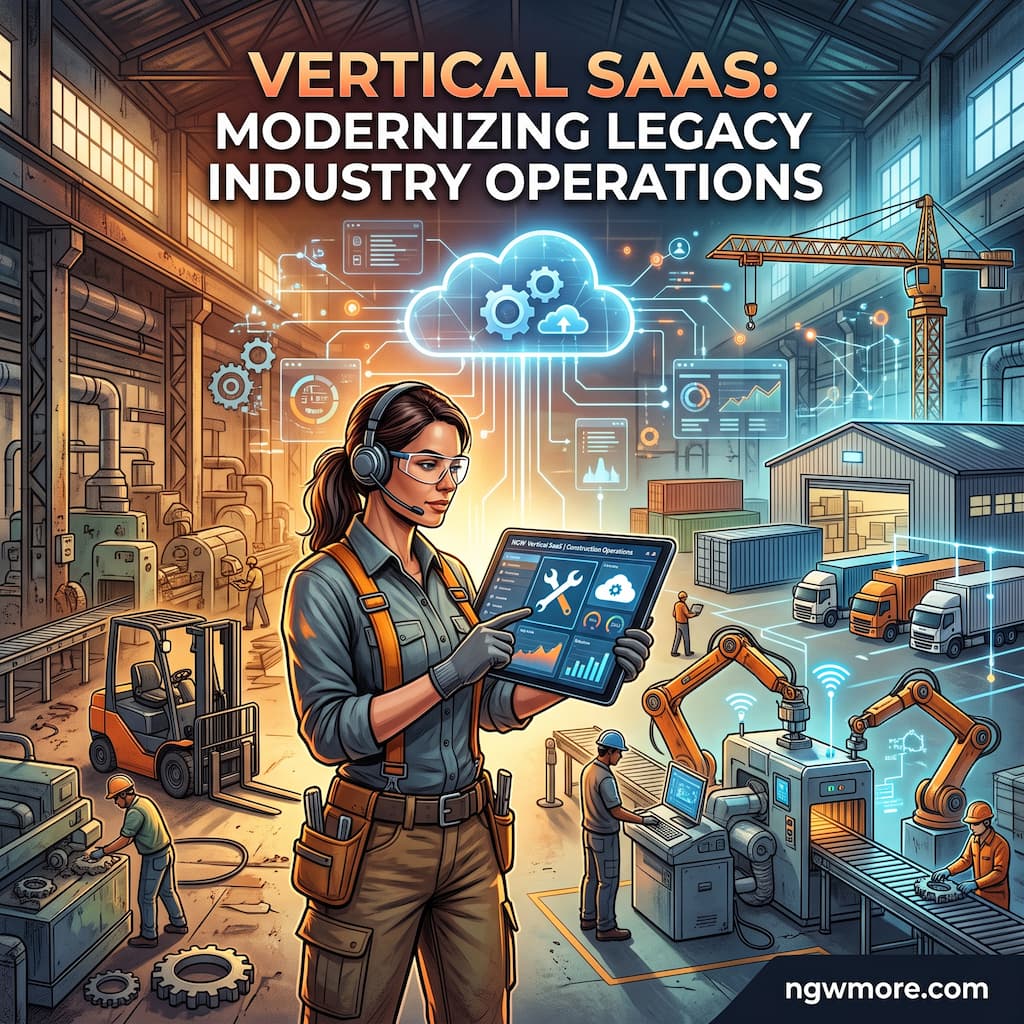
Vertical SaaS: Modernizing Legacy Industry Operations
For the first two decades of the cloud computing revolution, enterprise software expansion was driven by a single dominant playbook: Horizontal SaaS. Companies built generalized platforms designed to serve broad, functional categories across every industry imaginable. Platforms like Salesforce tackled customer relationship management, Workday centralized human resources, and QuickBooks automated basic bookkeeping. These software-as-a-service pioneers unlocked massive enterprise value by replacing on-premises servers with flexible, browser-accessible tools.
However, as horizontal platforms matured, an operational boundary became evident across traditional industries.
While horizontal platforms work well for generic administrative workflows, they fail to address the complex, highly regulated, and deeply idiosyncratic operations of specialized legacy sectors. A commercial roofing contractor, an independent dental practice, an interstate logistics fleet, a regional scrap metal recycling plant, and a marine shipyard operate on completely different business models.
For decades, these legacy sectors relied on fragmented collections of horizontal software, clunky spreadsheets, physical clipboards, and outdated on-premises systems.
To bridge this operational gap and lead the next wave of enterprise software value creation, specialized software architects are executing an industry-specific transformation: Vertical SaaS.
Vertical Software-as-a-Service platforms are purpose-built software suites designed from the ground up to serve the end-to-end operational workflows of a single, specific industry vertical. Rather than offering generic forms and surface-level dashboards, Vertical SaaS platforms integrate field dispatching, regulatory compliance, specialized inventory tracking, supply chain procurement, embedded financial services, and automated billing into a single, cohesive operating system.
This post analyzes the architectural mechanics of vertical software platforms, evaluates the power of embedded fintech and multi-product expansion, compares horizontal software against vertical operating systems, and examines the cloud server infrastructure required to host high-consequence business management platforms on ngwmore.com.
1. The Legacy Industry Barrier: Why Horizontal Software Stalls
To understand why legacy industry operators are abandoning horizontal software suites in favor of vertical solutions, one must examine the severe operational friction points inherent in generic platforms.
The Customization Deficit and Fragmented Tool Sprawl
Horizontal platforms are intentionally broad. To accommodate a bakery, a legal firm, and an industrial HVAC company simultaneously, horizontal software relies on generic data models.
When a specialized enterprise adopts a horizontal tool, it must spend tens of thousands of dollars on custom development, third-party consultants, and complex API connectors. Despite these investments, the resulting workflow remains disjointed, forcing staff to switch between multiple disconnected apps to complete daily operational tasks.
The “Paper and Clipboard” Legacy Reality
Because horizontal tools fail to address unique industry nuances (such as job costing for construction, compliance audits for commercial waste management, or complex patient charting for veterinarians), field workers frequently abandon software altogether.
Critical operational data remains locked in physical paper forms, SMS threads, whiteboards, and localized spreadsheets. This creates massive informational blind spots for business owners, leading to lost invoices, unbilled overtime, inventory leakage, and delayed project timelines.
Regulatory Compliance and Domain Nuance
Legacy industries operate under strict regulatory and operational mandates. An auto repair shop must track hazardous fluid disposal and integrate directly with parts catalog databases; an agricultural grower must comply with pesticide application logs and water district quotas.
Horizontal platforms cannot natively support these domain-specific regulatory frameworks without extensive manual intervention.
Vertical SaaS eliminates this friction by embedding domain-specific logic, regulatory compliance, and day-to-day operational realities directly into core platform features.
2. Architectural Pillars: The Anatomy of a Vertical Industry Operating System
Modern Vertical SaaS platforms do not function merely as simple administrative tools; they serve as the core operating system (System of Record) for an entire industry.
A comprehensive Vertical SaaS platform operates across four modular functional layers:
The Vertical SaaS Architecture Stack
- Layer 1: Core System of Record: Specialized data schemas, customer profiles, domain-specific job costing, and operational scheduling engines.
- Layer 2: Workflow Automation & Field Enablement: Mobile-first tools for field technicians, barcode scanning, automated dispatching, and route optimization.
- Layer 3: Embedded Financial Services (Fintech Layer): Integrated payment processing, automated invoicing, payroll, working capital lending, and insurance underwriting.
- Layer 4: Vertical B2B Marketplace & Supply Chain Integration: Direct procurement catalogs connecting end-users to wholesale suppliers, parts distributors, and equipment manufacturers.
1. The Core System of Record and Domain Data Schema
At the base of the platform sits a specialized data schema designed specifically for the target industry. In a vertical platform built for commercial construction (such as Procore) or beauty salons (such as Boulevard), every database table, entity relationship, and field reflects actual trade terminology and operational milestones.
This enables automated scheduling, job tracking, and resource allocation without requiring custom configuration.
2. Workflow Automation and Mobile Field Enablement
Legacy industries are defined by mobile field workers, job sites, and warehouse floors.
A successful Vertical SaaS platform delivers native mobile experiences that empower field staff to log hours, capture job-site photos, scan parts barcodes, generate digital estimates, and collect customer signatures on-site—syncing field telemetry directly to back-office accounting ledgers in real time.
3. The Embedded Fintech Multiplier
The modern Vertical SaaS business model extends far beyond recurring software subscriptions. By embedding financial services directly into core workflows, vertical platforms capture significant revenue from payment processing, digital payroll, corporate credit cards, automated accounts payable financing, and trade credit insurance.
Because the vertical platform maintains direct visibility into a business’s operational health, it can underwrite loans and process payments with lower fraud risk than traditional third-party banks.
3. Structural Optimization Ledger: Horizontal SaaS vs. Vertical Operating Systems
Evaluating the operational, economic, and retention metrics that separate generic horizontal platforms from industry-specific Vertical SaaS platforms illustrates why vertical software commands high customer retention and expanding net revenue metrics.
Industry Focus & Market Strategy
- Horizontal SaaS: Broad and generalist. Targets single functional departments (Sales, HR, Accounting) across all market sectors.
- Vertical SaaS: Narrow and deep. Serves the complete end-to-end operational requirements of a single target vertical.
Onboarding Time & Time-to-Value
- Horizontal SaaS: Long onboarding cycles. Requires custom configuration, developer consultants, and complex workflow restructuring.
- Vertical SaaS: Instant time-to-value. Out-of-the-box templates, terminology, and workflows designed natively for the target trade.
Revenue Model & Monetization Potential
- Horizontal SaaS: Primarily seat-based SaaS subscription fees ($/user/month). Revenue growth is tied strictly to customer headcount.
- Vertical SaaS: Multi-product monetization. Combines base subscription fees with embedded payment processing (take rates), lending interest, and B2B marketplace fees.
Customer Churn & Retention Dynamics
- Horizontal SaaS: Moderate to high churn risk. Vulnerable to budget cuts, software consolidation, and departmental turnover.
- Vertical SaaS: Extremely low churn (high switching costs). Becoming the mission-critical operating system embeds the software deeply into daily physical operations.
4. Transformative Vertical Deployments: Case Studies in Industry Modernization
Vertical SaaS platforms are modernizing traditional businesses across virtually every sector of the global economy:
Construction and Field Service Management (e.g., ServiceTitan, Procore)
Residential and commercial field services (HVAC, plumbing, electrical, roofing) historically struggled with dispatch inefficiencies, paper invoices, and slow customer payment cycles.
Vertical field service platforms provide dispatchers with real-time GPS fleet tracking, automate customer SMS notifications, generate dynamic on-site price books for technicians, and enable instant mobile credit card processing at the job site—slashing accounts receivable cycles from weeks to minutes.
Restaurant and Hospitality Management (e.g., Toast)
Restaurants operate on thin margins, high staff turnover, and fast-paced operational demands.
Vertical hospitality platforms integrate point-of-sale hardware, kitchen display systems, online ordering, tableside mobile payments, shift scheduling, inventory tracking, and payroll into a single unified dashboard—eliminating the need for separate point solutions and streamlining front-of-house and back-of-house coordination.
Automotive Repair and Fleet Maintenance (e.g., Shopmonkey, Tekmetric)
Independent auto repair shops require complex integrations with OEM parts supplier catalogs, labor guide rate estimators, and vehicle diagnostic registries.
Vertical automotive platforms allow service advisors to look up VIN histories instantly, order parts from local suppliers with a single click, send digital multi-point inspection videos to vehicle owners via text message, and automate digital repair order approvals.
Legal and Medical Practice Management (e.g., Clio, Kareo)
Professional service practices navigate strict regulatory frameworks, patient privacy mandates (HIPAA), and specialized trust accounting rules.
Vertical platforms automate patient intake, electronic health records (EHR), medical billing insurance claims submissions, and calendar scheduling—freeing practitioners to focus on client care rather than administrative overhead.
5. Systemic Operations: Cloud Infrastructure for High-Throughput Business Platforms
Deploying, monitoring, and scaling mission-critical Vertical SaaS platforms demands an underlying digital server infrastructure that prioritizes high availability, low latency, and zero-downtime execution. Vertical software suites handle continuous, high-consequence data streams—ranging from real-time point-of-sale payment authorization payloads and mobile field dispatch GPS pings to high-frequency accounting database updates and encrypted customer records.
If an enterprise vertical platform or multi-tenant hosting gateway experiences database configuration drift, network latency, or server downtime during peak business hours (such as a busy Friday dinner rush for restaurants or a storm surge for roofing contractors), the consequences are immediate. Point-of-sale terminals freeze, technicians cannot access job details, invoices fail to process, and customer businesses grind to a halt.
To eliminate this operational friction, progressive software engineering teams and digital platform developers deploy highly optimized, zero-downtime server architectures.
These infrastructure layers continuously monitor active API endpoints, encrypted payment gateway write paths, and high-throughput transactional database clusters, ensuring processing response times stay locked within sub-millisecond thresholds regardless of concurrent traffic volume.
Maintaining an unassailable infrastructure perimeter is vital to eliminate bandwidth bottlenecks, protect sensitive financial records, and preserve platform trust, driving peak structural execution across enterprise portals and hosting domains like ngwmore.com.
6. Growth Playbook: The Vertical SaaS Expansion Journey
Building a dominant Vertical SaaS platform follows a proven, multi-stage expansion playbook:
- Stage 1: Win the Core Workflow: Identify the single most painful administrative bottleneck in the industry (e.g., scheduling, dispatching, or estimating) and build a tool that solves it 10x better than spreadsheets.
- Stage 2: Expand into the System of Record: Deepen platform functionality to handle end-to-end operational workflows, becoming the indispensable database that holds all customer, employee, and job history.
- Stage 3: Embed Financial Services: Integrate native payment processing, payroll engines, automated invoice financing, and insurance products to capture a percentage of total Gross Payment Volume (GPV).
- Stage 4: Launch B2B Marketplaces & Supply Chain Portals: Connect platform customers directly to wholesale distributors, materials suppliers, and subcontractors, capturing marketplace transaction fees across the broader industry supply chain.
Read More⚡ Account Abstraction: Simplifying Crypto Onboarding
Conclusion: The Era of Industry-Specific Cloud Software
Vertical SaaS is not a minor niche within the broader technology sector; it represents the primary engine modernizing legacy global commerce. The historical approach of forcing traditional trade businesses to adapt their complex operations to generic horizontal tools is an obsolete practice that is being permanently replaced by purpose-built industry operating systems.
The future of enterprise software belongs entirely to the visionary software developers, domain experts, and data-driven platform networks that master the orchestration of Vertical SaaS architectures today.
By combining domain-specific workflows, embedded fintech layers, mobile field enablement, and zero-downtime cloud infrastructure perimeters, the international technology community is building an unassailable foundation for global industrial efficiency.
As traditional legacy sectors continue to digitize operations, purpose-built cloud operating systems will become standard infrastructure across every trade and profession—permanently establishing Vertical SaaS as the essential engine driving modern business operations forward.
Hosting computationally intensive business application engines, processing real-time transactional data streams, validating cloud-scale automation pipelines, and managing ultra-secure global server frameworks requires world-class, zero-downtime infrastructure. Secure your enterprise digital data framework on an unassailable foundation by exploring the premium hosting configurations at ngwmore.com.