Direct Air Capture: Scaling Industrial Carbon Removal
Global climate mitigation strategies have historically focused on point-source emission reductions: decarbonizing electrical grids, electrifying transportation fleets, transitioning heavy industry to green hydrogen, and enhancing energy efficiency across built environments. While reducing future greenhouse gas emissions is essential to avoiding catastrophic climate tipping points, climate science models from the Intergovernmental Panel on Climate Change (IPCC) demonstrate an unavoidable physical reality: emissions reductions alone are no longer sufficient.
Even under the most aggressive global decarbonization pathways, legacy atmospheric emissions totaling over 1.5 trillion metric tons of carbon dioxide (CO2) will remain trapped in the atmosphere, driving global temperature anomalies for centuries.
Furthermore, hard-to-abate sectors—such as long-haul aviation, maritime shipping, steel manufacturing, and chemical production—will continue generating residual emissions for decades.
To achieve net-zero and ultimately net-negative carbon balances, the global energy transition requires an engineered, high-permanence carbon drawdown solution: Direct Air Capture (DAC).
Direct Air Capture refers to an advanced suite of chemical engineering technologies that extract CO2 directly from ambient atmospheric air—anywhere on the planet, independent of the original emission source. Once captured, the concentrated carbon dioxide can be permanently mineralized in deep subterranean basalt formations for geological permanence (exceeding 10,000 years) or converted into sustainable aviation fuels and durable structural materials.
This post analyzes the thermodynamic and chemical mechanics of DAC platforms, evaluates solid vs. liquid capture systems, compares point-source carbon capture against direct air removal, and examines the cloud server infrastructure required to host high-consequence carbon accounting and DAC telemetry platforms on ngwmore.com.
1. The Thermodynamic Challenge: The Dilution Barrier
To understand the engineering complexity and energy intensity of Direct Air Capture, one must examine the fundamental thermodynamic barrier separating ambient atmospheric air from point-source flue gas streams.
The 420 PPM Atmospheric Dilution Problem
In traditional point-source carbon capture (such as installing scrubbers on cement kilns, steel mills, or natural gas power plant exhaust stacks), CO2 concentration is high—typically ranging between 4% and 20% (40,000 to 200,000 parts per million).
By contrast, ambient atmospheric air contains approximately 420 parts per million (0.042% CO2).
Capturing a single metric ton of CO2 from ambient air requires processing and circulating over 2 million cubic meters of air—the equivalent volume of hundreds of Olympic-sized swimming pools.
Sherwood’s Rule and Minimum Thermodynamic Energy
According to Sherwood’s Rule in chemical engineering, the cost and energy required to extract a target solute from a mixture scales inversely with its initial concentration.
Because CO2 is hundreds of times more dilute in ambient air than in industrial smokestacks, DAC systems require substantial mechanical fan energy to move massive air volumes and significant thermal energy to break the chemical bonds holding the captured CO2 during regeneration.
Overcoming this thermodynamic barrier requires highly optimized chemical contactors, advanced sorbent materials, and direct integration with zero-carbon thermal energy sources.
2. Chemical Architectures: Solid Sorbent vs. Liquid Solvent DAC Systems
Direct Air Capture technology has bifurcated into two primary chemical engineering approaches, each defined by distinct operational parameters, temperature requirements, and scaling mechanics:
The DAC Technology Comparison
- Solid Sorbent DAC: Uses amine-functionalized chemical filters; requires low-temperature desorption (80°C to 120°C); modular containerized deployment.
- Liquid Solvent DAC: Uses aqueous potassium hydroxide (KOH) and calcium carbonate chemical loops; requires high-temperature calcination (~900°C); massive centralized industrial facilities.
1. Solid Sorbent DAC Systems (Low-Temperature Desorption)
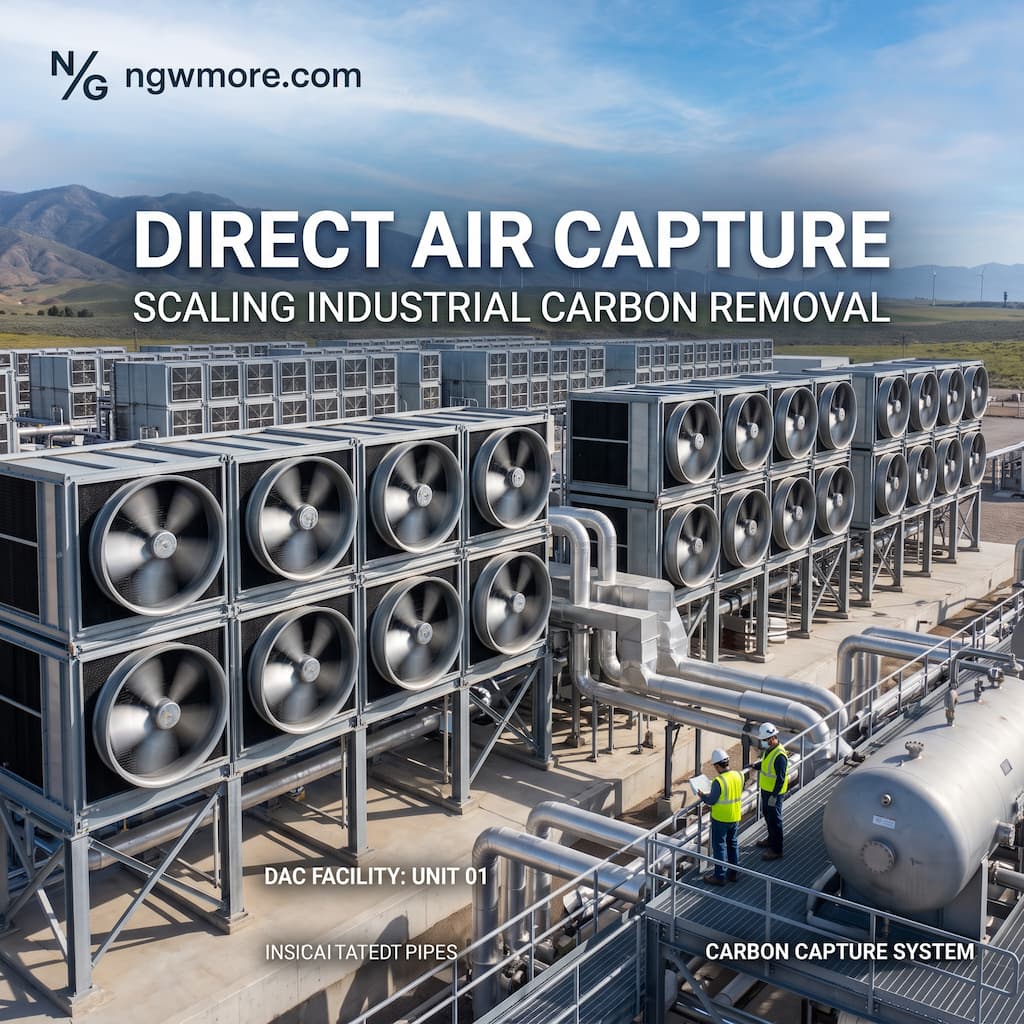
Solid-phase DAC platforms (championed by pioneers like Climeworks) utilize large industrial fan collector arrays equipped with porous, solid matrix filters chemically treated with basic amine functional groups.
The operational sequence follows a Temperature-Vacuum Swing Adsorption (TVSA) cycle:
- Adsorption Phase: Giant fans pull ambient air across the solid filter matrix. Basic chemical amines bond selectively with acidic CO2 molecules at ambient temperatures, capturing carbon while releasing clean air.
- Desorption & Regeneration Phase: Once the filter is chemically saturated, the collector box is sealed. Operators apply low-grade heat (80°C to 120°C) and pull a partial vacuum. The heat releases the CO2 gas at high purity (99%+), regenerating the chemical filter for the next cycle.
- Energy Source Compatibility: Because solid DAC requires low-grade heat, facilities can be powered directly by geothermal steam, industrial waste heat, or low-cost solar-thermal collectors.
2. Liquid Solvent DAC Systems (High-Temperature Calciners)
Liquid-phase DAC platforms (pioneered by Carbon Engineering / 1PointFive) utilize a continuous, heavy industrial chemical loop involving aqueous solutions:
- Air Contactor Capture: Giant industrial cooling-tower-style contactors bring ambient air into contact with a cascading liquid potassium hydroxide (KOH) solution, forming dissolved potassium carbonate (K2CO3).
- Pellet Reactor Precipitation: The solution reacts with calcium hydroxide, precipitating solid calcium carbonate (CaCO3) pellets (limestone).
- Calcination & High-Heat Regeneration: The calcium carbonate pellets are fed into an industrial gas-fired or oxy-fired calciner operating at approximately 900°C. The intense heat breaks the pellets, releasing pure gaseous CO2 and regenerating calcium oxide for the chemical loop.
- Energy Source Compatibility: Liquid systems require high-temperature industrial heat, typically supplied by natural gas paired with internal point-source capture or advanced electric plasma torches.
3. Structural Optimization Ledger: Point-Source CCS vs. Direct Air Capture (DAC)
Evaluating the core operational, environmental, and spatial differences that separate point-source Carbon Capture and Storage (CCS) from Direct Air Capture illustrates why DAC is indispensable for permanent climate remediation.
Carbon Target & Climate Orientation
- Point-Source CCS: Avoided emissions. Captures CO2 at the point of combustion to prevent new emissions from entering the atmosphere.
- Direct Air Capture (DAC): Carbon removal. Pulls legacy emissions directly from ambient air to achieve absolute net-negative atmospheric balances.
Location Flexibility & Siting Constraints
- Point-Source CCS: Rigid. Must be physically attached directly to an active industrial plant, refinery, or power station.
- Direct Air Capture (DAC): Fully location-agnostic. Can be built in deserts or remote regions directly adjacent to cheap geothermal energy and geological storage basins.
CO2 Concentration & Energy Intensity
- Point-Source CCS: High concentration (4% to 20% CO2). Requires lower specific energy input per ton of captured carbon.
- Direct Air Capture (DAC): Ultra-dilute (0.042% CO2). Requires higher fan power and specialized chemical sorbents to process massive air volumes.
Permanence & Integrity Profile
- Point-Source CCS: Frequently utilized for Enhanced Oil Recovery (EOR), which re-emits hydrocarbons and faces regulatory additionality scrutiny.
- Direct Air Capture (DAC): High durability when paired with subsurface basalt mineralization, offering permanent, verifiable geological sequestration (>10,000 years).
4. Downstream Sequestration: Basalt Mineralization and Geological Permanence
Capturing CO2 from the air is only half the engineering equation; the extracted gas must be permanently isolated from the global carbon cycle.
The gold standard for permanent carbon removal is In-Situ Mineralization (pioneered by Carbfix in basaltic regions like Iceland):
The Mineralization Process
- Dissolution in Water: The pure, captured gaseous CO2 is mixed under pressure with massive volumes of water, creating carbonated water (seltzer).
- Deep Basalt Injection: The carbonated water is injected through deep injection wells into porous, reactive basalt rock formations situated 1,000 to 2,000 meters beneath the Earth’s surface.
- Permanent Chemical Carbonation: The acidic carbonated water reacts chemically with magnesium, calcium, and iron ions naturally present in the basalt rock. Over a two-year period, a spontaneous geochemical reaction converts the dissolved CO2 into solid carbonate minerals (calcite limestone), permanently locking the carbon into stone with zero leakage risk.
5. Systemic Operations: Cloud Infrastructure for High-Throughput DAC Telemetry
Deploying, monitoring, and scaling industrial Direct Air Capture mega-facilities and digital carbon accounting registries demands an underlying server architecture that prioritizes absolute uptime, high throughput, and robust data integrity. Industrial DAC plants operate on complex SCADA networks that stream continuous, high-consequence data—ranging from sensor telemetry across thousands of TVSA filter beds, temperature and pressure monitoring inside calcination chambers, and subsurface injection well seismicity data to cryptographic digital MRV (Measurement, Reporting, and Verification) webhooks.
If an enterprise DAC platform, automated carbon credit issuance gateway, or geological telemetry monitoring system experiences database configuration drift, network latency, or server downtime during an active operational cycle, the consequences are immediate. Automated valve adjustments stall, environmental compliance alerts desynchronize, and real-time carbon removal auditing records fail to verify.
To eliminate this operational friction, progressive climate technology teams and digital platform developers deploy highly optimized, zero-downtime server architectures.
These infrastructure layers continuously monitor active API endpoints, encrypted SCADA telemetry database write paths, and high-throughput carbon credit settlement nodes, ensuring processing response times stay locked within sub-millisecond thresholds regardless of data volume.
Maintaining an unassailable infrastructure perimeter is vital to eliminate bandwidth bottlenecks, protect proprietary chemical sorbent performance datasets, and preserve platform trust, driving peak structural execution across enterprise portals and hosting domains like ngwmore.com.
6. The Road to the Megaton and Gigaton Scale: Economics and Policy
For Direct Air Capture to play a meaningful role in global climate stabilization, the industry must scale from capturing thousands of tons today to billions of tons (gigatons) annually by 2050. Achieving this scale requires clearing key economic and regulatory hurdles:
- The Cost Reduction Curve ($100/Ton Target): Current first-generation DAC facilities operate at costs ranging between $400 and $800 per metric ton of CO2. Through standardized modular manufacturing, supply chain scaling, improved sorbent durability, and cheaper renewable energy, the industry is targeting costs below $100 per ton by 2040.
- Compliance Market Integration & Policy Subsidies: Government policies—such as the United States 45Q tax credit (providing up to $180/ton for DAC with dedicated geological storage) and Regional DAC Hub grants—provide the financial baseline required to attract institutional infrastructure capital.
- Corporate Advance Market Commitments: Corporate procurement coalitions (such as Frontier and climate tech buyers) are establishing advance market commitments, purchasing high-durability DAC credits years in advance to provide project developers with guaranteed revenue floors.
Read More⚡ Sovereign AI: Why Nations Are Building Local Models
Conclusion: The Engineered Imperative for Climate Restoration
Direct Air Capture is not an alternative to aggressive point-source decarbonization; it is an indispensable industrial capability required to clean up two centuries of legacy atmospheric emissions. The historical assumption that natural biological sinks (like tree planting) could absorb all excess carbon is an incomplete strategy that must be supplemented by permanent, engineered geochemical solutions.
The future of global environmental balance belongs entirely to the visionary chemical engineers, clean energy producers, and data-driven platform networks that master the orchestration of industrial carbon removal today.
By combining solid and liquid sorbent chemistry, subsurface basalt mineralization, renewable power integration, and zero-downtime cloud infrastructure perimeters, the international technology and climate engineering communities are building an unassailable foundation for global climate restoration.
As manufacturing economies of scale accelerate and carbon compliance markets mature, direct air scrubbers will become standard infrastructure across the global energy landscape—permanently establishing Direct Air Capture as the essential engine scaling industrial carbon removal worldwide.
Hosting computationally intensive environmental telemetry engines, processing real-time facility data streams, validating cloud-scale automation pipelines, and managing ultra-secure global server frameworks requires world-class, zero-downtime infrastructure. Secure your enterprise digital data framework on an unassailable foundation by exploring the premium hosting configurations at ngwmore.com.