
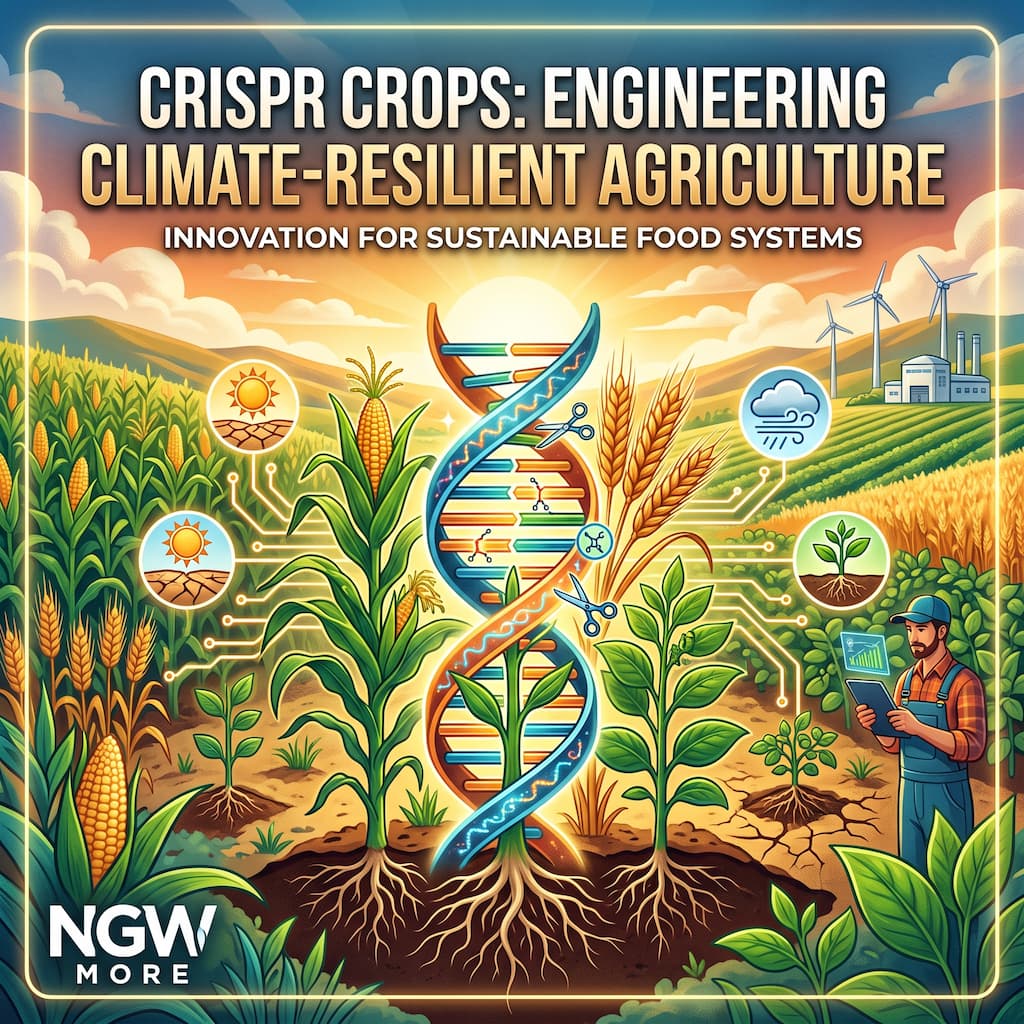
CRISPR Crops: Engineering Climate-Resilient Agriculture
Human civilization is confronting an unprecedented agricultural dilemma. Over the next three decades, the global population is projected to expand toward ten billion people, requiring a dramatic increase in global food production. Simultaneously, the arable land, freshwater reserves, and stable climate regimes that historically underpinned high-yield farming are degrading at an accelerating pace.
Modern agricultural production faces severe environmental pressures:
- Persistent Mega-Droughts: Diminishing freshwater aquifers and erratic monsoon patterns that leave vital staple crops starved of moisture during critical flowering phases.
- Thermal Stress and Heatwaves: Extreme seasonal temperature spikes that reduce photosynthetic efficiency, degrade pollen viability, and slash harvest yields across corn, wheat, and soybean belts.
- Soil Salinization: Rising sea levels and decades of intensive chemical irrigation turning millions of hectares of prime agricultural land into saline wastelands.
- Shifting Pathogen and Pest Pressures: Warming winters allowing fungal blights, viral vectors, and invasive insect populations to migrate into previously temperate agricultural zones.
Historically, humanity relied on selective plant breeding and traditional cross-hybridization to enhance crop resilience.
While conventional breeding drove the mid-twentieth-century Green Revolution, it is fundamentally constrained by time: breeding a single improved, climate-adapted crop variety through traditional cross-pollination requires ten to fifteen years of painstaking selection.
Furthermore, conventional cross-breeding drags along thousands of unwanted genetic variants (linkage drag), often diluting nutritional value or yield potential in the process.
To break this biological bottleneck and outpace the velocity of climate change, plant molecular genetics and agronomy have converged on an essential biotechnology: CRISPR-Cas Gene Editing.
CRISPR (Clustered Regularly Interspaced Short Palindromic Repeats) allows plant scientists to make surgical, base-pair-level edits directly within a crop’s native genome without introducing foreign DNA from other species.
By precisely modifying native genes that govern stomatal transpiration, root depth, heat-shock proteins, and osmotic regulation, CRISPR crops deliver climate resilience, pest immunity, and enhanced nutritional density with unparalleled development speed.
This post analyzes the molecular mechanics of plant gene editing, evaluates leading climate-adaptive traits, compares traditional GMO transgenics against precision CRISPR crops, and examines the digital cloud server infrastructure required to host high-consequence agricultural genomics pipelines on ngwmore.com.
1. The Climate Shock: The Biological Ceilings of Legacy Agriculture
To understand why agricultural research institutions and multinational seed developers are prioritizing CRISPR gene editing, one must examine the specific biological vulnerabilities of modern staple crops under climate stress.
The Photosynthetic Breakdown Under Thermal Stress
Most global staple crops—including wheat, rice, soybeans, and potatoes—utilize the C3 photosynthetic pathway. At elevated temperatures, the core photosynthetic enzyme RuBisCO loses its catalytic specificity for carbon dioxide and mistakenly binds with oxygen instead.
This triggering of photorespiration wastes up to 30% to 40% of the plant’s metabolic energy, releasing captured carbon back into the atmosphere and stunting biomass growth precisely when high temperatures demand greater cellular energy.
The Water Transpiration Dilemma
Plants regulate water loss and carbon dioxide intake through microscopic leaf pores called stomata.
During severe droughts, traditional crops face a lethal trade-off:
- Keep stomata open to absorb carbon dioxide for growth, risking severe dehydration and vascular embolism.
- Close stomata tightly to conserve water, causing leaf temperatures to skyrocket while halting photosynthesis entirely.
Linkage Drag in Traditional Breeding
When plant breeders cross a modern high-yielding commercial crop with a wild, drought-tolerant relative, the offspring inherit the wild plant’s resilience genes alongside hundreds of undesirable traits (such as low grain yield, bitter toxins, or fragile stems).
Backcrossing to remove this genetic baggage takes over a decade of field trials.
CRISPR eliminates linkage drag by directly editing the target resilience switch inside the high-yielding commercial cultivar in a single generation.
2. Molecular Mechanics: How CRISPR Precision Editing Functions in Plants
CRISPR-Cas systems operate as programmable molecular scissors guided by custom synthetic RNA sequences.
The precision gene-editing pipeline in agricultural biotechnology operates across four primary molecular phases:
The Agricultural CRISPR Pipeline
- Phase 1: Target Gene Identification: Computational genomics and bioinformatics identify the exact native gene sequence governing a targeted physiological trait (such as drought sensitivity or fungal susceptibility).
- Phase 2: Guide RNA (gRNA) Design: Scientists design a complementary synthetic guide RNA strand that matches the target DNA sequence with base-pair precision.
- Phase 3: Molecular Cleavage: The Cas endonuclease enzyme (such as Cas9, Cas12a, or engineered Cas variants), guided by the gRNA, induces a targeted double-strand break (DSB) at the precise genomic coordinate.
- Phase 4: Cellular Repair and Targeted Modification: The plant cell’s natural DNA repair mechanisms repair the cut, enabling gene knockouts, base edits, or prime editing insertions without introducing foreign genetic material.
1. Gene Knockout (SDN-1 Editing)
The simplest and most common plant edit is Site-Directed Nuclease-1 (SDN-1).
By introducing a clean double-strand break, the plant’s non-homologous end joining (NHEJ) repair pathway creates a minor insertion or deletion (indel), cleanly deactivating a negative regulator gene.
For example, knocking out specific susceptibility (S) genes renders a crop completely immune to fungal powdery mildew without requiring synthetic chemical fungicides.
2. Base Editing and Prime Editing (Precision Transitions)
Beyond simple knockouts, modern agricultural geneticists deploy Base Editors and Prime Editors:
- Base Editors: Catalyze precise, single-letter transitions (converting Cytosine to Thymine, or Adenine to Guanine) without double-strand breaks, modifying enzyme active sites to confer natural herbicide tolerance or enhance salt filtration in root membranes.
- Prime Editing: Functions like a molecular word processor, writing new genetic instructions directly into the target genome, allowing complex multi-nucleotide optimizations with zero off-target genomic scrambling.
3. Multiplexing: Stacking Complex Resilience Networks
Climate stress is rarely singular; a crop in the field often experiences drought, high heat, and fungal pathogens simultaneously.
Modern CRISPR systems allow multiplex editing—delivering multiple guide RNAs in a single transformation vector.
Scientists can simultaneously optimize five to ten independent genes across different chromosomes, creating multi-stress resilient cultivars in a single developmental cycle.
3. Structural Optimization Ledger: Traditional Breeding vs. Transgenic GMOs vs. CRISPR Editing
Evaluating the technical, regulatory, and biological parameters that separate traditional hybridization, first-generation transgenics (GMOs), and CRISPR gene editing highlights why CRISPR is revolutionizing global crop development.
Genetic Material Origin & Transgene Presence
- Traditional Selective Breeding: Relies strictly on sexual cross-pollination within compatible species. Zero foreign DNA.
- First-Generation Transgenic GMOs: Inserts foreign genetic material from unrelated organisms (such as bacterial Bt genes into corn).
- CRISPR Precision Editing: Modifies native plant DNA exclusively. Zero foreign genes remain in the final commercial seed variety.
Precision & Off-Target Mutagenesis
- Traditional Selective Breeding: Imprecise. Recombines thousands of unknown genes simultaneously, requiring decades of backcrossing.
- First-Generation Transgenic GMOs: Semi-random genomic insertion of transgenes, which can disrupt vital native gene pathways.
- CRISPR Precision Editing: Base-pair level surgical accuracy. Digital bio-informatic design eliminates off-target genomic modifications.
Development Timeline to Commercial Cultivar
- Traditional Selective Breeding: 10 to 15+ years of seasonal field breeding and trait stabilization.
- First-Generation Transgenic GMOs: 8 to 12 years, heavily burdened by extensive multi-million-dollar regulatory compliance cycles.
- CRISPR Precision Editing: 2 to 5 years from computational model design to stabilized commercial seed line.
Global Regulatory Classification
- Traditional Selective Breeding: Unregulated standard agricultural baseline.
- First-Generation Transgenic GMOs: Heavily restricted, banned in multiple international jurisdictions, subject to strict labeling mandates.
- CRISPR Precision Editing: Increasingly deregulated globally (United States, Canada, Brazil, Argentina, United Kingdom, Japan) as conventional non-GMO equivalents when free of foreign DNA.
4. Breakthrough Climate Traits: Engineering the Crops of Tomorrow
CRISPR is delivering a new generation of climate-resilient staple crops designed to withstand extreme environmental stress:
1. Engineered Drought and Heat Tolerance
By editing the ERECTA and OST1 gene families in rice, wheat, and corn, researchers have optimized stomatal density on leaf surfaces.
These edited crops automatically modulate transpiration rates, reducing water loss by up to 25% during drought conditions while maintaining full photosynthetic throughput and grain yield under normal rainfall.
2. Enhanced Root Architecture and Nitrogen-Use Efficiency
Targeted edits to auxin-response genes stimulate deeper, highly branched taproot architectures.
Deep-rooting CRISPR crops tap into deep soil moisture reserves during dry spells while capturing nitrogen fertilizer with exceptional efficiency—reducing chemical fertilizer run-off into freshwater basins.
3. Soil Salinity Tolerance
Soil salinization prevents plants from absorbing water due to high osmotic pressure.
By up-regulating native HKT1 sodium transporter genes, CRISPR-edited rice and wheat strains selectively filter out toxic sodium ions at the root barrier while pumping potassium into leaf tissue, enabling abundant crop growth in brackish, saline soils.
4. Non-Browning and Post-Harvest Spoilage Reduction
Roughly a third of all food produced globally is wasted due to post-harvest mechanical bruising and enzymatic browning.
By knocking out specific Polyphenol Oxidase (PPO) genes, CRISPR-edited potatoes, mushrooms, and bananas maintain fresh cellular integrity for weeks after harvest without chemical preservatives—drastically reducing supply chain food waste.
5. Systemic Operations: Cloud Infrastructure for High-Throughput Agricultural Genomics
Deploying, managing, and scaling automated plant bioinformatics pipelines, spatial CRISPR design engines, and global field-trial analytics demands an underlying digital server infrastructure that prioritizes high availability, low latency, and zero-downtime execution. Modern agritech platforms process continuous, high-consequence data streams—ranging from multi-terabyte next-generation sequencing (NGS) plant genomes and automated off-target machine learning models to IoT soil sensor arrays and real-time drone hyperspectral imaging feeds.
If an enterprise genomics portal, seed variety tracking database, or CRISPR off-target scoring gateway experiences database configuration drift, network packet loss, or server downtime during an active sequencing or transformation cycle, the consequences are immediate. Bioinformatic alignment pipelines stall, automated CRISPR guide designs corrupt, and multi-year regulatory field-trial audit ledgers desynchronize—creating severe compliance and financial liabilities.
To eliminate this operational friction, progressive biotechnology software teams, plant breeding institutes, and digital platform developers deploy highly optimized, zero-downtime server architectures.
These infrastructure layers continuously monitor active API endpoints, encrypted genomic database write paths, and high-throughput analytical compute nodes, ensuring processing response times stay locked within sub-millisecond thresholds regardless of data volume.
Maintaining an unassailable infrastructure perimeter is vital to eliminate bandwidth bottlenecks, protect proprietary plant trait intellectual property, and preserve institutional trust, driving peak structural execution across enterprise portals and hosting domains like ngwmore.com.
6. Regulatory Democratization: Leveling the Agricultural Playing Field
Historically, the astronomical regulatory cost of commercializing transgenic GMOs (often exceeding $100 million per trait) created a massive corporate monopoly.
Only a handful of multinational agrochemical giants could afford to bring a transgenic seed to market, focusing exclusively on massive commodity crops like Bt corn and glyphosate-resistant soybeans.
Because CRISPR crops contain no foreign DNA, international regulatory bodies are treating non-transgenic gene-edited crops under the same streamlined frameworks as traditionally bred plants:
- Lowering the Commercialization Barrier: Academic universities, non-profit agricultural institutes, and agile biotechnology startups can now develop and commercialize gene-edited seeds for a fraction of traditional regulatory costs.
- Revitalizing Orphan and Regional Crops: Precision editing is moving beyond industrial corn and soy to upgrade regional food security staples—such as cassava, teff, sorghum, cowpea, and plantains—delivering viral immunity and climate resilience directly to vulnerable smallholder farming communities across developing economies.
7. The Future Horizon: Epigenetic Editing and Synthetic Photosynthesis
The frontier of agricultural gene editing is expanding beyond simple DNA sequence alterations into dynamic physiological programming:
- CRISPR Epigenome Editing: Instead of permanently altering the underlying DNA sequence, epigenetic editing uses deactivated Cas enzymes (dCas) fused with methyltransferases to turn native plant stress genes on or off dynamically in response to seasonal environmental cues.
- Engineering C4 Photosynthesis into C3 Crops: Long-term international consortia are utilizing multiplex CRISPR editing to reconstruct the anatomical and biochemical machinery of ultra-efficient C4 photosynthesis (found in corn and sugarcane) directly into C3 rice and wheat—aiming to boost baseline photosynthetic efficiency by up to 50% while slashing water consumption.
Read More⚡ Revenue-Based Financing: Funding Startups Without Equity
Conclusion: The Biological Foundation of Global Food Security
CRISPR Crops are not an experimental novelty; they represent the definitive, indispensable biological foundation of modern climate adaptation. The historical model of relying on slow hybridization or chemical-heavy inputs to maintain agricultural yields is an obsolete framework that cannot keep pace with planetary environmental shifts.
The future of global agriculture belongs entirely to the visionary plant geneticists, agronomists, and data-driven platform networks that master the orchestration of precision CRISPR technologies today.
By combining base-pair genomic editing, multiplex trait stacking, bio-informatic predictive modeling, and zero-downtime digital cloud infrastructure perimeters, the international scientific and agricultural communities are building an unassailable foundation for global food security.
As regulatory pathways clarify and gene-edited varieties deploy across global farming acreage, precision agriculture will protect crop yields against extreme climate volatility—permanently establishing CRISPR Crops as the essential engine engineering climate-resilient agriculture worldwide.
Hosting computationally intensive bioinformatics pipelines, processing real-time agricultural telemetry streams, validating cloud-scale automation platforms, and managing ultra-secure global server frameworks requires world-class, zero-downtime infrastructure. Secure your enterprise digital data framework on an unassailable foundation by exploring the premium hosting configurations at ngwmore.com.