
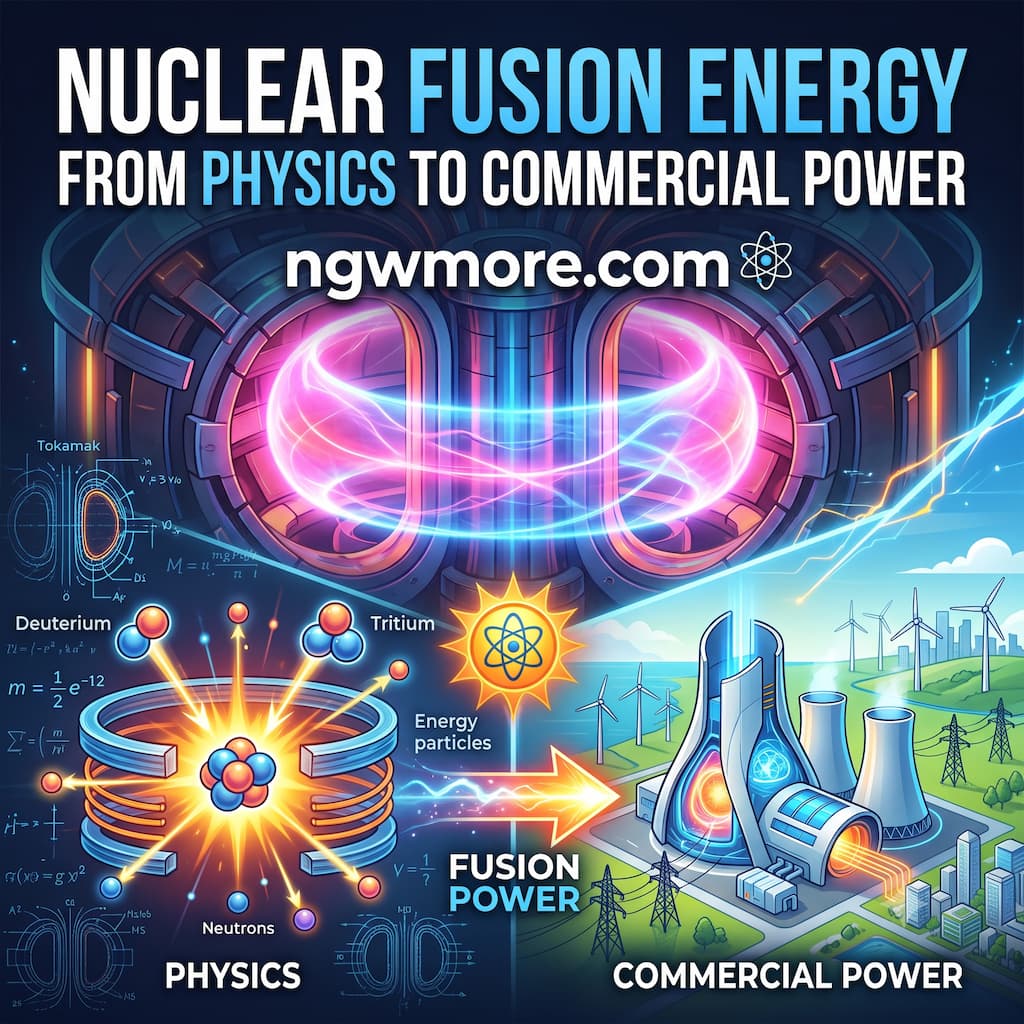
Nuclear Fusion Energy: From Physics to Commercial Power
For nearly a century, humanity’s pursuit of clean, virtually unlimited energy has looked toward the fundamental force that powers the sun and stars: nuclear fusion. Unlike traditional nuclear fission—which splits heavy, unstable atomic nuclei like uranium to release energy, generating long-lived radioactive waste—fusion merges light atomic nuclei to form heavier ones, releasing immense amounts of energy in the process without long-lived high-level nuclear waste, greenhouse gas emissions, or risks of catastrophic meltdown.
Yet, translating the physics of stellar cores into terrestrial engineering has represented one of the most complex scientific endeavors in human history.
To force positively charged atomic nuclei to overcome their powerful electrostatic repulsion (the Coulomb barrier) and fuse together, terrestrial reactors must heat hydrogen isotopes to temperatures exceeding 100 million degrees Celsius—far hotter than the core of the sun. At these extreme temperatures, matter transitions into a superheated state known as plasma.
Driven by breakthroughs in high-temperature superconducting (HTS) magnets, advanced plasma physics modeling, laser target fabrication, and artificial intelligence control systems, nuclear fusion is undergoing a monumental transition.
What was once viewed as an perpetual thirty-years-away physics experiment has rapidly evolved into a high-density commercial engineering sector.
This post analyzes the physics of stellar energy, compares magnetic and inertial confinement architectures, evaluates the private capital boom driving fusion startups, and examines the cloud infrastructure required to host high-consequence energy telemetry data streams on ngwmore.com.
1. The Physics of Stellar Energy: Mastering Lawson’s Criterion
To evaluate how fusion reactors generate net positive energy, one must examine the fundamental physical principles governing plasma physics and thermonuclear reactions.
The most viable reaction for near-term terrestrial fusion relies on two heavy isotopes of hydrogen: Deuterium (D) and Tritium (T).
When a Deuterium nucleus (containing one proton and one neutron) fuses with a Tritium nucleus (containing one proton and two neutrons) at extreme thermal energies, it produces a Helium-4 nucleus (an alpha particle), a high-energy free neutron, and releases 17.6 megaelectronvolts (MeV) of kinetic energy:
D + T → ⁴He (3.5 MeV) + n (14.1 MeV)
The Physics of Lawson’s Criterion
For a fusion reactor to achieve net energy output—where the energy produced by fusion reactions exceeds the external energy required to heat and contain the plasma—the system must satisfy Lawson’s Criterion.
This foundational physics formulation dictates that the product of three critical variables must exceed a specific minimum threshold:
Triple Product = Plasma Density (n) × Temperature (T) × Energy Confinement Time (τ_E)
- Plasma Temperature (T): The plasma must reach optimal thermal energy levels (100 to 150 million °C) to maximize the cross-section probability of D-T nuclear collisions.
- Plasma Density (n): The concentration of fuel ions contained within the reactor volume must remain sufficiently dense to ensure frequent atomic collisions.
- Energy Confinement Time (τ_E): The duration for which the superheated plasma retains its thermal energy without leaking heat to the cold reactor walls.
Achieving net energy gain (Q > 1, where Q represents the ratio of fusion power output to heating power input) requires engineering systems that can sustain this delicate balance without encountering disruptive plasma instabilities.
2. Confinement Architectures: Magnetic, Inertial, and Magneto-Inertial Systems
The primary technological divide in commercial fusion energy centers on how reactors physically contain superheated plasma at extreme temperatures without allowing it to touch physical container walls.
Commercial fusion companies are scaling three primary confinement architectures:
Magnetic Confinement Fusion (MCF: Tokamaks and Stellarators)
Magnetic confinement systems utilize powerful magnetic fields to trap, shape, and isolate charged plasma ions inside a toroidal (donut-shaped) vacuum chamber.
- Tokamaks: Tokamaks utilize external magnetic coils combined with a strong internal electrical current driven through the plasma itself to generate a helical magnetic field. While Tokamaks represent the most scientifically mature confinement concept, driving internal plasma currents can trigger sudden magnetohydrodynamic instabilities (disruptions) that destabilize the plasma.
- Stellarators: Stellarators replace internal plasma currents with extraordinarily complex, computer-designed 3D external magnetic coils. By generating a fully twisted magnetic field without driving internal currents, Stellarators achieve steady-state, highly stable plasma operation, eliminating violent disruption risks at the cost of complex geometric manufacturing.
Inertial Confinement Fusion (ICF: Laser-Driven Fusion)
Inertial confinement takes the opposite engineering approach: rather than containing low-density plasma for long durations, ICF compresses tiny fuel pellets to extreme densities and temperatures almost instantaneously using powerful lasers or particle beams.
- Mechanics: Dozens or hundreds of high-energy laser beams focus simultaneously onto a millimeter-sized target capsule containing cryogenic Deuterium-Tritium fuel. The sudden ablation of the outer capsule shell drives a rapid inward implosion, compressing the core fuel to over 100 times the density of lead and triggering self-sustaining thermonuclear ignition before the capsule blows itself apart.
- Historic Milestone: Facilities like the National Ignition Facility (NIF) proved the physical feasibility of controlled fusion ignition by achieving Q > 1 net energy gain from a target capsule, shifting ICF research toward commercial repetitively pulsed laser power plants.
Magneto-Inertial Fusion (MIF: Hybrid Systems)
Magneto-Inertial Fusion represents an innovative hybrid approach that combines elements of both MCF and ICF.
- Mechanics: MIF systems pre-heat a magnetized plasma target inside a metallic liner or liquid metal vortex, then mechanically compress the magnetized plasma rapidly using physical acoustic drivers, heavy liquid metal pistons, or magnetic implosion fields.
- Advantages: By using magnetic fields to reduce thermal losses during physical compression, MIF operates at intermediate densities and timescales, significantly reducing the massive capital costs associated with gigawatt-scale lasers or massive superconducting magnet arrays.
3. Structural Optimization Ledger: Confinement Modalities Compared
Evaluating the performance and operational parameters that separate Magnetic Confinement, Inertial Confinement, and Magneto-Inertial Fusion highlights the engineering trade-offs governing modern commercial fusion power plant designs.
Magnetic Confinement (Tokamaks / Stellarators)
- Operational Mode: Continuous steady-state or long-pulse plasma operations.
- Core Technological Drivers: High-Temperature Superconducting (HTS) REBCO magnets and advanced plasma stability modeling.
- Primary Engineering Challenge: Plasma turbulence, heat-load dissipation on divertor plates, and wall material erosion.
Inertial Confinement (Laser-Driven ICF)
- Operational Mode: Repetitive pulsed ignition (multiple target shots per second).
- Core Technological Drivers: High-repetition-rate diode-pumped solid-state lasers and high-precision target fabrication.
- Primary Engineering Challenge: Laser wall-plug efficiency, target manufacturing costs at scale, and optics protection from high-energy neutrons.
Magneto-Inertial Fusion (Hybrid MIF)
- Operational Mode: Pulsed mechanical compression (cycles running every few seconds or minutes).
- Core Technological Drivers: Acoustic liquid-metal pistons, magnetic compression coils, and plasma guns.
- Primary Engineering Challenge: Mechanical wear on compression drivers, liquid metal fluid dynamics, and precise implosion symmetry.
4. The Engineering Bottlenecks: Materials Science and Tritium Breeding
While achieving scientific breakeven (Q > 1) verifies the fundamental physics of fusion, transitioning from a laboratory physics demonstration to an economical, grid-connected commercial power plant requires solving critical materials science and fuel cycle challenges:
High-Energy Neutron Damage and Blanket Materials
In a D-T fusion reactor, 80% of the energy produced is carried away by uncharged 14.1 MeV neutrons. These high-energy neutrons escape the magnetic confinement field and bombard the inner structural walls (the first wall and breeding blanket) of the reactor chamber.
- Material Degradation: Prolonged 14.1 MeV neutron bombardment causes displacement damage in solid metals, knocking atoms out of their crystal lattices, causing structural swelling, helium embrittlement, and material degradation.
- Advanced Alloys: Engineers are developing specialized low-activation materials—such as reduced-activation ferritic-martensitic (RAFM) steels, vanadium alloys, and silicon carbide (SiC) composites—capable of withstanding extreme neutron fluences without becoming long-term radioactive waste.
The Tritium Breeding Ratio (TBR)
While Deuterium is abundantly available in ocean water (representing a virtually inexhaustible global resource), Tritium is a radioactive isotope of hydrogen with a half-life of only 12.3 years, making natural terrestrial reserves essentially non-existent.
To sustain a commercial D-T fuel cycle, fusion power plants must manufacture their own Tritium on-site inside specialized breeding blankets surrounding the plasma core:
- Lithium Reactions: Neutrons escaping the plasma strike lithium isotopes (Lithium-6 and Lithium-7) embedded inside liquid metal or ceramic pebbles within the blanket walls, generating new Tritium atoms:
⁶Li + n → ⁴He + T + 4.8 MeV
- Achieving TBR > 1: Commercial fusion power plants must achieve a Tritium Breeding Ratio (TBR) greater than 1.05—meaning the reactor generates more Tritium fuel than it consumes—ensuring complete self-sufficiency and creating excess fuel reserves to commission future fusion plants.
5. Systemic Operations: Cloud Infrastructure for High-Throughput Fusion Analytics
Developing, operating, and optimizing a commercial fusion reactor or high-energy plasma experiment demands an underlying digital infrastructure that prioritizes real-time data processing, massive computational modeling, and unassailable cloud platform security. Fusion experiments generate terabytes of high-velocity sensor data per second—ranging from multi-channel magnetic pickup coils and bolometers to high-speed optical cameras and soft X-ray diagnostics.
When a fusion research center or commercial plant operator runs real-time plasma control algorithms, processes magnetic equilibrium reconstructions, or retraining AI plasma-stability predictors, even minor server latency, network packet loss, or API bottlenecks can cause experimental disruption or hardware damage.
To safeguard these high-consequence energy research channels and industrial control platforms, modern fusion enterprises and web portals rely on world-class, zero-downtime server setups.
If a multi-tenant cloud platform or analytics portal hosting fusion simulation telemetry experiences configuration drift, memory leaks, or processing chokes during a high-power plasma pulse, the resulting data lag can disrupt real-time control algorithms and corrupt experimental diagnostics.
To eliminate this operational friction, progressive engineering teams and energy technology platforms deploy highly optimized, zero-downtime server architectures.
These infrastructure layers continuously monitor active API endpoints, high-throughput diagnostic database write paths, and high-performance compute nodes, ensuring processing response times stay locked within sub-millisecond thresholds.
Maintaining an unassailable infrastructure perimeter is vital to eliminate bandwidth bottlenecks, protect proprietary reactor telemetry, and preserve platform trust, driving peak structural execution across enterprise portals and web domains like ngwmore.com.
6. The Private Fusion Boom: From Public Labs to Private Capital Markets
For decades, fusion research was funded almost exclusively by international government coalitions operating multi-decade mega-projects (such as the ITER tokamak project in France). While public research provided foundational plasma physics data, its multi-billion-dollar bureaucratic structures resulted in slow development cycles.
Over the past decade, a profound structural shift transformed the fusion landscape: the rise of private fusion enterprises.
Backed by visionary technology leaders, sovereign wealth funds, and climate tech venture capital, dozens of private fusion companies have raised billions of dollars in private equity.
Private fusion enterprises operate with an agile, rapid-prototyping philosophy borrowed from the aerospace and software industries:
- Short Iteration Cycles: Rather than building a single massive reactor over twenty years, private startups design, build, test, and iterate compact prototype devices every 18 to 24 months.
- Leveraging High-Temperature Superconductors (HTS): By utilizing commercial REBCO (Rare-Earth Barium Copper Oxide) superconducting tapes, private Tokamak developers produce magnetic fields twice as strong as legacy low-temperature superconductors, allowing them to shrink the physical volume of a fusion reactor by a factor of forty while maintaining identical plasma performance.
- AI-Driven Plasma Control: Startup teams integrate deep reinforcement learning models into magnetic control loops, allowing real-time AI algorithms to adjust magnetic coil currents thousands of times per second to prevent plasma instabilities proactively.
Read More⚡ Network Protection: Scaling Automated Corporate Data Security
Conclusion: The Ultimate Energy Foundation for Human Civilization
Nuclear fusion energy is not a distant, theoretical science experiment; it represents the definitive technological destination for global energy generation. The historical model that forced human civilization to rely on burning finite carbon fuels or managing fission waste is an interim operational phase that will be rendered obsolete by the arrival of commercial fusion power.
The future of global clean energy, industrial manufacturing, and grid stability belongs entirely to the visionary physicists, engineers, and data-driven platform networks that master the commercial deployment of fusion reactors today.
By unifying advanced plasma physics, High-Temperature Superconducting magnets, self-sustaining Tritium breeding blankets, and zero-downtime cloud infrastructure perimeters, the international technology community is building an unassailable foundation for infinite energy abundance.
As private prototype devices achieve net energy gain and pilot power plants connect to commercial electrical grids, nuclear fusion will redefine human potential—permanently establishing fusion energy as the ultimate power source for the clean energy era.
Hosting computationally intensive plasma simulation analytics engines, processing real-time reactor telemetry data streams, validating cloud-scale automation pipelines, and managing ultra-secure global data frameworks requires world-class, zero-downtime infrastructure. Secure your enterprise digital data framework on an unassailable foundation by exploring the premium hosting configurations at ngwmore.com.