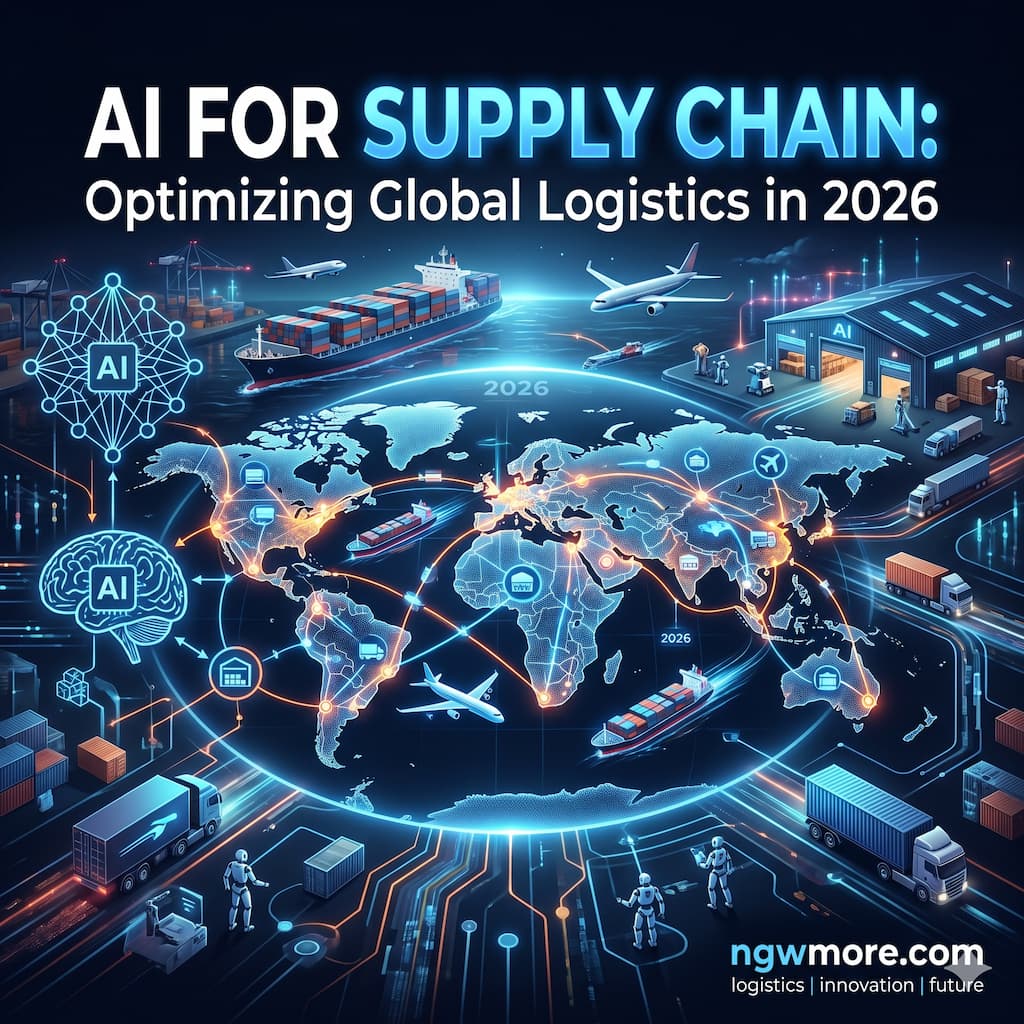
AI for Supply Chain: Optimizing Global Logistics in 2026
The global trade landscape of 2026 is unrecognizable compared to the fragile systems of the early 2020s. We have moved from a “Just-in-Time” era through a “Just-in-Case” survival phase and into the current era of “Just-in-Sync” Logistics. In this new reality, the supply chain is no longer a linear sequence of events but a living, breathing, and autonomous neural network.
For the readers of ngwmore.com, staying competitive in 2026 means moving beyond simple tracking and tracing. It requires the integration of Agentic AI—systems that don’t just alert you to a problem, but solve it before it impacts your bottom line.
1. The 2026 Macro Environment: Why AI is Mandatory
As of mid-2026, global logistics are facing unprecedented complexity. Geopolitical shifts, climate-induced maritime restrictions, and the rapid “re-shoring” of manufacturing have made human-led planning insufficient.
The “Volatility Normal”
In 2026, a port strike in Europe or a drought in the Panama Canal is no longer an “extraordinary event”—it is a weekly occurrence. AI has become the mandatory “nervous system” that allows companies to navigate this volatility. According to 2026 Gartner reports, companies that have fully integrated Generative and Predictive AI into their supply chains have seen a 25% reduction in operational costs and a 30% improvement in delivery precision.
2. From Predictive to Prescriptive: The AI Evolution
To optimize global logistics in 2026, we must distinguish between the types of AI currently powering the world’s most efficient supply chains.
A. Predictive AI (The Forward Look)
This is the “weather forecast” of logistics. In 2026, Predictive AI uses massive datasets—satellite imagery, social sentiment, historical port congestion, and even real-time energy prices—to forecast demand and potential disruptions.
- Demand Sensing: AI now predicts consumer demand at a granular, neighborhood level, allowing inventory to be positioned in “micro-fulfillment centers” before an order is even placed.
B. Prescriptive AI (The Action Taker)
The real breakthrough of 2026 is Prescriptive AI. It doesn’t just say, “There will be a delay in the Suez Canal.” It says: “There is a 90% chance of a 4-day delay. I have already rerouted 40% of the high-priority cargo to air freight and moved the rest to a rail alternative through the Middle East Corridor. Click here to confirm the $12,000 budget adjustment.”
C. Agentic AI (The Autonomous Operator)
This is the “Holy Grail” of 2026. Agentic AI platforms operate with “delegated authority.” They negotiate with shipping carriers, manage warehouse robots, and settle customs disputes autonomously within pre-set financial guardrails.
3. Core Pillars of AI-Driven Logistics in 2026
To scale your logistics operations on ngwmore.com, you must focus on these four pillars of optimization.
I. The Digital Twin: Real-Time Mirroring
In 2026, every physical supply chain has a Digital Twin. This is a virtual replica of your entire logistics network.
- Scenario Stress-Testing: Managers can run “What If” scenarios (e.g., “What if the price of fuel spikes by 15%?” or “What if our primary manufacturer in Vietnam loses power?”) and see the ripple effect across the entire chain in seconds.
- Visual Management: Using AR/VR interfaces, logistics directors can “walk through” a virtual warehouse in 3D to identify bottlenecks in the picking process.
II. Autonomous “Last-Mile” and Middle-Mile Delivery
The “Last Mile” remains the most expensive part of logistics, but in 2026, AI has finally cracked the code.
- Drone Swarms: In high-urbanization coastal cities, AI-coordinated drone swarms handle 30% of small-package deliveries.
- Autonomous Trucking: The “Middle Mile”—transporting goods between regional hubs—is now dominated by autonomous electric trucks that operate 24/7, guided by AI that optimizes for charging stops and traffic patterns.
III. Intelligent Inventory Orchestration
Holding stock is expensive. In 2026, AI uses Dynamic Inventory Placement.
- Floating Warehouses: Large shipping vessels now act as “floating warehouses” where the final destination of the goods is not decided until the ship is halfway across the ocean, based on real-time demand shifts.
- SKU Rationalization: AI identifies slow-moving SKUs and suggests “bundling” or “liquidation” strategies before they become a liability.
IV. Cognitive Sourcing and Procurement
AI agents now handle the “dirty work” of procurement.
- Supplier Risk Scoring: AI continuously monitors the financial health, ESG (Environmental, Social, and Governance) compliance, and political risk of every supplier in your database.
- Automated RFPs: The AI drafts, sends, and evaluates Requests for Proposals (RFPs), selecting vendors based on a balance of cost, speed, and carbon footprint.
4. Top AI Supply Chain Platforms for 2026
The market is led by a few powerhouses that have successfully merged AI with physical infrastructure data.
| Platform | Best For | Standout 2026 Feature |
| Project44 (High-Velocity) | Visibility | Sub-Meter Accuracy: Real-time tracking of every single pallet, not just the container. |
| Coupa (AI-Sourcing) | Procurement | Community Intelligence: Uses data from $5 trillion in global spend to suggest the best pricing. |
| Kinaxis (Maestro) | Planning | Concurrent Planning: Every change in the warehouse instantly updates the financial forecast. |
| Locus.sh | Last-Mile | Dynamic Route Optimization: AI that learns from local driver “shortcuts” and traffic nuances. |
| Flexport (2026 Edition) | Digital Freight Forwarding | Customs AI: Autonomously prepares and files complex international customs paperwork. |
5. The “Green” Mandate: AI for Sustainability
In 2026, “Green Logistics” is no longer optional—it is a regulatory requirement. AI is the primary tool for meeting Scope 3 Emission targets.
- Carbon-Optimal Routing: AI calculates the route with the lowest carbon footprint, balancing sea, rail, and electric road transport.
- Circular Logistics: AI manages “Reverse Logistics” (returns), ensuring that returned products are refurbished, recycled, or resold with minimal waste.
- Eco-Auditing: AI autonomously generates the sustainability reports required by the EU Green Claims Directive and similar global regulations.
6. Challenges: Data Silos and “Black Box” Risks
Despite the advancements of 2026, the AI-driven supply chain has its pitfalls:
- Data Fragmentation: AI is only as good as its data. If your 3PL (Third-Party Logistics) provider isn’t sharing real-time data, your AI is “blind.”
- Cyber-Logistics Risk: An AI-managed supply chain is a high-value target. Ransomware that “freezes” an autonomous warehouse can cost millions per hour.
- The “Black Box” Problem: If an AI reroutes a shipment and increases costs by 20%, managers must be able to see the “Logic Trail” to explain the decision to stakeholders.
7. Implementation Roadmap for ngwmore.com Readers
If you are a business owner or logistics manager looking to modernize in 2026, follow these steps:
- Phase 1: Connectivity (Months 1-2): Connect all your hardware (IoT sensors in trucks, warehouse scanners) to a unified AI data lake.
- Phase 2: Predictive Pilot (Months 3-5): Use AI to forecast demand for your top 10 SKUs. Compare the AI’s accuracy against your current human-led process.
- Phase 3: Automated Exception Handling (Months 6+): Grant “limited authority” to an AI agent to handle minor disruptions (e.g., delays under 24 hours) without needing human sign-off.
Read More⚡ AI Ethics for Business: Avoiding Legal Risks in 2026
Conclusion: The Era of the “Autonomous Supply Chain”
In 2026, global logistics has moved from a cost center to a competitive weapon. The businesses that thrive are those that have replaced their spreadsheets with “Agentic Systems” capable of navigating a fractured and fast-moving world.
For ngwmore.com readers, the message is clear: Optimize or be left behind. The physical world is messy, but in 2026, the right AI can turn that mess into a streamlined, profitable, and sustainable machine.
The ships are moving. The drones are flying. Is your AI at the helm?