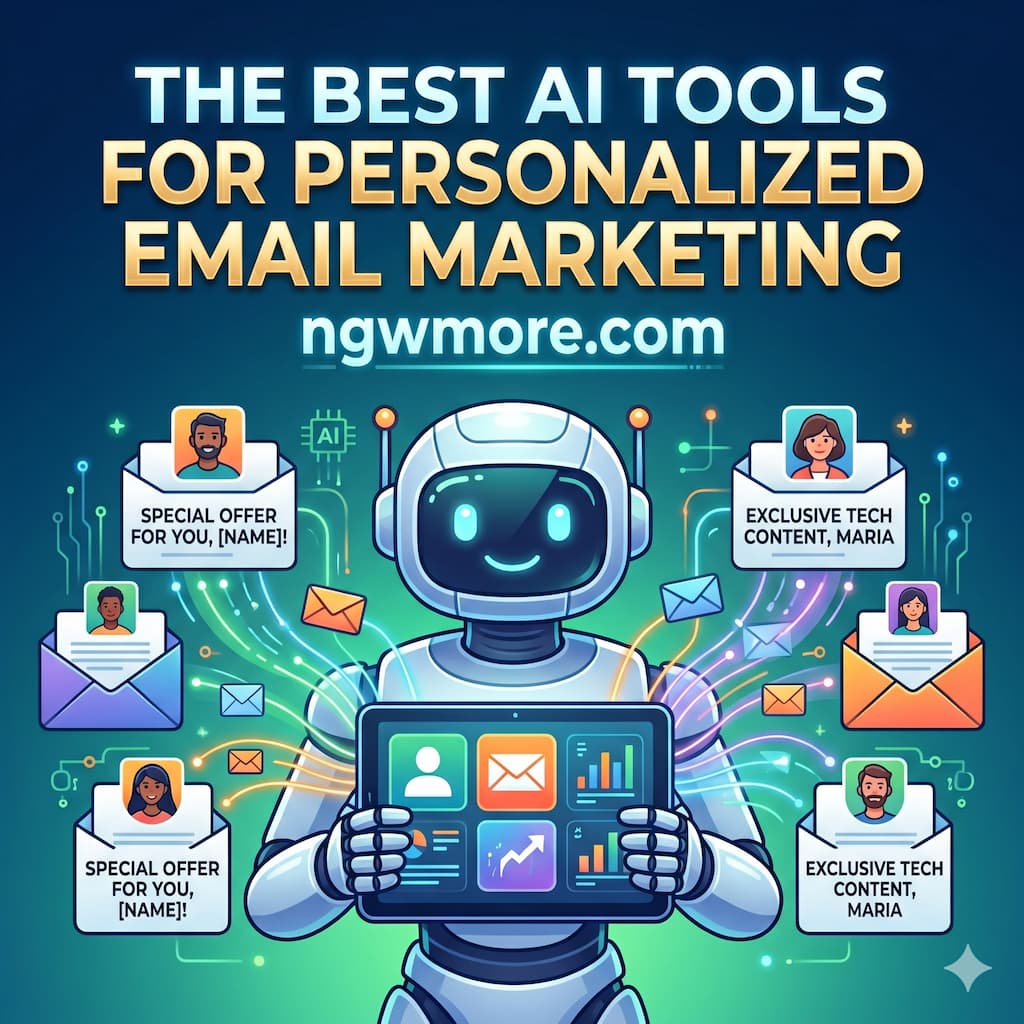
The Best AI Tools for Personalized Email Marketing
The era of “spray and pray” email marketing is officially over. In 2026, the average consumer’s inbox is managed by intelligent filters that can smell a generic template from a mile away. If your brand is still sending the same blast to 10,000 people, you aren’t just wasting your budget—you are actively damaging your sender reputation.
At ngwmore.com, we’ve tracked the evolution of digital communication, and the consensus for 2026 is clear: Personalization is the only way to convert. Fortunately, the rise of Generative AI and Predictive Analytics has given marketers a “superpower” to deliver the right message to the right person at the exact millisecond they are most likely to engage.
This guide explores the absolute best AI tools for personalized email marketing in 2026, moving beyond simple “First Name” tags into the world of hyper-relevance.
1. The Power of Hyper-Personalization in 2026
In the past, personalization meant putting a customer’s name in the subject line. In 2026, hyper-personalization means the AI understands the customer’s intent, mood, and lifecycle stage.
From Segmentation to “Segments of One”
Traditional segmenting involved grouping people by “Age 25-35” or “Last Purchase: 30 days ago.” AI now allows for Micro-Segmentation. The tools we discuss below analyze thousands of data points—from mouse-hover patterns on your website to the weather in the recipient’s city—to craft a unique email experience for every single subscriber.
2. Top-Tier AI Email Platforms for 2026
Klaviyo: The Predictive Powerhouse
Klaviyo has solidified its position as the leader for e-commerce brands by integrating deep machine learning into its core.
- Predictive Analytics: Klaviyo’s AI predicts a customer’s Expected Next Order Date and Customer Lifetime Value (CLV). It can automatically trigger an email three days before a customer is statistically likely to run out of a product.
- Smart Send Time: It doesn’t just send at 9:00 AM; it sends at the specific time that specific user historically opens their emails.
Seventh Sense: The Delivery Specialist
If you are already using a platform like Hubspot or Marketo, Seventh Sense is the AI “brain” you plug into it.
- Individualized Frequency: Some people love daily updates; others want one a week. Seventh Sense analyzes engagement to automatically throttle or increase the frequency of emails for each subscriber, drastically reducing unsubscribe rates.
3. Generative AI for Content and Subject Lines
Content creation is often the biggest bottleneck in marketing. AI has turned this hurdle into a competitive advantage.
Phrasee: AI Copywriting with Brand Voice
Phrasee uses “Language Generation” (NLG) to write subject lines and body copy that outperform human writers in 95% of head-to-head tests.
- Brand Harmony: Unlike generic AI, Phrasee is trained on your specific brand voice. It learns whether your audience responds better to humor, urgency, or curiosity.
- Dynamic Optimization: It continuously A/B tests millions of variations in real-time, doubling down on what works and discarding what doesn’t.
Jasper for Business: Scaling Content
Jasper remains a favorite for creating the actual “meat” of the email. Its Campaign Architect feature allows you to feed it a single product brief, and it will generate an entire 10-email sequence, complete with personalized angles for different buyer personas.
4. Visual Personalization: AI Images and Videos
Static images are being replaced by dynamic, AI-generated visuals that change depending on who is looking at them.
Movable Ink: Real-Time Visual Content
Movable Ink allows you to “code” your emails to change at the moment of opening.
- Live Content: If a user opens an email in New York, they see winter coats; if they open it in Rio Grande, they see light jackets.
- Personalized Maps: It can generate a map showing the user the exact distance from their current GPS location to your nearest physical store.
Tavus: Personalization via AI Video
Tavus allows you to record one video and then use AI to “clone” your face and voice to say the recipient’s name and specific details. Imagine sending an email where you personally say, “Hey Mark, I saw you were looking at the S24 Ultra accessories on our site…” to 5,000 different people simultaneously.
5. Behavioral Triggers and Cart Abandonment 2.0
Standard cart abandonment emails are boring. AI makes them irresistible.
Bloomreach: The “Discovery” Engine
Bloomreach uses AI to suggest “Complementary Products” that aren’t just based on what others bought, but on a deep analysis of the user’s visual preferences. If a user looked at a minimalist black backpack, the AI won’t suggest a colorful one; it will suggest a minimalist black laptop sleeve.
Rejoiner: Precision Retargeting
Rejoiner uses AI to identify “Intent to Buy” versus “Casual Browsing.” It prevents you from “burning” your list by only sending aggressive discount codes to users the AI identifies as being on the fence, while sending “Social Proof” (reviews) to those who just need a little more trust.
6. Maintaining Deliverability: AI Technical Defense
Sending great emails is pointless if they land in the spam folder. AI is now the gatekeeper of your sender reputation.
GlockApps: AI Spam Testing
Before you hit send, GlockApps uses AI to run your email through thousands of “Spam Filters.” It identifies specific words, link structures, or image-to-text ratios that might trigger a “Spam” flag in Gmail or Outlook.
Snov.io: AI Verification
Snov.io uses AI to verify email lists in real-time. It doesn’t just check if an email exists; it predicts if that email is likely to result in a “Hard Bounce,” allowing you to keep your list “clean” and your sender score high.
7. The Strategy: How to Build Your 2026 AI Stack
For the readers of ngwmore.com ready to implement these tools, we recommend the “Layered Approach”:
- The Foundation (The ESP): Choose an AI-native platform like Klaviyo or Omnisend.
- The Brain (Copy): Integrate Phrasee to ensure your subject lines are constantly improving.
- The Hook (Visuals): Use Movable Ink to make the emails feel “alive” and local.
- The Cleanup (Security): Use Snov.io monthly to ensure you aren’t sending to “dead” inboxes.
8. Ethics and Privacy: The “Creepy” Factor
With great power comes great responsibility. In 2026, “Over-Personalization” can become “Creepy.”
- The Transparency Rule: At ngwmore.com, we suggest being subtle. You don’t need to tell the customer you know they were browsing at 2:00 AM on their couch. Use the data to guide the content, but keep the tone helpful and human.
- Data Sovereignty: Ensure your AI tools are compliant with global privacy laws (GDPR, LGPD, etc.). The AI should process the data to provide value, not to store it for unauthorized use.
Read More⚡ AI for Retail: How Smart Inventory Slashes Costs
Conclusion: The Human Behind the AI
The best AI tools for personalized email marketing in 2026 are force multipliers. They take your creative vision and scale it to thousands of individuals without losing the personal touch. However, the most successful campaigns still require a human “Editor-in-Chief.”
The AI provides the data, the timing, and the variations, but you provide the Brand Mission. When you combine the cold, predictive power of the machine with the warm, creative empathy of the human marketer, you create a marketing engine that doesn’t just “send emails”—it builds relationships.
The future of your inbox is intelligent. Are your emails smart enough to get through?