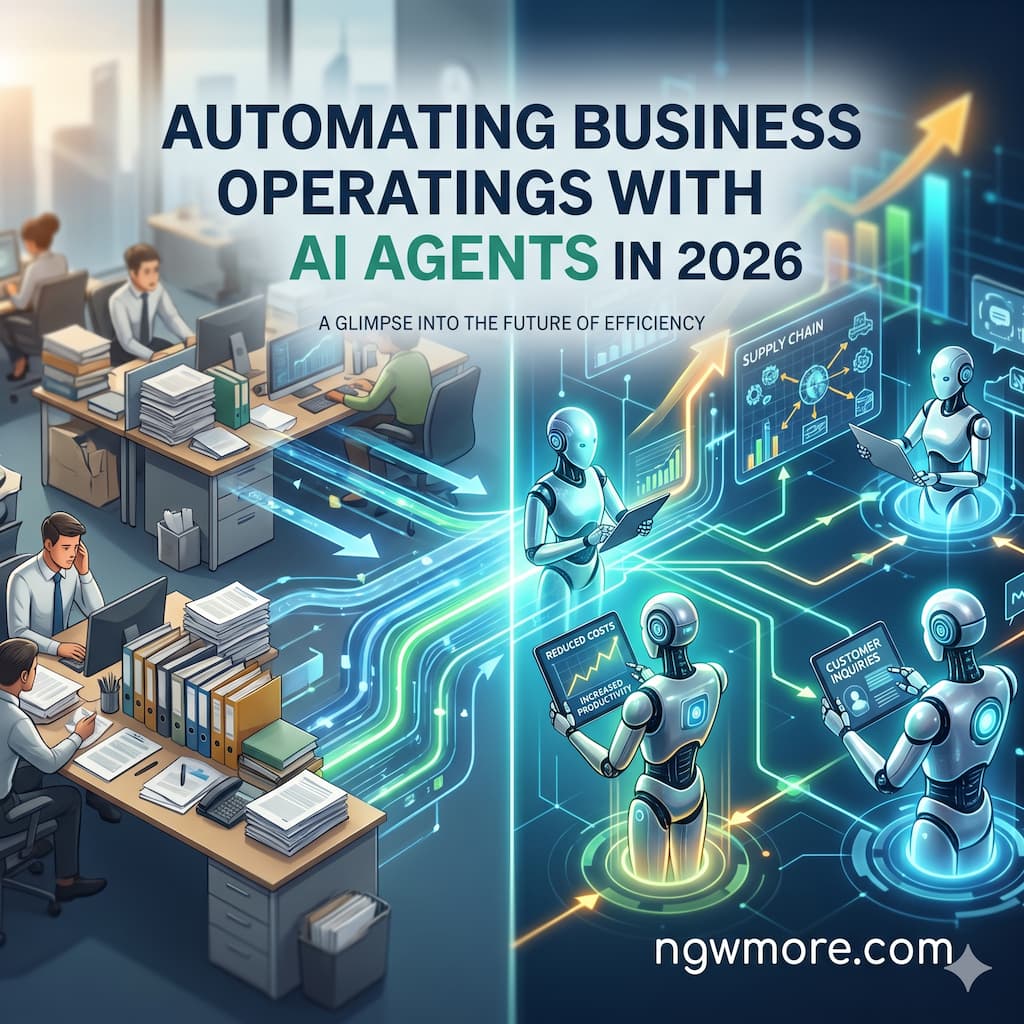
Automating Business Operations with AI Agents in 2026
The corporate landscape of 2026 is no longer defined by traditional software automation or simple “if-this-then-that” workflows. We have officially entered the age of Agentic Operations. For the forward-thinking entrepreneurs and digital administrators at ngwmore.com, the shift from “tools you use” to “agents that work for you” represents the single greatest opportunity for scaling since the birth of the cloud.
In this deep-dive, we will explore how AI agents are fundamentally restructuring business processes, the “Agentic Stack” required to compete in 2026, and a strategic roadmap to achieve autonomous operational excellence.
1. The 2026 Paradigm: From Automation to Autonomy
To succeed in the current market, it is vital to understand the technological leap that occurred between 2024 and 2026.
The Death of Manual Integration
In the early 2020s, automation was “brittle.” You had to connect App A to App B using platforms like Zapier, and if a field changed or a service went down, the whole chain broke. In 2026, AI Agents are Reasoning Engines. They don’t just follow a path; they understand the goal.
If an agent is tasked with “Resolving a customer refund dispute,” it doesn’t just follow a script. It accesses the CRM, checks the shipping logs, analyzes the customer’s sentiment in previous emails, and makes a reasoned decision based on company policy. If it encounters a new problem, it researches a solution or asks for human clarification, learning from the interaction for the next time.
The Rise of the “Synthetic Workforce”
We are seeing the birth of the Synthetic Workforce—a layer of digital employees that handle high-volume, high-complexity tasks. Unlike the “dumb bots” of the past, these agents have memory (Long-Term Context) and agency (The ability to use tools). They operate in the background 24/7, allowing human teams to focus entirely on creative strategy and high-stakes relationship management.
2. Core Operational Domains Transformed by AI Agents
As of May 2026, AI agents have moved beyond experimental phases and are now dominating these four critical business domains:
A. Customer Experience (CX) & Support
The “Chatbot” is a relic. Today, we use Autonomous Service Agents.
- Multimodal Interaction: Agents can now “see” a customer’s screen via shared feed or “hear” the frustration in a voice call, adjusting their tone and solution in real-time.
- Proactive Resolution: Agents monitor system health and proactively reach out to customers before they notice a problem.
- Result: A 2026 benchmark shows that AI agents now resolve 85% of all tier-1 and tier-2 support tickets without any human intervention, with higher satisfaction scores than human-led teams.
B. Supply Chain & Procurement
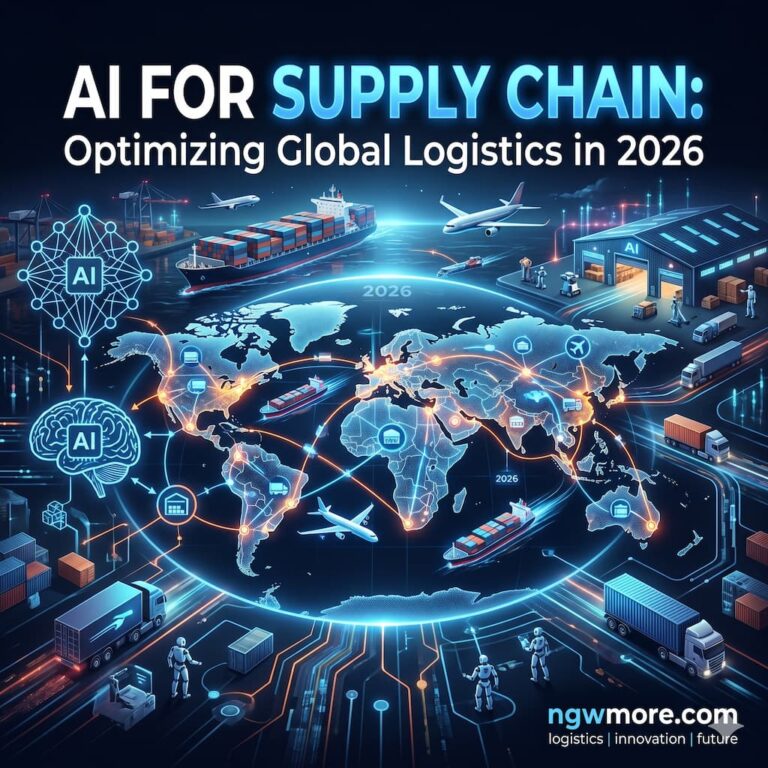
Global logistics in 2026 are too fast for humans to manage via spreadsheets.
- Autonomous Negotiation: AI agents represent your company in digital marketplaces, negotiating prices with shipping carriers and vendors based on real-time inventory needs.
- Predictive Healing: If a port strike is predicted in 72 hours, the agent autonomously reroutes shipments and updates the e-commerce storefront’s “Estimated Delivery” times across all platforms.
C. Financial Operations (FinOps)
Accounting has become a “Real-Time” discipline.
- Autonomous Reconciliation: Agents match invoices to bank statements every minute, not every month.
- Dynamic Tax Optimization: Agents monitor global tax law changes (like the 2026 updates to digital services taxes) and adjust pricing or reporting structures instantly to remain compliant and profitable.
- Fraud Interception: AI agents act as “Digital Bouncers,” identifying and freezing suspicious transactions in milliseconds, often before the bank’s own systems flag them.
D. Human Resources & Recruitment
Recruitment in 2026 is about Skills-Matching, not keyword searching.
- Autonomous Sourcing: Agents “scout” talent across specialized forums and project repositories (like GitHub or Behance), engaging in initial outreach conversations to gauge a candidate’s interest and “culture fit.”
- Onboarding Orchestration: From hardware provisioning to training module assignments, AI agents manage the entire first 90 days of an employee’s journey.
3. The 2026 Agentic Stack: Tools You Need
To scale your operations on ngwmore.com, you must build your business on a robust Agentic Stack.
| Layer | Recommended Platform | Why it Matters in 2026 |
| Brain (LLM) | OpenAI o1 / Claude 3.5 | High-reasoning models that can plan and execute multi-step tasks. |
| Orchestration | LangChain / CrewAI | The “Operating System” that allows multiple agents to talk to each other. |
| Memory | Pinecone / Weaviate | Vector databases that give your agents a “long-term memory” of your business. |
| Tools/Connectors | Composio / Skyvern | Specialized interfaces that allow agents to “click buttons” in your browser or ERP. |
| Monitoring | LangSmith | An observability layer to ensure your agents aren’t “hallucinating” or making errors. |
4. Strategic Implementation: The “Agentic Roadmap”
How do you transition from a manual business to an agent-led powerhouse in 2026?
Step 1: Identify “High-Friction” Workflows
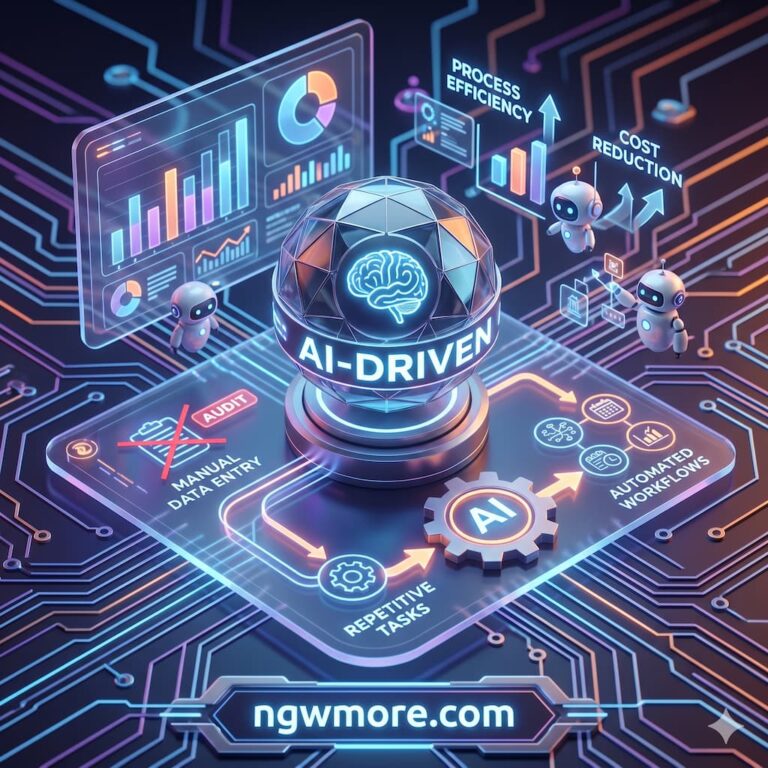
Don’t automate everything at once. Look for the “Boring, Frequent, and High-Volume” tasks. Usually, this is in data entry, lead qualification, or invoice processing.
Step 2: Define the “Guardrails”
In 2026, Governance is God. You must define the limits of your agents’ authority.
- Financial Limits: “The agent can issue a refund up to $100. Anything higher requires a human ‘thumbs up’.”
- Safety Limits: “The agent cannot delete customer data from the primary database.”
Step 3: Deploy a “Swarm” (Multi-Agent Systems)
The most efficient businesses in 2026 don’t use one “Giant AI.” They use a Swarm of Specialists.
- Agent A (The Researcher): Finds the data.
- Agent B (The Writer): Drafts the response.
- Agent C (The Critic): Checks the response for errors and brand voice.By having agents check each other’s work, you virtually eliminate the risk of AI errors.
Step 4: The “Human-in-the-Loop” (HITL) Feedback
The agents should present their work to a human manager for the first 30 days. This “Training Phase” allows the AI to learn the nuances of your specific brand voice and business ethics. By day 60, the human should move to an “Exception Management” role.
5. Challenges and Risks: The “Sobering” Reality of 2026
Automating with agents is not without its perils. In 2026, we are specifically watching:
- Prompt Injection & Security: Hackers now try to “trick” your agents into revealing company secrets or bypassing payment walls. Robust security for your Agentic Stack is a top priority for ngwmore.com readers.
- Model Drift: As the “Brains” (LLMs) are updated, an agent that worked perfectly in April might behave differently in May. Continuous testing is mandatory.
- The “Uncanny Valley” of Service: If an agent tries too hard to sound “Human,” it can lead to customer distrust. In 2026, Transparency is the best policy. Let your customers know they are talking to a highly capable AI agent; they will usually appreciate the speed and efficiency.
6. The ROI of Autonomy: By the Numbers
The financial data for May 2026 is clear. Businesses that successfully implement AI agents are seeing:
- 70% Reduction in Administrative Overhead: Reallocating those funds into R&D and Marketing.
- 3x Improvement in “Speed to Lead”: Qualifying and responding to a potential customer in under 10 seconds.
- Scalability without Linearity: The ability to double your customer base without doubling your headcount.
Read More⚡ AI for HR: Automating Recruitment in 2026
Conclusion: The New CEO Mandate
In 2026, the role of the CEO or Business Owner has changed. You are no longer a “Manager of People”; you are an Orchestrator of Systems.
For the community at ngwmore.com, the message is simple: Start Building Your Synthetic Workforce Today. The technology has matured, the costs have dropped, and the competitive advantage is immense. The businesses that thrive in the latter half of this decade will be those that view AI agents not as “software,” but as teammates.
The future is autonomous. Is your business ready to lead the swarm?