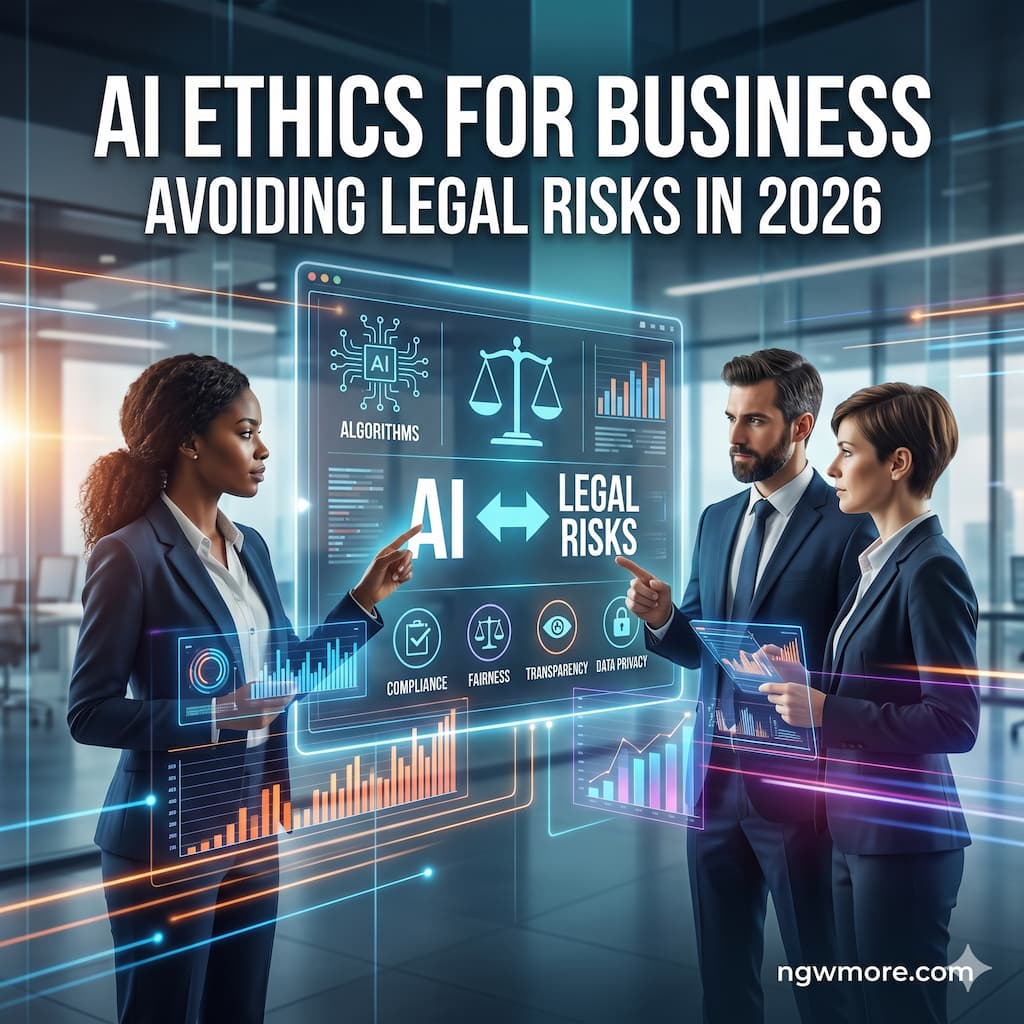
AI Ethics for Business: Avoiding Legal Risks in 2026
The “Wild West” era of artificial intelligence is officially over. If 2023 was the year of wonder and 2024 was the year of implementation, 2026 is the year of the auditor. As of May 2026, the global legal landscape has shifted from vague guidelines to hard, enforceable statutes. For digital entrepreneurs and corporate leaders alike, “ethics” is no longer just a corporate social responsibility (CSR) buzzword—it is a critical legal shield.
Operating a business in 2026 without a robust AI ethical framework is like driving a high-performance car without insurance or brakes. You might go fast for a while, but the crash won’t just be expensive; it could be existential. With the EU AI Act deadlines looming, state-level patchwork in the US becoming active, and major copyright precedents being set in the courts, the stakes have never been higher.
In this guide, we’ll break down the essential ethical and legal pillars every business must establish to scale safely in 2026.
1. The Global Regulatory Landscape: A Patchwork Reality
In mid-2026, we are dealing with a fragmented regulatory environment. While global convergence is the goal, the reality is a multi-polar world of data and AI laws.
The European Union: The August Deadline
The EU AI Act remains the “Gold Standard” of regulation. As of May 2026, all eyes are on the August 2nd deadline. Unless the “Omnibus” proposal for a deferral is finalized in the coming weeks, high-risk AI systems—particularly those used in employment, recruitment, and critical infrastructure—must be fully compliant by this summer.
- The Risk: Fines can reach up to 7% of global annual turnover.
- The Strategy: If your AI tools handle resume screening or performance monitoring, you need a “High-Risk Impact Assessment” on file now.
The United States: The State-Level Surge
In the absence of a federal AI bill, the US has become a patchwork. The Texas Responsible AI Governance Act (TRAIGA) went into effect on January 1st, and the highly anticipated Colorado AI Act becomes effective next month, in June 2026.
- The Risk: These laws require “reasonable care” assessments. In states like California and Utah, transparency is the law; if a customer interacts with a bot, they must be informed.
- The Strategy: Adopt the strictest state’s standard as your baseline to avoid regional fragmentation in your operations.
Brazil and the “Marco Legal”
South America has become a surprising leader in AI oversight. Brazil’s Bill 2338/2023 is nearing finalization in the House, emphasizing risk-based governance and the rights of the data subject.
- The Risk: The ANPD (National Data Protection Authority) has transitioned into a full regulatory agency with increased oversight over AI-driven data scraping.
2. Core Legal Risks and How to Mitigate Them
To navigate 2026, you must understand the four primary legal “landmines” currently facing businesses.
Risk A: Intellectual Property & Content Ownership
The “Great Training War” is currently playing out in the Southern District of New York. As of this week, major publishers have filed a massive class-action lawsuit against Meta, alleging that Llama models were trained on pirated “shadow libraries.”
- Ethical Mitigation: Never use generative AI for core brand assets without verifying the training data’s provenance. If you are using enterprise-grade LLMs, ensure your contract includes an IP Indemnification Clause—shifting the legal liability for infringement back to the provider.
Risk B: Algorithmic Bias & “Automated Discrimination”
In early 2026, New York’s watchdog issued a series of critical audits on automated hiring tools. The results were startling: many “neutral” AIs were still filtering candidates based on zip codes or speech patterns that acted as proxies for race or disability.
- Ethical Mitigation: Conduct bi-annual Bias Audits. If you are using AI for credit scoring, hiring, or insurance pricing, you are legally responsible for the output, regardless of whether the tool is “third-party.”
Risk C: The “Shadow AI” Data Leak
The greatest threat to your trade secrets isn’t a hacker—it’s an employee pasting your strategic plan into a public, non-enterprise chatbot to “summarize it.”
- Ethical Mitigation: Implement a company-wide AI Acceptable Use Policy (AUP). Prohibit the input of any proprietary or client-sensitive data into public models. Use enterprise versions (like ChatGPT Team/Enterprise or Gemini for Business) where “opt-out” of training is the default.
Risk D: Deepfakes and the “No FAKES Act”
The rise of synthetic media has led to the proposed No FAKES Act in the US, designed to protect individuals from unauthorized likeness synthesis.
- Ethical Mitigation: If your marketing uses “AI Models” or “AI Voiceovers,” ensure you have explicit, documented consent from any person whose likeness or voice served as the seed data. Transparency isn’t just ethical; in 2026, it’s a defense against defamation claims.
3. Operationalizing Ethics: From Theory to Workflow
How do you turn 50 pages of ethics guidelines into a working business model? You build it into the workflow.
The “Human-in-the-Loop” (HITL) Standard
In 2026, using a public AI tool for client work without human verification is considered an ethical—and often a professional—violation.
Standard Operating Procedure: Every AI-generated output (code, copy, or legal summary) must be signed off by a human subject matter expert. This creates a “Paper Trail of Accountability” that protects you during an audit.
Explainability (XAI) as a Competitive Edge
If a customer asks, “Why was my application denied?” and your answer is “The AI said so,” you are in legal trouble. You must move toward Explainable AI.
- Action: Choose models that offer “reasoning logs.” Being able to explain the “Why” behind an automated decision is the difference between a minor inquiry and a “nuclear verdict.”
Vendor Due Diligence
Your AI is only as ethical as the vendors you hire. In 2026, your procurement team should ask:
- Was this model trained on licensed data?
- What are the red-teaming protocols for this system?
- Does the vendor assume liability for autonomous errors?
4. AI Liability and the “Autonomous Agent” Problem
We have moved beyond chatbots. 2026 is the year of Autonomous Agents—AI that can sign contracts, book travel, and execute trades. But who is liable when the agent makes a mistake?
Traditional agency law is being tested in the courts right now. If your AI agent accidentally commits your company to a disadvantageous contract, the prevailing legal trend suggests you are still bound by it.
- The Insurance Shift: Standard General Liability (GL) policies often exclude “autonomous algorithmic errors.” You may need a specific AI Liability Rider to cover “hallucinations” or autonomous financial losses.
5. Ethical Marketing: Balancing SEO with Integrity
For those focused on SEO and digital growth (like the readers of ngwmore.com), 2026 has introduced a new challenge: SGE (Search Generative Experience) Ethics.
Search engines now prioritize “Information Gain.” If your site is filled with mass-produced, low-effort AI content, you aren’t just risking a Google penalty; you are risking “Deceptive Marketing” claims under updated consumer protection laws (like the Utah AI Policy Act).
The 2026 Content Rule: Use AI to research, but use humans to verify and spice. Authenticity is the only currency that AI cannot inflate.
6. The 2026 Compliance Checklist
To ensure your business stays on the right side of history (and the law), use this checklist:
| Category | Action Item | Priority |
| Governance | Appoint an “AI Ethics Lead” or a Cross-Functional Committee. | High |
| Inventory | Map every AI tool used in the company (including “Shadow AI”). | High |
| Policy | Update Employee Handbooks with AI Acceptable Use Policies. | High |
| Legal | Update vendor contracts with AI-specific indemnification. | Medium |
| Transparency | Add “Generated by AI” watermarks or disclosures to public content. | Medium |
| Insurance | Audit liability coverage for “Autonomous Errors.” | Medium |
Read More⚡ Cybersecurity for Remote Teams: AI Protection Tools
7. Conclusion: Ethics as an Accelerator
It is tempting to view AI ethics and legal compliance as a “brake” on innovation. But in 2026, the opposite is true. Businesses with clear, ethical frameworks move faster.
Why? Because they don’t have to pause for every new regulation. They don’t live in fear of a sudden “cease and desist.” And most importantly, they build Trust. In a world flooded with synthetic content and automated decisions, a brand that can say, “Our AI is audited, transparent, and human-led,” will always win.
The legal risks of AI in 2026 are real, but they are manageable. By moving from a “move fast and break things” mentality to a “scale fast and protect things” strategy, you aren’t just avoiding a lawsuit—you are building a legacy.
Final Thought: The “Paper Trail”
Remember, in a court of law, intent matters. If you can show a judge that you had an AI Ethics Policy, conducted regular audits, and prioritized human oversight, your risk profile drops significantly. Don’t wait for the lawsuit to start documenting your ethics; start today.
Stay ahead of the curve here at ngwmore.com, where we blend the power of 2026 automation with the integrity of the human touch.