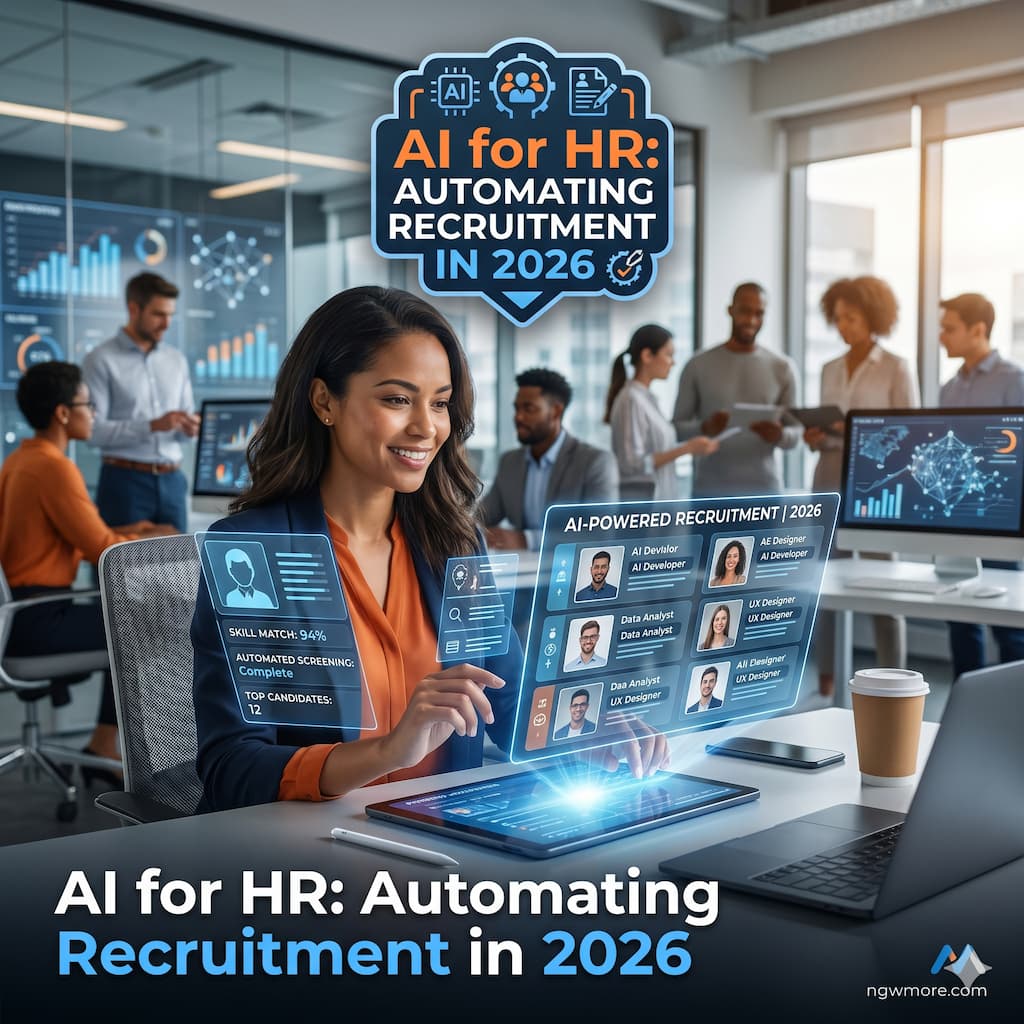
AI for HR: Automating Recruitment in 2026
The recruitment landscape has officially crossed the rubicon. As we navigate through 2026, the “Human Resources” department is undergoing its most significant evolution since the dawn of the internet. We have moved past the era of simple keyword-matching resumes; we are now firmly in the age of Agentic Recruitment—where AI doesn’t just assist the recruiter, but orchestrates the entire talent lifecycle.
For the readers of ngwmore.com, understanding this shift is critical. In 2026, a “manual” recruitment process is no longer just slow—it is a competitive liability. With the global talent war reaching new heights and candidates using AI themselves to flood systems with hyper-optimized resumes, HR teams must fight fire with fire.
1. The 2026 Paradigm: Agentic Hiring vs. Traditional Automation
To maximize efficiency in 2026, it is vital to distinguish between the automation of the past and the Agentic AI of today.
- Traditional Automation (2020-2024): Used “if-then” logic to move a candidate from one stage to another or send automated rejection emails based on a low test score.
- Agentic AI (2026): These are autonomous “hiring agents” that can reason. They don’t wait for a recruiter to trigger a task. Instead, they monitor the company’s growth metrics, detect a future skills gap in the engineering team, and autonomously begin sourcing “passive” candidates from global databases before a job description is even written.
According to 2026 industry reports, agentic hiring has reduced operational costs by up to 51% for HR teams, allowing recruiters to pivot from “paper-pushers” to “strategic talent advisors.”
2. The Rise of “Skills-First” Hiring
In 2026, the traditional resume is losing its crown. AI has enabled a massive shift toward Skills-Based Hiring, where what you can do matters more than where you went to school.
Why Credentials are Fading
AI models can now verify skills in real-time through:
- Simulated Work Assessments: Candidates are placed in a 20-minute virtual environment that simulates the actual job tasks.
- AI Skills Inference: Platforms like iMocha and Eightfold AI analyze a candidate’s entire digital footprint—projects, learning records, and certifications—to build a “Capability Map” that is far more accurate than a self-written CV.
This shift has expanded access to diverse talent pools, allowing companies to find “hidden gems” who might have been filtered out by old-school degree requirements.
3. Top AI Recruitment Platforms for 2026
The HR tech stack of 2026 is dominated by platforms that prioritize trust, explainability, and speed.
| Platform | Best For | Standout 2026 Feature |
| Eightfold AI | Enterprise Talent Intelligence | Career Pathing: Predicts which internal employees can be reskilled for new roles. |
| Greenhouse | Structured Hiring | Greenhouse MCP: Governed AI agents that orchestrate end-to-end workflows safely. |
| Juicebox | AI-Native Sourcing | Natural Language Search: Find candidates by typing “Find me a dev who scaled a fintech app in Ruby.” |
| Textio | Diversity & Inclusion | Textio Loop: Uses predictive data to ensure job postings attract the most diverse candidate pool. |
| SeekOut | Hard-to-Fill Tech Roles | Holistic Profiles: Combines GitHub, patents, and social signals into one unified view. |
4. The “AI vs. AI” Challenge: The Resume Inflation
One of the biggest hurdles for HR in 2026 is that candidates are also using AI.
The Problem: 65% of hiring managers report that AI-generated resumes are creating “inflated credentials.” Candidates use GenAI to perfectly mirror job descriptions, even if they don’t possess the underlying skills.
How HR is Solving This:
- Interview Intelligence: Tools like Bluedot or Metaview record and analyze live interviews, flagging discrepancies between a candidate’s resume and their verbal answers.
- Asynchronous AI Interviews: Candidates record video answers to questions. The AI then summarizes their communication style, sentiment, and technical accuracy, helping recruiters spot “scripted” or AI-assisted responses.
5. Compliance and the EU AI Act: High-Risk Systems
If you are operating in the European market—or even globally—2026 is the year of Regulatory Accountability. Under the EU AI Act, any AI tool used for recruitment and worker management is classified as a “High-Risk System.”
What this means for your HR team:
- Mandatory Human Oversight: An AI can suggest a shortlist, but a human must be the one to make the final “High-Stake” decision (hiring or firing).
- Anti-Bias Audits: You must prove that your algorithms aren’t discriminating based on gender, age, or ethnicity.
- Transparency Rules: Candidates have a legal right to know when an AI is evaluating them. By August 2026, transparency labels on all AI-generated content and screening summaries will be a strict requirement.
6. The “Human” Shift: From HR Director to Chief Productivity Officer
In 2026, we are seeing the emergence of the Chief Productivity Officer (CPO), a role that replaces the traditional HR Director by merging People Operations with IT.
The goal of HR in 2026 is no longer just “happiness” or “compliance”—it is Workforce Orchestration. HR professionals are now expected to:
- Decompose Roles: Break down jobs into specific tasks that can be shared between humans and AI agents.
- Skills Velocity: Measure how fast the organization is acquiring the skills needed for 2027 and beyond.
- Culture Engineering: Focus on the “Human-First” aspects of the company that AI cannot replicate—empathy, mentorship, and creative conflict resolution.
7. Strategic Roadmap: Automating Your Recruitment
Ready to upgrade your HR motion on ngwmore.com? Follow these steps for 2026:
Step 1: Audit for “Fragmented Automation”
Many companies have “Frankenstein” stacks—one tool for scheduling, another for screening. Aim for Consolidation. Use a platform like Greenhouse or Eightfold that acts as a “System of Work,” where data flows seamlessly between stages.
Step 2: Implement “Skills-First” Testing
Stop relying on the first-round phone screen. Use AI-powered skill assessments early in the funnel to filter for actual capability. This reduces “Time-to-Hire” by eliminating unqualified candidates before they reach a human recruiter.
Step 3: Train Your Recruiters in “Prompt Engineering”
In 2026, a recruiter’s most valuable skill is the ability to communicate with the AI. Training your team to write precise prompts for sourcing agents will yield 10x better results than traditional Boolean searches.
Read More⚡ Generative AI for Customer Support: Reducing Costs
Conclusion: The Era of Digital Labor
Recruitment in 2026 is a collaboration between Human Intuition and Machine Precision. The automation of drudgery—scheduling, basic screening, and data entry—has finally freed HR professionals to do what they were meant to do: build world-class teams.
For ngwmore.com readers, the message is clear: AI is taking over tasks, not HR jobs. The recruiters who thrive in 2026 will be those who embrace the role of “AI Orchestrator,” using technology to build a faster, fairer, and more agile workforce.
The future of hiring is here. Is your HR team ready to lead?