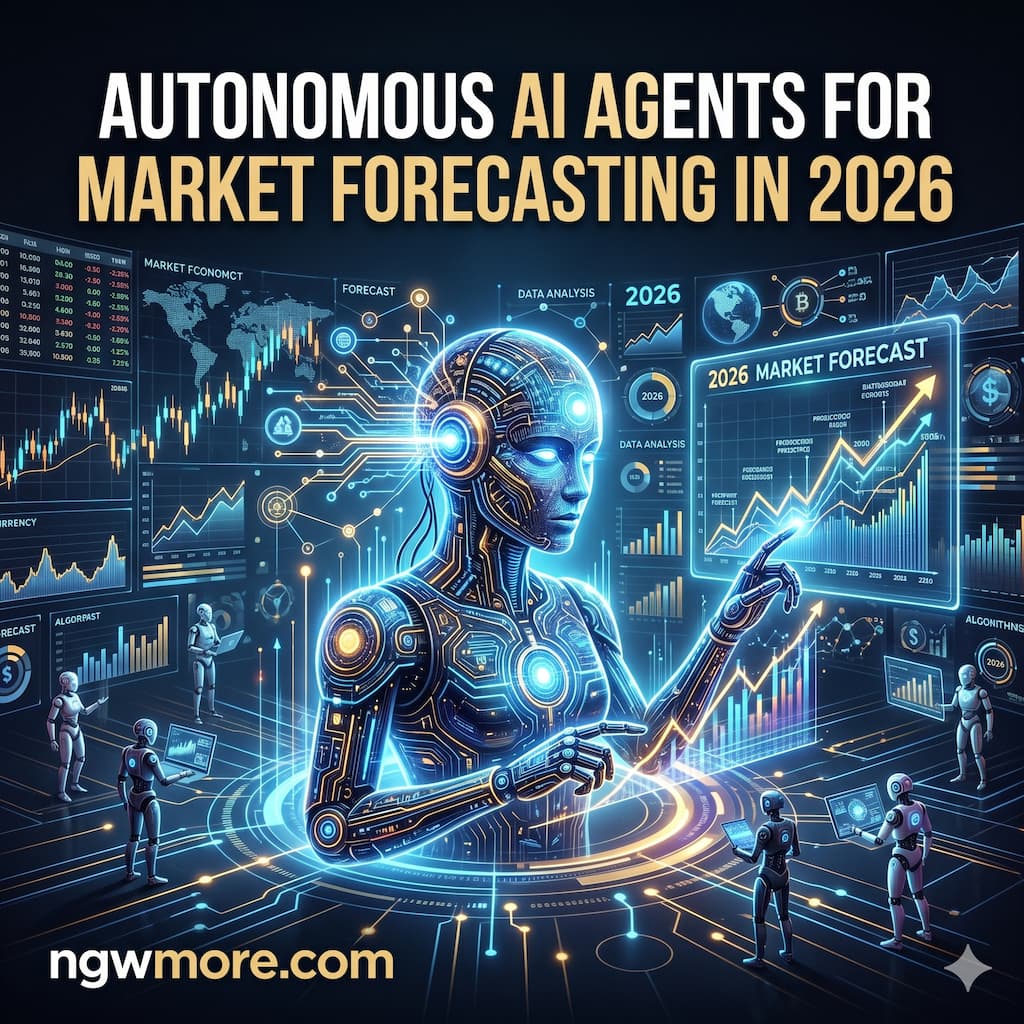
Autonomous AI Agents for Market Forecasting in 2026
The baseline architecture of financial intelligence has officially transitioned from a reactive state to a predictive, fully autonomous domain. As we chart our way through May 2026, the legacy practice of relying on centralized business intelligence (BI) boards, static spreadsheet correlations, and retrospective market data loops has become a form of structural operational failure. In a globalized digital economy characterized by hyper-velocity capital movements, algorithmic social narrative shifts, and tokenized real-world assets (RWAs), market trends wait for no one.
Historically, quantitative and trend analysis was a linear, human-driven sequence. Enterprise analytics teams or digital growth leads would spend weeks collecting structured data rows, configuring complex data pipelines, running statistical regression tests, and attempting to forecast future product demands or macroeconomic shifts. By the time an actionable whitepaper or quarterly market forecast hit an executive’s desk, the underlying market conditions had frequently morphed into an entirely new paradigm.
For the forward-thinking developers, e-commerce networks, and platform architects within the ngwmore.com community, speed to value and data autonomy are the core variables of market survival. The standard defining elite digital operations this year is Agentic Data Intelligence.
Driven by the mainstream stabilization of advanced reasoning foundation models, multi-agent orchestration frameworks, and real-time open data meshes, businesses are building automated financial nerve centers. Modern enterprises are deploying dedicated Autonomous AI Software Agents that don’t just report on past anomalies but continuously scan the global web, independently simulate future economic outcomes, and execute proactive tactical adjustments with zero human drag.
1. The 2026 Shift: From Passive Charting to Agentic Autonomy
To successfully exploit the power of predictive forecasting this year, you must first distinguish between traditional machine learning models and modern Autonomous Agents. The evolution of corporate forecasting can be categorized into three distinct historical waves:
- The Predictive Statistics Era (The Past): Standard regression algorithms and basic machine learning engines. These models evaluated structured, clean historical datasets (such as a 5-year log of seasonal sales margins) to project a fixed linear baseline. They lacked text comprehension, possessed zero awareness of external news events, and suffered total system failure when confronted with “Black Swan” macroeconomic disruptions.
- The Copilot/Chat Era (The Transition): The early integration of generative AI. Financial teams gained the capability to upload thousands of pages of PDF earnings call transcripts, messy spreadsheets, or consumer surveys into a chat interface (like ChatGPT or basic Claude instances), prompting the model to summarize key takeaways or generate basic “What-If” scenario equations. While powerful, this model remained completely passive—it required manual prompting, precise context engineering, and continuous human intervention.
- The Agentic Era (2026): The current global benchmark. We now deploy fully cognitive Autonomous Forecasting Agents. Given an executive-level, natural language directive—such as “Maximize our Q3 global tech-infrastructure inventory allocation against projected European cloud hosting trends”—the agent independently orchestrates a multi-step workflow. It maps its own technical goals, queries live databases, scrapes unstructured global sentiment streams, builds complex mathematical forecast models, tests its own code scripts inside isolated sandboxes, and alerts executives directly to emerging bottlenecks with finished, shareable reports.
  LEGACY REVENUE FORECASTING (Episodic & Manual)
  [Messy CSV Exports] ──► [Manual Python Modeling] ──► [Human Data Scrubbing] ──► [Retroactive Report]

  2026 AGENTIC FORECASTING GRID (Ambient & Continuous)
  [Continuous API Data Ingestion]
                │
                ▼
   ┌────────────────────────────────────────┐
   │    Autonomous AI Forecasting Core     │ ──► [Real-Time Open Web Deep Research]
   ├────────────────────────────────────────┤
   │ * Multi-Agent Systemic Simulation      │ ──► [Automatic Predictive Inventory Scaling]
   │ * Real-Time Sentiment & Narrative Sync │ ──► [Self-Correcting Algorithmic Execution]
   └────────────────────────────────────────┘
According to comprehensive 2026 global enterprise automation data, the market size for autonomous AI agents has scaled exponentially to become a multi-billion dollar pillar of corporate infrastructure. Leading organizations report that moving from execution to pure agentic oversight has allowed internal data science operations to triple their output while saving hours of routine administrative processing every single business day.
2. Core Pillars of the 2026 AI Agent Forecasting Architecture
Constructing a self-directed, un-hackable financial sensing engine requires integrating four foundational technological layers into your enterprise intelligence stack.
I. Real-Time Deep Research and Multi-Modal Stream Ingestion
Traditional forecasting systems are fundamentally crippled by data formatting silos—they can only parse clean, relational SQL databases or highly structured CSV files.
- The 2026 Breakthrough: Modern autonomous agents utilize Multi-Modal Data Mesh Ingestion Layers.
- The Execution: Over extended processing execution loops (often running autonomously for 30 minutes to an hour per analytical cycle), specialized agents like OpenAI’s Deep Research system pull data simultaneously from hundreds of highly disparate sources. The AI ingests satellite imagery tracking industrial container ship port velocities, parses real-time text narratives across global social listening matrixes, combs through newly uploaded regulatory filing databases, and reads global central bank transcripts, converting raw, unstructured digital chaos into a clean, unified data stream ready for execution.
II. Multi-Agent Collaborative Simulation Frameworks
Complex macro markets cannot be accurately modeled by a single isolated AI algorithm. Modern platforms deploy Collaborative Multi-Agent Networks where specialized digital personas are configured to aggressively stress-test each other’s conclusions within a sandboxed environment.
- The Trend Hunter Agent continuously monitors micro-sentiment changes and alternative cultural trends across fast-moving online communities.
- The Quantitative Economist Agent takes those qualitative behavioral signals and converts them into hard, structured statistical regression formulas.
- The Risk/Adversarial Agent acts as an internal algorithmic short-seller. It deliberately creates extreme, synthetic “Black Swan” scenarios (e.g., a systemic logistics shutdown or an unexpected interest rate hike), forcing the system to prove its resilience.
- The Governance Agent verifies that all modeled decisions strictly conform to pre-configured enterprise financial parameters, data privacy laws, and compliance safety thresholds.
III. Cognitive Open-Reasoning and Tool Orchestration
In 2026, autonomous systems have transcended basic probabilistic word completion and entered the phase of Open-Reasoning and Planning. When an agent encounters an anomaly or a data mismatch in its forecasting pipeline, it doesn’t hallucinate or crash. It halts its workflow, executes an internal self-correction tree, breaks down the problem into smaller logical blocks, and leverages specialized enterprise tools. The agent can dynamically write and compile its own Python scripts to clean data, call external APIs to query missing data variables, or interface directly with internal ERP systems to verify physical warehouse counts.
IV. Real-Time Anomaly Sensing and Root Cause Isolation
Waiting for an end-of-month or quarterly financial summary to discover that an ad campaign is burning capital or a product segment is experiencing supply chain contraction is an unacceptable corporate risk.
- The System Shield: 2026 business monitoring engines (such as advanced configurations of Anodot or Energent.ai) execute continuous, ambient anomaly sensing across your entire operational surface.
- The Isolation: By continuously mapping correlation metrics—such as real-time server traffic spikes against international checkout page conversion costs—the AI catches micro-deviations from normal behavioral baselines within milliseconds. The moment a trend breaks its statistical corridor, the agent isolates the exact root cause, drafts an explanatory narrative summary, and pings the executive leadership team before brand or capital damage occurs.
3. The 2026 AI Forecasting Stack: Enterprise Engines to Know
Transforming your analytical layers from a slow, manual reporting cost-center into an agile, predictive competitive advantage requires connecting your repository channels to dedicated, context-aware agentic engines. The current 2026 landscape features highly specialized tools:
| Platform Category | Leading 2026 Platforms | Core Portfolio Utility | Standout Agentic Advantage |
| High-Accuracy Data Intelligence | Energent.ai | Autonomous data cleaning, trend mapping, & deliverable synthesis | 94.4% Validated Accuracy: Autonomously turns messy real-world inputs into verified PPT and Excel artifacts with no-code automation. |
| Continuous Operations & Trend Sync | NoimosAI | Unifying macro market trend analysis with direct cross-channel execution | Unified Knowledge Core: Tracks 24/7 competitor moves and shifts social content or marketing pipelines in real-time. |
| Deep Text & Sentiment Insights | Brandwatch Iris AI / Sprout Social | Long-form consumer sentiment tracking & real-time crisis detection | Natural Language Discovery: Constructs automated Boolean queries dynamically via simple text prompts to map niche cultural shifts. |
| Enterprise Digital Twin Operations | Palantir AIP for Finance | Supply chain mapping, logistics simulation, & internal corporate finance | Ontological Synthesis: Builds a living, interactive digital twin of a global company’s physical and financial operations. |
4. Tactical Roadmap: Operationalizing Agentic Forecasting
Transitioning an enterprise away from reactive data extraction habits and constructing a fully automated, agentic market forecasting pipeline requires a systematic, architecturally sound blueprint.
Step 1: Maximize Internal Data Liquidity and Standardize Core Records
An autonomous AI agent’s predictive capability is fundamentally bounded by the breadth and cleanliness of its information pool. Before deploying agentic networks, you must systematically eliminate your internal data silos. Establish direct API hooks and real-time open-telemetry streams connecting your web hosting parameters on ngwhost.com, your payment gateways (Stripe, Pix, local multi-currency accounts), your inventory management software, and your customer acquisition channels into a centralized Unified Data Store (utilizing frameworks like Snowflake or Microsoft Fabric). This provides the AI agents with an un-obstructed, 360-degree view of your operating reality.
Step 2: Establish the “Human-on-the-Loop” Governance Gate
Do not attempt to remove human strategic judgment entirely from your high-stakes financial forecasting and execution loops. While autonomous agents are unmatched at data collection, multi-file synthesis, and rapid trend detection, ultimate risk accountability and visionary corporate redirection require human emotional intelligence. Implement a highly fluid communication corridor:
[Live Data Stream Ingestion] ──► [Multi-Agent Simulation Engine] ──► [AI Isolates High-ROI Trend] ──► [Live Work Feed: Human Executive Approval] ──► [Automated System Execution]
Configure your platform’s administration console to push all high-conviction forecasting insights and automated cross-channel actions straight into a centralized Live Work Feed. The AI handles the exhaustive heavy lifting—scraping data, testing models, and structuring the recommendation dossier—while the human executive retains absolute veto power, signing off on the strategy before the automated system modifies production pipelines or commits capital.
Step 3: Deploy Cross-Model Multi-Provider Verification
To completely eliminate the threat of algorithmic blind spots or systemic model bias, structure your multi-agent architecture to utilize Cross-Model Multi-Provider Verification for high-risk forecasting decisions.
- The Execution: Set up your primary research and data synthesis routines to run on a core foundation model provider (such as OpenAI’s reasoning stack). Concurrently, configure your internal risk validation and audit agents to run on a completely separate, independent foundation model architecture (such as Anthropic’s Claude family or an open-weight Llama instance). Forcing different model ecosystems to check each other’s mathematical work radically minimizes the risk of shared hallucinations or hidden systematic processing errors.
5. Critical Risk Mitigation: Navigating the Agentic Pitfalls
Scaling an enterprise intelligence layer with autonomous software networks requires continuous, data-backed governance to insulate your brand from unique digital liabilities:
- The Danger of Over-Automation and Systemic Drifts: Because autonomous agents operate in continuous loops, an unnoticed error or data drift in an early processing stage can cascade rapidly. If an agent misinterprets an anomalous, short-term social media joke as a permanent shift in consumer demand, it can trigger automated systems to over-purchase unwanted inventory, creating intense liquidity friction. Engineering teams must implement strict Operational Bound Safeguards and daily parameter calibrations.
- The Trap of Agent Sprawl and Governance Failure: In the race to achieve maximum data agility, individual departments within a multi-national company frequently deploy localized, custom AI agents without consulting centralized IT or compliance teams. This creates “Agent Sprawl,” where un-monitored, overlapping digital workers consume massive computing token volumes, cross-contaminate internal databases, and create secure data security leakage vulnerabilities. A centralized AI control plane remains mandatory.
- Navigating the Intellectual Property and Privacy Boundaries: Under the rigorous global enforcement of data protection codes and updated AI deployment acts in 2026, setting up autonomous scraping agents to pull unstructured competitor metrics or proprietary customer logs can inadvertently trigger severe legal compliance violations if the data collection parameters cross into copyrighted or private enclaves. Ensure your agents use Zero-Knowledge Data Parsing mechanisms and respect public domain boundaries.
6. The Infrastructure Synergy: Engineering the Resilient Enterprise
For the advanced cloud systems engineers, software developers, and technology visionaries who scale their digital footprints on the backbone of ngwhost.com, the architecture of an autonomous AI forecasting system is deeply intuitive.
When you configure an enterprise hosting layout, configure an international web application cluster, or scale an enterprise database, you do not tolerate single points of failure. You don’t leave your system vulnerable to an isolated computing crash or a sudden localized data corruption. You design with structural, mathematical redundancy: you utilize load balancers to route data traffic smoothly, deploy isolated cloud instances across multiple geographic zones to handle processing spikes effortlessly, and maintain secure, multi-region database mirrors to ensure that if a critical server cluster drops offline, the broader network continues to perform flawlessly.
Deploying an integrated Autonomous AI Market Forecasting Engine is simply extending that exact same systemic, multi-layered architectural redundancy to your company’s intelligence and capital stacks:
- Your Multi-Modal Data Mesh Ingestion and Real-Time Sentiment Trackers operate as your high-velocity edge nodes, managing day-to-day incoming market insights and consumer behavioral spikes with absolute fluid execution.
- Your Multi-Agent Collaborative Networks and Isolated Sandbox Testing Environments act as your resilient core database clusters, instantly compounding, simulating, and validating your strategic options, completely insulated from individual human blind spots or data processing failures.
- Your Autonomous Real-Time Anomaly Monitors and Governance Agents behave as your secure, enterprise-grade firewalls, silently protecting your operating margins, shielding your corporate treasury from market volatility, and ensuring absolute legal defensibility against changing global regulatory demands.
By mastering this technical configuration, you strip away financial vulnerability, eliminate operational cash drag, and position your digital brand to scale at terminal velocity while maintaining total financial sovereignty over the global enterprise you built.
Read More⚡ AI for Financial Auditing: Scaling Compliance in 2026
Conclusion: The Era of Autonomous Market Victory
The division between market research and active enterprise execution has been permanently erased by the 2026 agentic revolution. Continuous, autonomous market forecasting is no longer a luxury exclusive to Wall Street hedge funds or Fortune 500 conglomerates with multi-million dollar data-science payrolls; the technology has decentralized the capability, placing predictive commercial power directly into the hands of agile digital founders.
Managing the risks within this globally distributed, high-density environment is not a matter of luck; it is an exact discipline of precise data liquidity, continuous multi-provider validation, and zero-trust data governance. By unifying your transactional and hosting pipelines via secure APIs, configuring automated agentic enrichment workflows, enforcing absolute transparency across your forecasting models, and prioritizing data quality over raw transactional volume, you completely eliminate structural friction from your expansion equation.
The commercial landscape of 2026 rewards velocity, data integrity, and capital-efficient execution. Build your prediction stack with absolute precision, protect your cap table fiercely, and let your enterprise scale to global heights on your own terms.