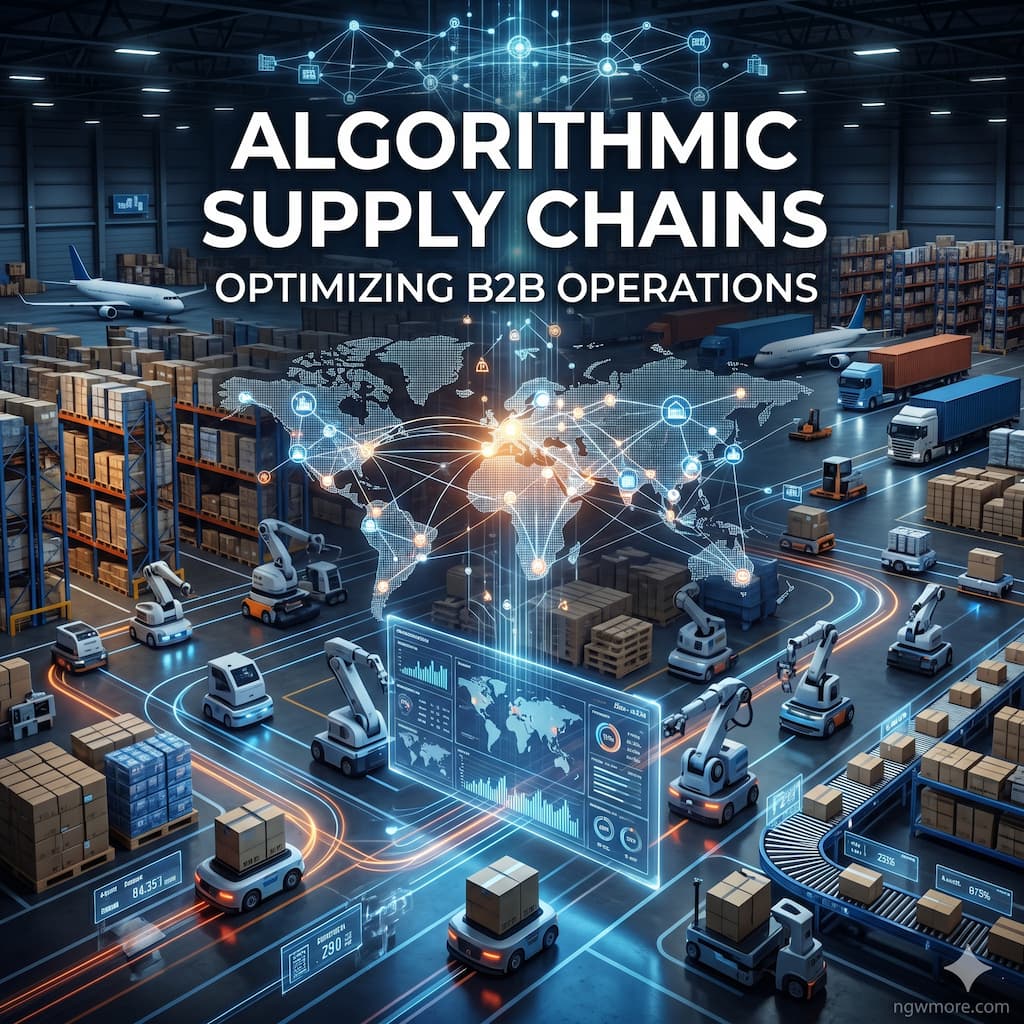
Algorithmic Supply Chains: Optimizing B2B Operations
The global Business-to-Business (B2B) supply chain architecture has entered a period of intense structural disruption. For generations, enterprise logistics, industrial procurement, warehouse inventory management, and multi-tier supplier fulfillment relied heavily on linear, manual tracking models. Operations directors evaluated material requirements using historical intuition, adjusted safety-stock parameters on monthly cadences within isolated enterprise resource planning (ERP) silos, and communicated production demands down the supply chain through uncoordinated email grids and batch-processed electronic data interchange (EDI) logs.
While this traditional, human-centric management paradigm provided basic organizational coordination during slower-moving economic cycles, it introduces severe systemic vulnerabilities within today’s hyper-connected, high-velocity commercial ecosystem.
Modern enterprise networks handle a massive volume of data, fast transactional speeds, and intense geographic fragmentation that completely overwhelm traditional administrative systems. A sudden macroeconomic localized event, an unannounced manufacturing delay from a tier-three sub-component vendor, a rapid bottleneck across international maritime shipping corridors, or shifting regulatory data mandates can instantly trigger severe bullwhip effects across the entire enterprise fabric.
Operating under this volatile reality using rigid, legacy software tools leaves revenue operations blind to active patterns. This lack of insight results in bloated capital reserves locked up in duplicate inventory, extended delivery lead times, missed client service-level agreements (SLAs), and heavily eroded profit margins.
To eliminate this operational friction, maximize systemic throughput, and secure an absolute market-leading competitive moat, forward-thinking enterprise technology and business leaders are abandoning rigid, manual forecasting methodologies. They are overhauling their underlying logistics backbones and migrating toward highly scalable, data-driven frameworks known as Algorithmic Supply Chains.
Far from an incremental reporting dashboard or a basic inventory tracking plug-in, an algorithmic supply chain integrates advanced machine learning models, streaming real-time data orchestration pipelines, multi-variable constraint optimization engines, and zero-trust data perimeters straight into the core corporate revenue infrastructure.
1. The Core Paradigm Shift: From Reactive Logistics to Autonomous Network Orchestration
To forge a highly resilient corporate fulfillment engine, Chief Operating Officers (COOs) and enterprise systems architects must transition their underlying operational philosophy away from descriptive hindsight and toward continuous, algorithmically driven foresight.
The Structural Evolution of Enterprise Logistics Logic
- Legacy Logistics Frameworks: Rely almost entirely on reactive data tracking. Systems record what has already occurred inside the network—such as historical inventory turnover rates, past delivery fulfillment timelines, and retrospective quarterly shipping cost reports.
- The Algorithmic Supply Fabric: Unifies internal corporate transactional logs with real-time external data streams. The core engine applies advanced time-series forecasting, neural network regression models, and deep learning pattern-recognition algorithms to calculate exactly how materials, inventory assets, and transportation fleets should move across the global network simultaneously.
By establishing an uninterrupted, live feedback loop between live physical behaviors and automated process optimization pipelines, algorithmic supply chains permanently eliminate information lag. The enterprise operations center moves past its historical role as a passive coordinator of disjointed siloes.
The software framework evolves into an active, strategic advisory network engineered to optimize inventory balances, predict component failures, and route transit assets programmatically at peak efficiency.
2. Core Pillars of an Algorithmic Supply Chain Stack
Constructing a production-grade algorithmic supply chain infrastructure capable of scaling safely across thousands of international distribution nodes requires an integrated technology layer anchored by four foundational execution pillars.
Pillar I: Real-Time Multi-Source Data Orchestration Ingestion
The absolute predictive performance of any algorithmic optimization model depends entirely on the volume, consistency, and real-time ingestion velocity of the underlying data streams feeding its processing loops.
- The Engineering Blueprint: Systems architects deploy automated real-time data orchestration pipelines (such as Apache Kafka or Apache Flink) connected straight to all internal and external operational layers. The system unifies first-party data (warehouse Internet of Things—IoT sensor networks, automated barcode scanning logs, live product telemetry fields) with external second-party and third-party data feeds (carrier transport telematics, real-time maritime port congestion indexes, automated customs clearance webhooks, and global weather satellite arrays). This continuous data harvest transforms unstructured physical tracking events into a standardized data schema, providing the analytical models with a live, uncorrupted view of the global supply network without human data-entry latency.
Pillar II: Predictive Multi-Variable Demand Forecasting Engines
Traditional enterprise procurement models plan inventory replenishment cycles using basic historical sales averages, assuming past consumer behaviors will repeat linearly in future quarters while failing to map complex external variables.
- The Engineering Blueprint: Scaled supply architectures deploy highly optimized Predictive Demand Engines. The machine learning core processes thousands of variable data inputs concurrently—including historical seasonal purchasing patterns, shifting B2B buyer behavioral velocity signals, regional macroeconomic indicators, and real-time open-market content consumption streams. The model computes an adaptive, rolling probability score mapping the exact volume of product units required at specific geographic distribution nodes weeks before an order is formally placed, minimizing under-stocking risks and preventing unnecessary capital allocation into surplus safety stock.
Pillar III: Programmatic Multi-Tier Inventory and Supplier Optimization
Managing an enterprise supply chain requires managing a multi-tier network of raw material extractors, component manufacturers, assembly plants, and regional fulfillment hubs. A single breakdown at a sub-tier vendor node can trigger a massive, cascading delay across the entire manufacturing pipeline if left unmonitored.
- The Scale Blueprint: Systems engineers implement automated Multi-Echelon Inventory Optimization (MEIO) models paired with algorithmic vendor monitoring tools. The platform continuously tracks inventory balances, production velocities, and delivery timelines across all supplier tiers simultaneously. If the engine detects a subtle drop in production throughput or an uncharacteristic material lead-time expansion at a tier-three component factory, the system bypasses manual communication delays. It programmatically rebalances inventory allocations across alternative distribution hubs, alters local factory scheduling queues, or re-routes order requests to pre-approved alternative supplier nodes automatically, preserving system-wide production velocity.
Pillar IV: Algorithmic Logistics Routing and Dispatch Networks
Once materials leave the warehouse floor, managing fleet distribution, dispatch schedules, and final-mile delivery corridors presents an incredibly complex, non-linear optimization puzzle highly vulnerable to real-time real-world disruptions.
- The Scale Blueprint: Operations teams deploy dynamic Combinatorial Optimization Engines that execute automated fleet routing and dispatch orchestration. The algorithm models the corporation’s entire logistics matrix as a multi-dimensional graph, evaluating driver availability limits, physical vehicle volume capacities, fuel consumption metrics, real-time traffic gridlocks, and strict customer SLA windows concurrently. The system outputs mathematically optimized transit itineraries programmatically, updating delivery vectors in real time via mobile field interfaces as on-the-ground conditions change, slicing transit overhead and maximizing delivery certainty.
3. High-Performance Optimization: The Algorithmic Supply Chain Ledger
The transition away from uncoordinated manual logistics tracking to an automated algorithmic supply chain architecture completely reconfigures an organization’s operational efficiency.
- Operational Disruptive Response Latency: Manual review requires days of cross-department communication. Algorithmic engines execute automated real-time optimization updates in seconds.
- Global Inventory Position Tracking: Opaque and siloed; restricted to snapshot batch-processed updates. Real-time, continuous ledger tracking across all international entity nodes.
- Bullwhip Effect Mitigation Efficiency: High exposure to severe inventory amplification and stockout shocks. Minimized through dynamic, multi-echelon machine learning demand tracking.
- Fleet Asset Capacity Utilization: Inefficient; burdened by high deadhead miles and under-utilized volumes. Mathematically maximized via combinatorial routing and automated dispatch arrays.
- Supply Chain Data Integrity Security: Vulnerable to tampering, manual record modification, and data leakage. Ironclad data protection via role-based access gates and hardware enclaves.
4. Real-World Applications: Algorithmic Engines in Global Commerce
Evaluating how advanced supply chain optimization platforms perform under complex, real-world enterprise environments demonstrates their critical role in safeguarding global corporate value.
Real-Time Fleet Re-Routing and Inventory Preservation During Port Gridlocks
Consider a multinational manufacturing corporation that coordinates the daily distribution of high-value industrial equipment across dozens of international shipping corridors, maritime ports, and regional fulfillment warehouses. The business operates under highly capital-intensive conditions. If a sudden regional dockworker strike or an unexpected infrastructure breakdown triggers an immediate gridlock at a primary maritime port, finished assets become trapped in transit, threatening inventory starvation across downstream assembly plants.
The enterprise eliminates this logistical friction by deploying an integrated algorithmic supply chain framework. The machine learning core monitors global port telematics data and maritime transponder feeds continuously.
The moment a significant shipping delay clears preset threshold parameters at an international port, the algorithmic engine registers the anomaly instantly.
The system bypasses traditional corporate review cycles and executes an automated protection playbook: it computes the financial and production impact of the delay across all downstream facilities, updates alternative maritime transport schedules, programmatically redirects cargo ships to uncongested alternative ports, and alerts domestic logistics networks to coordinate on-demand freight hauling to the new nodes automatically, preserving uninterrupted manufacturing throughput across the entire global enterprise network.
Proactive Supplier Rebalancing for Hyper-Scale High-Tech Manufacturing Pipelines
A global telecommunications and hardware provider manages a highly intricate assembly ecosystem, requiring the continuous integration of hundreds of precision components sourced from multi-tier international suppliers to fulfill enterprise buyer contracts. The company runs tight, lean production parameters. A single component delay can stall an entire assembly line, resulting in heavy contractual financial penalties and long-term client churn.
The corporation stabilizes its manufacturing pipeline by anchoring its procurement operations to an automated multi-tier supplier monitoring core. The platform tracks daily component production logs, raw material market availability indexes, and sub-tier shipping velocities via secure API links.
When the model detects an uncharacteristic material lead-time expansion at a specialized component factory in Europe due to localized resource shortages, it flags the bottleneck signature immediately.
The algorithm runs an automated impact analysis and executes a programmatic mitigation strategy: it locks in alternative production volumes with a pre-approved back-up supplier in Asia, updates shipping schedules with automated freight carriers, and alters regional warehouse distribution targets programmatically, insulating the primary assembly line from material shortages and ensuring full compliance with client SLA windows.
5. Security and Infrastructure Architecture for Hardened Supply Data Fabrics
Centralizing global inventory records, integrating live IoT hardware sensor telemetry, and automating API-driven logistics dispatch pathways introduces intense data privacy and system security demands. Because algorithmic supply chain networks handle an organization’s absolute physical lifeblood and process rich commercial intelligence, they represent top-tier targets for advanced cyber-espionage networks, corporate data harvesting syndicates, and logistical disruption rings.
[IoT Fleet Telemetry] ──> [Confidential Compute Enclave] ──> Secure Ingestion proxy ──> Optimization Matrix
Implementing Anonymized Data Tokenization across Supply Pipelines
To train predictive models and execute large-scale lookalike demand clustering safely without violating global user privacy directives or exposing proprietary corporate trade secrets to external analytics networks, organizations must implement a robust data perimeter.
- The Security Remedy: Systems architects deploy an automated data tokenization proxy directly at the edge of the data ingestion stream. Before any warehouse log, carrier telematics record, or vendor shipment manifest is written to the central database, all sensitive identifying fields (such as individual driver names, specific vehicle registration numbers, and client identity details) are automatically extracted, cryptographically hashed, and replaced with secure tokens. The machine learning models calculate optimization logic strictly over anonymized operational metadata and firmographic IDs, maintaining total system performance while ensuring absolute corporate confidentiality.
Hardening the Core Optimization Interfaces via Zero-Trust Isolation
Because the centralized algorithmic supply chain hub commands the absolute authority to orchestrate logistics routes, manage warehouse inventories, and trigger programmatic vendor orders, accessing this administrative engine requires extreme security constraints.
- The Security Remedy: Isolate the entire analytics infrastructure, database lakehouses, and API configuration consoles inside a strict Zero-Trust Network Access (ZTNA) envelope. Every corporate account, data-scientist terminal, and internal software integration must undergo continuous multi-factor authentication, rigorous behavioral risk screening, and endpoint device posture assessments before gaining access to the control interface. Furthermore, the core processing repositories must run within hardware-isolated Confidential Computing Enclaves equipped with hardware-level memory encryption, keeping all operational models and system weights completely insulated from unauthorized lateral access, internal insider threats, or external cyber-espionage syndicates.
6. Regulatory Convergence: Adhering to Global Data Governance Mandates
Scaling a comprehensive algorithmic supply chain architecture requires absolute compliance with an evolving web of international data governance, environmental tracking, and transaction verification standards.
- The Corporate Sustainability Due Diligence Directive (CSDDD): Landmark international legislation enforces strict tracking requirements on global enterprise networks, demanding that companies maintain pristine, data-driven audit records of their entire multi-tier supply chain’s environmental footprints and labor practices.
- Global Data Privacy Compliances (GDPR / CCPA): Imposing severe financial penalties for non-compliant tracking operations, these frameworks dictate that any automated fleet monitoring, IoT geolocation data processing, or individual driver tracking must implement reliable user consent records and robust anonymization perimeters.
- Regional Data Sovereignty Directives: Tightening data isolation laws across international boundaries require that any operational metadata, transaction record, or system telemetry captured within regional business networks must reside and be processed strictly within the physical geographic borders of that nation-state, requiring optimization engines to deploy decentralized, multi-region hybrid cloud networks.
Read More⚡ Quantum Semicondutors: Driving Next-Gen Computing Hardware
Conclusion: Orchestrating the Predictive Operational Engine
The implementation of an algorithmic supply chain architecture is not an optional optimization update for modern enterprise IT; it is a fundamental technological requirement to achieve long-term corporate resilience and operational velocity. The historical strategy of managing multi-region logistics networks through slow, manual spreadsheet tracking—while tolerating severe calculation latencies, bullwhip effect disruptions, and opaque asset tracking visibility—is an unsafe operational approach that invites market displacement and balance-sheet erosion.
By engineering an integrated, forward-looking software fabric built on high-throughput real-time data ingestion pipelines, predictive machine learning demand forecasting engines, automated multi-echelon inventory optimization models, and ironclad zero-trust data protection environments, progressive enterprise leaders transform their logistics networks from passive tracking nodes into high-performance strategic weapons.
Ultimately, the definitive advantage in the global commercial ecosystem belongs entirely to the visionary enterprises that can evaluate anomalies, optimize systems, and execute logistical decisions as fast as the physical world moves—mastering advanced algorithmic supply chain frameworks to drive secure, highly predictable, and market-leading global scale across any operational horizon.
Deploying computationally intensive time-series demand models, high-throughput IoT telematics data lakehouses, real-time fleet optimization pipelines, and ultra-secure global supply chain simulation dashboards requires world-class, zero-downtime server infrastructure. Secure your company’s operational core on an unassailable infrastructure foundation by exploring the premium enterprise hosting configurations at ngwmore.com.