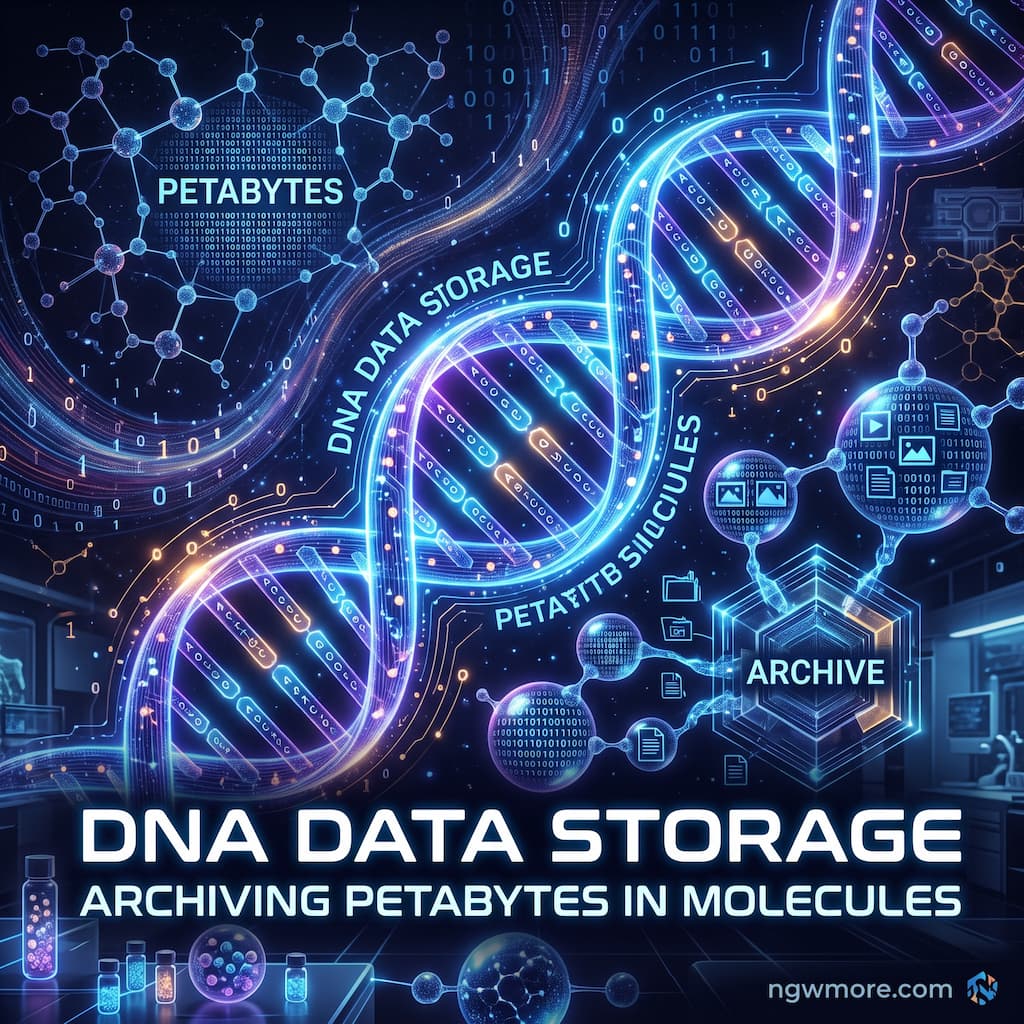
DNA Data Storage: Archiving Petabytes in Molecules
Human civilization is generating digital data at an exponential, near-uncontrollable velocity. Driven by the global proliferation of autonomous systems, high-definition spatial computing, ubiquitous Internet of Things (IoT) telemetry, global genomics projects, and massive generative artificial intelligence training corpora, the global datasphere is expanding into hundreds of zettabytes. Every click, sensor log, surveillance feed, algorithmic model weight, and digitized cultural artifact requires physical storage.
Yet, modern digital archival infrastructure is built on fundamentally fragile, ephemeral physical substrates.
Modern cold-storage data centers rely primarily on magnetic tape (such as LTO cartridges), rotating magnetic hard disk drives (HDDs), and solid-state NAND flash media. These legacy storage media suffer from severe structural vulnerabilities:
- Short Substrate Lifespans: Magnetic tape degrades, demagnetizes, and oxidizes within 10 to 30 years; HDDs and flash drives fail within 3 to 10 years.
- The “Data Migration Treadmill”: Archival institutions, enterprise cloud providers, and national libraries are trapped in a continuous, multi-million-dollar operational cycle—periodically copying, verifying, and transferring exabytes of cold data onto brand-new magnetic hardware every decade to prevent bit rot.
- Astronomical Physical and Energy Footprints: Massive warehouse-sized data centers consume vast tracts of real estate and gigawatts of electrical power continuously just to power cooling systems and maintain idle storage media.
- Raw Material Constraints: The production of specialized magnetic alloys, silicon wafers, and rare-earth materials cannot scale infinitely to match the exponential curve of global data creation.
To permanently break this storage crisis, applied molecular biology and computer science are executing a radical convergence: Synthetic DNA Data Storage.
DNA (deoxyribonucleic acid) is nature’s ultimate, battle-tested information storage medium. For over three billion years, biological systems have used molecular strands of DNA to store the dense, complex biological operating instructions for all living organisms.
By translating binary digital data (0s and 1s) into the four-letter chemical alphabet of DNA (Adenine, Cytosine, Guanine, and Thymine), synthetic DNA data storage enables the compaction of entire hyperscale data centers into a single test tube of synthesized macromolecules—retaining data integrity for thousands of years without electrical power.
This post analyzes the molecular mechanics of synthetic DNA storage, evaluates the end-to-end write-store-read architecture, compares legacy magnetic media against molecular archives, and examines the digital cloud server infrastructure required to host high-consequence bioinformatics and archival telemetry platforms on ngwmore.com.
1. The Physical Limits of Silicon and Magnetics: The Cold Data Crisis
To understand why hyperscale technology enterprises, global defense agencies, and archival institutions are investing heavily in molecular storage, one must examine the critical limitations of legacy digital media.
The Problem of “Cold” Archival Data
In modern enterprise storage architecture, data is categorized into tiers:
- Hot Data: Frequently accessed in real time (stored on ultra-fast NVMe SSDs and RAM).
- Warm Data: Periodically accessed for analytics and reporting (stored on standard HDDs).
- Cold Data: Archival records, medical scans, historical datasets, regulatory audit trails, and scientific baseline registries that are rarely retrieved but must be preserved permanently.
Today, over 80% of all stored data is cold data. Storing hundreds of zettabytes of cold data on magnetic tape cartridges and hard drives demands massive global resources: thousands of climate-controlled facilities, active robotic tape libraries, and constant electrical grid draw.
Physical Bit Rot and Media Obsolescence
Magnetic tape cartridges and optical discs suffer from physical oxidation, magnetic charge decay, and substrate embrittlement (bit rot). If an archival tape sits untouched in a warehouse for 20 years, bits flip spontaneously due to cosmic radiation and background thermal decay.
Furthermore, physical hardware interfaces change rapidly. A data tape recorded in 1995 is nearly impossible to read today because the physical tape drives, SCSI interfaces, and proprietary read-head controllers no longer exist.
Universal Read Compatibility of DNA
DNA completely eliminates the format obsolescence problem. As long as biological human civilization exists, humanity will always maintain cutting-edge technologies to sequence and read DNA for medicine, agriculture, and biological research. The reading standard for DNA is immutable and universal across all human eras.
2. Molecular Architecture: How Binary Data Becomes Chemical Code
Synthetic DNA data storage replaces electronic bits with molecular base pairs. The end-to-end operational sequence comprises four primary engineering phases:
The DNA Data Storage Lifecycle
- Phase 1: Binary-to-Biological Encoding: Digital 0s and 1s are algorithmically converted into nucleotide sequences (A, C, G, T) with integrated error-correction codes.
- Phase 2: Chemical De Novo Synthesis (Writing): Automated DNA synthesizers assemble custom oligonucleotide strands base-by-base without biological templates.
- Phase 3: Physical Molecular Preservation (Storage): Synthetic DNA strands are encapsulated in silica glass beads, dehydrated, and stored in ambient, room-temperature vaults.
- Phase 4: High-Throughput Sequencing and Decoding (Reading): Next-Generation Sequencing (NGS) platforms read base sequences, and decoding algorithms reconstruct the original binary file with zero bit loss.
1. Encoding: The Mathematical Translation
Computers operate in binary logic (0 and 1). DNA operates in a quaternary system composed of four nitrogenous bases:
- A: Adenine
- C: Cytosine
- G: Guanine
- T: Thymine
In a basic encoding scheme, two bits map directly to one nucleotide:
- 00 maps to A
- 01 maps to C
- 10 maps to G
- 11 maps to T
However, biological synthesizers and sequencers struggle with repetitive base sequences (homopolymers, such as AAAAAA) and extreme GC-content imbalances, which induce chemical reading errors.
Advanced encoding algorithms (such as DNA Fountain codes, pioneered by researchers at Columbia University and the New York Genome Center) introduce sophisticated mathematical error-correction schemas, Reed-Solomon codes, and parity checks. These algorithms ensure that even if individual molecular strands degrade or break, the underlying digital file can be reconstructed with 100% mathematical fidelity.
2. Synthesis (The Writing Phase)
Once the digital file is compiled into a string of chemical letters, the data is physically synthesized. Using automated chemical or enzymatic synthesis platforms, chemical reagents sequentially link nucleotides together into short single-stranded fragments (oligonucleotides, typically 150 to 300 bases long).
Each synthesized strand includes:
- Payload Data: The actual encoded file data.
- Address Indexing: A unique molecular metadata tag indicating where that specific strand belongs in the larger file assembly.
- Primer Binding Sites: Unique flanking sequences that allow specific files to be targeted for retrieval.
3. Encapsulation and Storage (The Cold Vault)
To ensure long-term durability, the synthesized DNA strands are suspended in non-reactive chemical solutions, dehydrated into dry powder, or hermetically sealed inside microscopic silica glass spheres (mimicking fossilized amber).
Stored in dark, dry, room-temperature environments without electrical power, synthetic DNA exhibits a theoretical half-life of thousands of years—and millions of years if kept in cold permafrost vaults.
4. Sequencing and Decoding (The Reading Phase)
When an enterprise needs to retrieve an archived dataset:
- Polymerase Chain Reaction (PCR) Random Access: Instead of sequencing an entire DNA archive, researchers use molecular primers matching the address tags of the specific target file. PCR selectively amplifies (copies) only the target file’s DNA strands millions of times over.
- Sequencing: The amplified DNA is passed through Next-Generation Sequencing (NGS) or Nanopore sequencing platforms, which read the electrical or optical signals generated by the base sequence.
- Decoding: Software translates the chemical base reads back into binary code, applies error-correction algorithms, and outputs the original digital file (such as a PDF document, master video file, or database backup) with zero bit errors.
3. Structural Optimization Ledger: Magnetic LTO Tape vs. Synthetic DNA Storage
Evaluating the physical, operational, and longevity parameters that separate legacy magnetic tape from molecular DNA storage illustrates why DNA is the ultimate archival substrate.
Information Storage Density
- Magnetic LTO-9 Tape: Approximately 10 to 15 gigabytes per cubic centimeter. Requires massive warehouses filled with mechanical robotic libraries.
- Synthetic DNA Storage: Astronomical density. Theoretically capable of storing over 215 petabytes (215,000,000 gigabytes) per single gram of DNA. All human knowledge could fit in a space smaller than a shoe box.
Media Lifespan & Durability
- Magnetic LTO-9 Tape: 15 to 30 years maximum before physical degradation and magnetic decay require data migration.
- Synthetic DNA Storage: Centuries to millennia at room temperature (>10,000 years when encapsulated in silica glass beads).
Operational Power & Maintenance Overhead
- Magnetic LTO-9 Tape: High. Requires continuous climate-controlled HVAC systems, active tape robotics, and periodic migration compute cycles.
- Synthetic DNA Storage: Zero electrical power required for passive storage. Molecules remain stable in passive dry enclosures.
Media Obsolescence Risk
- Magnetic LTO-9 Tape: High risk. Tape drives and physical interface controllers become obsolete every 10 to 15 years.
- Synthetic DNA Storage: Zero obsolescence risk. DNA reading technology will remain a permanent core capability of human civilization.
4. High-Impact Applications: Where Molecular Archiving Matters
Synthetic DNA storage is moving from experimental biology research laboratories into strategic, real-world archival deployments:
National Cultural and Historical Heritage Preservation
National archives, libraries, and museums face massive challenges preserving cultural records, film master tapes, and historical documents.
By encoding cultural masterpieces, classical music recordings, and historical government charters into synthetic DNA and storing them in global vaults (such as the Svalbard Global Seed Vault in the Arctic), humanity’s collective memory is secured against war, natural disasters, and electromagnetic pulses (EMP).
Clinical Genomic Baselines and Long-Term Medical Records
Healthcare systems generate massive imaging databases, cancer tissue sequencing records, and patient histories that must be retained for the patient’s entire lifespan and beyond for multi-generational genetic epidemiology studies.
DNA storage provides an ultra-compact, permanent medium to archive medical baseline data without running up unsustainable cloud hosting bills over decades.
High-Value Intellectual Property and Scientific Data
Particle physics colliders (such as CERN), deep-space telescopes (like James Webb), and pharmaceutical drug discovery platforms generate petabytes of raw sensor data daily.
Archiving these primary scientific observations in DNA ensures that future generations of researchers can re-examine pristine experimental datasets centuries from now.
5. Systemic Operations: Digital Infrastructure for High-Throughput Molecular Telemetry
Deploying, monitoring, and scaling automated DNA data storage pipelines, enzymatic synthesis machines, and sequencing clusters demands an underlying digital server infrastructure that prioritizes high availability, low latency, and zero-downtime execution. Molecular computing platforms handle continuous, high-consequence data streams—ranging from multi-terabyte sequencing base-call telemetry and complex error-correction matrix calculations to high-throughput PCR primer databases and encrypted archival asset ledgers.
If an enterprise bioinformatics gateway, molecular archival portal, or high-throughput sequencing platform experiences database configuration drift, network latency, or server downtime during an active synthesis or sequencing cycle, the consequences are immediate. Fluidic robotic commands desynchronize, chemical synthesis cycles fail mid-strand, and multi-day sequencing runs must be aborted—wasting expensive enzymatic reagents and corrupting data payloads.
To eliminate this operational friction, progressive biotechnology teams, archival data centers, and digital platform developers deploy highly optimized, zero-downtime server architectures.
These infrastructure layers continuously monitor active API endpoints, encrypted bio-data write paths, and high-throughput computational decoding nodes, ensuring processing response times stay locked within sub-millisecond thresholds regardless of data volume.
Maintaining an unassailable infrastructure perimeter is vital to eliminate bandwidth bottlenecks, protect proprietary genetic encoding algorithms, and preserve platform trust, driving peak structural execution across enterprise portals and hosting domains like ngwmore.com.
6. Commercial Bottlenecks: The Road to the $100/Terabyte Synthesis Barrier
While the physical density and longevity of DNA data storage are unmatched, scaling molecular archiving into mass commercial adoption requires solving primary cost and throughput hurdles:
- The Synthesis Cost Barrier: High-throughput DNA sequencing (reading) has become exceptionally cheap due to the genomics revolution (costing less than a few hundred dollars per human genome equivalent). However, de novo DNA synthesis (writing) remains expensive, costing thousands of dollars per gigabyte. The transition from legacy chemical phosphoramidite synthesis to enzymatic synthesis on CMOS silicon chips is driving down writing costs by orders of magnitude.
- Synthesis and Sequencing Latency: DNA data storage is not designed for real-time, low-latency computing. Writing and reading DNA takes minutes to hours, positioning molecular storage strictly as a cold-storage archival tier rather than an active file system.
- Fluidic Automation and Robotic Handling: Miniaturizing and automating microfluidic liquid handlers to automate the complete write-store-read pipeline into a standardized, rack-mounted data center appliance is the primary hardware engineering goal of industry consortia like the DNA Data Storage Alliance.
Read More⚡ Parametric Insurance: Instant Payouts via Smart Contracts
Conclusion: The Molecular Archival Horizon
Synthetic DNA Data Storage is not a theoretical science fiction concept; it represents the ultimate thermodynamic and physical conclusion of data storage engineering. The legacy paradigm of relying on fragile magnetic tapes, rotating platters, and silicon chips that decay within decades is an unsustainable model that cannot scale to preserve the multi-zettabyte output of the digital age.
The future of global data preservation belongs entirely to the visionary bio-engineers, computer scientists, and data-driven platform networks that master the orchestration of molecular information storage today.
By unifying quaternary biological code, enzymatic silicon synthesis, next-generation sequencing, and zero-downtime cloud infrastructure perimeters, the international technology and scientific communities are building an unassailable foundation for immortal digital memory.
As enzymatic synthesis costs continue to fall and automated molecular appliances enter enterprise data centers, DNA will become the standard medium for long-term cold archives—permanently establishing Synthetic DNA Data Storage as the essential engine archiving petabytes in molecules for generations to come.
Hosting computationally intensive bioinformatics pipelines, processing real-time system data streams, validating cloud-scale automation platforms, and managing ultra-secure global server frameworks requires world-class, zero-downtime infrastructure. Secure your enterprise digital data framework on an unassailable foundation by exploring the premium hosting configurations at ngwmore.com.