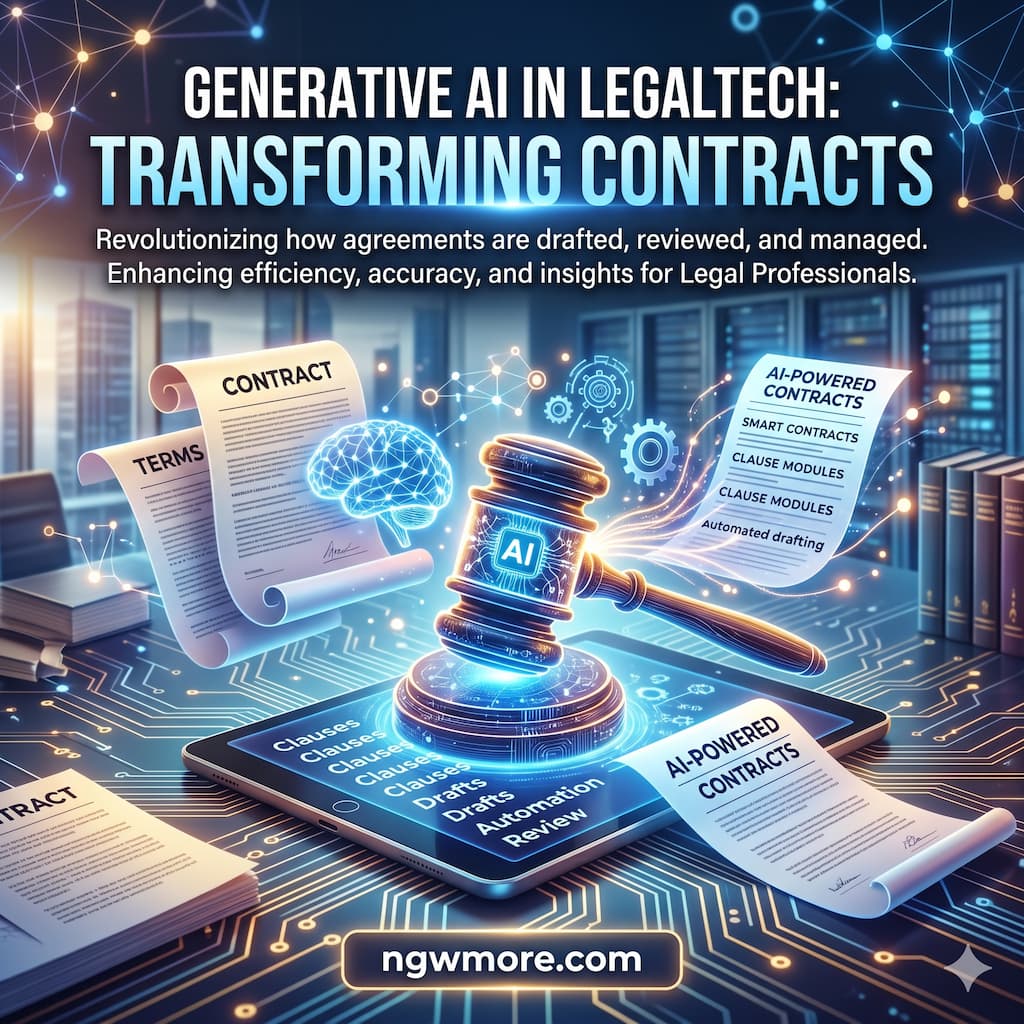
Generative AI in LegalTech: Transforming Contracts
The execution matrix of enterprise legal operations has hit a structural threshold. As we navigate through May 2026, the historic paradigm of contract management—defined by manual line-by-line redlining, lengthy transactional turnaround windows, fragmented document repositories, and exhausting forensic discovery loops—has transitioned from a traditional operational chore into a catastrophic liabilities trap. In a global marketplace accelerating through programmatic API integrations, autonomous supply chain loops, and instant on-chain settlements, corporate legal departments can no longer function as the organizational bottleneck where deal velocity goes to die.
Historically, legal teams attempted to solve the problem of scaling contract review through two highly flawed paths: either inflating their external legal counsel budgets at an unsustainable financial margin drag, or forcing internal resources to utilize primitive, keyword-based document comparison templates that completely lacked semantic comprehension.
Today, that structural vulnerability has been permanently eliminated. The standard driving elite corporate counsel efficiency and enterprise risk mitigation is the deployment of Agentic Generative AI Contract Architectures.
By embedding multi-layered, context-aware foundation models natively into your enterprise data fabric, contract management shifts from a passive, administrative risk check into a high-speed engine of proactive strategic growth. For the digital innovators, corporate legal leads, and technology growth leaders within the ngwmore.com community, mastering this intelligence grid is the definitive playbook to collapse time-to-signature friction, protect corporate cap tables, and maintain absolute structural compliance across your entire transactional perimeter with zero manual administrative drag.
1. The 2026 Legal Revolution: From Passive Text to Cognitive Contracts
To successfully operationalize generative systems within an enterprise legal workspace today, you must first dismantle legacy assumptions and distinguish between simple consumer-grade conversational text assistants and Institutional, Legal-Grade Agentic Knowledge Frameworks.
In the traditional legal operations loop, contracts were treated as static, unstructured blobs of text. Reviewing an inbound Master Services Agreement (MSA) or an international joint-venture framework required an experienced corporate attorney to dedicate hours of focused cognitive bandwidth to trace hidden cross-indemnification liabilities, analyze governing law jurisdictional cross-winds, and verify performance milestone triggers against legacy enterprise precedents.
In 2026, the industry operates on a completely digitized foundation: The Programmable Cognitive Contract Mesh. Powered by large reasoning foundation models trained explicitly on heavily curated legal ontologies and operating natively on top of centralized corporate data lakes, contracts are treated not as passive ink on paper, but as living, executable code blocks. The system continuously maps incoming contract risks, autonomously crafts precise counter-proposals based on verified corporate playbooks, and maintains active, post-signature compliance tracking with absolute structural visibility.
  LEGACY CONTRACT REVIEW PIPELINE (High Friction & Latency Chokes)
  [Inbound Contract Received] ──► [Manual Attorney Review (Days)] ──► [Iterative Redlining (Weeks)] ──► [Delayed Deal Closing]

  2026 AI-DRIVED CONTRACT FABRIC (Sub-Minute Cognitive Processing)
  [Inbound Contract Ingestion]
                │
                ▼
   ┌────────────────────────────────────────┐
   │    Generative LegalTech Engine         │ ──► [Instant Playbook Deviation Identification]
   ├────────────────────────────────────────┤
   │ * Multi-Layered Legal RAG Graph Sync   │ ──► [Autonomous Counter-Clause Generation]
   │ * Semantic Compliance Risk Profiling   │ ──► [Real-Time Post-Signature Obligation Hooks]
   └────────────────────────────────────────┘
According to international corporate legal operations metrics recorded this quarter, enterprises utilizing fully integrated generative contract architectures experience a 75% reduction in total contract lifecycle times (CLM) while expanding their risk mitigation profiles by over 40%, completely outperforming legacy departments trapped in manual word-processing loops.
2. Core Pillars of AI-Native Contract Architecture
Scaling an enterprise legal infrastructure this year requires integrating four primary technological pillars directly into your software and repository networks.
I. Multi-Layered Retrieval-Augmented Generation (RAG) and Legal Knowledge Graphs
Forcing a generative model to draft or review high-stakes corporate contracts without strict, institutional grounding parameters leads to disastrous model hallucinations and severe legal liability exposure. 2026 enterprise legal architectures deploy Advanced RAG Fabrics Tied to Sovereign Corporate Knowledge Graphs.
- The Ingestion: When an inbound contract is uploaded to the corporate ingest funnel, the AI instantly parses the text semantically, referencing your company’s proprietary negotiation history, historical board-approved policy positions, pre-vetted clause libraries, and active operational risk limits.
- The Output: The model generates recommendations completely grounded in your enterprise’s verified source of truth, guaranteeing that every automated redline or modified clause aligns perfectly with your specific corporate mandate.
II. Sub-Second Playbook Deviation Discovery and Semantic Risk Scoring
Negotiating contracts across a massive global supply chain network involves managing extreme variations in vendor terms, frequently introducing hidden liabilities that manual human review slips past during high-volume end-of-quarter pushes.
- The Algorithmic Audit: 2026 LegalTech platforms execute continuous Playbook Deviation Scoring. As soon as an inbound agreement is ingested, the AI maps the document structure against your corporate benchmark guidelines.
- The Risk Extraction: If a vendor attempts to alter an intellectual property ownership clause, inflate a limitation of liability ceiling, or introduce non-standard payment term latencies, the AI flags the deviation in milliseconds. It highlights the explicit text anomaly, calculates a multi-factor Systemic Risk Score, and appends clear, contextual explanations detailing exactly how the clause compromises your operational parameters.
III. Autonomous Counter-Clause Generation and Agentic Redlining
Identifying a contract risk is only half the battle; the defensive system must possess the capability to formulate immediate, highly persuasive counter-arguments and legal revisions.
- The Mechanical Revision: Modern generative legal platforms utilize specialized Legal Counter-Drafting Agents.
- The Alignment: When a deviation is isolated, the AI doesn’t just block the text; it programmatically rewrites the clause, pulling optimized alternatives directly from your internal pre-approved clause repository. If the vendor’s terms require custom tuning, the model writes novel, contextually sound legal prose designed to bridge the transactional divide while completely safeguarding your company’s intellectual property rights and financial margins, formatting the entire interaction cleanly into standard track-changes layout.
IV. Post-Signature Obligation Management and Programmatic System Hooks
The legal risk of a contract does not terminate once the executive team appends their digital signatures to the document execution block. In fact, that is precisely where operational risk compounds.
- The Operational Blind Spot: Companies routinely bleed millions in top-line revenue because post-signature milestones, automatic renewal opt-out windows, service-level agreement (SLA) service credits, and localized regulatory reporting triggers are forgotten inside dead PDF archives.
- The Programmable Solution: 2026 generative legal architectures completely dissolve this tracking drag via Programmatic Event-Driven System Hooks. The moment a contract is signed, the AI extracts all operational obligations, schedules, and financial triggers, programmatically injecting milestone reminders straight into your core enterprise ERP ledgers, developer sprint boards, and tracking arrays on ngwmore.com, ensuring total compliance visibility across your entire operational horizon.
3. The 2026 LegalTech Stack: Leading Enterprise Platforms
Transforming your corporate legal operations from an opaque, slow cost-center into an agile, predictive competitive advantage requires connecting your document repositories to specialized, context-aware software planes. The current 2026 landscape features highly advanced options:
| Platform Category | Leading 2026 Platforms | Core Portfolio Utility | Standout AI Advantage |
| Enterprise Legal CLM Core | Ironclad (AI Core) / Icertis / Evisort | Complete contract lifecycle orchestration, repository indexing, & risk scoring | Automated Playbook Alignment: Instantly re-aligns non-standard inbound contracts with your internal corporate compliance guidelines. |
| Deep Cognitive Review | Luminance / Harvey AI / Spellbook | Multi-file semantic synthesis, forensic due diligence, & interactive draft generation | Reasoning Foundation Core: Leverages specialized legal-language models to handle complex multi-file contract audits. |
| Data Infrastructure Layer | Palantir AIP for Legal / CoCounsel | Enterprise data lake integration, asset mapping, & secure model isolation | Secure Knowledge Mesh: Unifies unstructured legal document pools smoothly with active corporate databases. |
4. Tactical Blueprint: Operationalizing Generative AI for Contract Scale
Transitioning your enterprise away from reactive, human-constrained contract patterns and constructing an automated, data-driven legal defense grid requires a systematic, architecturally sound blueprint.
Step 1: Maximize Corporate Legal Data Liquidity
An autonomous contract analysis engine’s precision is fundamentally bounded by the transparency and completeness of its incoming data streams. You must eliminate your document storage silos. Establish direct API integrations and real-time open-telemetry webhooks connecting your primary contract storage repositories (SharePoint, Google Drive, legacy CLM vaults), your customer CRM platforms (Salesforce, HubSpot), and your enterprise ERP engines into a centralized, highly secure Unified Legal Data Lake. This provides your generative models with an unobstructed, 360-degree stream of historical corporate intelligence.
Step 2: Establish the “Attorney-in-the-Loop” Operational Flow
Do not attempt to remove human strategic legal judgment entirely from high-stakes corporate contract negotiations, complex international joint ventures, or unique M&A structuring loops. While generative models are unmatched at rapid data extraction, clause pattern matching, and accelerating volume reviews, final strategic accountability and relationship negotiation require human emotional intelligence and nuance. Implement an optimized, high-velocity operational gate:
[Inbound Contract Ingested] ──► [AI Maps Deviations & Generates Redlines] ──► [AI Compiles Forensic Analysis Dossier] ──► [Human Corporate Counsel One-Click Review]
Configure your platform settings to push high-conviction redlines and pre-populated counter-clause options straight into a centralized Live Legal Operations Feed. The AI handles the grueling, time-consuming heavy lifting—processing text, calculating risks, and writing revision code—while the human attorney retains absolute strategic control, approving or modifying the redlines with a single click before the documents are transmitted to external counter-parties.
Step 3: Implement Zero-Trust Data Isolation and Token Redaction Shields
Because an advanced generative LegalTech framework requires processing continuous data streams containing hyper-sensitive corporate trade secrets, unreleased financial parameters, and private employee data, maintaining absolute adherence to global data privacy regulations, GDPR mandates, and strict attorney-client privilege boundaries is a non-negotiable requirement.
- The Security Guard: Enforce strict Enterprise Data Isolation Parameters.
- The Execution: Ensure all individual document processing and model inference loops occur within dedicated, hardware-isolated cloud enclaves. Deploy real-time Token Redaction Shields at your API parameters to automatically sanitize highly confidential data points, private cryptographic keys, or proprietary technical algorithms before the text strings exit your secure network perimeter, keeping your enterprise core 100% insulated from external model training exploitation or data leak vulnerabilities.
5. Critical Risk Management: Navigating the 2026 Legal AI Pitfalls
Operating a highly automated, software-driven legal infrastructure requires continuous, data-backed governance to protect your enterprise from unique digital and contractual liabilities:
- The Hazard of the “Hallucinated Precedent” Trap: While modern reasoning models feature exceptional linguistic precision, they remain susceptible to subtle Model Hallucinations if confronted with highly ambiguous, non-linear text inputs. An un-monitored model can confidently invent fictional state judicial precedents or misinterpret a complex multi-jurisdictional tax withholding clause, generating non-compliant redlines that create intense structural risk if signed into law. Human legal specialists must always perform final validation checks on high-stakes clause generations.
- The Legal Precedent of AI Agency Accountability: In 2026, international regulatory bodies and contract courts have firmly established that a corporate entity is 100% legally, financially, and contractually bound by the outputs, commitments, and errors generated by its autonomous software systems. If your customer-facing automated billing bot or procurement agent accidentally commits your enterprise to an unauthorized pricing tier or signs off on a highly unfavorable vendor indemnity clause via automated API function calling, your company is legally obligated to honor that execution. Continuous adversarial red-teaming of system triggers is mandatory.
- Managing Model Drift and Jurisdictional Compliance Decay: Statutory laws, municipal codes, and corporate governance frameworks mutate continuously across the global landscape. If an enterprise contract engine continues to execute automated compliance tracking utilizing models whose training weights have drifted from active real-world legal updates, your contractual frameworks will experience silent compliance degradation. Your technical data operations team must implement automated, monthly backtesting loops to keep your model weights perfectly aligned with real-time global legal updates.
6. The Systems Synergy: Engineering High-Availability Corporate Infrastructures
For the advanced cloud systems developers, full-stack database architects, and technology visionaries who scale their digital platforms on the backbone of the ngwmore.com ecosystem, the structural logic of an integrated AI contract grid is deeply intuitive.
When you configure an enterprise server architecture, build an international e-commerce web layout, or manage a high-traffic database network on ngwhost.com, you do not tolerate single points of failure. You don’t leave your system architecture vulnerable to an isolated computing crash, a localized network drop, or an un-monitored processing leak. You design with comprehensive, mathematical redundancy: you utilize load balancers to distribute data traffic smoothly, deploy isolated container instances across multiple geographic data zones to handle processing spikes effortlessly, and maintain secure, multi-region database mirrors to ensure that if a critical server cluster drops offline, the broader network continues to perform flawlessly without data loss or asset corruption.
Deploying an integrated Generative AI LegalTech Architecture is simply extending that exact same systemic, multi-layered structural redundancy to your company’s risk mitigation and contractual frameworks:
- Your Multi-Layered Legal RAG Graphs and Real-Time Token Redaction Shields operate as your high-velocity edge nodes, parsing, filtering, and securing incoming document text streams with absolute fluid precision.
- Your Automated Deviation Trackers and Multi-Agent Redlining Engines act as your resilient core database systems, instantly compounding, simulating, and protecting your active corporate playbooks, completely insulated from individual human memory blind spots or administrative operational latency.
- Your Programmatic Obligation Hooks and Attorney-in-the-Loop Escalation Gates behave as your secure, enterprise-grade system firewalls, silently optimizing your operating margins, shielding your physical brand from contractual liabilities, and ensuring absolute corporate velocity against changing global market demands.
By mastering this integrated configuration, you strip away operational tracking drag, eliminate corporate financial vulnerabilities, and position your digital brand to scale at terminal velocity while retaining absolute, sovereign control over the global enterprise you built.
Read More⚡ Conversational AI in Enterprise: Scaling B2B Customer Care
Conclusion: Securing the Transactional Scale Victory
The era of manual contract redlining and slow paper escrow queues has run its course. In a hyper-competitive global marketplace defined by rapid technological adaptation, omni-channel fluid commerce, and instant transaction settlement requirements, forcing your scaling enterprise to rely on slow, human-constrained contract review processes is a recipe for operational failure and margin erosion.
The path to sustainable enterprise scalability requires an absolute embrace of autonomous, generative, and data-liquid software architecture applied directly to your contract perimeter. By unifying your multi-source document archives via high-performance cloud networks, linking your automated tracking telemetry directly into your central ERP and repository cores, enforcing rigorous real-time data anonymization protocols, and prioritizing an optimized attorney-in-the-loop escalation gate, you completely remove risk, friction, and human operational latency from your expansion loops entirely.
The legal frameworks of the global digital economy are transforming into programmable, high-speed intelligent applications. Build your LegalTech stack with absolute precision, protect your cap table fiercely, and let your enterprise scale to global heights on your own terms.