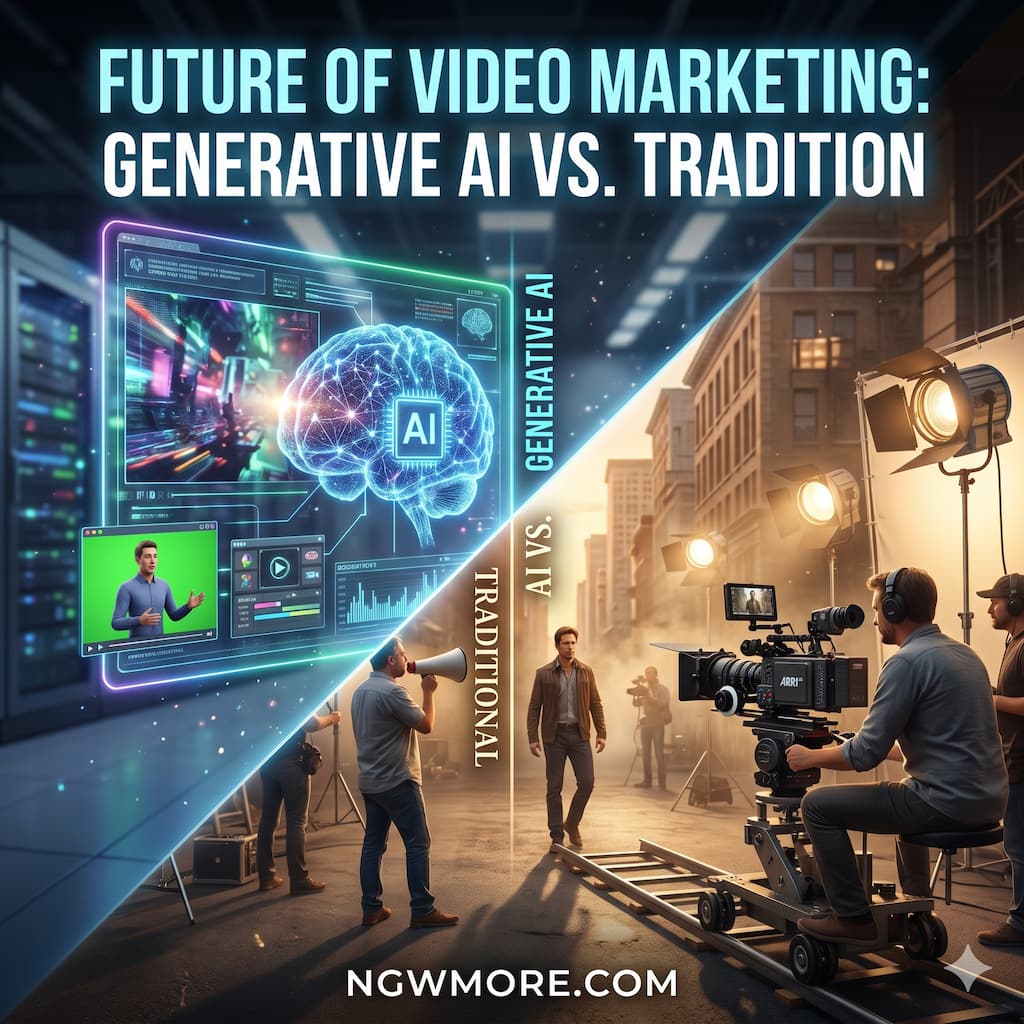
Future of Video Marketing: Generative AI vs. Tradition
The Great Cinematic Pivot
The digital marketing landscape is currently witnessing a tectonic shift that parallels the transition from silent films to talkies, or from celluloid to digital sensors. For the digital entrepreneurs and portfolio managers at ngwmore.com, video has long been the highest-converting medium. However, the traditional barriers to entry—high production costs, specialized labor, and agonizingly slow turnaround times—have historically limited the velocity of video marketing campaigns.
In 2026, we find ourselves at a crossroads. On one side stands Traditional Video Production, a craft perfected over a century, rooted in human intuition, physical sets, and expensive hardware. On the other side is Generative AI, a disruptive force capable of conjuring hyper-realistic visuals and natively generated audio from a simple text prompt.
This is not merely a battle of “Man vs. Machine.” It is an architectural evolution. For operators scaling e-commerce brands on TikTok Shop or managing content empires across multiple domains, understanding the tension between these two methodologies is essential for survival. This comprehensive guide explores the future of video marketing, comparing the soulful precision of tradition against the exponential speed of Generative AI.
1. The Traditional Bastion: Why Human Craft Still Matters
Traditional video marketing is defined by its physical constraints and human-centric execution. It involves location scouting, casting calls, lighting rigs, and the meticulous process of frame-by-frame editing by a human specialist.
Emotional Nuance and Subtext
The primary argument for tradition is the “human element.” A human director understands subtext—the subtle twitch of an eye or a specific vocal inflection that conveys trust or irony. In high-ticket marketing or brand storytelling, these micro-expressions are often what close the deal. Traditional production excels at capturing raw, unscripted moments of authenticity that resonate on a biological level.
Physical Authenticity
For certain industries—such as automotive detailing or luxury jewelry—physical authenticity is a requirement. If you are showcasing the water-beading effect on a car or the light refraction of a custom necklace, viewers demand to see the actual product in a real environment. Tradition provides the “proof of reality” that AI still struggles to replicate with 100% fidelity in a physical context.
2. Generative AI: The Engine of Hyper-Scale
Generative AI, powered by models like Veo, has redefined what is possible for a solo entrepreneur. It allows for the creation of high-fidelity video with natively generated audio cues from text, reference images, or even specified first and last frames.
Drastic Cost Reduction
A traditional commercial shoot can cost thousands of dollars per day in equipment and labor. Generative AI collapses these costs into a software subscription and compute time. For a digital entrepreneur managing a brand, the ability to generate a high-quality product showcase video for a few cents allows for an aggressive trial-and-error approach that was previously impossible.
Content Velocity and The “Infinite Ad”
In the era of social commerce, ad fatigue is a silent killer. Traditional production cannot keep up with the algorithm’s demand for fresh content. Generative AI allows for Content Velocity. You can generate 50 variations of an ad—changing the background, the spokesperson’s language, or the background music—in the time it takes to set up a single light in a traditional studio.
3. The Hybrid Model: Orchestrating a New Workflow
The most successful marketers in 2026 are not choosing one over the other; they are building a hybrid architecture. They use tradition for the core brand “DNA” and Generative AI for the “Tactical Execution.”
AI-Enhanced Post-Production
Traditional footage is now routinely enhanced by AI. Editors can use Generative AI to extend a shot, remove an unwanted object from the background, or change the lighting of a scene after it has been filmed. This “Composition and Style Transfer” capability bridges the gap between the two worlds.
Personalized Video at Scale
The future of video marketing is hyper-personalization. Tradition creates the template, but AI executes the delivery. A brand can film a single traditional message and then use AI to dynamically change the audio and visual cues to address the viewer by name or mention their specific city, such as Rio Grande.
4. Technical Infrastructure: Supporting the AI Load
At https://www.google.com/search?q=ngwmore.com, we understand that high-end AI tools require high-end digital foundations. Running Generative AI workflows, especially video and music generation through models like Veo and Lyria 3, puts a massive strain on server resources.
API Latency and GPU Compute
For businesses integrating AI video tools into their sales funnels, API performance is critical. If your server environment—managed via aaPanel or a similar VPS setup—cannot handle the rapid-fire requests needed for real-time video generation, your funnel will fail.
The Role of SynthID and Security
As Generative AI becomes more prevalent, the issue of authenticity arises. Tools like Lyria 3 now include SynthID watermarking for AI-identification. From an infrastructure standpoint, ensuring that your content is properly tagged and secured is vital for maintaining brand trust and adhering to emerging digital regulations.
5. Music and Audio: The Unsung Heroes of Video
Video is only half the battle; high-fidelity audio is what cements the viewer’s emotional connection. The future of video marketing involves the seamless integration of Music Generation.
Contextual Soundtracks
With models like Lyria 3, marketers can generate 30-second tracks with granular control over tempo, genre, and emotional mood. Instead of searching through stock music libraries for hours, an AI can generate a custom arrangement that perfectly syncs with the visual cues of the video.
Read More⚡ E-commerce AI: Using Hyper-Personalization to Triple Conversions
Conclusion: The Era of the Technical Director
The “Generative AI vs. Tradition” debate is moving toward a synthesis. Tradition provides the soul and the physical anchor, while Generative AI provides the scale and the infinite variety.
The digital marketer of the future is no longer just a “creative” or a “copywriter”; they are a Technical Director. They must understand how to prompt a video model, how to orchestrate APIs, and how to manage the server infrastructure that hosts these powerful tools.
By embracing Generative AI while respecting the core tenets of traditional storytelling, you can build a video marketing engine that is both emotionally resonant and mathematically optimized for profit.
To stay at the forefront of AI-driven marketing and the server architecture that makes it possible, continue your deep-dive with the resources here at ngwmore.com.