
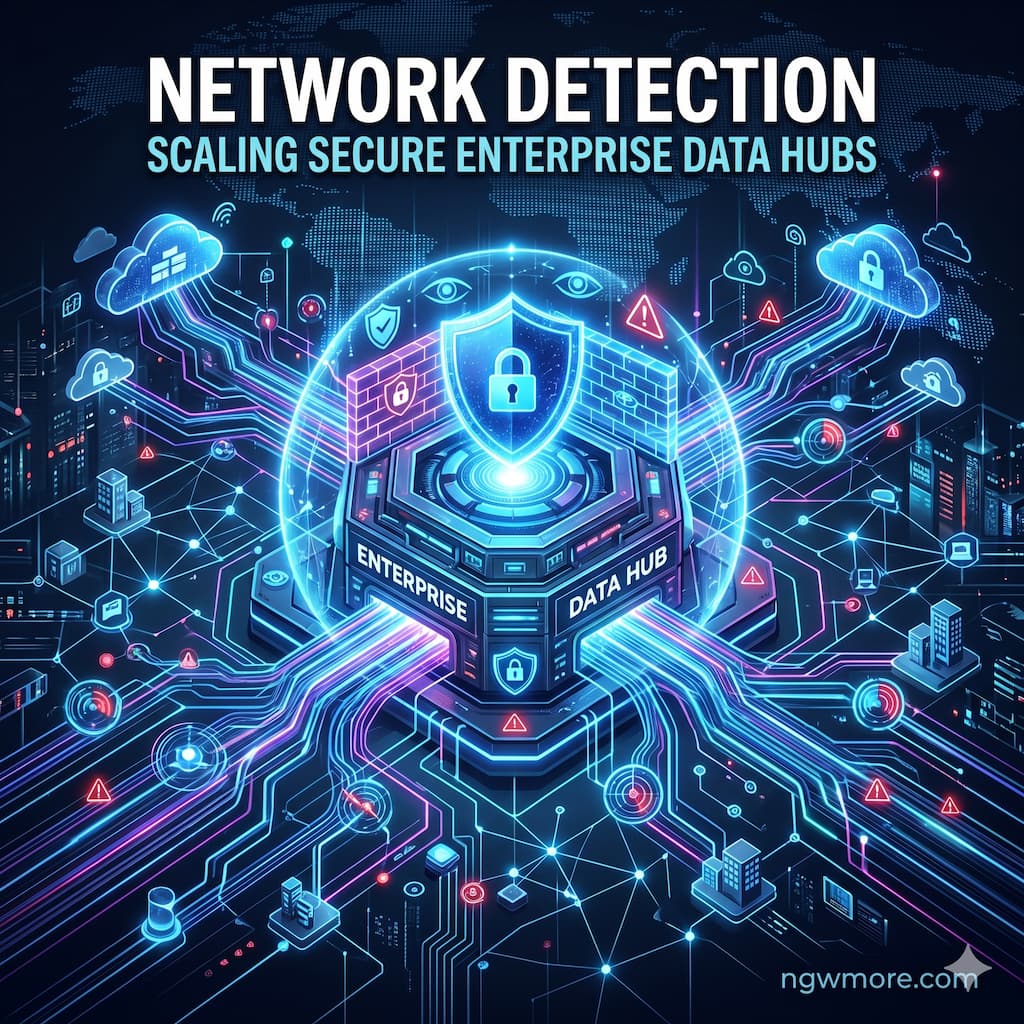
Network Detection: Scaling Secure Enterprise Data Hubs
The corporate network perimeter has fundamentally transformed. For decades, enterprise technology architecture operated within a localized, static model. Systems engineers built centralized data repositories on-premises, insulated by heavy hardware firewalls and secure web gateways. This established a structural “castle-and-moat” defense matrix that treated all internal data traffic as inherently safe and verified.
However, the rapid acceleration of hyper-scale multi-cloud deployments, distributed hybrid workforces, cross-border API-driven data frameworks, and high-velocity business intelligence applications has permanently broken this legacy baseline.
Today, enterprise data is no longer confined to an isolated physical mainframe. Modern organizations aggregate their core computational assets within massive, highly distributed ecosystems known as Enterprise Data Hubs. These architectures ingest billions of daily transactional events, streaming telemetry feeds, customer records, and product logs simultaneously across dynamic cloud fabrics like AWS, Microsoft Azure, and Google Cloud.
Concurrently, the applications and pipelines interacting with these high-value data repositories are completely decentralized—connecting from edge endpoints, automated third-party supplier portals, and hybrid cloud containers globally.
Operating a high-throughput, multi-region enterprise data hub under this highly open, elastic reality while relying on legacy network monitoring paradigms introducing intense systemic vulnerability. Conventional security tools like basic signature-matching Intrusion Detection Systems (IDS), superficial packet-filtering logs, and reactive security information and event management (SIEM) batch-processing routines are structurally incapable of handling the sheer scale, speed, and sophistication of modern zero-day exploits, advanced persistent threats (APTs), and lateral living-off-the-land techniques.
To maintain total data sovereignty, eliminate critical infrastructure blind spots, and guarantee uninterrupted systemic availability, progressive technology and security leaders are upgrading their core defensive perimeters. They are systematically designing and scaling advanced Network Detection and Response (NDR) frameworks as the foundational security layer for their corporate data ecosystems.
1. The Architectural Bottleneck: Why Passive Log Analysis Fails at Scale
To architect an unassailable data ingestion environment, systems engineers must first analyze the severe limitations of legacy security frameworks when confronted with modern enterprise data hubs.
- Legacy Log-Based Monitoring: Relies heavily on retrospective log file generation from discrete application points. The system records an event after a transaction executes, structures the record into a text file, and streams it to a central repository for manual analysis. If an adversary gains legitimate credential access and uses native administrative software to extract data laterally, the behavioral anomaly is obscured within terabytes of standard text logs, resulting in months of detection latency.
- Modern Scaled NDR Infrastructure: Abandons passive, retrospective text log parsing in favor of continuous, real-time Network Traffic Analysis (NTA). NDR platforms operate by mirroring raw network packet data straight from physical and virtual cloud switches, processing the raw packet headers and payloads at the network layer simultaneously.
 [Raw Network Packet Streams] ──> Real-Time Packet Mirroring ──> Behavioral AI Engine ──> Sub-Second Threat Mitigation
 [Siloed Log Generation]      ──> Batch Log Shipping        ──> Delayed Manual Triage ──> Extended Threat Exposure Window
By evaluating the broad structural context of every individual packet interaction—such as anomalous protocol handshakes, unusual port behaviors, local data-staging sequences, and outbound connection velocities—NDR platforms identify highly sophisticated cyber-espionage networks instantly, long before a trailing log file can ever be generated or transmitted to a security queue.
2. Definitive Trends Reshaping Scaled Network Detection
The landscape of enterprise data center security is adapting to clear macro trends, driven by the increasing cleverness of threat groups and the emergence of advanced automated software processing capabilities.
Trend I: The Rise of Real-Time Deep Packet Inspection (DPI) Powered by Behavioral AI
Enterprise data hubs ingest trillions of data bytes across thousands of distributed pipelines. Attempting to backhaul every single network packet to a centralized cloud data center for analysis introduces severe network latency bottlenecks and excessive cloud infrastructure bandwidth costs.
To solve this operational scaling bottleneck, modern NDR architectures embed deep packet inspection (DPI) and machine learning engines directly into localized, distributed software sensors and virtual appliances.
These edge sensors run advanced behavioral artificial intelligence models locally, monitoring network traffic velocities independently. The machine learning core establishes an adaptive baseline of normal network communication patterns.
If a specific database node suddenly begins communicating via an uncommon protocol, spawning abnormal peer-to-peer data transfers, or attempting to connect to unverified external IP registries, the local AI model flags the behavioral anomaly instantly. The system isolates the suspicious traffic stream at the packet level without waiting for instructions from a centralized cloud manager.
Trend II: Cryptographic Traffic Analysis and Decryption-Free Threat Detection
As privacy mandates tighten and corporate data perimeters harden, the overwhelming majority of modern enterprise network traffic travels across completely encrypted pathways using advanced transport layer security (TLS 1.3 protocols). While encryption is essential to protect proprietary business files from passive external sniffing, it introduces a massive defensive blind spot: sophisticated adversaries use these identical encrypted tunnels to mask their internal command-and-control communications and hide data exfiltration paths.
Modern network detection frameworks bypass this visibility barrier by deploying advanced Encrypted Traffic Analytics (ETA). Instead of using high-overhead, high-latency decryption proxies to physically unwrap every data packet—which introduces massive computational processing drag and violates user data privacy laws—ETA algorithms analyze the metadata characteristics of the encrypted stream.
The machine learning engine evaluates packet length sequences, arrival time distributions, handshake variations, and initial cryptographic self-assertions to identify hidden malware signatures and active malicious channels with sub-percent error rates, completely preserving data privacy while maintaining absolute network visibility.
Trend III: Automated Incident Playbooks and Network Fabric Integration
The baseline execution velocity of modern automated ransomware scripts means that manual human response speeds are no longer fast enough to protect distributed cloud databases from systemic compromise. If an attacker breaches a remote database and initiates an automated multi-threaded encryption loop, a security analyst taking fifteen minutes to open an operational ticket and review event logs will result in total data loss for that segment and adjacent data pools.
Scaled NDR infrastructures counteract this risk by implementing automated incident playbooks through deep Security Orchestration, Automation, and Response (SOAR) and network fabric integrations. Security architects program granular, automated isolation rules tailored to specific threat certainty scores.
The moment the NDR platform verifies a high-confidence data-exfiltration signature or an active lateral movement attack, it triggers an immediate response programmatically: it signals the network’s software-defined networking (SDN) controllers or cloud security groups to dynamically rewrite routing tables—quarantining the infected database node from the rest of the global infrastructure core in seconds, containing the blast radius of the attack automatically.
3. High-Performance Optimization: The Network Detection Metric Ledger
Transitioning an enterprise infrastructure away from uncoordinated point logging tools to a scaled, automated NDR framework fundamentally redefines an organization’s defensive efficiency and network optimization parameters.
- Average Threat Discovery Latency: Traditional logging systems require hours or days of manual analysis. Scaled NDR drops threat discovery times to sub-seconds via deep packet inspection.
- Alert Noise Compression Ratio: Legacy environments face heavy alert fatigue from uncoordinated logs. NDR compresses data inputs up to 15x by clustering related alerts into unified incidents.
- Network Infrastructure Bandwidth Drag: High-overhead text log streaming creates bandwidth constraints. NDR uses lightweight, edge packet mirroring to minimize data backhaul costs.
- Lateral Containment Velocity: Manual, multi-department intervention delays threat isolation. NDR utilizes automated, programmatic SOAR and SDN playbooks to isolate nodes in seconds.
- Data Lineage and Packet Visibility: Fragmented local data logs lack context. NDR provides complete, network-wide cryptographic packet data history across all hub nodes.
4. Real-World Applications: Network Detection Across Enterprise Hubs
Analyzing how scaled network detection platforms perform under real-world enterprise conditions demonstrates their critical role in safeguarding global business operations and high-volume data streams.
Defending Multi-Cloud Analytics Lakes and Distributed Microservices
Modern enterprise data hubs are not limited to physical office hardware; they encompass thousands of dynamic, short-lived cloud containers and microservices running inside hybrid cloud infrastructures. If an attacker exploits a remote-code execution vulnerability within a public-facing cloud application, they can compromise the underlying container instance and attempt to move laterally to compromise the central analytics data lake where proprietary business intelligence resides.
The enterprise shields its multi-cloud fabric by deploying specialized, cloud-native NDR virtual sensors across all virtual private clouds (VPCs) and container network interfaces (CNIs). The NDR platform monitors inter-container East-West traffic patterns continuously.
If a compromised web application container suddenly attempts to scan adjacent database clusters or execute unauthorized database query commands, the cloud NDR agent detects the anomalous internal lateral scanning attempt instantly.
The platform triggers an automated API call to the cloud provider’s identity and access control layer, revoking the compromised instance’s active security tokens immediately and spinning up a fresh, uncorrupted application instance programmatically, ensuring uninterrupted web app availability while preserving complete cryptographic packet logs for forensic analysis.
Protecting Critical Industrial Internet of Things (IoT) Data Ingestion Conduits
For energy conglomerates, automated manufacturing systems, and global logistics networks, corporate enterprise data hubs are tightly linked to sprawling Internet of Things (IoT) edge systems and automated operational technology (OT) sensors. If an adversary compromises a legacy engineering terminal or a remote IoT data-collector hub, they can attempt to inject rogue operational commands or false telemetry data into the central data hub, threatening to distort business intelligence reports or trigger physical equipment breakdowns.
The corporation hardens this critical ingestion intersection by implementing an IoT-focused NDR architecture. Because legacy industrial terminals and lightweight IoT sensors frequently run on older software that cannot tolerate heavy on-device security applications, the scaled NDR framework utilizes non-disruptive, passive physical network sensors to monitor the traffic streams.
The platform continuously audits command-execution patterns, communication protocol compliance, and transactional data packet frequencies across the OT-IT interface.
The moment an unauthorized edge sensor attempts to transmit malformed data packets or alter internal system parameters, the NDR system blocks the transmission route instantly, flags the device as compromised, and safeguards critical physical infrastructure assets from digital sabotage.
5. Security Architecture for Hardened Telemetry Ingestion Networks
Because a scaled enterprise NDR framework handles an organization’s ultimate financial and operational intelligence—including real-time data flows, network configuration schema maps, and sensitive employee identity telemetry—the underlying data infrastructure itself represents a premium target for advanced espionage networks and cyber-sabotage syndicates.
- Enforcing Cryptographic Data Integrity and Append-Only WORM Storage: Advanced adversaries attempting a high-tier enterprise penetration frequently try to erase or modify local network security logs to blind the Security Operations Center (SOC) to their ongoing lateral data movements. To solve this risk, implement strict Write-Once-Read-Many (WORM) storage parameters and cryptographic packet hashing across the entire enterprise telemetry lakehouse infrastructure. The moment a security packet or metadata signal is captured by a local NDR sensor, it must be encrypted in transit using mutual TLS (mTLS) protocols and committed directly to an append-only data repository. This configuration ensures that once security data enters the central ingestion core, it becomes entirely unalterable and historically auditable, making it impossible for internal bad actors or external adversaries to delete or manipulate historical security records to hide active malicious footprints.
- Protecting the Central NDR Dashboard via Zero-Trust Access Gates: Because the centralized NDR dashboard commands the absolute authority to physically isolate database clusters, rewrite software-defined networking rules, and alter system security parameters across thousands of data hub nodes globally, accessing this administrative engine requires extreme security constraints. Isolate the entire NDR management console, analytics databases, and API integration pathways inside a strict Zero-Trust Network Access (ZTNA) envelope. Every security team account, administrative supervisor, and automated software integration must undergo continuous multi-factor authentication, rigorous behavioral risk screening, and device integrity checks before gaining access to the platform core. This strategy keeps your enterprise network defense engine completely insulated from unauthorized lateral access, data harvesting, or credential exploitation at all times.
6. Regulatory Compliance: Meeting Global Data Security Mandates
Scaling a comprehensive network detection architecture is no longer merely an infrastructure best practice; it is a vital legal necessity to maintain corporate compliance with tightening international regulatory frameworks and data protection standards.
- The SEC Cybersecurity Disclosure Rules: Imposing strict guidelines on public organizations, these mandates require companies to maintain reliable, continuous logging frameworks and deploy automated threat discovery mechanisms to ensure material security incidents are reported within a strict four-day window.
- The NIS 2 Directive (European Union): Expanding security mandates across essential infrastructure sectors in Europe, NIS 2 enforces rigorous requirements for end-to-end incident management, continuous network observability, and proactive cross-domain risk management, backed by heavy financial penalties for non-compliance.
- Global Data Protection Frameworks (GDPR / HIPAA): Tightening privacy laws demand that sensitive customer healthcare or financial records must be isolated via granular access controls, requiring organizations to deploy real-time network detection to prevent unauthorized data harvesting and maintain absolute compliance audit trails.
Read More⚡ Predictive Analytics: Strategy for Optimizing B2B Sales
Conclusion: Engineering the Resilient Enterprise Core
The deployment and scaling of a modern Network Detection and Response (NDR) architecture is not a discretionary luxury for the enterprise; it is a fundamental technological requirement to survive tomorrow’s high-velocity cyber-threat landscape. The historical strategy of managing corporate networks through static, signature-based intrusion sensors—while tolerating severe alert fatigue, visible blind spots, and slow, manual incident response cycles—is an unsafe approach that exposes an organization to severe financial, legal, and operational ruin.
By engineering an integrated, automated network defense fabric built on high-performance multi-source telemetry ingestion, distributed deep packet inspection engines, hardware-hardened data integrity protections, and autonomous response playbooks, forward-thinking technology and security leaders do far more than just log network activity. They build an incredibly fast, highly resilient, and endlessly scalable engine for corporate cyber resilience.
Ultimately, the competitive advantage in the global digital ecosystem belongs entirely to the agile enterprises that can defend their infrastructure as fast as they process data—mastering advanced NDR telemetry fabrics to drive secure, unassailable global expansion across any operational horizon.
Deploying computationally intensive network telemetry lakehouses, high-performance deep packet inspection engines, real-time multi-source data aggregators, and low-latency automated software-defined networking response dashboards requires state-of-the-art, zero-downtime server infrastructure. Secure your company’s digital data hubs on an unassailable foundation by exploring the premium enterprise hosting configurations at ngwmore.com.