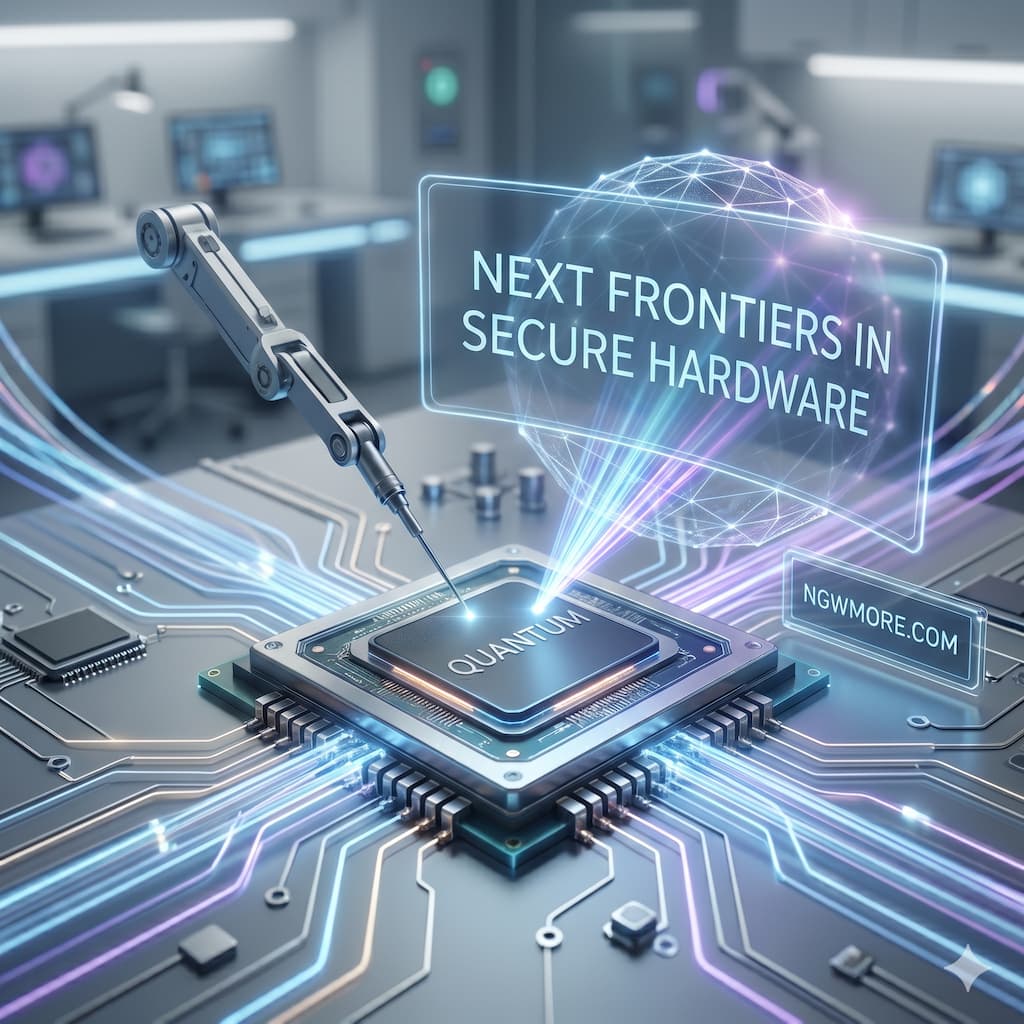
Quantum Cryptography: Next Frontiers in Secure Hardware
The global enterprise technology architecture is approaching a structural reckoning. For decades, international banking systems, corporate cloud fabrics, digital asset repositories, and critical national infrastructure have anchored their security perimeters to a foundational cryptographic paradigm: asymmetric public-key cryptography. Modern hardware roots of trust, secure enclaves, and encrypted data-transit pipelines utilize algorithms like RSA and Elliptic Curve Cryptography (ECC) to shield corporate intelligence, operating under the assumption that these mathematical problems are far too complex for classical microprocessors to solve within any practical timeframe.
However, the rapid computational scaling of fault-tolerant Quantum Computing Systems is on a direct collision course with this defensive model.
By leveraging the mechanics of sub-atomic physics—specifically superposition and entanglement—quantum processors run specialized mathematical procedures that bypass classical timelines entirely. Most notably, Shor’s Algorithm can effortlessly factor massive prime numbers and compute discrete logarithms in fractional timescales, effectively rendering legacy asymmetric encryption obsolete once quantum hardware reaches a sufficient qubit threshold.
The danger is not merely a future vulnerability; it manifests today as an active, retrospective corporate threat known as the “Harvest Now, Decrypt Later” (HNDL) exploit. Sophisticated threat groups and hostile nation-state syndicates are actively intercepting and archiving encrypted enterprise network traffic, financial datasets, and proprietary corporate intelligence right now. They are committing these scrambled data payloads to append-only storage networks, patiently waiting for quantum processing hardware to mature so they can execute Shor’s Algorithm and unlock historical corporate networks retroactively.
To permanently neutralize this exposure, mitigate systemic cryptographic degradation, and preserve data integrity across multi-generational timelines, forward-thinking technology and infrastructure leaders are overhauling their hardware security modules. They are migrating away from legacy, mathematics-dependent parameters and looking toward the absolute physical boundaries of data defense: Quantum Cryptography built onto Secure Hardware Frontiers.
1. The Architectural Paradigm Shift: Physics-Based Security vs. Algorithmic Complexity
To construct a truly resilient enterprise security framework, systems architects must first recognize the fundamental difference between software-defined post-quantum cryptography (PQC) and hardware-native quantum cryptography.
- Software-Defined Post-Quantum Cryptography (PQC): Replaces vulnerable RSA and ECC systems with complex, multi-dimensional geometric algorithms, such as lattice-based cryptography. While PQC software provides essential, low-friction integration across existing software applications, its core defense still relies on the assumed complexity of mathematical problems. It remains theoretically vulnerable to future mathematical breakthroughs or unmapped algorithmic shortcuts.
- Hardware-Native Quantum Cryptography: Abandons reliance on mathematical complexity entirely, shifting the burden of data protection straight to the immutable laws of quantum mechanics. Instead of hiding a secret key inside a difficult math problem, quantum hardware uses individual sub-atomic particles (such as photons) to generate, exchange, and verify cryptographic keys.
Because the physical behavior of a quantum state is governed by principles like the Heisenberg Uncertainty Principle and the No-Cloning Theorem, any attempt by an external adversary to intercept, measure, or clone a quantum key instantly alters the particle’s physical state. The security is absolute because it is enforced by the fabric of the universe: to break the encryption, an attacker would have to break the laws of physics.
2. Core Pillars of the Secure Quantum Hardware Frontier
Deploying a production-grade quantum cryptographic network across distributed enterprise cloud datacenters requires constructing a specialized, high-performance hardware infrastructure anchored across four foundational pillars.
Pillar I: Quantum Key Distribution (QKD) and Photonic Processing Cores
To transfer highly confidential data payloads between remote corporate datacenters safely, organizations cannot rely on standard fiber-optic networking gear, which is highly vulnerable to passive data tapping and fiber splicing splits.
- The Engineering Blueprint: Infrastructure teams deploy specialized QKD Optical Modules connected directly to dark fiber networks. These hardware units feature advanced single-photon sources and highly calibrated photonic processing chips. The system transmits cryptographic keys by sending individual photons polarized in specific quantum orientations. If an adversary attempts to tap into the fiber line to harvest the key data, the photon’s wave function collapses immediately, introducing a measurable error rate into the transmission channel. The QKD hardware flags the physical intrusion attempt in real time, drops the compromised key fragment automatically, and routes a clean, uncompromised key through a secondary optical channel instantly.
Pillar II: True Quantum Random Number Generators (QRNG) on Silicon
The structural strength of any encryption protocol—whether classical, post-quantum, or quantum-native—depends completely on the absolute unpredictability of its underlying cryptographic keys. Traditional software-defined pseudo-random number generators utilize mathematical formulas that are inherently deterministic; if an attacker maps the initial seed value, they can predict every subsequent key generated by the system.
- The Engineering Blueprint: Hardware designers integrate True Quantum Random Number Generators (QRNG) directly onto enterprise silicon microprocessors and secure enclave chipsets. These microscopic modules harvest pure, absolute thermodynamic and quantum entropy by measuring sub-atomic phenomena, such as the unpredictable arrival times of photons hitting a beam splitter or the quantum shot noise occurring inside a semiconductor junction. The QRNG chip outputs a continuous stream of pure, mathematically unpredictable entropy at gigabit-per-second velocities, providing corporate encryption engines with absolute protection against predictive brute-force simulations or algorithmic reverse-engineering.
Pillar III: Post-Quantum Hardware Roots of Trust (RoT) and Cryptographic Agility
While physics-based QKD networks secure core data-center transport lanes, local enterprise edge devices, server motherboards, and cloud hypervisors still require on-chip algorithmic protection capable of executing quantum-resistant calculations locally without introducing processing bottlenecks.
- The Engineering Blueprint: Silicon foundries embed specialized Post-Quantum Hardware Roots of Trust (RoT) directly into next-generation microprocessors. These dedicated cryptographic coprocessors feature custom hardware accelerators designed specifically to process complex lattice-based algorithms (such as ML-KEM and ML-DSA) at the physical gate level. Furthermore, these chips are engineered with complete Cryptographic Agility, allowing security administrators to update, swap, and reprogram the on-chip cryptographic algorithms via secure firmware updates without needing to replace the physical enterprise server hardware down the line.
Pillar IV: Solid-State Quantum Memory Modules and Repeaters
Photons traveling through traditional silica fiber-optic lines naturally degrade and experience signal loss over long distances, limiting traditional point-to-point QKD networks to a physical range of approximately 100 to 200 kilometers before the quantum signal becomes unreadable. Classical network amplifiers cannot resolve this issue because physically reading and amplifying a quantum state violates the No-Cloning Theorem, destroying the key’s security.
- The Engineering Blueprint: Quantum network engineers deploy Quantum Repeaters equipped with solid-state Quantum Memory Modules. These advanced hardware components trap individual photons within microscopic crystalline structures—such as nitrogen-vacancy centers in synthetic diamonds or rare-earth-ion dopants in silicates—preserving the particle’s delicate quantum superposition state without measuring it. The repeater executes quantum teleportation and entanglement-swapping procedures across successive physical segments, safely extending the range of unassailable quantum cryptographic networks across continental scales without exposing a single byte of data to classical interceptors.
3. High-Performance Optimization: The Secure Quantum Hardware Ledger
Transitioning an enterprise technology fabric from software-defined, mathematics-dependent security models to a hardware-native quantum cryptographic architecture completely redefines operational parameters and resilience benchmarks.
- Core Source of Security: Algorithmic complexity; vulnerable to future mathematical breakthroughs. Immutable laws of physics; protected by quantum mechanics.
- Vulnerability to HNDL Vectors: High risk; archived network data can be decrypted in the future. Eradicated; quantum keys alter states immediately if intercepted or measured.
- Cryptographic Key Unpredictability: Deterministic math equations vulnerable to seed-value mapping. Absolute entropy harvested directly from sub-atomic quantum phenomena.
- Maximum Transmission Distance: Unlimited over traditional global routing networks. Geographically limited; requires specialized quantum memory repeaters over 200km.
- Hardware Integration Complexity: Standard; implemented via baseline software updates. High; requires custom photonic chips, QKD optics, and specialized dark fiber.
4. Real-World Applications: Quantum Hardware in Enterprise Infrastructures
Analyzing how quantum cryptographic hardware operates under rigorous enterprise conditions underscores its transformative value across high-stakes commercial environments.
Securing Ultra-High-Volume Sovereign Financial Networks and Clearinghouses
Global clearinghouses, international central bank settlement links, and high-frequency financial messaging networks process trillions of dollars in daily asset transfers. These financial pipelines represent the absolute primary target for sophisticated state-sponsored cyber-espionage groups seeking to induce systemic market destabilization or execute high-value capital thefts.
The financial network permanently hardens its transactional infrastructure by implementing a comprehensive quantum cryptographic hardware layer. All primary data storage networks and data center nodes are interlinked via dedicated fiber lines equipped with QKD optical modules.
When a multi-billion-dollar wire settlement is initiated, the required encryption keys are generated locally via on-chip silicon QRNG modules and exchanged across the photonic network using single-photon polarization routing.
If a malicious actor attempts to split the fiber line to harvest the key exchange packets, the quantum states collapse instantly, alerting the clearinghouse’s Security Operations Center (SOC) within milliseconds. The system drops the compromised transmission lane automatically and switches to an alternative route, ensuring sovereign capital mobility remains completely unassailable.
Protecting Long-Term Government Intelligence and Strategic Defense Pipelines
National defense organizations, aerospace engineering groups, and state intelligence networks manage vast, highly confidential datasets—including weapon design blueprints, satellite tracking telemetry, and diplomatic communication logs. Because this data remains strategically sensitive for decades, it is the prime target for aggressive Harvest Now, Decrypt Later (HNDL) data-harvesting operations.
The defense network immunizes its communication pipelines by deploying advanced post-quantum hardware roots of trust and cryptographic agility engines across all tactical deployment terminals, field command modules, and cloud servers.
All historical data archives and live communication feeds are encrypted using lattice-based post-quantum algorithms executed by dedicated on-chip hardware accelerators.
This infrastructure configuration guarantees that even if an adversary captures the data packets as they travel across public communication channels today, the archived files remain an unreadable, permanently scrambled puzzle that cannot be reverse-engineered by future quantum computers, preserving national security assets across generations.
5. Security Architecture for Hardened Quantum Policy Control Planes
Because a centralized quantum cryptographic gateway orchestrates an organization’s ultimate line of data defense—controlling QKD key-routing tables, silicon QRNG entropy distribution allocations, and post-quantum hardware firmware policies—the administrative management console represents a premium target for advanced persistent threat actors.
[Enterprise Core Ledger] ──> [Multi-Signer MPC Gateway] ──> Hardware-Enclosed RoT ──> Quantum Crypto Fabric
Implementing Multi-Party Cryptographic Signatures for Policy Alterations
Security directors must never allow single administrative accounts, individual network technicians, or unmonitored automated software integrations to possess the independent authority to alter hardware encryption rules, modify QKD routing configurations, or downgrade on-chip post-quantum algorithms.
- The Infrastructure Safeguard: Enforce strict Multi-Party Computation (MPC) cryptographic frameworks paired with multi-signer validation rules across the hardware management interface. Altering a system-wide encryption perimeter, updating a hardware root-of-trust firmware certificate, or changing a whitelisted QKD optical node destination must require concurrent, cryptographic confirmation from a distributed quorum of verified executive keys across completely isolated network segments, eliminating internal insider threats and single points of system vulnerability.
Hardening the Management Console via Enclave Isolation and Anti-Tamper Core Logs
Because the central security dashboard commands absolute oversight over the organization’s physical cryptographic keys and hardware routing configurations, accessing this analytical interface requires extreme security constraints.
- The Infrastructure Safeguard: Isolate the entire quantum policy manager, configuration databases, and API integration pathways inside a strict Zero-Trust Network Access (ZTNA) envelope. Every corporate user account, data-scientist terminal, and internal software integration must clear continuous multi-factor authentication, rigorous behavioral risk screening, and endpoint device posture assessments before gaining access to the control interface. Furthermore, the management databases must run within hardware-isolated Confidential Computing Enclaves equipped with hardware-level memory encryption, keeping all internal security parameters completely insulated from unauthorized lateral access, data harvesting, or remote injection exploits at all times.
6. Regulatory Convergence: Adhering to Global Post-Quantum Standards
Scaling a comprehensive quantum cryptographic hardware framework is no longer merely an infrastructure option; it is an active legal necessity to satisfy international regulatory oversight bodies as quantum risk compliance moves into global law.
- The Quantum Computing Cybersecurity Preparedness Act: Enforcing strict, legally binding timelines within the United States, this legislative directive mandates that all federal agencies, public enterprise networks, and integrated supply-chain vendors must complete a comprehensive inventory of their cryptographic applications and systematically migrate all hardware infrastructures toward NIST-approved post-quantum algorithms.
- The NIS 2 Directive (European Union): Expanding rigorous security mandates across essential infrastructure sectors in Europe, NIS 2 enforces strict rules for long-term data sustainability, cryptographic resilience, and proactive cross-domain risk management, backed by heavy financial penalties for structural non-compliance.
- Global Financial and Data Protection Audits (SOX / GDPR): Tightening compliance frameworks dictate that organizations processing high-value corporate ledgers, transaction records, or sensitive customer profiles must proactively protect their data assets against future known technological vulnerabilities, establishing post-quantum hardware migration as a foundational requirement to satisfy fiduciary data protection audits.
Read More⚡ Autonomous AI Agents: Scaling B2B Productivity Architecture
Conclusion: Engineering the Quantum-Resistant Enterprise Core
The deployment and scaling of an advanced Quantum Cryptographic Hardware infrastructure is not a discretionary luxury for modern enterprise IT; it is a fundamental technological requirement to achieve long-term corporate resilience and operational data velocity. The historical strategy of defending distributed corporate networks through static, software-defined asymmetric encryption—while tolerating severe vulnerability to Shor’s Algorithm, visible Harvest Now, Decrypt Later exposures, and slow manual migration loops—is an unsafe operational approach that invites catastrophic data exposure, financial loss, and systemic operational ruin.
By engineering an integrated, quantum-resistant communication fabric built on high-performance QKD photonic processing networks, silicon-embedded true quantum random number generators, agile post-quantum hardware roots of trust, and solid-state quantum memory repeaters, progressive technology and security leaders do far more than just patch local systems. They forge an incredibly fast, highly adaptive, and structurally unassailable core for long-term global corporate resilience.
Ultimately, the definitive advantage in the global digital ecosystem belongs entirely to the visionary enterprises that can upgrade their defense perimeters as fast as the technology moves—mastering advanced quantum cryptographic hardware frameworks to drive secure, unassailable global scale across any operational horizon.
Deploying computationally intensive lattice-based encryption engines, high-throughput QKD photonic data lakehouses, real-time post-quantum hardware roots of trust, and ultra-secure global network security dashboards requires world-class, zero-downtime server infrastructure. Secure your company’s digital security architecture on an unassailable infrastructure foundation by exploring the premium enterprise hosting configurations at ngwmore.com.