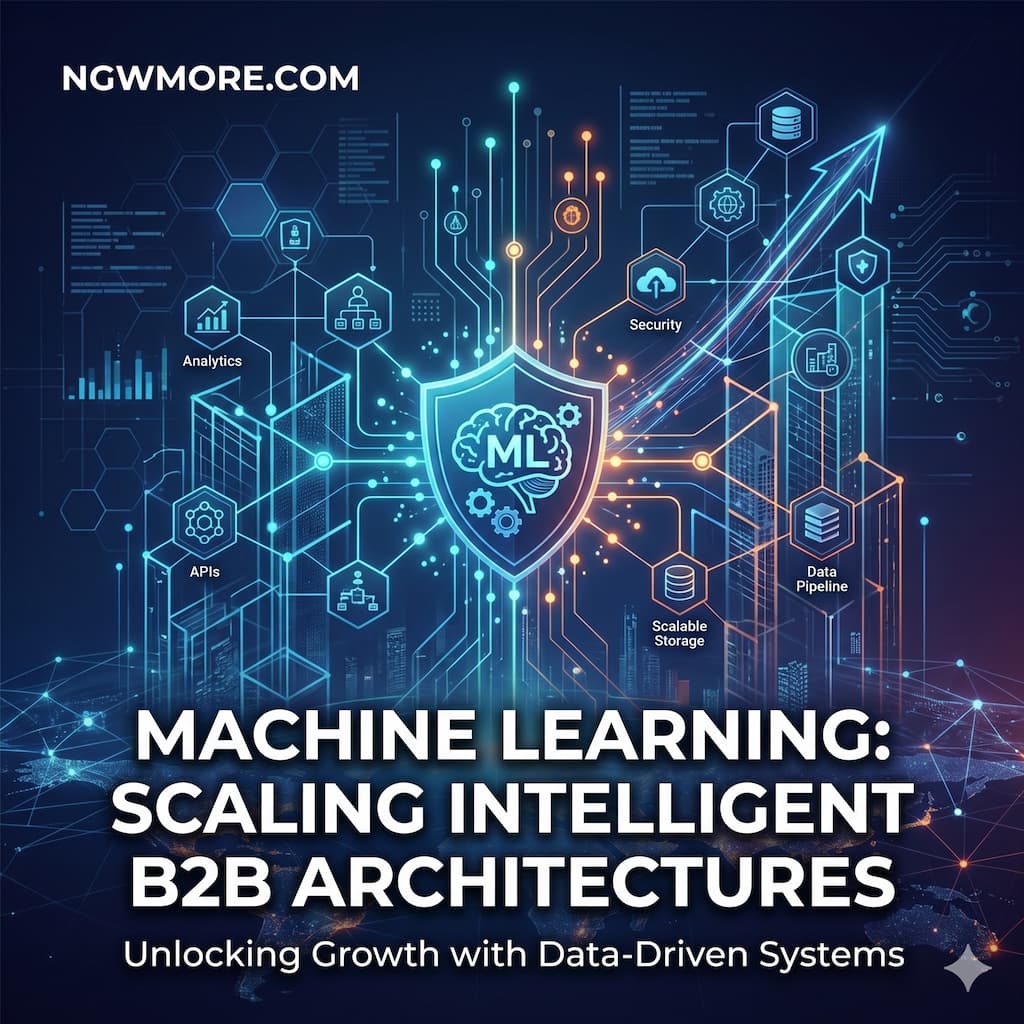
Machine Learning: Scaling Intelligent B2B Architectures
The global Business-to-Business (B2B) enterprise ecosystem has entered a period of systemic architectural restructuring. For decades, enterprise software, supply chain operations, corporate CRM platforms, and industrial data pipelines functioned as deterministic, rule-based software networks. Software engineers mapped business logic through explicit if-then code statements, data analysts compiled retrospective SQL data lakes on weekly cadences, and sales operations processed incoming pipelines using static, human-coded scoring spreadsheets.
While these deterministic applications provided structural predictability during the early eras of corporate digitalization, they introduce severe operational limitations inside modern, high-velocity digital enterprise networks.
Today’s multinational enterprise handles data mass, velocity, and fragmentation that completely overwhelm human administrative capabilities. Organizations operate across multi-region hybrid cloud environments, manage complex global logistics lines, and ingest billions of continuous operational log signals every single day.
Operating under this fast-moving paradigm with rigid, legacy software architectures leaves enterprise infrastructure blind to active patterns. This lack of insight results in severe computing resource waste, extended system downtime, massive customer churn exposure, and misallocated corporate capital.
To eliminate this operational friction, maximize computational efficiency, and secure an absolute market-leading competitive moat, forward-thinking enterprise technology and business leaders are abandoning rigid, rule-based systems. They are overhauling their underlying data backbones and migrating toward highly scalable, autonomous frameworks known as Intelligent B2B Architectures powered by Machine Learning.
Far from a superficial software add-on, scaling machine learning across an enterprise requires embedding real-time data orchestration pipelines, advanced automated model training loops (MLOps), edge-inference execution engines, and zero-trust data security matrices straight into the core corporate infrastructure.
1. The Core Paradigm Shift: From Deterministic Rules to Autonomous Adaptation
To engineer a resilient, modern enterprise technology stack, Chief Information Officers (CIOs) and software systems architects must shift their underlying software design philosophy away from static code execution and toward continuous, data-driven mathematical adaptation.
The Structural Evolution of Enterprise Application Logic
- Legacy Software Engineering: Relies on human program code to process input data to output specific, static business results. If a real-world scenario shifts outside the pre-programmed code parameters, the software immediately breaks, requiring expensive, manual developer interventions.
- The Scaled Machine Learning Core: Reconfigures this workflow entirely. The engine ingests vast streams of historical enterprise data and corresponding operational results, applying complex neural network regression loops, gradient-boosting machines, and clustering algorithms to output autonomous, adaptive business rules programmatically.
By establishing an uninterrupted, live feedback loop between live system behaviors and automated model retraining pipelines, intelligent B2B architectures eliminate operational data lag. The enterprise core moves past its historical role as a passive transactional registry.
The software framework evolves into an active, strategic engine designed to optimize cloud infrastructure resource allocation, predict structural component failures, and orchestrate hyper-personalized customer experiences at peak velocity.
2. Core Pillars of an Intelligent Enterprise ML Stack
Constructing a production-grade machine learning infrastructure capable of scaling safely across thousands of distributed enterprise nodes requires a robust technology layer built across four foundational pillars.
Pillar I: High-Throughput Data Orchestration and Feature Stores
The absolute predictive performance of any machine learning model depends entirely on the volume, consistency, and real-time ingestion velocity of the underlying data pipelines feeding its training loops.
- The Engineering Blueprint: Systems architects deploy automated real-time data orchestration layers (such as Apache Kafka or Apache Flink) linked directly to a centralized, enterprise-grade Feature Store (such as Feast or Tecton). The feature store acts as a single source of truth for both online real-time inference and offline training loops, converting raw unstructured system logs, database entries, and streaming webhooks into standardized, mathematically organized feature vectors. This configuration ensures that models executing real-time predictions utilize identical, uncorrupted data definitions, completely preventing train-serve skew vulnerabilities.
Pillar II: Automated MLOps Lifecycles and Continuous Retraining Loops
Deploying a single machine learning model to production is a manageable data science task; however, scaling hundreds of distinct models across a global enterprise running distinct regional operations creates immense operational complexity. Over time, real-world data distributions naturally shift, causing model performance to decay via a phenomenon known as Concept Drift.
- The Engineering Blueprint: Enterprise infrastructure incorporates robust MLOps Pipelines that automate the entire model lifecycle. The system monitors live inference accuracy continuously. If a model’s prediction confidence metrics drop below a preset mathematical baseline due to shifting market conditions, the MLOps pipeline automatically triggers a new training run inside an isolated cloud container environment. The framework pulls fresh training datasets from the feature store, executes hyperparameter optimization loops, tests the newly trained model against validation safety parameters, and deploys the updated model proxy to production programmatically with zero downtime.
Pillar III: Distributed Edge Inference Fabrics and Low-Latency Serving
For global logistics operations, industrial manufacturing plants, and high-frequency financial platforms, backhauling every local data payload to a centralized public cloud data center for machine learning processing introduces severe network latency and excessive bandwidth consumption costs.
- The Engineering Blueprint: Enterprise networks implement a Distributed Edge Inference Fabric. Lightweight, heavily quantized machine learning models are deployed directly onto localized edge gateways, micro-data center nodes, and industrial on-premises hardware. These edge agents process incoming data streams and execute complex predictive inferences locally within sub-milliseconds independent of an active main internet connection. The local systems only stream aggregated, anomalous data parameters back to the primary cloud lakehouse for long-term pattern analysis, slashing data transit overhead up to 70% and preserving operational continuity.
Pillar IV: Explainable AI ($XAI$) and Auditability Cores
Within highly regulated B2B sectors—including healthcare logistics, credit underwriting, and aerospace manufacturing—enterprises are strictly prohibited from utilizing “black-box” artificial intelligence models that make high-stakes operational choices without presenting a clear, step-by-step verification logic.
- The Engineering Blueprint: Enterprise ML architectures embed dedicated Explainable AI ($XAI$) Modules directly into the model serving layer. These frameworks apply advanced game-theory and mathematical attribution concepts (such as SHAP—Shapley Additive exPlanations, or LIME) to calculate the precise relative importance weight that every individual input variable contributed to a final automated prediction. The system generates fully readable, compliant cryptographic audit trails alongside every automated decision, enabling compliance teams and external regulators to audit model reasoning and guarantee unbiased system performance.
3. High-Performance Optimization: The Intelligent B2B Performance Ledger
Upgrading an enterprise technology stack from rigid, rule-based software logic to an automated, scaled machine learning architecture completely redefines an organization’s computing efficiency and operational agility.
- Operational Decision Latency: Manual database queries and human review require hours or days of execution lag. Scaled ML platforms execute automated sub-millisecond real-time inference loops.
- System Logic Adaptability: Rigid code parameters that break when confronted with unmapped real-world variables. Highly resilient, continuous automated model retraining loops (MLOps).
- Compute Infrastructure Utilization: Fragmented server clusters running at inefficient, fixed resource boundaries. Optimized via predictive resource provisioning, cutting cloud infrastructure costs up to 40%.
- Predictive Asset Maintenance: Reactive triage patterns that handle infrastructure issues only after a physical breakdown occurs. Isolates early failure telemetry to reduce unplanned system downtime by up to 35%.
- Data Privacy and Governance Shielding: Vulnerable to data leakage due to unencrypted pipeline files and manual scripts. Ironclad security via anonymized feature tokenization and hardware enclaves.
4. Operational Implementations: Intelligent Architectures in Active Industry
Evaluating how scaled machine learning platforms perform across complex, real-world enterprise environments demonstrates their transformative capacity to safeguard global business operations.
Predictive Supply Chain Optimization for High-Volume Global Logistics
Consider a multinational manufacturing corporation that coordinates the daily distribution of high-value industrial components across dozens of international shipping corridors, maritime ports, and regional fulfillment warehouses. The operation is highly sensitive to unexpected logistics gridlocks, regional customs delays, and severe meteorological disruptions. Relying on legacy manual dispatch mapping triggers immediate supply-chain delays, ballooning storage fees, and inventory starvation across production plants.
The enterprise eliminates this logistical friction by deploying an integrated intelligent supply chain architecture. The machine learning core ingests data streams simultaneously from warehouse inventory telemetry, real-time port congestion indexes, global weather satellites, and historical transit timelines.
The predictive models process this multi-dimensional vector array to project potential supply chain bottlenecks up to two weeks before they physically manifest.
If the system calculates a high-probability congestion signature along a specific maritime route, the algorithm programmatically re-orchestrates the company’s fulfillment pathways: it updates alternative transport schedules, re-routes container shipments to uncongested transit nodes, and alters local factory assembly runs automatically, maintaining uninterrupted operational throughput across the entire global manufacturing network.
Algorithmic Resource Allocation and Maintenance for Cloud Infrastructure
A high-growth global Software-as-a-Service (SaaS) conglomerate manages thousands of containerized microservices and dynamic database lakehouses across multi-tenant public cloud environments to serve millions of daily business users. Enterprise user demands fluctuate wildly depending on regional working hours, localized corporate holidays, and unannounced software update sequences, creating massive infrastructure utilization imbalances.
The corporation stabilizes its cloud overhead and guarantees absolute platform availability by anchoring its operations to an automated machine learning infrastructure coordinator. The platform continuously monitors system resource metrics, database I/O speeds, network packet delays, and local processor temperatures across all active server clusters.
Using advanced time-series forecasting architectures, the model projects processing demand spikes hours before they hit the cloud perimeter.
The system programmatically scales container allocations, dynamically shifts data processing pipelines to energy-efficient server nodes, and schedules proactive, automated maintenance cycles on deteriorating virtual arrays before a physical hardware failure can trigger a cascading system blackout, lowering cloud computing infrastructure costs up to 40% while preserving absolute system availability.
5. Security Architecture for Hardened Machine Learning Infrastructure
Centralizing enterprise core data feature stores, running continuous automated MLOps retraining pipelines, and serving high-velocity edge inference pathways introduces intense data privacy and system security demands. Because scaled machine learning platforms process an organization’s core proprietary data assets and dictate automated operational decisions, they represent premium targets for advanced cyber-espionage networks, model-poisoning exploiters, and malicious data harvesting rings.
[Enterprise Data Ingestion] ──> [Confidential Compute Enclave] ──> Secure Feature Store ──> Encrypted Edge Inference
Implementing Anonymized Feature Tokenization and Data Lineage Protection
To train predictive models and execute large-scale lookalike clustering safely without violating global data privacy frameworks or exposing sensitive trade secrets to unauthorized processing layers, systems architects implement an automated data tokenization proxy directly at the edge of the data ingestion stream.
Before any raw system log, customer interaction record, or financial dataset is committed to the central feature store, all sensitive individual identifiers and proprietary metadata strings are automatically extracted, cryptographically hashed, and replaced with secure tokens. The machine learning models calculate their pattern-matching weights and optimization loops strictly over anonymized numerical vectors, maintaining total model performance while ensuring absolute corporate data privacy.
Hardening the ML Serving Layer via Enclave Isolation and Anti-Poisoning Controls
Because the centralized machine learning core commands the absolute authority to orchestrate supply chains, manage cloud resources, and drive corporate customer scoring, accessing this analytical interface requires extreme security constraints.
- Enclave Isolation: Isolate the entire MLOps architecture, feature store repositories, and model deployment consoles inside a strict Zero-Trust Network Access (ZTNA) envelope. The training and inference cores must execute within hardware-isolated Confidential Computing Enclaves equipped with hardware-level memory encryption, keeping all model parameters and training weights completely insulated from unauthorized lateral access, internal insider threats, or external data exploitation.
- Anti-Poisoning Controls: Implement strict automated validation checks over all incoming training data payloads. The data pipeline scans fresh features for anomalous variance anomalies or adversarial data injections, blocking malicious data-poisoning attempts designed to degrade model accuracy or introduce backdoors into the inference core.
6. Regulatory Convergence: Adhering to Global AI Governance Mandates
Scaling a comprehensive machine learning framework across international borders requires absolute compliance with an evolving web of global regulatory oversight guidelines.
- The EU AI Act Compliance Standards: Landmark international legislation enforces strict requirements on automated enterprise profiling, machine learning risk assessments, and model output transparency, demanding that organizations maintain meticulous verification of data lineage, bias checks, and human-in-the-loop validation parameters.
- The GDPR and CCPA Privacy Frameworks: Imposing severe financial penalties for non-compliant consumer tracking, these frameworks mandate that any automated machine learning profiling or predictive scoring must offer users transparent data opt-out mechanisms and verifiable “right-to-be-forgotten” records within the central feature store.
- Global Data Sovereignty Laws: Tightening data isolation laws across international boundaries dictate that any user behavioral data or system telemetry captured within regional business operations must reside and be processed strictly within the physical geographic borders of that nation-state, requiring intelligent growth engines to deploy decentralized, multi-region hybrid cloud networks.
Read More⚡ Extended Detection and Response: Scaling Enterprise XDR Security
Conclusion: Orchestrating the Intelligent Corporate Engine
The integration of scaled machine learning architectures is not an optional optimization update for modern enterprise IT; it is a fundamental technological requirement to achieve long-term corporate resilience and operational velocity. The historical methodology of managing multi-region businesses through rigid, rule-based software programs—while tolerating severe calculation latencies, concept drift degradation, and high computing infrastructure costs—is an unsafe operational approach that invites market displacement and balance-sheet erosion.
By engineering an integrated, forward-looking software fabric built on high-throughput real-time feature stores, automated continuous MLOps retraining pipelines, distributed edge inference networks, and ironclad zero-trust data protection environments, progressive enterprise leaders transform their technology stacks from passive recording tools into high-performance strategic weapons.
Ultimately, the definitive advantage in the global B2B ecosystem belongs entirely to the visionary enterprises that can analyze data, optimize systems, and execute intelligent decisions as fast as the market moves—mastering advanced machine learning frameworks to drive secure, highly predictable, and market-leading global scale across any operational horizon.
Deploying computationally intensive automated MLOps pipelines, high-throughput streaming feature stores, real-time edge inference networks, and ultra-secure global machine learning data lakehouses requires world-class, zero-downtime server infrastructure. Secure your company’s intelligent data engine on an unassailable infrastructure foundation by exploring the premium enterprise hosting configurations at ngwmore.com.