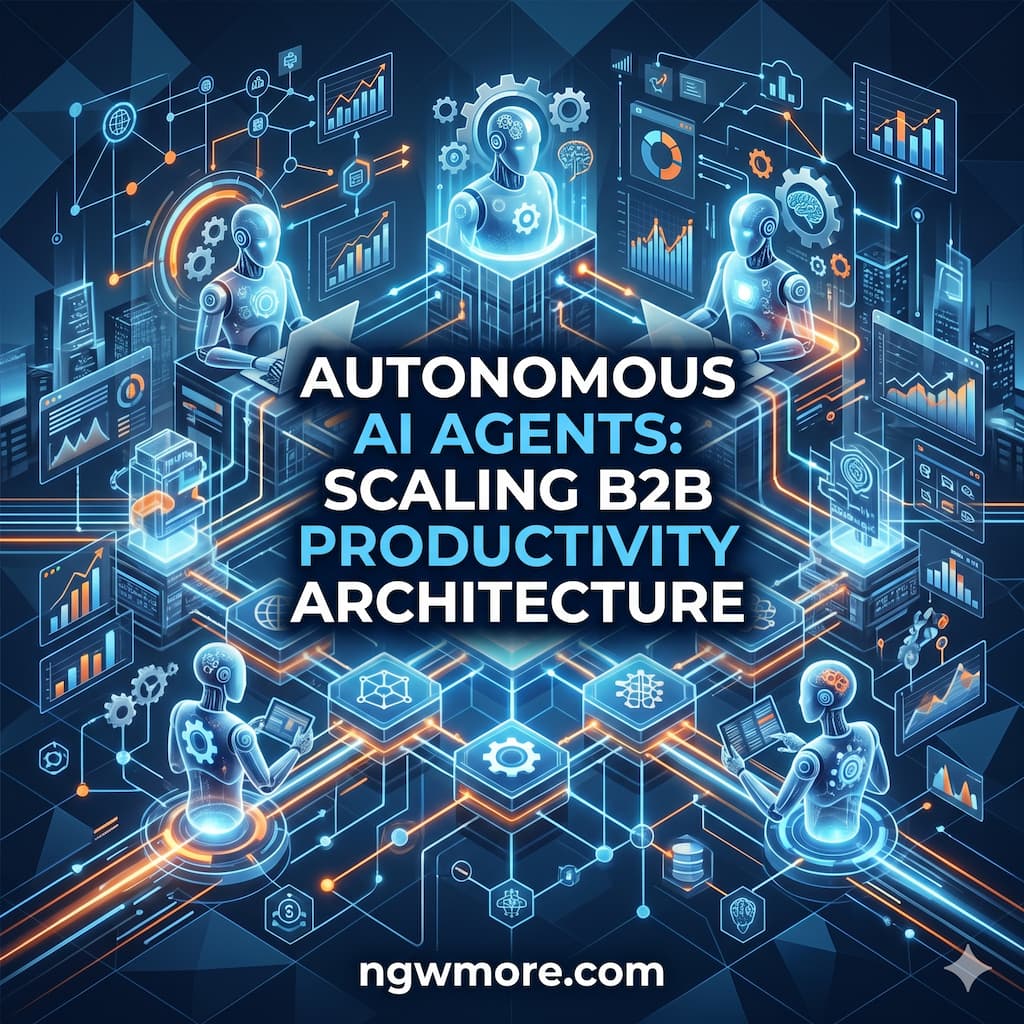
Autonomous AI Agents: Scaling B2B Productivity Architecture
The architecture of enterprise productivity is undergoing a profound structural shift. For the past decade, digital transformation focused primarily on the integration of centralized software-as-a-service (SaaS) platforms, cloud-native data repositories, and robotic process automation (RPA). These systems excelled at eliminating manual data entry, standardizing predictable back-office records, and running linear, rule-based workflows.
However, they remained fundamentally rigid. Traditional SaaS and RPA pipelines cannot reason through ambiguous scenarios, adjust dynamically to erratic market signals, or learn from contextual execution failures without heavy, expensive manual engineering code interventions.
The arrival of Large Language Models (LLMs) and multi-modal neural networks promised to solve these cognitive limitations. Yet, the initial wave of enterprise implementations relied on a highly reactive paradigm: the conversational chat interface. While useful for isolated text generation, localized code debugging, and manual data summarization, human-in-the-loop chat interfaces introduce a severe operational bottleneck.
An enterprise architecture that requires a human professional to continuously draft prompts, review outputs, and manually copy-paste data payloads between separate application windows cannot achieve true operational scale.
To unlock the next horizon of industrial efficiency, forward-thinking enterprise technology leaders are migrating past passive, chat-based software layers. They are systematically building and deploying self-directing, unmonitored execution frameworks known as Autonomous AI Agents.
Far from an incremental software automation update, multi-agent productivity architectures represent the definitive execution engine for next-generation B2B operations—enabling corporations to scale their computational workflows, optimize cross-border logistics, and automate highly complex business logic at a fraction of traditional operational expenses.
1. The Architectural Paradigm: Defining Agentic Autonomy vs. Linear Automation
To build an institutional-grade defense against operational bloat, system designers must first separate autonomous agentic architecture from traditional, linear software pipelines.
Traditional RPA and software scripts operate on deterministic “If-This-Then-That” (IFTTT) logic gates. If a vendor invoice arrives via email, the script extracts the text, maps it to a known database field, and routes it to an approval queue. If the invoice format changes slightly or arrives with corrupted image scaling, the script breaks instantly, requiring manual exception handling.
An Autonomous AI Agent operates on a probabilistic, goal-oriented paradigm. Instead of receiving a rigid sequence of step-by-step instructions, the agent is initialized with a high-level objective, a set of operational boundary constraints, and a comprehensive toolkit of accessible APIs, databases, and software interfaces.
Using advanced cognitive loop frameworks (such as ReAct, Plan-and-Solve, or Reflexion), the agent dynamically deconstructs the objective into an optimized sequence of sub-tasks, selects the appropriate software tools, evaluates the output of its execution, and self-corrects its strategy in real time if it encounters an error.
2. Core Pillars of an Enterprise-Scale Multi-Agent Architecture
Constructing a production-ready autonomous agent infrastructure across a distributed B2B enterprise demands a robust technology stack built across four foundational pillars.
Pillar I: Advanced Memory Fab and Persistent Vector Subsystems
To execute multi-step business strategies that span days, weeks, or thousands of sequential API calls, autonomous agents cannot rely strictly on the transient, short-term context window of an underlying LLM.
- The Scale Blueprint: Engineering teams implement a multi-tiered memory architecture. Short-term episodic memory is managed through highly optimized, rolling prompt caching systems. Long-term semantic and institutional memory is anchored within high-throughput Vector Database Networks (such as Pinecone, Milvus, or Qdrant). This configuration allows agents to continuously read from and write to persistent corporate knowledge bases, storing execution logs, user preference modifications, and historical error-correction strategies, ensuring the agent becomes progressively more accurate over its operational lifecycle.
Pillar II: Dynamic Tool Orchestration and Semantic API Discovery
An autonomous agent isolated from the external digital world is merely a text processor. To scale enterprise productivity, agents must possess the capacity to interact directly with core B2B infrastructure software layers.
- The Scale Blueprint: Systems architects deploy an abstraction layer known as a Tool Registry. This framework exposes secure API endpoints—spanning Enterprise Resource Planning (ERP) engines like SAP, Customer Relationship Management (CRM) databases like Salesforce, and financial settlement rails—directly to the agentic core. The agent reads the semantic documentation of these APIs, programmatically generates the required JSON or GraphQL payloads during runtime, and invokes the necessary functions to execute real-time reads, updates, and writes across legacy corporate applications.
Pillar III: Orchestrating Hierarchical Multi-Agent Systems (MAS)
Attempting to build a single, monolithic AI agent tasked with managing an entire global corporate operation results in immediate cognitive overload, high token latencies, and frequent logical hallucinations.
- The Scale Blueprint: Production-grade deployments utilize a Hierarchical Multi-Agent Mesh. In this paradigm, complex corporate objectives are funneled through a high-level Supervisor Agent. The supervisor decomposes the goal and orchestrates specialized Subordinate Agents, each engineered for distinct functional arenas:
- The Ingestion Agent: Specializes in processing raw, multi-format vendor contracts and checking data lineage.
- The Analysis Agent: Specialized in querying internal corporate financial data lakes and calculating tax arbitrage vectors.
- The Compliance Agent: Programmed to continuously cross-reference output streams against strict sovereign regulatory frameworks (like GDPR or HIPAA). By operating as an autonomous, digital corporate structure, the agents communicate with each other over low-latency message brokers, reconciling data mismatches and validating outputs internally before serving final results.
Pillar IV: Guardrails, Alignment Layers, and Deterministic Circuit Breakers
Granting autonomous systems the authority to make operational decisions across enterprise infrastructure introduces significant downside risk if the agent experiences a logical hallucination or malicious prompt injection.
- The Scale Blueprint: Enterprises wrap every agentic node inside a strict, deterministic Guardrail Envelope (utilizing frameworks like NeMo Guardrails or Llama Guard). This layer sits between the agent’s cognitive engine and the external tool registry. Every generated API call is parsed programmatically against strict corporate security matrices, budget limits, and system authorization rules. If an agent attempts an action that breaches a threshold—such as executing an unauthorized cross-border capital wire or requesting data outside its access tier—the gateway triggers a hard Circuit Breaker, pausing execution instantly and demanding manual human-in-the-loop validation.
3. High-Performance Optimization: The Autonomous Agent Matrix
The transition away from manual, chat-centric operations to an autonomous, multi-agent productivity fabric radically alters enterprise operational metrics.
- Operational Throughput Speed: Human-in-the-loop chat interaction scales linearly with staff hours. Autonomous multi-agent loops scale exponentially via parallel cloud compute structures.
- Average Process Execution Cost: High manual human resource overhead per task. Drops down to micro-cents per token execution loop.
- Error-Exception Rate: Fragmented manual workflows introduce frequent transcription errors. Automated self-correcting logic loops drive exceptions near zero.
- Data Core Integration Depth: Superficial; reliant on slow manual copy-paste mechanisms. Deep, programmatic API-level read/write synchronization.
- System Deployment Scaling Velocity: Fragmented across regional teams and localized desktop settings. Cloud-native multi-agent nodes scale instantly across global container environments.
4. Real-World Applications: Multi-Agent Systems in Global Commerce
Evaluating how autonomous agentic architectures perform under enterprise conditions highlights their capacity to transform legacy operational workflows.
Autonomous B2B Contract Procurement and Vendor Reconciliation
Managing supplier procurement within a multinational manufacturing enterprise historically requires hours of tedious legal and financial review. When a factory requires a new batch of raw specialty chemicals, human procurement officers must manually source supplier sheets, cross-reference fluctuating pricing tiers across international trade boards, evaluate legal delivery compliance liabilities, and draft specialized purchase orders.
By introducing a Hierarchical Multi-Agent System, the procurement process becomes entirely autonomous. The supervisor agent monitors internal factory inventory data lakes in real time.
The moment raw materials dip below optimal thresholds, the system launches localized sourcing agents to query external vendor APIs, scrape market pricing indexes, and ingest multi-page contract drafts.
The compliance agent inspects the contract text for structural liability risks, while the transaction agent programmatically drafts an optimized purchase agreement, routes it to the financial ledger for automatic settlement, and schedules freight arrival times via logistics APIs—completing a multi-day administrative cycle in under five minutes without manual intervention.
Dynamic, Multi-Channel B2B Customer Success Architecture
Traditional enterprise client support operations suffer from severe structural friction. Customer tickets are funneled into generic, static email queues or uncoordinated ticketing dashboards, forcing support staff to spend precious minutes manually researching a client’s historical contract tier, software deployment logs, and open technical tickets before providing a resolution.
Autonomous AI agents erase this operational lag. When a tier-one corporate client submits a highly complex, multi-variable technical issue via an enterprise service portal, a specialized Customer Success Agent intercepts the payload.
The agent queries the central vector memory base to instantly pull the client’s full interaction history, accesses the live cloud system monitoring dashboard to parse the precise error telemetry logs, and isolates the coding anomaly.
If the ticket requires a standard configuration adjustment, the agent generates the required patch script, pushes it to an isolated staging environment for safety testing, applies the fix to production, and drafts a comprehensive, highly technical resolution summary back to the client—resolving a major technical infrastructure disruption autonomously within seconds.
5. Security Architecture for Connected Agentic Ecosystems
Connecting autonomous agents directly to sensitive corporate ERP frameworks, internal customer databases, and active transaction layers introduces critical digital security demands. Because autonomous agents operate with high levels of execution authority, protecting their digital perimeter is paramount to prevent adversarial exploitation or corporate data exfiltration.
Implementing Strict Principal of Least Privilege Agent Identity (IAM)
Enterprises must never initialize an autonomous AI agent using a master corporate administrator API token or broad root-level software credentials. If an agent running on an unchecked admin account suffers an indirect prompt injection exploit, an attacker can command the system to delete entire database tables or download sensitive user records.
- The Security Remedy: Treat every autonomous agent node as an independent, unverified corporate identity. Assign a unique Machine Identity Token to every agent within the central Identity and Access Management (IAM) directory. Enforce strict Principal of Least Privilege (PoLP) parameters: an agent tasked with auditing warehouse inventory logs must be cryptographically restricted from accessing customer credit card records or modifying system security configurations. Every API call must include the agent’s unique identity token, enabling comprehensive tracking and auditability.
Defending Against Indirect Prompt Injection in Unstructured Data Streams
The primary vulnerability vector threatening autonomous B2B agents is indirect prompt injection. This exploit occurs when a malicious actor implants hidden, adversarial instructions inside an unstructured external file, such as a vendor PDF invoice, a customer support email attachment, or a public pricing webpage. When the agent reads and processes this document to execute an objective, the hidden malicious text hijacks the model’s inner alignment logic, forcing it to execute unauthorized commands.
- The Security Remedy: Implement a multi-layered, secure data processing gateway. Before any external document or API payload is fed to the core agentic reasoning engine, the data must pass through an isolated Sanitization Proxy. Specialized classifier models analyze the text to isolate and scrub known jailbreak syntax and hidden prompt overrides. Furthermore, the agentic core must run entirely within hardware-isolated Confidential Computing Enclaves with strict memory encryption, preventing external system threats from polluting the underlying corporate core models.
6. Regulatory Convergence: Adhering to Global AI Safety Mandates
Deploying fully autonomous agentic systems within global enterprise architectures demands absolute alignment with rapidly tightening international governance standards.
- The EU AI Act Compliance Mandates: This comprehensive framework enforces strict logging parameters, algorithmic data lineage transparency, and continuous risk-mitigation reporting for all high-stakes autonomous systems operating within European borders.
- NIST AI Risk Management Framework: Providing a highly detailed blueprint for enterprise organizations in the United States, the NIST framework outlines explicit guidelines to maximize the trustworthiness, technical security, and operational safety of corporate AI systems throughout their deployment lifecycles.
- Global Data Localization Directives: Emerging sovereignty regulations require that any user data analyzed or recorded by autonomous agents must reside strictly within local physical data jurisdictions, requiring the infrastructure to utilize decentralized, multi-region hybrid cloud fabrics.
Read More⚡ Zero Trust Architecture: Securing Decentralized Enterprise
Conclusion: Orchestrating the Autonomous Enterprise
The integration of autonomous AI agent architectures is not an optional software update for forward-thinking enterprises; it is a fundamental infrastructure evolution required to navigate tomorrow’s hyper-connected economic landscape. The legacy methodology of relying on rigid, rule-based automation software—while tolerating massive manual chat-prompting bottlenecks, visibility silos, and slow response loops—is an unviable operational approach that stalls corporate growth.
By forging an integrated, automated enterprise fabric built on dynamic multi-agent meshes, persistent vector data memories, secure tool orchestration registries, and ironclad zero-trust machine identity protections, progressive technology leaders transform their operations into a highly scalable, self-correcting asset.
Ultimately, the competitive advantage in the future of the global economy belongs entirely to the agile corporations that can process reasoning as fast as they process data—mastering autonomous AI agent networks to drive secure, seamless, and market-leading global scale across any digital horizon.
Deploying computationally intensive multi-agent orchestration meshes, real-time vector database networks, high-performance confidential computing enclaves, and low-latency tool registry portals requires world-class, zero-downtime server infrastructure. Secure your enterprise productivity backbone on an unassailable foundation by exploring the premium high-performance hosting configurations at ngwmore.com.