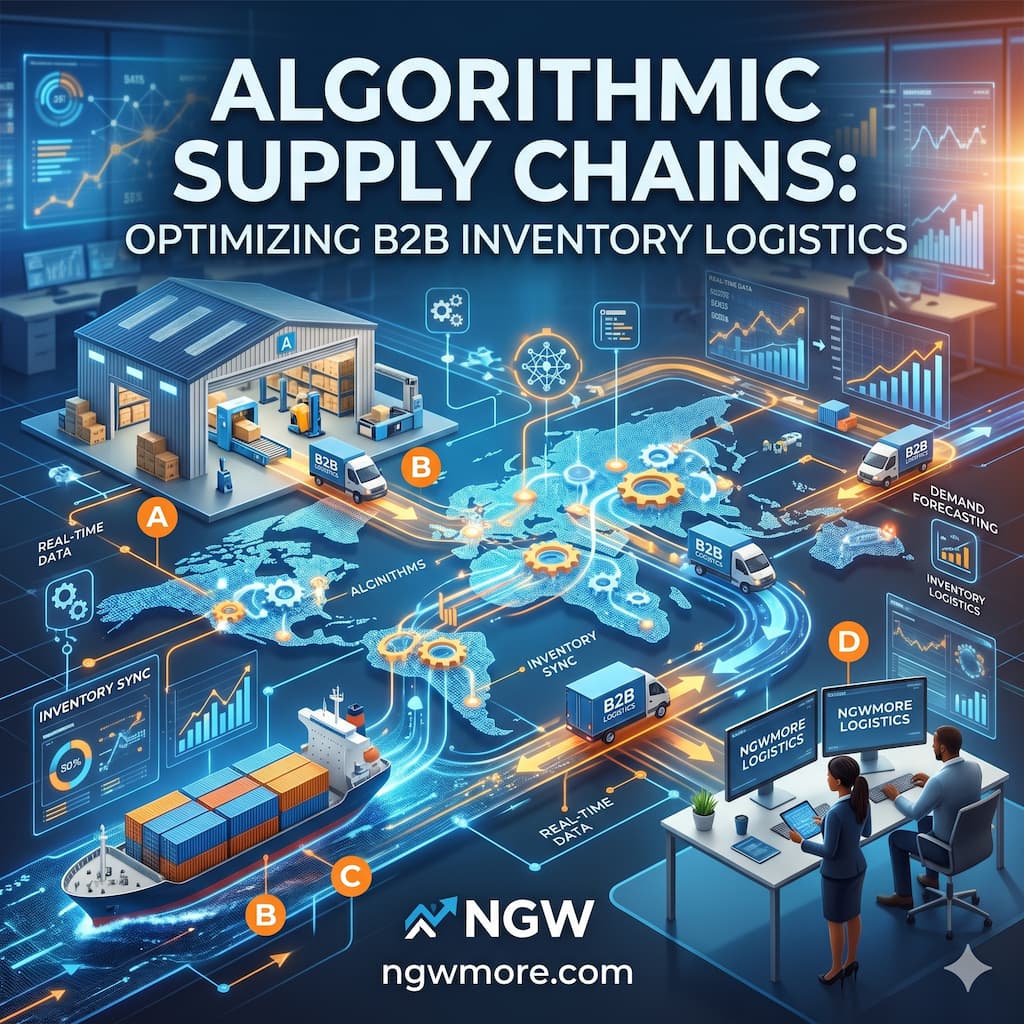
Algorithmic Supply Chains: Optimizing B2B Inventory Logistics
The global Business-to-Business (B2B) commerce landscape is undergoing a structural transition. For decades, supply chain management, warehousing logistics, and inventory distribution operated on reactive, historical heuristics. Organizations calculated reorder points using basic linear models, managed supplier relations through localized communications, and tolerated substantial safety stock buffers to hedge against market unpredictability.
While these traditional practices sufficed in isolated, slow-moving regional economies, they introduce severe systemic vulnerabilities inside modern, highly integrated global networks.
Today’s enterprise supply chains are bound to hyper-volatile dynamics. Corporate buyers face shifting international trade policies, compressed product lifecycles, erratic raw material access, and fluctuating freight lane capacities. Operating with opaque, disconnected legacy inventory databases under these conditions triggers the destructive Bullwhip Effect—where minor demand variations at the client endpoint amplify exponentially as they travel upstream, saddling suppliers with excessive overhead, severe margin compression, and dead warehouse stock.
To eliminate this systemic friction, forward-thinking logistics networks are abandoning manual, intuition-driven operations. They are migrating their commerce networks toward autonomous, data-driven frameworks known as Algorithmic Supply Chains. Far from a speculative software layer, algorithmic supply chains leverage predictive machine learning models, real-time telemetry architectures, and multi-variable optimization loops to transform B2B logistics into an agile, self-correcting asset.
1. The Paradigm Shift: From Reactive Storage to Predictive Velocity
To architect a resilient corporate logistics framework, system designers must transition their fundamental philosophy from passive asset management to continuous velocity optimization.
The Structural Evolution of B2B Logistics
- Legacy Logistics Infrastructure: Relies on manual inventory audits, retrospective quarterly demand spreadsheets, localized forecasting silos, and rigid, fixed-interval ordering cadences.
- Algorithmic Supply Chain Fabric: Merges real-time enterprise resource planning (ERP) streams, predictive market indicators, and programmatic fulfillment networks into a unified data ecosystem, executing near-instantaneous replenishment cycles.
By establishing a continuous, live loop of operational data across every vendor node simultaneously, algorithmic logistics architectures eliminate data latencies. The warehouse moves past its historical role as a static, expensive storage facility and transforms into a dynamic fulfillment node engineered to keep physical assets moving at peak economic efficiency.
2. Core Pillars of an Algorithmic Supply Chain Architecture
Constructing a production-ready algorithmic logistics platform demands a multi-layered technology stack engineered around four foundational execution pillars.
Pillar I: Predictive Demand Engines and Multi-Variable Forecast Models
The foundational layer of an algorithmic supply chain is the ability to forecast consumer and corporate demand profiles weeks before purchase orders are submitted.
- The Scale Blueprint: Platforms move completely past traditional time-series forecasting. Advanced engines ingest dense streams of non-traditional data—including localized weather volatility vectors, shifting global macroeconomic indexes, regional industrial output reports, and live B2B digital marketplace search metrics. Machine learning models (such as deep neural networks and gradient-boosted trees) process this data to forecast demand fluctuations at a granular, SKU-specific level, allowing enterprise distributors to proactively adjust manufacturing schedules.
Pillar II: Real-Time IoT Telemetry and Edge Visibility Arrays
Predictive models are only as accurate as the live data anchoring them. A supply chain operating on delayed tracking logs remains inherently vulnerable to sudden transport breakdowns.
- The Scale Blueprint: Enterprises deploy comprehensive Internet of Things (IoT) sensor arrays across their entire logistics infrastructure. Every shipping container, heavy transport asset, and automated warehouse pallet is equipped with cellular or satellite-linked edge sensors that continuously stream spatial telemetry, ambient temperature parameters, vibration metrics, and exact geo-location coordinates. This stream is processed by cloud data lakehouses to monitor transit parameters, automatically rerouting shipments or adjusting temperature rules the moment an anomaly is detected.
Pillar III: Programmatic Multi-Echelon Inventory Optimization (MEIO)
In a complex B2B ecosystem, inventory is distributed across an intricate network of regional distribution centers, central cross-docking facilities, localized hub locks, and transit vessels. Optimizing every node independently results in localized excess and global capital inefficiencies.
- The Scale Blueprint: Algorithmic platforms deploy Multi-Echelon Inventory Optimization (MEIO) logic. MEIO evaluates the entire distribution fabric concurrently, calculating optimal safety stock margins and replenishment velocities across all tiers simultaneously. If a demand spike occurs in a specific regional corridor, the algorithm calculates the most cost-effective redistribution path across the entire network—minimizing total system holding costs while maintaining strict Service Level Agreements (SLAs).
Pillar IV: Dynamic Route Optimization and Algorithmic Dispatch
Once inventory exits the warehouse dock, the final challenge is managing transit lane volatility. Fixed, historic delivery routes leave fleets exposed to unexpected urban congestion, changing port waiting queues, and fuel-burn inefficiencies.
- The Scale Blueprint: Dispatch centers implement real-time Dynamic Route Optimization Routing Engines. These algorithms continually evaluate live traffic feedback loop updates, port-clearance delays, and weather anomalies. The system generates optimized multi-stop delivery pathways on the fly, sending live adjustments straight to autonomous vehicle screens or automated drone platforms, maximizing fuel efficiency and guaranteeing on-time delivery.
3. High-Performance Optimization: The Algorithmic Performance Ledger
The transition away from manual inventory tracking to an autonomous, algorithmic framework allows corporate enterprises to achieve profound efficiency gains.
| Operational Logistics Metric | Traditional Heuristic Logistics | Algorithmic Supply Chain Networks |
| Demand Forecast Accuracy | 60% – 70% (Characterized by high manual error margins) | Extreme Precision: Achieves 92% – 98% accuracy via multi-variable ML loops |
| Inventory Holding Costs | High (Heavy safety stock blocks tied up in warehouses) | Ultra-Lean: Minimizes storage overhead up to 35% via just-in-time calculation |
| Order Cycle Execution Time | 5 – 7 business days (Requires multi-party human handoffs) | Near-Instant: Drops processing cycles down to under 24 hours programmatically |
| Disruption Recovery Speed | Slow, reactive (Requires hours of emergency phone calls) | Autonomous Adaptation: Real-time algorithmic rerouting in minutes |
| Fleet Carbon & Fuel Burn | High due to static routing and unoptimized load factors | Optimized Footprint: Slashes carbon output up to 22% via smart load pooling |
4. Operational Implementations: Algorithmic Logistics in Global Enterprise Commerce
Evaluating how these algorithms perform under real-world conditions demonstrates the transformative power of data-driven infrastructure.
Automated Just-In-Time (JIT) Component Staging in Industrial Manufacturing
Modern high-tech manufacturing facilities operate on hyper-compressed schedules. If a specific micro-component or raw chemical agent fails to arrive at the factory floor on time, entire assembly lines freeze, racking up devastating operational losses.
By deploying an algorithmic supply chain layer, the manufacturer’s internal ERP communicates directly with its tier-one suppliers’ inventory ledgers. When factory sensors register that raw materials are depleting, the system automatically triggers a programmatic purchase order, books automated freight transport lanes, and schedules exact, minute-specific delivery times that align perfectly with the factory’s real-time assembly sequence. This setup eliminates the need for expensive on-site warehousing facilities while keeping production continuously active.
Dynamic Fleet Load Pooling for Cold-Chain Pharmaceutics
Distributing temperature-sensitive pharmaceutical therapeutics requires flawless temperature maintenance and strict delivery timelines. A single transport delay or refrigeration failure can ruin millions of dollars in vital medical cargo.
Algorithmic supply chains protect these high-value payloads through intelligent load pooling and predictive maintenance. The algorithm calculates the exact thermodynamic load properties of every vehicle, clusters complementary hospital delivery routes together, and continuously monitors the health of onboard refrigeration units. If an edge sensor detects a subtle compressor failure, the platform automatically alerts the vehicle, books an alternative cold-storage transfer truck at the next logical junction, and alerts the receiving medical center—preserving product safety and eliminating asset wastage.
5. Security Architecture for Connected Supply Chain Ecosystems
Centralizing B2B data systems and integrating autonomous API-driven logistics tools introduces critical digital security requirements. Because supply chain networks handle the physical movement of global trade and critical national resources, they represent premium targets for cyber-sabotage networks and corporate data-harvesting exploits.
Securing the API Ingestion Layer via Multi-Party Authorization
Multinational supply networks must never allow unauthenticated, external vendor portals to execute direct, unmonitored data writes into the central ERP core database.
- The Security Safeguard: Wrap all inbound vendor APIs, inventory data webhooks, and tracking feeds inside a strict Zero-Trust API Gateway. Every external connection must utilize rotating cryptographic access tokens, present valid mTLS certificates, and undergo automated behavioral payload screening. Furthermore, any algorithmically generated order that exceeds pre-approved capital thresholds must trigger a mandatory multi-party cryptographic authorization workflow, requiring human approval from verified treasury heads before capital is released.
Defending the Edge: Firmware Integrity across the IoT Fleet
With thousands of autonomous IoT tracking sensors streaming live telemetry from containers and transport assets worldwide, the physical edge represents a significant cyber-attack vector. Attackers can attempt to compromise these devices to inject spoofed location logs or manipulate temperature readouts.
- The Security Safeguard: Enforce strict Hardware Root of Trust (RoT) architectures across all deployed edge telemetry devices. Every tracking sensor must utilize an encrypted cryptographic chip that verifies its firmware integrity boot sequence upon startup. Any device presenting an unverified code change or anomalous data signal is automatically isolated from the primary corporate data stream, preventing localized hardware compromises from polluting the central analytics model.
6. Sustainable Logistics: The Green Routing Directive
A major trend defining the future of algorithmic supply chain engineering is the systematic alignment of logistical efficiency with global sustainability targets. Corporate allocators are realizing that reducing carbon output is not merely a public relations exercise; it is directly correlated with cutting operational waste.
[Live Route Telemetry] ──> [Carbon Optimization Engine] ──> Minimal Fuel Burn & Lower Fleet Emissions
Algorithmic routing engines optimize fleet dynamics to actively lower environmental footprints. By processing complex load-stacking variables alongside real-time traffic data, the routing software ensures that transport trucks never travel empty or underloaded, maximizing space utilization.
Furthermore, algorithms dynamically adjust vehicle speeds and transit paths to favor energy-efficient freight corridors, reducing fuel consumption up to 20% across international distribution loops. This integration optimizes bottom-line profitability while ensuring absolute compliance with tightening global carbon emission standards.
Read More⚡ Neuromorphic Computing: The Next Frontier in AI Hardware
Conclusion: Orchestrating the Autonomous Commerce Machine
The integration of algorithmic supply chains is not an optional software update for B2B logistics; it is a fundamental reconfiguration of global enterprise trade. The legacy methodology of relying on fragmented, manual database tracking—while tolerating massive safety stock gluts, costly data silos, and systemic bullwhip vulnerabilities—is rapidly becoming an unviable operational strategy.
By leveraging predictive demand networks, deploying live IoT edge arrays, optimizing distribution paths via multi-echelon logic, and enforcing absolute end-to-end cryptographic data security, progressive technology leaders transform their logistics networks from an operational expense into a powerful competitive asset.
Ultimately, the future of international enterprise distribution belongs entirely to the agile corporations that can orchestrate their physical assets as seamlessly as their digital files—mastering algorithmic supply chain fabrics to drive secure, highly efficient, and market-leading global scale across any operational horizon.
Deploying computationally intensive demand forecasting engines, real-time IoT edge data aggregators, multi-echelon inventory lakehouses, and low-latency dynamic routing portals requires state-of-the-art, zero-downtime server infrastructure. Secure your enterprise logistics backbone on an unassailable foundation by exploring the premium high-performance hosting configurations at ngwmore.com.