
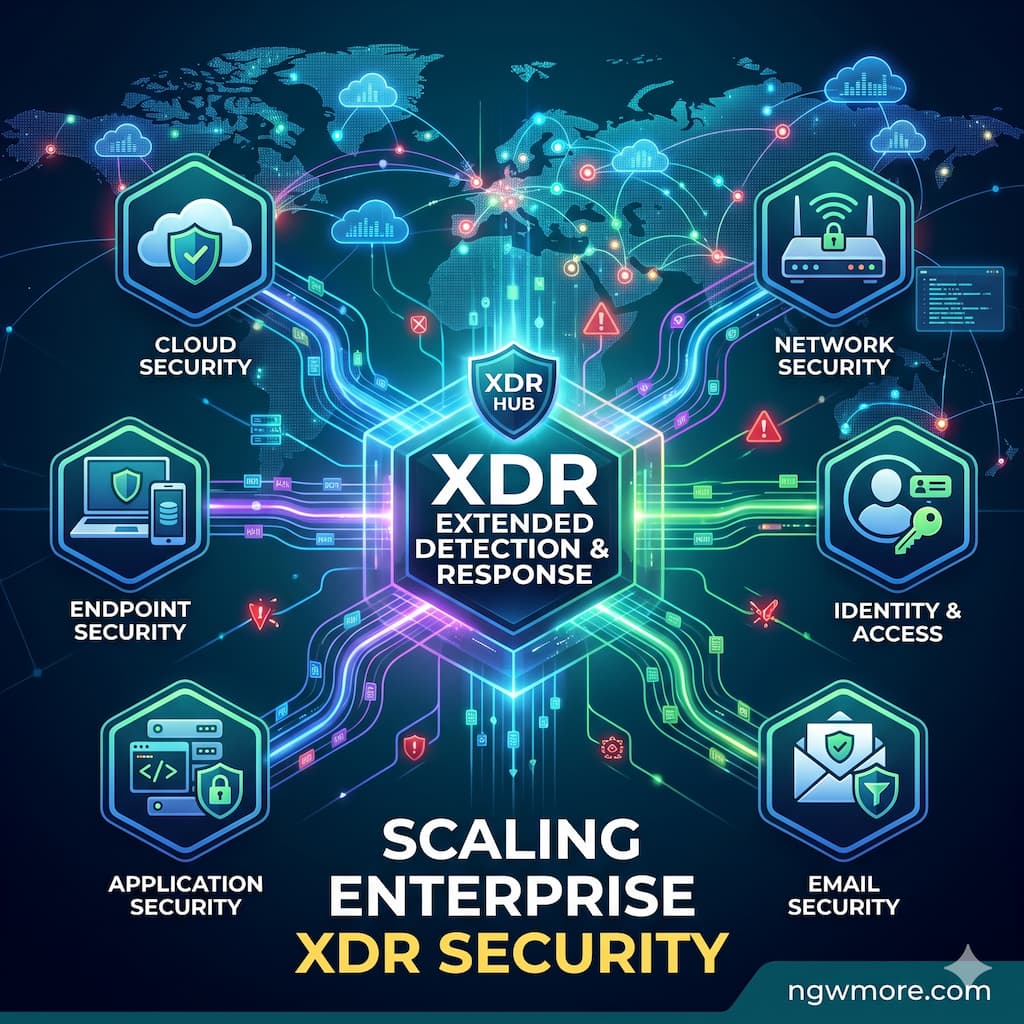
Extended Detection and Response: Scaling Enterprise XDR Security
The corporate digital landscape has expanded past the protective perimeter of traditional cybersecurity frameworks. Enterprise networks are no longer self-contained, centralized structures managed through on-premises firewalls and uniform desktop endpoints. Today, a modern enterprise footprint is inherently decentralized, sprawling across multi-cloud environments, distributed remote workforces, containerized microservices, connected Internet of Things (IoT) edge fleets, and a dense layer of third-party SaaS integrations.
While this rapid digital expansion has catalyzed unprecedented corporate productivity, it has simultaneously introduced an unmanageable and highly fragmented attack surface for malicious exploitation.
Historically, Security Operations Centers (SOCs) defended this distributed infrastructure using siloed, point-security software applications. Security teams deployed Endpoint Detection and Response (EDR) to monitor laptops and servers, Network Detection and Response (NDR) to audit internal data packets, and specialized cloud access security controls to track identity perimeters.
Operating under this disconnected, legacy paradigm creates severe systemic vulnerabilities. Every standalone security tool generates its own massive volume of logs and behavioral alerts, isolating data inside disconnected repositories.
SOC analysts face an overwhelming phenomenon known as “alert fatigue,” forcing teams to manually stitch together disparate telemetry feeds while missing the subtle, multi-stage indicators of a sophisticated, cross-domain cyber-offensive.
To bypass these operational limitations and reclaim the defensive advantage, enterprise organizations are systematically upgrading their security telemetry infrastructure. They are migrating away from isolated point solutions toward an integrated, autonomous analytics platform known as Extended Detection and Response (XDR).
Far from an incremental software consolidation trend, scaling enterprise XDR infrastructure represents a fundamental evolution in cyber defense, unifying threat detection, real-time cryptographic correlation, and automated cross-domain incident response into a single high-performance security engine.
1. The Architectural Evolution: From Siloed Logs to Unified Telemetry
To architect a scalable enterprise defense against advanced persistent threats (APTs) and ransomware syndicates, cybersecurity engineers must understand the structural differences between traditional monitoring software and an advanced XDR data fabric.
The Fragmentation of Legacy Security Infrastructure
- The Siloed Point Paradigm: Individual monitoring tools act as isolated information nodes. EDR platforms record file modifications on a laptop, network firewalls log connection attempts at the perimeter, and email filters isolate suspicious attachments. Because these logs remain disconnected, an attacker can execute a series of low-threshold, seemingly benign actions across multiple domains—such as logging in from an uncommon IP, modifying a minor registry key, and establishing a slow outbound connection—without triggering a single standalone security alarm.
- The Scaled XDR Telemetry Fabric: XDR eliminates these information silos by establishing a centralized, high-throughput data lakehouse purpose-built for security ingestion. The platform pulls raw, real-time telemetry from endpoints, cloud instances, network switches, identity providers, and email gateways concurrently, normalizing the data into a unified schema. This comprehensive data visibility allows the platform’s correlation engine to analyze security behaviors globally, transforming fragmented data fields into actionable, contextual security intelligence.
2. Core Pillars of an Enterprise-Scale XDR Architecture
Deploying a production-grade enterprise XDR platform requires building an integrated technology stack anchored by four foundational engineering pillars.
Pillar I: Multi-Domain Data Ingestion and Normalization
The primary capability of a scaled XDR platform is its capacity to digest terabytes of diverse streaming logs without introducing operational lag or data drops.
- The Scaling Blueprint: Enterprises deploy high-throughput, cloud-native ingestion frameworks capable of streaming data directly via open APIs, webhooks, and lightweight telemetry agents. As logs pour into the central data lakehouse from disparate sources—such as AWS CloudTrail, Microsoft Active Directory, Cisco routers, and CrowdStrike endpoint agents—the XDR normalization engine processes the data through a standard security framework, such as the Open Cybersecurity Schema Framework (OCSF). This step guarantees that every log file, regardless of its original vendor format, shares an identical temporal, behavioral, and structural language, paving the way for high-speed algorithmic analysis.
Pillar II: Algorithmic Correlation Engines and Machine Learning Anchors
Once data is unified and normalized, the XDR platform relies on advanced processing engines to identify malicious activity across massive, multi-variable data volumes.
- The Scaling Blueprint: Platforms deploy specialized machine learning correlation models that move completely past traditional, signature-based rules. These behavioral models establish an adaptive baseline of normal corporate activity across every user account, endpoint asset, and network corridor. When an attack occurs, the XDR engine links subtle anomalies across multiple domains simultaneously using advanced graph-database logic. For instance, if a user downloads an unusual file from a corporate email account and minutes later an administrative server attempts an unapproved outbound database connection, the XDR engine correlates these isolated events into a single, high-context security incident, eliminating alert noise and exposing the attack path instantly.
Pillar III: Automated Playbooks and Cross-Domain SOAR Integration
Detecting a highly destructive threat like a automated ransomware strain is only half the battle; security infrastructure must possess the capability to neutralize the exploit before it can execute bulk data encryption.
- The Scaling Blueprint: Scaled XDR platforms integrate native Security Orchestration, Automation, and Response (SOAR) capabilities directly into their core loops. Security teams program granular, automated incident playbooks tailored to specific threat behaviors. If the XDR correlation engine verifies a high-confidence credential-stuffing attack or data exfiltration attempt, the platform executes an immediate, multi-domain response without waiting for manual human authorization: it simultaneously isolates the compromised endpoint from the local network, revokes the user’s active session tokens across the corporate IAM identity engine, and updates global firewall rules to block the adversarial command-and-control IP.
Pillar IV: Comprehensive Threat Intelligence Injection
An enterprise security posture must remain highly adaptive, constantly updated with real-time visibility into global threat trends, newly discovered software vulnerabilities, and active malicious infrastructures.
- The Scaling Blueprint: The XDR platform maintains continuous, bi-directional synchronization with open-source, commercial, and sovereign threat intelligence networks via automated STIX/TAXII data feeds. This injection layers international security intelligence directly over the enterprise’s local data streams. The XDR engine cross-references internal telemetry with known indicators of compromise (IoCs) and specific tactics, techniques, and procedures (TTPs) mapped to the MITRE ATT&CK framework, enabling proactive threat hunting and shielding the corporate network from emerging global cyber campaigns.
3. High-Performance Optimization: The XDR Efficiency Ledger
The structural transition from fragmented point security monitoring to an enterprise-scale XDR framework completely redefines the operational metrics of the modern Security Operations Center.
- Alert Ingestion Volume: Traditional silos pass along thousands of uncoordinated daily alerts, burying teams in noise. XDR compresses these inputs up to 10x by intelligently clustering multi-domain events into a few high-context incidents.
- Mean Time to Detection (MTTD): Legacy manual analysis takes days to identify cross-domain intrusions. XDR cuts detection cycles down to sub-minute timeframes through real-time algorithmic correlation engines.
- Mean Time to Remediation (MTTR): Manual, multi-party remediation workflows drag on for hours. XDR drives remediation down to seconds via automated, programmatic SOAR playbooks.
- Analytical Dashboard Complexity: Legacy teams must navigate multiple fragmented dashboards. XDR unifies telemetry into a single-pane-of-glass workspace, maximizing analyst focus.
- Infrastructure Scaling Speed: Traditional agents require slow, complex deployment steps. Cloud-native XDR architectures accelerate deployment speeds up to 1.5x via automated API-driven integrations.
4. Operational Implementations: XDR in the Modern Enterprise
Analyzing how extended detection and response architectures operate under real-world conditions demonstrates the transformative power of cross-domain data automation.
Thwarting Distributed Business Email Compromise (BEC) Campaigns
In a sophisticated BEC attack, adversaries do not simply steal a password and immediately download files; they execute a slow, calculated sequence of lateral movements designed to compromise high-value financial targets. An attacker steals a remote employee’s corporate login credentials, logs into their email portal from an unusual regional network corridor, and inserts custom mail-forwarding rules to silently monitor upcoming corporate invoice schedules.
A standalone email security tool or basic firewall sees this as a sequence of legitimate, authorized activities.
An enterprise-scale XDR platform identifies the underlying threat by connecting the dots. The system cross-references the unusual geographic login coordinates from the identity provider with a sudden, anomalous modification of email rules recorded by the productivity suite, while concurrently monitoring the endpoint for any unauthorized administrative commands.
The XDR platform automatically alerts the SOC of a multi-domain account hijacking event, deletes the fraudulent forwarding rules, and forces an immediate corporate password reset across the entire identity registry, neutralizing the threat before a single fraudulent financial transfer can occur.
Isolating Zero-Day Ransomware Exploits Across Multi-Cloud Fabrics
Ransomware variants evolve continuously to bypass traditional signature-based antivirus software. When a zero-day ransomware strain penetrates a network via a compromised third-party SaaS integration, it immediately attempts to discover adjacent corporate network shares, establish lateral connections to cloud data storage buckets, and initiate mass data encryption loops.
A scaled XDR infrastructure acts as a critical circuit breaker during these high-velocity attacks. The endpoint and network telemetry feeds register a sudden, abnormal spike in internal file modification rates and a rapid increase in lateral data transfer volumes across internal servers.
The correlation engine identifies this combined behavioral pattern as an active ransomware execution. The platform’s automated playbook triggers instantly: it isolates the infected virtual instances within the cloud network, cuts off communication to the primary database lakes to prevent data corruption, and alerts the global on-call incident response team within seconds, preserving vital corporate records and avoiding massive operational downtime.
5. Security Architecture for Scaled Telemetry Ingestion Networks
Because an enterprise XDR platform ingests an organization’s ultimate lifeblood—including sensitive system configurations, application logs, and employee identity telemetry—the underlying data infrastructure itself represents a prime target for high-tier adversarial targeting.
Enforcing Cryptographic Data Integrity and Non-Repudiation
Attackers attempting a sophisticated network penetration frequently try to cover their tracks by modifying or erasing local security logs. If an adversary can tamper with the underlying security database, they can blind the SOC to active exfiltration campaigns.
- The Infrastructure Safeguard: Implement strict Write-Once-Read-Many (WORM) storage parameters and cryptographic hashing across the entire XDR data lakehouse infrastructure. The moment a security log is generated by an endpoint, network switch, or cloud gateway, it must be encrypted in transit using mTLS protocols and committed to a hardened, append-only data repository. This setup ensures that once data enters the central security lakehouse, it becomes completely immutable and programmatically auditable, making it impossible for internal actors or external adversaries to alter historical security records.
Protecting the Analytics Engine via Zero-Trust Isolation
As enterprise security analysts access the centralized XDR interface from various physical locations and corporate execution hubs, protecting access to the central security dashboard is paramount.
- The Infrastructure Safeguard: Isolate the entire XDR analytics platform, database nodes, and API configuration consoles inside a strict Zero-Trust Network Access (ZTNA) architecture. Every security operator account and management device must undergo continuous multi-factor authentication, rigorous behavioral risk screening, and hardware integrity checks before gaining access to the security core, keeping your enterprise defense matrix completely insulated from unauthorized lateral access at all times.
6. Regulatory Alignment: Achieving Compliance Through Continuous Observability
As global regulatory landscapes tighten around data governance and infrastructure security, scaling an XDR architecture is vital for maintaining corporate compliance across international boundaries.
- The SEC Cybersecurity Mandate: Imposing strict guidelines on public corporations within the United States, this framework requires organizations to implement reliable, comprehensive logging and automated discovery mechanisms to report material security incidents within a tight four-day window.
- The NIS 2 Directive (European Union): Expanding security mandates across essential sectors in Europe, NIS 2 enforces rigorous requirements for incident management, data isolation integrity, and proactive cross-domain risk management, backed by heavy financial penalties for structural non-compliance.
- Global Data Localization Laws: Emerging sovereignty guidelines demand that security logs and identity telemetry must reside entirely within the geographic boundaries of the region where they were captured, requiring XDR platforms to utilize decentralized, multi-region cloud storage architectures.
Read More⚡ Predictive Analytics: Maximizing B2B Revenue Operations
Conclusion: Engineering the Resilient Corporate Defense
The deployment and scaling of an Extended Detection and Response (XDR) security architecture is not a discretionary luxury for the enterprise enterprise; it is a fundamental infrastructure requirement to survive tomorrow’s high-velocity cyber-threat landscape. The historical strategy of managing corporate defense through disconnected point products—while tolerating massive alert fatigue, visible blind spots, and slow, manual incident response cycles—is an unsafe approach that exposes an organization to severe financial and operational ruin.
By engineering an integrated, automated security fabric built on high-throughput multi-domain data ingestion, real-time algorithmic correlation engines, hardware-hardened data integrity protections, and autonomous cross-domain response playbooks, forward-thinking technology leaders do far more than just log network activity. They build a highly resilient, unified, and endlessly scalable engine for corporate cyber resilience.
Ultimately, the competitive advantage in the global digital ecosystem belongs entirely to the agile enterprises that can defend their infrastructure as fast as they process data—mastering advanced XDR telemetry fabrics to drive secure, unassailable global expansion across any operational horizon.
Deploying computationally intensive XDR data lakehouses, high-performance machine learning correlation engines, real-time multi-domain log aggregators, and low-latency automated response dashboards requires state-of-the-art, zero-downtime server infrastructure. Secure your company’s digital security engine on an unassailable foundation by exploring the premium enterprise hosting architectures at ngwmore.com.