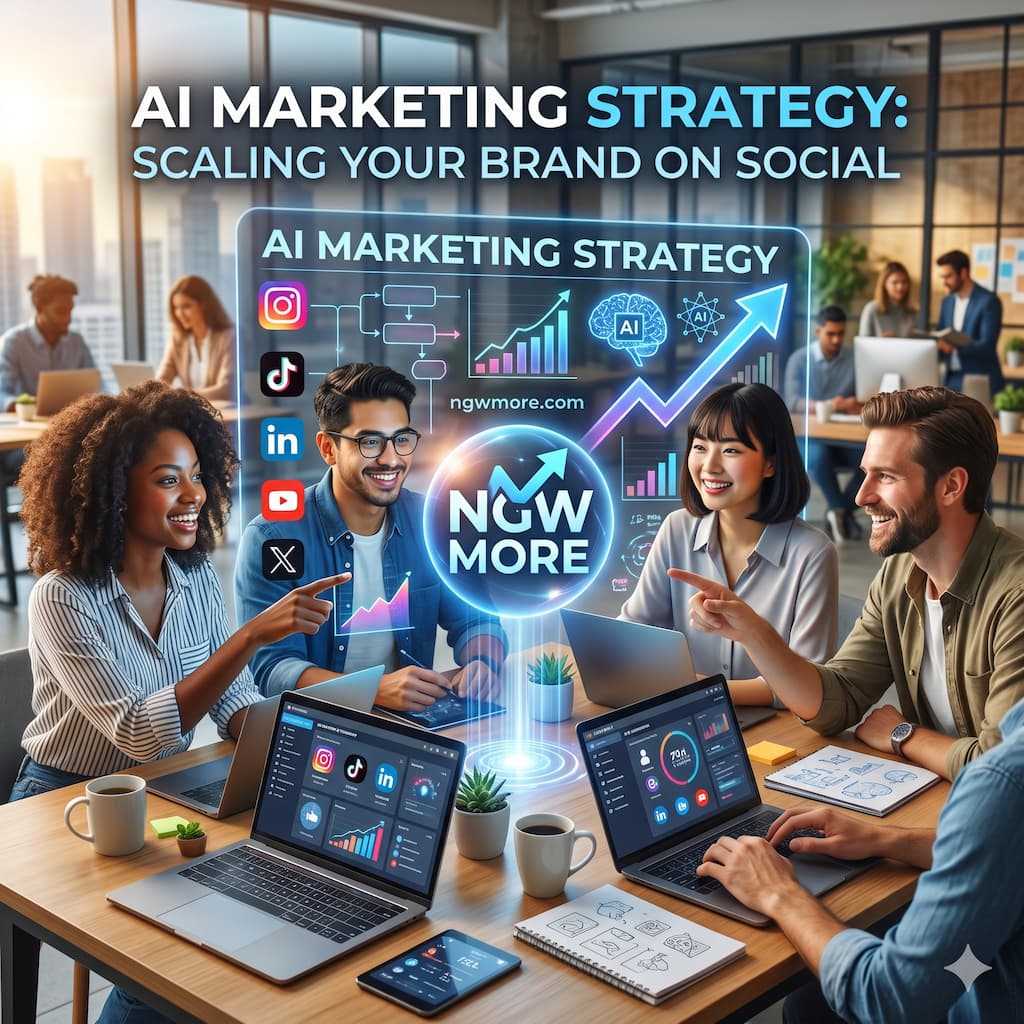
AI Marketing Strategy: Scaling Your Brand on Social
In the hyper-competitive landscape of social media, “going viral” is no longer a matter of luck—it is a matter of data. As platforms like Instagram, TikTok, and LinkedIn evolve their algorithms to prioritize hyper-personalized content, the traditional “spray and pray” marketing method has become obsolete. For brands looking to scale, the answer lies in a robust AI Marketing Strategy.
At ngwmore.com, we understand that technology should serve creativity. By integrating Artificial Intelligence into your social media workflow, you aren’t just automating tasks; you are gaining a predictive superpower that allows you to understand your audience better than they understand themselves.
1. The Core Pillars of an AI-Driven Social Strategy
To scale effectively, your strategy must move beyond simple scheduling. A modern AI marketing framework rests on four essential pillars:
- Predictive Analytics: Using historical data to forecast which content formats will perform best.
- Hyper-Personalization: Tailoring messages to micro-segments of your audience in real-time.
- Content Generation & Optimization: Leveraging generative models to produce high-quality assets at scale.
- Sentiment & Social Listening: Understanding the “vibe” of the conversation around your brand to pivot instantly.
2. Content Creation at Scale: The Generative Revolution
The biggest bottleneck in social media growth is the sheer volume of content required to stay relevant. AI has turned this bottleneck into a highway.
From Long-Form to Micro-Content
If you have a podcast or a long-form YouTube video, AI tools like Munch or OpusClip can automatically identify the “viral moments” and repurpose them into 10–15 short-form reels or TikToks. This ensures your brand stays active across all platforms without needing a massive video editing team.
AI-Enhanced Visual Identity
Visual consistency is key to brand recognition. AI image generators like Midjourney or Adobe Firefly allow you to create custom, high-fidelity brand assets that are impossible to find on stock photo sites.
- Pro Tip: Use “Style References” in your prompts to ensure every AI-generated image maintains your brand’s specific color palette and lighting style.
3. Mastering the Algorithm with Predictive Insights
Every social platform is governed by a recommendation engine. AI marketing tools allow you to “reverse engineer” these engines.
Optimal Posting Times and Formats
Instead of following generic “best time to post” guides, AI platforms like Sprout Social or Lately analyze your specific followers’ behavior. They can predict not just when they are online, but when they are most likely to engage with a specific type of content (e.g., educational vs. entertaining).
A/B Testing at Warp Speed
AI can run “synthetic” A/B tests. Before you spend a dollar on ad spend, AI models can predict which headline or thumbnail will achieve a higher Click-Through Rate (CTR) based on millions of data points from successful industry benchmarks.
4. Hyper-Personalization: The End of General Content
The future of social media isn’t “one-to-many”; it’s “one-to-one” at scale.
AI Chatbots as Social Salesmen
The integration of AI (like Gemini or GPT-based assistants) into Instagram DMs and Facebook Messenger is transforming social media from a megaphone into a storefront. Modern AI bots can:
- Qualify leads based on conversation.
- Suggest products based on a user’s previous comments.
- Provide 24/7 customer support with a human-like brand voice.
Dynamic Creative Optimization (DCO)
In paid social, AI can automatically swap out elements of an ad—changing the background, the call-to-action, or the featured product—depending on who is viewing the ad. This ensures that a 20-year-old student and a 50-year-old executive see two different versions of the same campaign, both optimized for their unique preferences.
5. Social Listening and Real-Time Brand Sentiment
Scaling a brand is dangerous if you aren’t listening. Social media is a two-way street, and AI is your ear to the ground.
Identifying Micro-Trends
AI tools like Brandwatch or Synthesio scan the entire web to find emerging trends before they hit the mainstream. If a specific “aesthetic” or “slang” is gaining traction in your niche, AI alerts you, allowing your brand to be an “early adopter” of the trend, which is a goldmine for organic growth.
Crisis Management
AI can detect a sudden spike in negative sentiment. If a post is being misinterpreted or a product is facing backlash, the AI flags the anomaly in real-time. This allows brand managers to address the issue within minutes, potentially saving the brand from a PR disaster.
6. Building Your AI Marketing Tech Stack
To implement this strategy, you need the right tools. Here is a recommended “Starter Pack” for 2026:
| Category | Recommended Tool | Core Benefit |
| Strategy & Copy | Gemini / Jasper | Drafting captions, scripts, and campaign angles. |
| Visuals | Midjourney / Canva Magic | Generating unique imagery and rapid layout design. |
| Video | HeyGen / Runway | Creating AI avatars or editing social clips instantly. |
| Management | Hootsuite (Iris AI) | Social listening and automated scheduling. |
| Analytics | Rival IQ | Competitive benchmarking and trend tracking. |
7. The Human Factor: Why AI Can’t Do It All
While we celebrate the efficiency of AI, it is crucial to remember that social media is, at its core, social.
Authenticity is the New Luxury
As the internet becomes flooded with AI-generated content, “Human-Made” content will become a premium. Your AI strategy should handle the logistics (scheduling, resizing, data analysis), but your brand soul—the controversial opinions, the behind-the-scenes messy reality, and the core values—must come from humans.
The “Blandness” Trap
AI tends to aim for the “average” because it is trained on existing data. If you rely 100% on AI for your creative direction, your brand will eventually look like everyone else. Use AI to build the foundation, but always add a “human garnish” to make it stand out.
8. Step-by-Step Guide to Scaling Your Brand
Ready to start? Follow this 30-day roadmap:
- Days 1-7 (Audit): Use an AI tool to analyze your last 6 months of social data. Identify your “Power Content” (high engagement) and “Dead Content” (low reach).
- Days 8-15 (Automate): Set up a content repurposing workflow. Turn your blog posts or long videos into a week’s worth of social posts using AI.
- Days 16-25 (Engage): Deploy an AI-driven DM assistant to handle FAQs and lead generation.
- Days 26-30 (Iterate): Review the AI-driven analytics and double down on the formats the AI identifies as high-growth.
Read More⚡ Top 5 AI Video Generators for Marketing in 2026
Conclusion: The Era of the Intelligent Brand
Scaling a brand on social media in 2026 is no longer about who has the biggest budget; it’s about who has the smartest workflow. By adopting an AI Marketing Strategy, you free your team from the drudgery of manual posting and data entry, allowing them to focus on what humans do best: Storytelling.
The transition to AI-integrated marketing is an ongoing journey. Start small, experiment often, and always keep your audience’s needs at the center of your technology.
Explore more insights on digital growth and innovation at ngwmore.com. The future of your brand is just one prompt away.