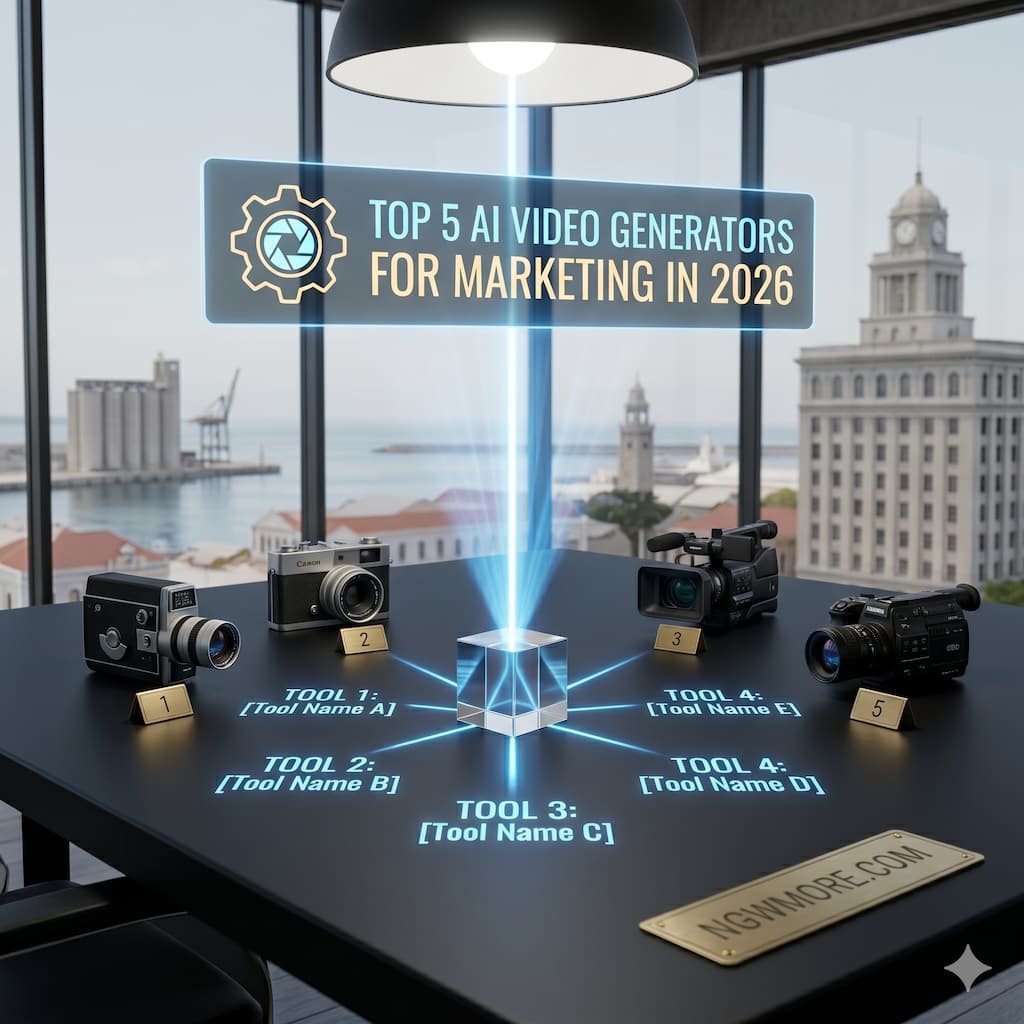
Top 5 AI Video Generators for Marketing in 2026
The era of “experimenting” with AI video is officially over. As we move through 2026, Artificial Intelligence is no longer a luxury or a novelty for marketing teams—it is the engine of production. For the creators at ngwmore.com, the challenge has shifted from “How do I make an AI video?” to “Which AI model will help me dominate my niche at scale?”
In 2026, the boundaries between professional cinematography and AI-generated content have blurred into obsolescence. We are now seeing native 4K resolution, perfect physical consistency, and synchronized spatial audio as standard features. For marketers, this means the ability to produce high-conversion video ads, social media clips, and brand stories in minutes rather than weeks.
Below, we dive into the top 5 AI video generators currently leading the market, analyzed through the lens of marketing efficiency, technical power, and brand safety.
1. Google Veo 3.1: The Cinematic Powerhouse
If you are looking for the gold standard in technical precision and brand-grade quality, Google Veo 3.1 is the undisputed leader in 2026. After several major updates earlier this year, Veo has moved beyond simple clip generation to become a full-scale cinematic engine.
Why It’s Perfect for Marketing
Veo 3.1 excels in “Cinematic Realism.” For high-stakes brand campaigns where a “uncanny valley” look could damage your reputation, Veo offers the most stable and photorealistic results. Its new “Ingredients to Video” feature allows marketers to upload specific brand assets—like a product bottle or a logo—and have the AI generate a high-end commercial around that specific object with perfect physical accuracy.
Key Features for 2026:
- Native 4K Output: Crisp, professional resolution ready for TV and cinema screens.
- Spatial Audio: Automatically generates synchronized background music, ambient noise, and even Foley effects that match the movement on screen.
- Extended Context: Veo can now generate cohesive scenes up to 60 seconds long, maintaining character and environmental consistency throughout.
- Google Ecosystem Integration: Seamlessly works with Gemini for scripting and YouTube for instant distribution.
Best For: Enterprise-level commercials, high-fidelity B-roll, and luxury brand storytelling.
2. Kling 3.0 (Omni): The “Swiss Army Knife” of Video
Originating from Kuaishou and exploding globally, Kling 3.0 has become the favorite tool for creators who need high volume and high realism. Known for having the most advanced physics engine in the market, Kling 3.0 (often referred to as Kling Omni) handles human movement better than almost any other model.
Why It’s Perfect for Marketing
Marketers often struggle with AI that makes humans look stiff or “robotic.” Kling 3.0 has solved this. Whether it’s a person drinking a soda, running through a park, or speaking directly to the camera, the muscle movements and fabric physics are flawless.
Key Features for 2026:
- 6-Shot Storyboarding: You can prompt an entire narrative arc with six different camera angles, and Kling will ensure the characters and sets look identical in every shot.
- Multilingual Lip-Sync: Upload a script in English, and Kling can generate a video of a person speaking it, then instantly “dub” the lip movements to Spanish, Mandarin, or Portuguese.
- 4K @ 60fps: Perfect for slow-motion shots or high-action sports marketing.
Best For: Social media ads (TikTok/Reels), product demos involving human interaction, and globalized content.
3. Runway Gen-4.5: The Creative Director’s Choice
Runway has always been the pioneer of the “AI Creative Suite,” and Gen-4.5 continues that legacy by offering the most granular control. While other tools are “prompt-and-pray,” Runway gives you the steering wheel.
Why It’s Perfect for Marketing
Marketing is about specific aesthetics. If your brand has a “moody, noir” vibe or a “bright, vaporwave” aesthetic, Runway’s Director Mode allows you to control camera pans, tilts, and zooms with a virtual joystick. Its partnership with NVIDIA has made the rendering speeds almost instantaneous, allowing for real-time creative brainstorming.
Key Features for 2026:
- Advanced Image-to-Video: Take a static product photo and “animate” it with specific instructions (e.g., “make the steam rise from the coffee cup”).
- Multi-Motion Brush: Direct exactly which parts of an image should move and in what direction.
- Custom Style Presets: Save your brand’s visual identity as a “style filter” to ensure every video generated by your team looks consistent.
Best For: Creative agencies, stylized social content, and experimental visual marketing.
4. Pika (Pro): The Social Media Specialist
While others chase cinematic glory, Pika has doubled down on what works for the attention economy: speed, fun, and viral potential. In 2026, Pika Pro is the go-to for social media managers who need to react to trends in real-time.
Why It’s Perfect for Marketing
Pika’s strength lies in its “Sound-to-Video” and “Lip-Sync” simplicity. It is designed for the 9:16 vertical format. If a new meme format takes off on TikTok, you can use Pika to generate a high-quality version featuring your brand’s mascot or products in minutes.
Key Features for 2026:
- Fast Mode: Generates usable 10-second clips in under 30 seconds.
- Seamless Loop Generation: Perfect for creating mesmerizing background loops for websites or Spotify Canvas.
- AI Effects Library: Instantly add “physically impossible” effects, like a product melting into liquid or exploding into flower petals, which are great for “stop-the-scroll” marketing.
Best For: Short-form video (Shorts/TikTok/Reels), meme marketing, and rapid-fire social testing.
5. Genra AI: The End-to-End Orchestrator
Genra AI is a newer heavyweight that has disrupted the industry by acting as an “Orchestrator.” Instead of relying on just one model, Genra uses a multi-model backend, picking the best parts of Sora, Veo, and Kling to assemble a final product.
Why It’s Perfect for Marketing
For the busy marketer at ngwmore.com, Genra simplifies the workflow. You provide the goal (e.g., “I want a 30-second ad for a new skincare line”), and Genra handles the scriptwriting (via Claude integration), the video generation, the voiceover, and the final edit.
Key Features for 2026:
- AI Director Agent: A conversational agent that helps you refine the video. You can say, “Make the lighting warmer in the second shot,” and it will re-render just that segment.
- Built-in Analytics Prediction: Before you even publish, Genra uses AI to predict which version of the video will perform better based on current market trends.
- Collaborative Workspace: Allows entire marketing teams to work on the same video project simultaneously.
Best For: Marketing teams without in-house editors, “lean” startups, and high-volume performance marketing.
Comparison Table: Which One Should You Choose?
| Tool | Primary Strength | Best Use Case | Pricing Tier (2026) |
| Google Veo 3.1 | Technical Perfection | High-end Brand Ads | Part of Google AI Pro/Ultra |
| Kling 3.0 | Human Physics | UGC-style Ads / Global | Credit-based / Subscriptions |
| Runway Gen-4.5 | Creative Control | VFX / Specific Aesthetics | $28 – $76 / Month |
| Pika (Pro) | Speed & Virality | TikTok / Reels | Affordable Creator Plans |
| Genra AI | Workflow Automation | Full Ad Campaigns | Enterprise / Per-Project |
The Strategic Shift: How to Scale Your Video Production
Having the tools is only half the battle. To truly scale your production on ngwmore.com, you need to implement an AI-First Video Workflow.
1. Batch Your Ideation
Don’t prompt one video at a time. Use a tool like Gemini to generate 20 different hooks for a single product. Then, feed those hooks into your chosen generator (like Kling or Pika) to create 20 variations. This allows you to A/B test your content at a scale that was previously impossible.
2. Focus on Character Consistency
One of the biggest trends in 2026 is the use of Persistent AI Characters. By creating a “Brand Ambassador” (an AI-generated person or mascot) and saving their “seed” or “face ID,” you can use them across all five tools listed above. This builds long-term brand recognition without the cost of a celebrity spokesperson.
3. Native Audio is Key
In 2026, silent video is a mistake. Ensure you are using tools like Veo or Kling that generate native, synchronized audio. If the tool you love doesn’t have great audio, pair it with Lyria 3 for custom music or ElevenLabs for perfect voiceovers.
A Final Warning: The “Sora” Situation
While OpenAI’s Sora was the pioneer that started the AI video craze, it’s important for marketers to note that as of late 2026, Sora has shifted its focus toward the API and enterprise partnerships. For individual creators and small marketing teams, tools like Veo and Runway currently offer more accessible and stable “out-of-the-box” platforms. If you are building a long-term production pipeline, always have a backup model in your stack.
Read More⚡ Build a Remote Culture with AI Communication Tools
Conclusion
The “Top 5” list for 2026 shows a clear trend: Video production is no longer a bottleneck. Whether you are a solo creator or part of a global marketing department, these tools allow you to tell stories that were previously locked behind million-dollar budgets.
At ngwmore.com, we encourage you to start with one tool that fits your current most pressing need. Is it speed? Go with Pika. Is it absolute quality? Go with Veo.
The future of marketing isn’t just about moving images; it’s about the speed of relevance. With these AI video generators, you can finally move as fast as the culture does.
Follow ngwmore.com for the latest updates on AI marketing and digital production tools.