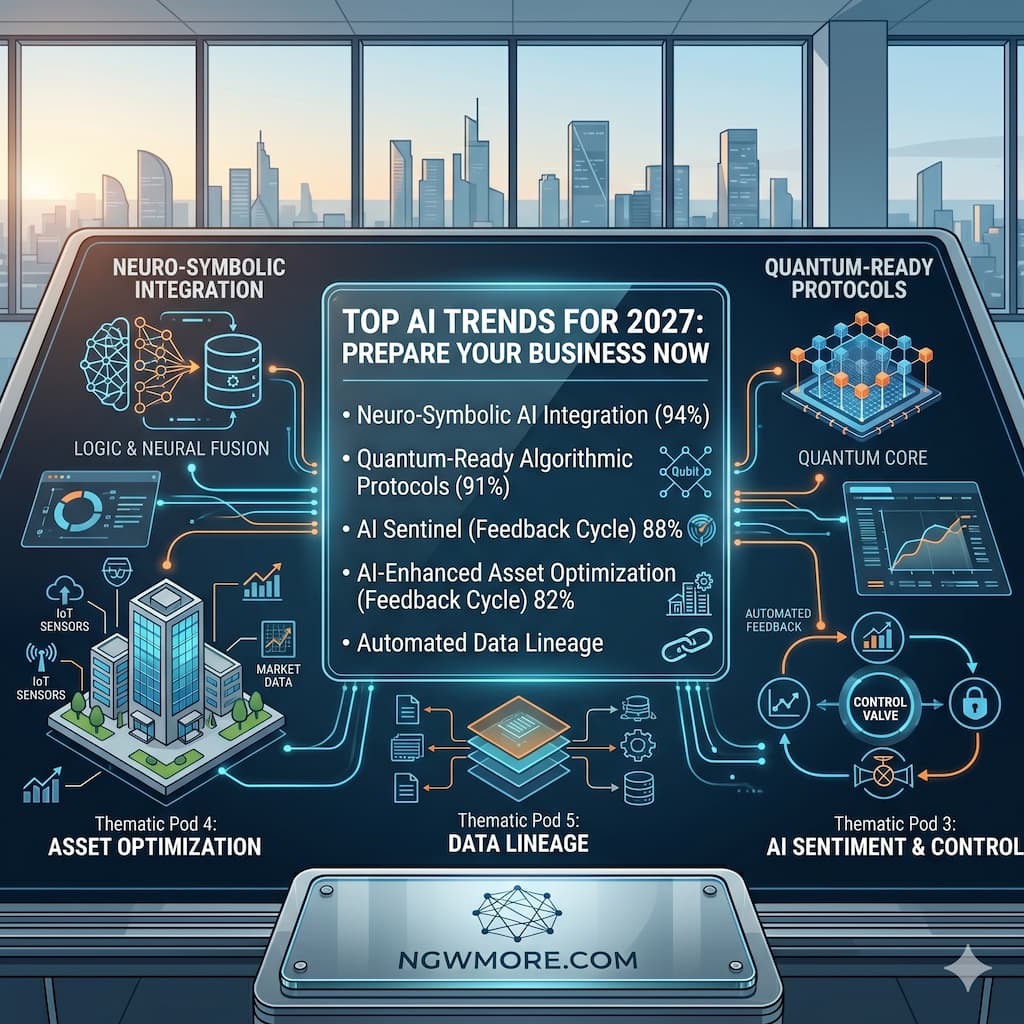
Top AI Trends for 2027: Prepare Your Business Now
As we move through the second half of 2026, the “AI Hype” has long since settled into a more profound “AI Reality.” We are no longer impressed by chatbots that can write poems; we are now dependent on integrated systems that manage supply chains, diagnose diseases, and write software in real-time.
However, the pace of evolution is not slowing down. 2027 is set to be the year of Agentic Autonomy and Physical Intelligence. For the community at ngwmore.com, staying ahead means looking beyond current generative tools and preparing for the structural shifts that will define the next fiscal year.
Here are the top AI trends for 2027 and the strategic steps you must take today to ensure your business remains relevant.
1. The Rise of Agentic Workflows (The End of “Prompting”)
In 2024 and 2025, we talked about “prompts.” In 2027, prompting is considered an archaic skill. We have entered the era of AI Agents.
Unlike standard LLMs that require a human to lead them through every step, AI Agents are goal-oriented. You don’t tell them how to do a task; you tell them what the desired outcome is. For example, instead of prompting an AI to “write an email to a supplier,” you will instruct your agent to “negotiate a 10% discount on next month’s inventory based on our loyalty history and current market prices.”
How to Prepare:
- Audit Your Processes: Identify workflows that require 5–10 manual steps. These are the first candidates for agentic automation.
- API Readiness: Agents need to “talk” to your other software. Ensure your business stack is API-first so that autonomous agents can pull data from your CRM and push it to your accounting software.
2. On-Device AI and Edge Computing (Privacy First)
By 2027, the reliance on massive, centralized cloud servers for every AI interaction will diminish. Driven by privacy concerns and the need for zero-latency, On-Device AI (Edge AI) will become the standard for enterprise security.
High-performance laptops and mobile devices in 2027 will come equipped with specialized NPUs (Neural Processing Units) capable of running sophisticated models locally. This means your sensitive business data never has to leave your hardware to be processed.
How to Prepare:
- Hardware Lifecycle Planning: If you are due for a hardware refresh in late 2026, ensure you are investing in “AI-Native” hardware.
- Data Governance: Re-evaluate your cloud privacy policies. Start moving toward a hybrid model where sensitive intellectual property is processed locally.
3. The “Physical AI” Revolution: Robotics and Vision
2027 will be the year AI truly “gains a body.” We are seeing the convergence of Large Language Models with Large Behavior Models (LBMs). This is the intelligence behind the next generation of humanoid robots and autonomous warehouse systems.
AI can now see a physical space, understand the physics of the objects within it, and manipulate them with human-like dexterity. For businesses in logistics, manufacturing, or even retail, this is the moment automation moves from the screen to the floor.
How to Prepare:
- Spatial Mapping: If you operate physical facilities, begin digitizing your floor plans and workflows into “Digital Twins.” AI needs a map before it can move.
- Labor Strategy: Start upskilling your physical workforce now. The goal is to move workers from “doing the lifting” to “managing the fleet.”
4. Multi-Modal “Omni-Models” as the Default
In 2027, the distinction between a “text AI,” an “image AI,” and a “video AI” has vanished. We are now using Omni-Models. These systems process video, audio, code, and text simultaneously in a single stream of consciousness.
Your AI assistant will watch a recorded Zoom meeting, analyze the tone of the participants’ voices, identify the whiteboard sketches via the camera, and produce a fully functional software prototype based on the discussion—all in one go.
How to Prepare:
- Consolidate Your Tools: Stop paying for five different specialized AI subscriptions. Look for unified platforms that offer integrated multi-modal capabilities to reduce “data silos.”
- Visual Documentation: Start recording your processes in video format. This will be the “training data” for your future Omni-Agents.
5. AI-Generated Synthetic Data for Niche Markets
One of the biggest bottlenecks in AI has been the “Data Wall”—the point where we run out of high-quality human text to train models. In 2027, the solution is Synthetic Data.
AI is now capable of creating perfectly accurate, simulated data to train other AI models. This is particularly huge for niche industries (like specialized medical tech or high-end legal services) where real-world data is scarce or highly sensitive.
How to Prepare:
- Focus on Customization: Don’t just use “off-the-shelf” AI. Use synthetic data to “fine-tune” a model specifically for your company’s unique jargon and customer behavior.
- Quality Control: Develop a “Human-in-the-Loop” verification process to ensure synthetic data doesn’t lead to “Model Collapse” or bias.
6. The “Human Premium” and Digital Provenance
As the internet becomes flooded with AI-generated content, 2027 will see the rise of the “Human Premium.” Consumers will begin to value content, products, and services that are verified as human-made.
The use of C2PA (Content Provenance and Authenticity) metadata will be mandatory for major platforms. Every image, video, and article will have a “nutrition label” showing exactly how much AI was involved in its creation.
How to Prepare:
- Brand Transparency: At ngwmore.com, we recommend being “Radically Transparent.” Clearly label which parts of your service are AI-powered and which are human-led.
- Verify Your Assets: Use digital signature tools to “protect” your original brand content from being scraped or faked.
7. Hyper-Personalization at Scale (Market-of-One)
By 2027, “Targeted Ads” will feel like ancient history. We are entering the era of Generative UI.
Instead of everyone seeing the same website at ngwmore.com, the interface will morph in real-time based on the user’s specific needs, accessibility requirements, and past behavior. The AI will generate a unique user experience for every single visitor.
How to Prepare:
- Modular Content: Start breaking your brand assets into “atoms”—small, reusable pieces of text, imagery, and code. This allows AI to reassemble them dynamically for different users.
- Customer Data Platforms (CDP): Invest in a robust CDP. AI can only personalize if it has a deep, organized understanding of your customer’s journey.
8. AI Sovereignty and Localized Regulation
By 2027, the “Global AI” dream will be replaced by AI Sovereignty. Nations (and even some large corporations) will insist on having their own models, trained on their own cultural values and legal frameworks.
Regulatory compliance will move from “vague guidelines” to “hard-coded constraints.” If your AI operates in the EU, it will have different hard-coded ethical boundaries than an AI operating in the US or Asia.
How to Prepare:
- Compliance Automation: Use AI to monitor AI. Implement automated compliance tools that check your outputs against regional laws in real-time.
- Diversify Your Models: Don’t put all your eggs in one basket (e.g., just OpenAI or just Google). Build a “Multi-Model Strategy” that allows you to swap providers based on local regulations.
9. The Energy Transition: AI for Sustainability
The massive energy consumption of AI will be a major political and economic issue in 2027. Businesses will be judged on their “Inference Efficiency.”
We will see the rise of Green AI—models specifically designed to use 90% less power while maintaining 95% of the performance. Sustainability isn’t just a PR move in 2027; it’s a cost-saving necessity.
How to Prepare:
- Efficiency Audits: Ask your AI providers about their “Carbon-per-Query” metrics.
- Optimize Your Hosting: Use energy-efficient hosting solutions (like those optimized at ngwmore.com) to ensure your digital footprint remains sustainable.
10. The Shift from “Worker” to “Orchestrator”
Finally, the most significant trend of 2027 is the change in human roles. We are moving away from being “Specialists” and toward being “Orchestrators.”
The most successful employees in 2027 will be those who can manage a “digital workforce” of 10–15 specialized AI agents. Leadership will be defined by how well you can direct machine intelligence to solve human problems.
How to Prepare:
- Change Management: This is a psychological shift as much as a technical one. Start foster a culture of “AI Curiosity” within your team.
- Soft Skills Investment: As AI handles the logic and the data, the value of empathy, ethics, and strategic intuition will skyrocket. Double down on leadership training.
Summary: Your 2027 Preparation Timeline
| Timeline | Action Item | Goal |
| Q3 2026 | Audit software stack for API access. | Agentic Readiness |
| Q4 2026 | Refresh hardware with NPU-enabled chips. | On-Device Privacy |
| Q1 2027 | Implement Digital Product Passports/Provenance. | Brand Trust |
| Q2 2027 | Launch Generative UI experiments. | Hyper-Personalization |
Read More⚡ Best AI Tools for Sales Funnel Automation
Conclusion
2027 will not be about “using AI”; it will be about living alongside it. The businesses that thrive will be those that view AI as a team of autonomous collaborators rather than just a set of tools.
At ngwmore.com, we are committed to providing the infrastructure and the insights you need to navigate this transition. The future isn’t coming; it’s already being coded. The only question is: Is your business the one writing the script, or are you just a character in someone else’s story?
Start your preparation today. The “Agentic Era” waits for no one.