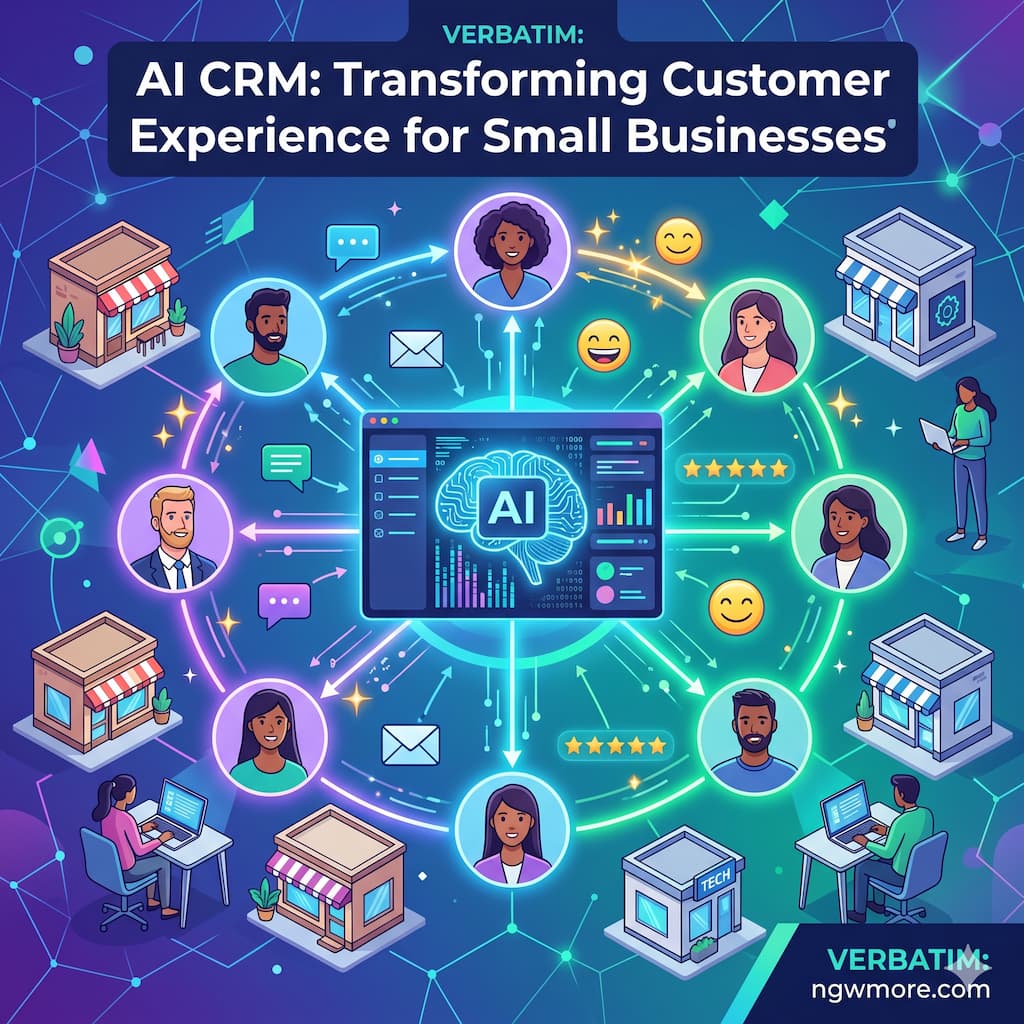
AI CRM: Transforming Customer Experience for Small Businesses
The Dawn of Intelligent Customer Relationships
In the rapidly evolving digital landscape of 2026, the phrase “Customer Relationship Management” (CRM) no longer evokes images of clunky spreadsheets, manual data entry, or fragmented email lists. For small businesses, digital entrepreneurs, and agile e-commerce brands, the margin between exponential growth and stagnation often comes down to a single factor: the quality and personalization of the customer experience. This is where Artificial Intelligence within CRM platforms has transitioned from a luxury feature to an absolute operational necessity.
Whether you are managing a portfolio of content websites, running a high-volume TikTok Shop, or offering specialized technical services, understanding your customer is paramount. Historically, enterprise-level corporations held a monopoly on deep customer insights because they had the capital to employ entire departments of data scientists. Today, AI CRMs have democratized this technology. They act as a tireless, incredibly precise analytical engine that lives at the core of your digital operations, quietly turning raw data into actionable, revenue-generating strategies.
This comprehensive guide, brought to you by ngwmore.com, explores how AI-driven CRMs are fundamentally transforming how small businesses interact with their audiences, optimize their workflows, and scale their operations without losing the human touch.
1. What Exactly is an AI CRM? Moving Beyond the Rolodex
To understand the transformation, we must first redefine the tool. A traditional CRM was essentially a digital Rolodex—a static database where sales reps logged calls, saved email addresses, and tracked the status of a deal. It relied entirely on human input. If a team member forgot to update a profile, the data was dead.
An AI CRM is a dynamic, predictive ecosystem. It leverages Machine Learning (ML), Natural Language Processing (NLP), and Generative AI to actively manage the customer lifecycle.
The Shift from Reactive to Proactive
Instead of simply storing data, an AI CRM analyzes it in real-time. It connects the dots across multiple touchpoints—website visits, email open rates, social media interactions, and purchase history. By identifying patterns within massive datasets that a human could never process, the AI transitions the business from a reactive posture (waiting for a customer to complain or ask a question) to a proactive posture (anticipating the customer’s need before they even articulate it).
For a small business owner juggling server maintenance, marketing campaigns, and product sourcing, this means the software is no longer just a storage facility; it is an active participant in your business strategy.
2. Hyper-Personalization at Scale: Treating Every Customer Like Your Only Customer
The most significant advantage of an AI CRM is its ability to deliver hyper-personalized experiences to thousands of users simultaneously. Modern consumers are blind to generic, batch-and-blast marketing. They expect brands to know their preferences, respect their time, and offer relevant solutions.
Dynamic Content and Tailored Messaging
Imagine running a digital storefront. A traditional CRM might allow you to send a generic “10% off” birthday email. An AI CRM, however, looks at a specific customer’s behavior. It notices that they frequently browse a specific category—say, high-performance cycling components or specialized home tools—but abandon their cart when shipping costs are calculated.
The AI can automatically generate and send a highly customized email featuring the exact products they viewed, written in a tone that matches their previous interactions with your brand, and offering a dynamic incentive (like free shipping) specifically tailored to overcome their unique purchasing hurdle.
Predictive Lead Scoring
Not all leads are created equal. For service-based businesses or B2B operations, chasing unqualified leads is a massive drain on resources. AI CRMs utilize predictive lead scoring to evaluate a prospect’s likelihood to convert. The system analyzes historical data, engagement levels, and demographic information to assign a real-time score to every lead in your pipeline.
This allows your sales efforts to be laser-focused. Instead of treating every inquiry equally, you can dedicate your energy to the top 10% of prospects who are statistically ready to buy, dramatically improving your conversion rates and operational efficiency.
3. Revolutionizing E-Commerce and Omnichannel Operations
For digital entrepreneurs operating in fast-paced environments like TikTok Shop, affiliate marketing, or omnichannel retail, the complexity of customer interactions can become overwhelming. Customers might discover a product via a short-form video, ask a question via Instagram DM, and finally purchase through your WordPress WooCommerce site.
Seamless Omnichannel Unification
An AI CRM acts as the central nervous system for these fragmented interactions. It unifies the customer profile regardless of the channel. When a customer reaches out to your support team via email regarding a delayed order, the CRM automatically pulls up their recent TikTok interactions, their lifetime value (LTV), and their browsing history on your main domain.
This unified view prevents the classic customer service nightmare where a buyer has to repeat their problem to three different representatives. The AI provides the human agent with complete, immediate context.
Optimizing ROAS and vCPM
In the realm of digital marketing, AI CRMs are secret weapons for optimizing Return on Ad Spend (ROAS). Because the CRM deeply understands who your most valuable customers are, it can seamlessly push this data back to advertising platforms (like Meta or TikTok Ads).
Instead of relying on broad, algorithmic guesses from the ad networks, you feed the network highly refined “lookalike” data based on your AI CRM’s analysis of customers with the highest LTV. This reduces your Viewable Cost Per Mille (vCPM) while simultaneously increasing the quality of the traffic, ensuring your marketing budget is deployed with surgical precision.
4. Automating Customer Support with Natural Language Processing
Customer support is often the heaviest operational burden for a growing small business. You want to provide 24/7, white-glove service, but hiring a massive support team destroys profit margins.
Intelligent Chatbots and Triage
AI CRMs integrate advanced Natural Language Processing (NLP) to handle the front lines of customer service. These are not the frustrating, rigid chatbots of 2018 that forced users into endless loops. Modern AI chatbots—often powered by the same underlying technology as advanced large language models—can understand nuance, context, and sentiment.
They can instantly resolve routine queries: processing a return, tracking a package, or explaining the difference between two products. More importantly, they feature intelligent triage. If the AI detects negative sentiment (e.g., the customer uses words indicating frustration) or the query is highly complex, it seamlessly routes the conversation to a human agent, providing the agent with a complete summary of the chat up to that point.
Sentiment Analysis and Churn Prevention
The AI is constantly “listening” to the tone of incoming emails, reviews, and support tickets. Through sentiment analysis, the CRM can flag accounts that are at a high risk of churning (leaving your business for a competitor). If a long-time customer suddenly submits a frustrated support ticket, the AI can elevate its priority, bypassing the standard queue, and alert a manager to intervene personally. This proactive approach saves relationships that would otherwise be lost in the noise of a busy inbox.
5. Generative AI: Your Automated Content and Marketing Assistant
Writing compelling copy, drafting follow-up emails, and creating engagement sequences takes time—a luxury most small business owners lack. The integration of Generative AI directly into the CRM interface is a game-changer.
Drafting Context-Aware Communications
Whether you need to write a delicate apology email for a shipping delay or draft an engaging newsletter for a specific segment of your audience, the AI CRM can generate the first draft instantly. Because the AI is integrated into the CRM, it doesn’t just write generic text; it uses the specific context of the customer’s history.
If you ask the CRM to “draft a follow-up email to John about his recent purchase of mountain bike gear,” the AI will reference the specific items John bought, ask how his recent rides have been, and suggest complementary products—all in a tone that aligns with your brand’s voice.
Automated Workflow Creation
Beyond writing text, Generative AI is now being used to build complex automation workflows. In the past, setting up a “cart abandonment sequence” required logic mapping and manual trigger configuration. Today, you can simply type a prompt: “Create a workflow that sends a reminder email 24 hours after an abandoned cart, followed by a 5% discount SMS two days later if they still haven’t purchased.” The AI CRM builds the logic, designs the templates, and activates the sequence.
6. The Technical Implementation: Getting Started Without the Overwhelm
The prospect of migrating to an AI-driven CRM can seem daunting, especially if your current customer data is scattered across legacy systems, payment gateways like Mercado Pago, and various email inboxes. However, a strategic rollout minimizes friction and accelerates the return on investment.
Step 1: Data Cleansing and Consolidation
AI is powerful, but it cannot fix fundamentally broken data. The principle of “garbage in, garbage out” applies heavily here. Before migrating, audit your existing data. Remove duplicates, standardize formatting, and ensure that your historical customer records are as clean as possible. The better the historical data, the faster the AI can train its predictive models to your specific business ecosystem.
Step 2: Choosing the Right Platform
Not all AI CRMs are built for small businesses. Enterprise solutions like Salesforce, while powerful, often require dedicated developers and massive budgets. Small businesses should look for agile, cloud-native platforms that offer robust API integrations. Ensure the CRM natively integrates with your specific tech stack—whether that’s a WordPress/WooCommerce environment running on aaPanel, your email marketing software, or your social commerce platforms.
Step 3: Start with High-Impact, Low-Risk Automations
Do not attempt to automate your entire business on day one. Start by implementing the AI in high-impact areas that immediately free up your time.
- Turn on predictive lead scoring to help you prioritize your day.
- Implement an AI chatbot to handle basic “Where is my order?” inquiries.
- Set up AI-driven cart abandonment sequences.
Once these foundational automations are running smoothly and you trust the system’s output, you can begin exploring more complex use cases, such as dynamic pricing triggers or fully automated re-engagement campaigns.
7. Security and Data Privacy in the AI Era
With great data comes great responsibility. As an AI CRM aggregates incredibly detailed profiles of your customers, securing that data becomes your highest priority.
Small businesses must ensure that their chosen CRM complies with global data protection regulations, such as GDPR and CCPA. Furthermore, look for CRMs that offer transparent AI models. You should be able to understand how the AI is using your customer data to make predictions. Ensure your hosting environments are secure, utilizing robust server-side security, and that all API handshakes between your website and the CRM are heavily encrypted. Building trust with your audience means assuring them that their hyper-personalized experience is built on a foundation of absolute privacy.
Read More⚡ Best Investment Strategies for Beginners in 2025
Conclusion: The Competitive Imperative
The adoption of AI CRM technology is no longer an experimental phase reserved for Silicon Valley startups. It is the new baseline for customer expectation. In 2026, a customer interacting with a small business expects the same level of personalization, speed, and intelligence that they receive from global tech giants.
For digital entrepreneurs, the choice is clear. You can continue to manage relationships manually, capping your growth by the limits of your own time and energy. Or, you can embrace an AI CRM as a digital partner—a system that scales your empathy, automates the mundane, and uncovers revenue opportunities hidden deep within your data.
By transforming your customer experience from a series of transactional moments into an intelligent, continuous relationship, you do more than just increase sales; you build a resilient, future-proof brand.
For more deep dives into digital infrastructure, marketing technology, and scaling your online business, stay connected with the latest insights right here on ngwmore.com.