Build a Remote Culture with AI Communication Tools
The shift to remote work was the defining movement of the early 2020s, but as we move through 2026, the challenge has evolved. It is no longer about simply “allowing” people to work from home; it is about sustaining a vibrant, cohesive, and high-performing culture across time zones and digital divides.
At ngwmore.com, we understand that culture isn’t built in a breakroom; it’s built through communication. In 2026, the “glue” holding remote teams together is increasingly powered by Artificial Intelligence. Build a remote culture with AI communication tools to turn a group of isolated workers into a synchronized powerhouse.
1. The 2026 Remote Work Paradox
In the past, remote work often led to “proximity bias” and digital isolation. Employees felt that if they weren’t seen, they weren’t heard. Today, AI communication tools have solved this by creating Digital Presence. These tools don’t just transmit text; they translate intent, manage energy levels, and bridge the gap between “working apart” and “working together.”
From Asynchronous to Hyper-Synchronized
The old way of communicating relied on endless Slack messages and Zoom fatigue. In 2026, AI acts as a communication synthesizer. It filters the noise, highlights the “must-knows,” and ensures that culture remains consistent even when the CEO is in London and the lead developer is in Tokyo.
2. AI-Driven Psychological Safety and Sentiment Analysis
A healthy culture is built on trust and psychological safety. In a physical office, a manager can “read the room.” In a remote setting, they must “read the data.”
Sentiment Mapping
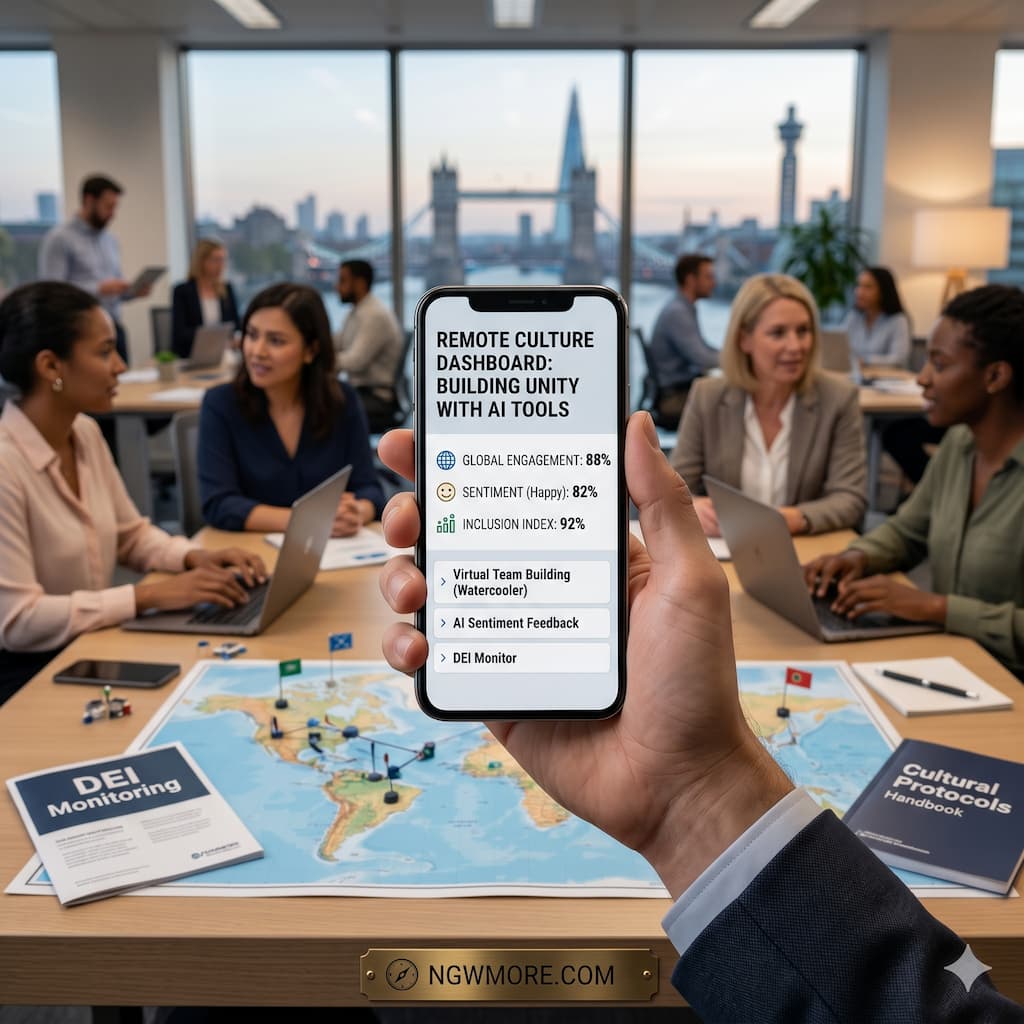
Modern AI tools integrated into platforms like Microsoft Teams or Slack now offer real-time sentiment analysis. These tools analyze the tone of written communication and meeting transcripts to identify signs of burnout, frustration, or misalignment before they lead to turnover.
- The Cultural Benefit: Managers receive “nudges” suggesting that a team member might need a 1-on-1, or that a specific project is causing undue stress.
- The Privacy Guardrail: In 2026, these tools are designed to protect anonymity, focusing on team health rather than individual surveillance, fostering a culture of support rather than scrutiny.
3. Breaking the Language Barrier: Universal Fluency
Nothing kills a global remote culture faster than a language gap. It creates hierarchies where native speakers dominate conversations.
Real-Time Neural Translation
AI tools now provide near-latency-free translation for video calls and chat. This allows a team member in Brazil to speak Portuguese while their colleague in Japan hears Japanese.
- Impact on Inclusion: This democratizes participation. When everyone can speak their “heart language,” you unlock the full intellectual potential of your global workforce. It signals that your brand, ngwmore.com, values talent over linguistic background.
4. AI as the “Chief Culture Officer” for Meetings
Zoom fatigue was the plague of 2024. In 2026, AI has cured it by making meetings shorter, smarter, and more inclusive.
AI Meeting Co-Pilots
Tools like Fireflies, Otter.ai, and proprietary internal models now do more than just transcribe. They:
- Enforce Inclusivity: AI can track “airtime.” If one person is dominating 80% of the call, the AI can privately nudge the moderator to invite quieter team members into the conversation.
- Eliminate “FOMO”: AI-generated “Golden Minute” summaries allow team members in conflicting time zones to skip the meeting entirely but still understand the nuances and emotional tone of the discussion.
- Action Item Clarity: By automatically assigning tasks based on verbal commitments, AI removes the “who was supposed to do that?” friction that erodes team trust.
5. Personalizing the Employee Experience with AI
A strong remote culture recognizes the individual. When you don’t see someone every day, you need AI to help you remember the small things that matter.
AI-Powered Social “Watercoolers”
Since “organic” watercooler talk doesn’t happen in remote settings, AI creates intentional serendipity. Algorithms can pair team members for “virtual coffees” based on shared interests found in their public profiles (e.g., both are into photography or retro gaming).
- Recognition Engines: AI tools can scan public “Kudos” channels and identify unsung heroes—the people who help others but don’t brag about it. The AI can then prompt leadership to provide a personalized reward, ensuring everyone feels seen.
6. Onboarding: The First Cultural Touchpoint
Onboarding is where culture begins. AI-driven onboarding portals now provide a “concierge” experience.
- Knowledge Retrieval: New hires often feel “culture shock” because they don’t know the “unwritten rules” or where to find information. AI chatbots trained on the company’s internal Wiki provide instant answers, reducing the “new kid” anxiety.
- Cultural Mentorship: AI can suggest the best “cultural mentors” for a new hire based on their working style and personality type, accelerating their integration into the team.
7. The Ethical Integration of AI Communication
To build a culture that lasts, you must integrate AI ethically. Transparency is the bedrock of trust.
The “Human-First” Policy
At ngwmore.com, we recommend a clear policy: AI is used to enhance human connection, not to replace it.
- No Ghost-Writing: Avoid using AI to write sensitive feedback or personal messages. Culture is lost when employees feel they are talking to an algorithm.
- Feedback Loops: Regularly ask the team: “Is the AI helping you feel more connected, or is it getting in the way?” Use their feedback to tune your communication stack.
8. Strategic Roadmap: Building Your AI-Communication Stack
| Tool Category | Purpose | Cultural Impact |
| Sentiment Analysis | Monitoring team morale. | Prevents burnout/Quiet Quitting. |
| Live Translation | Bridging global teams. | Promotes radical inclusion. |
| Meeting Synthesizers | Reducing meeting load. | Respects deep work and boundaries. |
| Social Algos | Connecting remote peers. | Builds genuine friendships. |
9. Overcoming the “Digital Exhaustion”
While AI helps, the risk of 2026 is “constant connectivity.” A great remote culture uses AI to protect time.
- AI Gatekeepers: Use AI to auto-decline meetings that don’t have an agenda or that conflict with an employee’s “Deep Work” blocks.
- Context Switching Prevention: AI can bundle notifications so employees aren’t interrupted every five minutes, allowing them to enter “flow state”—the most rewarding part of any job.
10. The Verdict: Is AI the Future of Culture?
The answer is a resounding yes. Remote culture in 2026 is no longer about the physical space; it’s about the quality of the interaction. By using AI to remove the frictions of language, time zones, and administrative overhead, we allow humans to do what they do best: create, innovate, and bond.
Build a remote culture with AI communication tools to ensure that your team at ngwmore.com is not just working in the same cloud, but moving in the same direction.
Read More⚡ Best Enterprise LLM: ChatGPT-5 vs. Competitors
Conclusion: Lead with Empathy, Power with AI
The technology is here, but the heart of the culture remains human. AI provides the data, the translation, and the efficiency, but it is the leaders who must provide the vision and the empathy. Use these tools to clear the path for more meaningful human moments.
When you invest in an AI-powered communication stack, you aren’t just buying software; you are investing in the mental health, productivity, and longevity of your most valuable asset: your people.