Best AI Tools for Sales Funnel Automation
The fundamental architecture of digital commerce is undergoing a massive transformation. For years, digital entrepreneurs, media buyers, and portfolio operators relied on static, linear sales funnels. The classical model was predictable but highly inefficient: drive cold traffic via paid ads, funnel them to a static landing page, capture an email, and hope a generic drip campaign would eventually convert them into paying customers.
Today, managing multiple high-traffic domains, scaling e-commerce brands, or optimizing programmatic ad networks requires a completely different approach. Artificial Intelligence has shattered the linear funnel, replacing it with a dynamic, highly personalized ecosystem that adapts to user behavior in real-time. For the modern digital operator—especially those running complex server environments and managing diverse online assets like the community here at ngwmore.com—automating the sales funnel with AI is no longer a luxury; it is the baseline for survival.
When you are managing the technical overhead of multiple WordPress installations, dealing with server optimizations, and trying to scale revenue, manual marketing tasks become your primary growth bottleneck. This comprehensive, deep-dive guide explores the absolute best Artificial Intelligence tools available today to fully automate every single stage of your sales funnel, from initial demand generation down to infrastructure-level data orchestration.
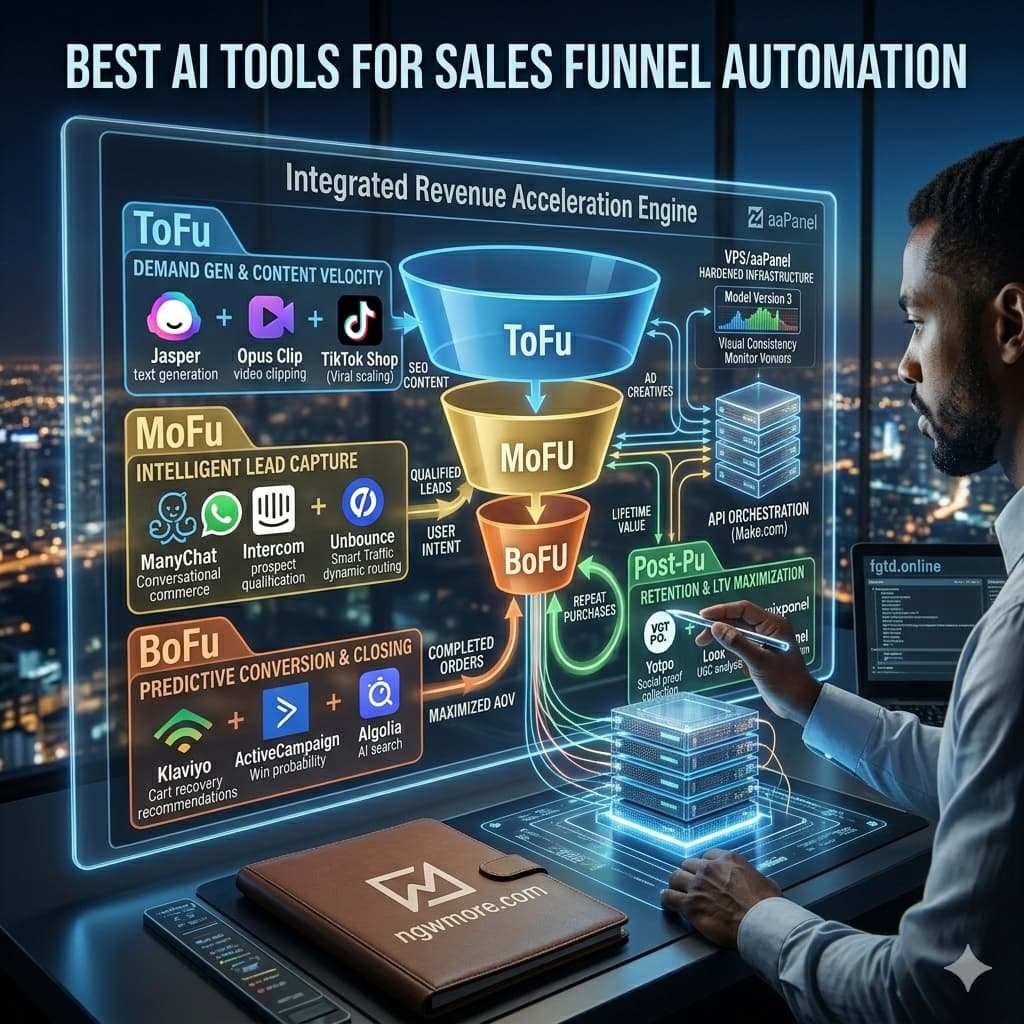
1. Top of the Funnel (ToFu): Demand Generation & Content Velocity
The top of the funnel is a volume game. Your goal is to capture attention, rank organically on search engines, and stop the scroll on highly visual social media platforms. AI tools in this tier are designed to eliminate the friction of content creation and drastically increase your output without sacrificing quality.
Programmatic SEO and Editorial Automation
If you are managing content-heavy domains or tech-focused sites, producing high-quality, SEO-optimized articles at scale is incredibly resource-intensive.
- Jasper AI / Copy.ai: These platforms have evolved far beyond basic text generators. They are complete editorial workflows. By utilizing their brand voice features, you can train the AI on your existing top-performing articles. You can set up automated workflows where the AI ingests a list of long-tail keywords, generates comprehensive outlines, writes the 2,000-word articles, formats the HTML (including H2 and H3 tags), and pushes the drafts directly to your WordPress backend via API.
- Claude 3.5 Sonnet (via API): For operators who prefer building custom workflows, integrating the Anthropic API into your backend provides the highest quality prose currently available. Claude is exceptionally good at writing technical buying guides, avoiding the repetitive, robotic tone that often triggers search engine spam filters.
Social Commerce and Short-Form Video Scaling
E-commerce has shifted dramatically toward entertainment-first platforms. If you are operating a highly visual brand on TikTok Shop—such as a curated viral product store—your ad creative lifecycle is brutal. Audiences suffer from ad fatigue within days.
- Opus Clip & Munch: These AI video engines are mandatory for scaling social commerce. You can feed them long-form product reviews, podcast interviews, or raw unboxing footage. The AI analyzes the video for high-engagement moments, automatically cuts it into dozens of 15-to-30-second vertical clips, adds dynamic, attention-grabbing captions (optimized for mobile viewing without sound), and perfectly centers the product.
- Midjourney (Advanced Prompting): For generating product backgrounds, lifestyle imagery, or blog post thumbnails, Midjourney remains the industry leader. The secret to using it for a cohesive brand funnel is parameter control. By locking in a specific seed or utilizing the “Model Version 3” standard in your prompts, you can ensure that the visual style, lighting, and aesthetic remain perfectly consistent across all your ads, landing pages, and email headers.
2. Middle of the Funnel (MoFu): Intelligent Lead Capture & Nurturing
Once you have secured the click, the objective shifts to conversion rate optimization (CRO) and lead capture. The era of forcing users to fill out clunky, ten-field contact forms is over. AI in the MoFu stage is all about removing friction through conversational interfaces and dynamic web elements.
Conversational Commerce and Intelligent Chatbots
Speed to lead is the most critical metric in digital sales. If a potential buyer is browsing your site and has a specific question, a delay of even two minutes can result in an abandoned session.
- ManyChat paired with OpenAI: ManyChat has long been the king of Instagram and WhatsApp automation, but when integrated with a robust LLM, it becomes an unstoppable sales agent. Imagine setting up a digital storefront for a bespoke, high-ticket jewelry business. A customer clicks an Instagram ad for a customized necklace but isn’t sure about the sizing or the payment gateways (like Mercado Pago or InfinitePay). Instead of a generic “We will reply in 24 hours” message, the AI instantly understands the context, explains the exact dimensions of the piece, details the secure payment options, and provides a direct checkout link—all natively within the WhatsApp or Instagram DM interface.
- Intercom / Drift (B2B & High-Ticket): For software services or high-ticket consulting, these platforms utilize AI to qualify leads in real-time. The AI analyzes the visitor’s firmographic data (IP address routing) and behavioral data (how long they spent on the pricing page). If the AI determines the visitor is a high-intent, enterprise-level prospect, it will instantly bypass the chatbot flow and route the conversation directly to a live human sales representative’s Slack channel.
Dynamic Traffic Routing
- Unbounce (Smart Traffic Engine): Traditional A/B testing wastes a massive amount of traffic on the “losing” variant while you wait for statistical significance. Unbounce’s AI-driven Smart Traffic changes this paradigm. You build five different variations of a landing page. The AI analyzes the incoming visitor’s metadata (device type, geolocation, browser, time of day) and instantly routes them to the specific page variant that has the highest statistical probability of converting that exact demographic.
3. Bottom of the Funnel (BoFu): Algorithmic Closing and Revenue Maximization
At the bottom of the funnel, the user has high intent but might be hesitant. This is where AI executes precise, data-driven interventions to recover lost sales and maximize the Average Order Value (AOV).
Predictive Email Marketing and Behavioral Triggers
Standard cart abandonment emails (“You left something behind!”) are no longer enough. AI transforms email marketing into a highly personalized 1-on-1 communication channel.
- Klaviyo: This is the undisputed heavyweight for e-commerce email automation. Klaviyo’s predictive analytics engine calculates the exact “Expected Date of Next Order” for every single customer in your database. It analyzes their browsing history to dynamically populate emails. If an automotive enthusiast adds a premium detailing product to their cart—like a 1200 GSM Twist Loop microfiber drying towel—and abandons checkout, Klaviyo doesn’t just send a reminder. The AI dynamically generates an email offering the towel, alongside highly relevant, algorithmically selected cross-sells, such as a pH-neutral snow foam or a ceramic detailing spray, while predicting the exact time of day the user is most likely to open the email.
- ActiveCampaign: For complex service businesses or digital product funnels, ActiveCampaign’s machine learning models can calculate a “Win Probability” score for every lead. If a lead’s score drops suddenly (indicating they stopped opening emails or visiting the site), the AI can automatically trigger a high-value discount code or a personal outreach email to re-engage them before the deal goes cold.
On-Site AI Search and Merchandising
- Algolia / Klevu: The search bar on your website is your most valuable real estate. Legacy search requires exact keyword matches. AI-powered search engines utilize Natural Language Processing (NLP) to understand intent, synonyms, and even typos. If a user searches for “loud alarm for gate,” the AI instantly understands the contextual need and dynamically merchandises the results to show vibration-triggered sensors and CCTV housings, drastically reducing bounce rates and accelerating the path to purchase.
4. Post-Purchase: Retention, Upselling, and Maximizing LTV
The most expensive action in marketing is acquiring a new customer. The most profitable action is retaining an existing one. AI automates the customer lifecycle to turn single purchasers into recurring revenue streams.
Automated Social Proof Collection
- Yotpo / Loox: User-generated content and reviews are vital for scaling conversion rates. These tools use AI to optimize the timing of your review request emails, analyzing shipping data to ask for a review exactly when the customer is experiencing peak satisfaction. Furthermore, the AI uses sentiment analysis to automatically extract the most persuasive quotes from long reviews (e.g., highlighting comments about fast shipping or exceptional build quality) and strategically displays those snippets on your checkout pages to boost trust.
Churn Prediction Models
- Mixpanel (with AI Add-ons): If you run a subscription model or a membership site, predicting churn is critical. Predictive AI models analyze user behavior (e.g., a drop in login frequency, decreased time on page, or ignored emails) and flag accounts that are at high risk of canceling. You can then trigger automated, hyper-personalized retention workflows via webhooks—perhaps offering a free 1-on-1 consultation or a temporary pause in billing—saving the recurring revenue without manual intervention.
5. The Silent Backbone: API Orchestration and Server Infrastructure
The most profound failure point in sales funnel automation is not the AI software itself; it is the underlying infrastructure. You cannot stack ten different AI tools, process thousands of webhooks, and run complex database queries on a shared hosting plan. It will break.
Advanced API Orchestration
- Make.com (formerly Integromat): Zapier is famous, but Make.com is the tool of choice for serious technical operators. To build an autonomous funnel, your tools must communicate flawlessly. Make.com provides a visual, highly complex routing system. You can build a scenario where a TikTok lead triggers an OpenAI API call to qualify the user’s text response, which then routes the data to Klaviyo, updates a custom field in WordPress, and pings your Slack channel—all executed in milliseconds with conditional logic and error-handling paths.
Server Environment Optimization (The aaPanel Advantage)
When you integrate heavy AI plugins into a CMS like WordPress, or rely heavily on the WordPress REST API to ingest programmatic content, your server’s CPU and RAM utilization will spike aggressively.
To maintain the lightning-fast page load speeds required for high conversion rates, you must control your own environment. Deploying a high-performance Virtual Private Server (VPS) managed by a robust control panel like aaPanel is non-negotiable for serious digital entrepreneurs.
- Database Tuning: AI tools generate and read massive amounts of metadata. Your MySQL or MariaDB configuration must be meticulously optimized within your panel to handle simultaneous read/write requests without locking up.
- Aggressive Object Caching: Implementing Redis or Memcached at the server level ensures that dynamic, AI-generated product recommendations load instantly from RAM rather than querying the database every single time a user loads a page.
- DNS and Network Resolution: A common, hidden error in complex automations is API timeouts. Ensuring your server’s network configuration (such as a properly configured
resolv.conf) is optimized guarantees that your server can rapidly connect to external AI APIs (like OpenAI or Stripe) without latency drops, ensuring that every automated webhook fires successfully.
Read More⚡ AI CRM: Transforming Customer Experience for Small Businesses
Conclusion: Architecting the Autonomous Revenue Engine
The transition to an AI-automated sales funnel is not about replacing human creativity; it is about amplifying it. By delegating the repetitive, high-volume tasks of content generation, lead routing, and predictive emailing to artificial intelligence, you free up your most valuable resource: your cognitive bandwidth.
Building this ecosystem requires a strategic, phased approach. Do not attempt to implement every tool simultaneously.
- Begin by identifying your largest operational bottleneck. If you need traffic, deploy programmatic AI content creation.
- If you have traffic but low conversions, implement conversational AI and dynamic routing.
- Ensure that every new tool is meticulously connected via API orchestrators like Make.com.
- Above all, ensure your server infrastructure is hardened, optimized, and capable of handling the automated velocity.
By thoughtfully integrating these AI technologies into a robust, high-performance web architecture, you transform your digital portfolio from a collection of static websites into an autonomous, predictive, and highly scalable revenue engine.
To stay at the absolute cutting edge of digital infrastructure, server optimization, and AI marketing workflows, continue exploring the technical deep-dives available right here at ngwmore.com.