How Businesses are Scaling Using Text-to-Video AI Technology
The Visual Content Bottleneck
In the digital economy of 2026, the demand for high-quality video content has reached a point of saturation that human teams can no longer satisfy through manual labor alone. For years, video production was the most significant bottleneck for businesses looking to scale. It required scriptwriters, actors, videographers, editors, and expensive hardware. A single one-minute promotional video could take weeks to produce and cost thousands of dollars.
However, the emergence of advanced Text-to-Video AI technology has shattered this barrier. Businesses are no longer asking if they should use AI for video; they are competing on how fast they can integrate these generative pipelines into their daily operations. From personalized sales outreach to autonomous social media engines, the ability to turn a text prompt into a broadcast-quality video in minutes is the new standard for operational excellence.
This article for ngwmore.com explores the technical pillars, strategic applications, and the massive scaling potential of Text-to-Video AI. We will analyze how modern enterprises are leveraging this technology to eliminate production bottlenecks, personalize the customer journey at scale, and maximize their ROI across all digital channels.
I. The Technical Pillars: How Text-to-Video Actually Works
To understand the scaling potential, we must first understand the underlying architecture. Text-to-Video AI in 2026 is the result of the convergence of three critical technologies:
1. Large Language Models (LLMs) as Creative Directors
The process begins with an LLM that acts as the “Director.” When a user inputs a simple text prompt, the LLM expands it into a comprehensive cinematic brief. It defines the lighting, camera movements, character expressions, and pacing. This ensures that the resulting video isn’t just a random sequence of frames but a coherent narrative.
2. Diffusion Models and Temporal Consistency
Unlike early AI videos that suffered from “warping” or flickering, 2026 models utilize advanced Diffusion Transformers (DiT). These models understand physics and temporal consistency. If a character walks behind a tree, the AI “remembers” what the character looked like and ensures they emerge on the other side with the same features. This level of realism is what allows businesses to use AI videos for professional-grade advertisements without breaking the “uncanny valley.”
3. Neural Rendering and AI Avatars
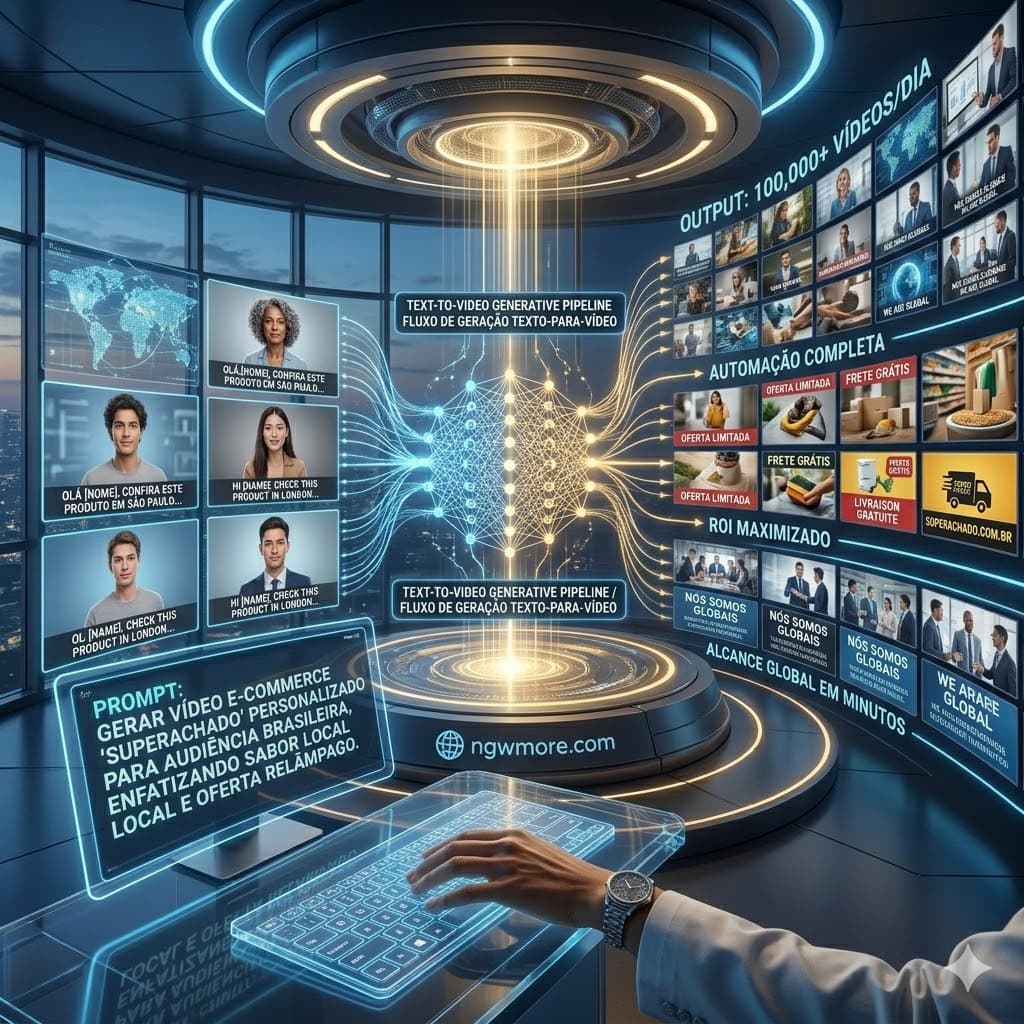
For businesses focused on e-commerce (like the SuperAchado storefront) or corporate training, Neural Rendering allows for the creation of hyper-realistic AI avatars. These are not cartoons; they are digital twins capable of replicating human micro-expressions and perfect lip-syncing in over 100 languages. This allows a business to record a “base” model once and generate thousands of unique videos where that model says different names, prices, and product features.
II. Strategic Scaling: Why AI Video is a Game Changer
The primary reason businesses are shifting to AI video is the radical decoupling of output from human hours.
1. Cost Reduction and Margin Expansion
In a traditional setup, doubling your video output meant doubling your team or your budget. With Text-to-Video AI, the marginal cost of producing the 100th video is nearly identical to the cost of the first. This allows businesses to expand their marketing reach while maintaining lean operational costs, directly increasing net profit margins.
2. Hyper-Personalization at Scale
Personalization is the most effective driver of conversion in 2026. Imagine a sales funnel where every lead receives a personalized video message.
- Traditional: Impossible at scale. A salesperson would spend their entire day filming.
- AI-Powered: A CRM trigger sends the lead’s name and industry to an API. The AI generates a personalized video where an avatar greets them by name and mentions their specific business challenge.
This level of 1:1 communication at the scale of 10,000 leads is the ultimate competitive advantage.
3. Rapid Market Testing (The Agile Content Method)
AI video allows for “Agile Content Creation.” A business can generate 20 different variations of a video ad—testing different hooks, backgrounds, and call-to-actions—and deploy them simultaneously. Within hours, the data shows which one performs best. The business can then pivot its entire campaign based on real-time feedback, a process that would have taken months in the pre-AI era.
III. Core Use Cases for Business Scaling
As businesses integrate these tools, four primary use cases have emerged as the most lucrative.
1. Social Commerce and E-commerce (The “SuperAchado” Model)
In social commerce, the algorithm demands constant freshness. Text-to-Video allows e-commerce managers to turn their entire product catalog into a video library. Whenever a new product is added to the database, a script is automatically generated, a video is rendered, and it is posted to TikTok, Reels, and YouTube Shorts. This autonomous content loop ensures that the brand is always “top of mind” without requiring a dedicated creative department.
2. Corporate Training and Onboarding
For global companies, maintaining consistent training across different regions is a logistical nightmare. Text-to-Video AI allows HR departments to update training materials instantly. If a policy changes, they simply update the text script, and the AI regenerates the training video in 20 different languages, featuring a localized avatar that resonates with the specific workforce.
3. Customer Support and Documentation
Text-based “How-To” guides are becoming obsolete. Businesses are scaling their support departments by turning every FAQ into a short, helpful video. When a user asks a question, the AI can even generate a bespoke video response that highlights the specific part of the software or product the user is struggling with. This reduces the load on human support agents and improves the Customer Satisfaction Score (CSAT).
4. B2B Sales and LinkedIn Prospecting
B2B scaling relies on breaking through the “noise” of crowded inboxes. A personalized AI video embedded in a LinkedIn message has a 4x higher click-through rate than plain text. Scaling this outreach allows B2B startups to act like established enterprises with massive sales teams.
IV. The Infrastructure Requirement: Powering the Render
Scaling AI video isn’t just a creative challenge; it’s an infrastructure challenge. This is where the synergy between content and hosting (like the solutions discussed at ngwhost.com) becomes critical.
1. High-Performance APIs and Latency
To generate videos in real-time (for example, as a user is browsing a website), businesses need low-latency API connections to AI rendering farms. This requires robust server infrastructure that can handle thousands of simultaneous requests without a 502 or 503 gateway error.
2. Media Storage and Content Delivery Networks (CDNs)
AI-generated videos produce massive amounts of data. To scale globally, businesses must utilize high-performance CDNs. If a user in Rio Grande, Brazil, and a user in Tokyo both click on an AI video, the infrastructure must ensure it loads instantly. Scaling video output requires a parallel scaling of your storage and bandwidth capacity.
3. Data Privacy and Compliance
When scaling personalized videos, businesses are handling sensitive user data (names, preferences). Ensuring that the AI pipeline is hosted in a secure, compliant environment is mandatory to avoid massive regulatory fines. The “Server-Side” of AI video is just as important as the “Prompt-Side.”
V. Overcoming the Challenges: Ethics and Quality Control
While the scaling potential is immense, businesses must navigate three primary hurdles:
1. Brand Consistency: AI can sometimes hallucinate. Scaling requires strict “Brand Guardrails” to ensure the AI doesn’t generate content that contradicts the company’s values or visual identity. 2. The Human-in-the-Loop: Total autonomy is risky. The most successful businesses use AI to generate 90% of the work, with a human “Editor-in-Chief” performing a final quality check before publication. 3. Ethical Transparency: In 2026, transparency is a trust-builder. Successful brands often include a small “Generated by AI” watermark or disclosure, which, paradoxically, increases trust by showing the brand is at the forefront of technology while being honest with its audience.
Read More⚡ Ethereum vs Solana: Which Will Lead the Next Bull Run?
VI. Conclusion: The Competitive Divide
The divide between businesses that use Text-to-Video AI and those that don’t is becoming an unbridgeable chasm. One side is limited by human speed and high costs; the other is powered by algorithmic efficiency and infinite scale.
As we move forward in 2026, the question for the readers of ngwmore.com is simple: Is your business a creator of content, or is it the architect of a content-generating machine? By embracing Text-to-Video technology and supporting it with a robust technical infrastructure, you aren’t just making videos; you are building a scalable asset that works for your brand 24 hours a day, 7 days a week, across the entire globe.