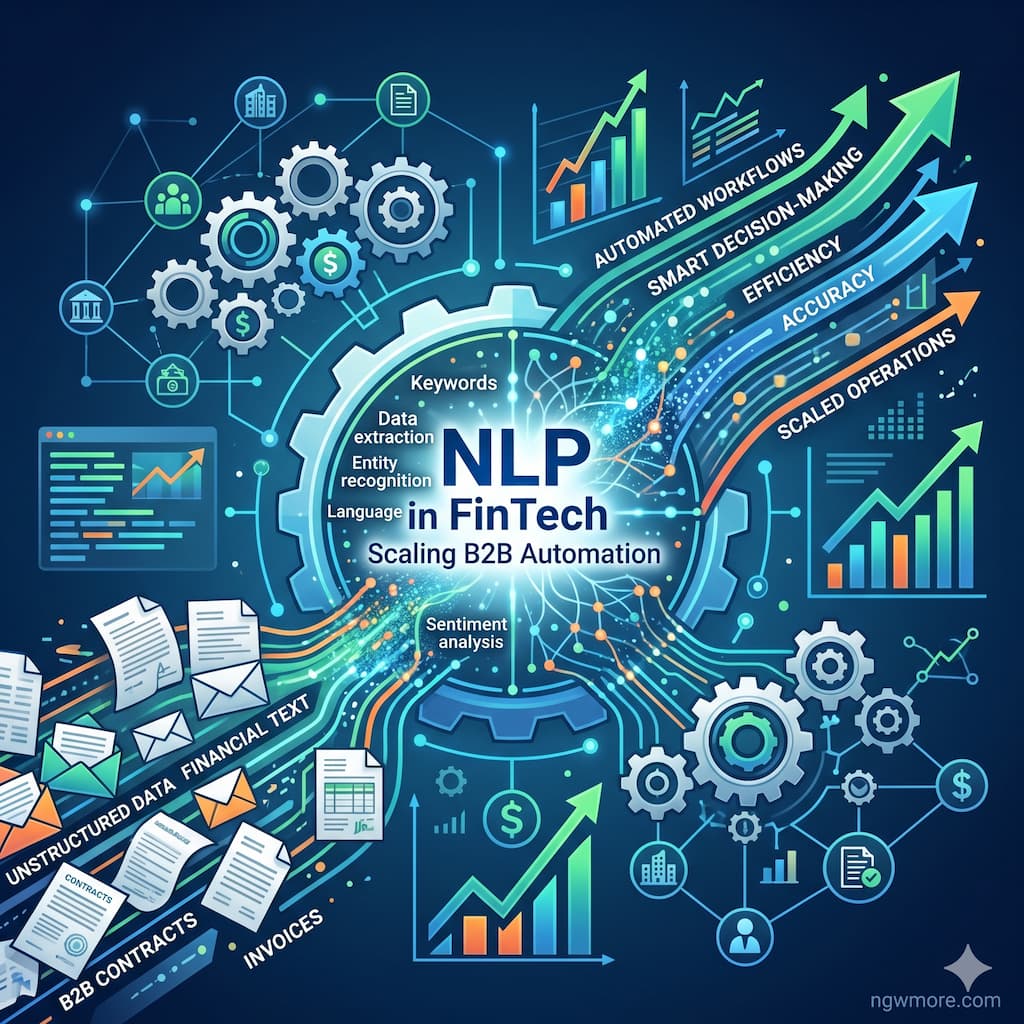
Natural Language Processing in FinTech: Scaling B2B Automation
The operational plumbing of institutional finance is fundamentally a text-processing problem. As we navigate May 2026, the global financial technology ecosystem has evolved past the limitations of simple quantitative data manipulation. While algorithmic high-frequency trading engines and numerical risk models have long mastered structured rows and columns, the vast majority of enterprise financial data remains hopelessly trapped within unstructured text. Every day, the global banking matrix exchanges billions of rich text packets—spanning multi-page corporate credit agreements, international trade financing applications, regulatory legislative filings, and cross-border bank statements.
Historically, parsing this mountain of linguistic data required massive departments of human operational specialists, compliance auditors, and portfolio analysts. When a corporate treasury had to wait 48 hours for an operations analyst to manually extract financial clauses from an inbound credit facility or verify compliance tags across a newly issued corporate bond prospectus, systemic latency cascaded across the supply chain. In a hyper-connected B2B market where computational speed defines enterprise valuation, human data-entry bottlenecks are a direct threat to structural scalability.
For the digital entrepreneurs, web system administrators, and technology growth leads within the ngwmore.com community, maximizing computational throughput and eliminating workflow drag are absolute core values. We design web hosting architectures, server layers, and distributed database networks to eliminate operational latency, remove data processing barriers, and erase resource waste.
Applying this exact same systemic discipline to your corporate financial workflows requires a total transition from manual documentation sorting to Agentic, High-Performance Natural Language Processing (NLP) Arrays.
    THE 2026 COGNITIVE NLP FINTECH STACK
┌─────────────────────────────────────────────────────┐
│  UNSTRUCTURED INBOUND FINANCIAL TEXT INGESTION      │
│  (Corporate MSAs, SWIFT MT/MX Logs, PDF Tax Forms) │
└──────────────────────────┬──────────────────────────┘
                           │ Real-Time Stream Ingest
                           ▼
┌─────────────────────────────────────────────────────┐
│           COGNITIVE NLP CORE ENGINE                 │
├─────────────────────────────────────────────────────┤
│ * Multi-Layered Financial RAG Domain Graph Sync     │
│ * Real-Time Semantic Intent & Metadata Extraction   │
│ * Automated Cross-System Tokenized Function Calling │
└──────────────────────────┬──────────────────────────┘
                           │ Autonomous Optimization
                           ▼
┌─────────────────────────────────────────────────────┐
│     REAL-TIME B2B LEDGER & COMPLIANCE CLEARING      │
└─────────────────────────────────────────────────────┘
By connecting advanced natural language processing architectures, semantic domain knowledge graphs, and secure function-calling rails directly onto your enterprise financial data fabric, B2B automation scales exponentially. This transformation shifts the nature of enterprise workflows from passive text reading to instantaneous, executable code strings, compressing operational latencies to zero.
1. The 2026 Linguistic Paradigm Shift: From Keywords to Semantic Reasoners
To successfully deploy an enterprise-grade NLP framework within a financial technology stack today, you must first dismantle the legacy frameworks that governed text automation over the past decade. The modernization of financial language processing can be broken down into three distinct operational waves:
- The Regex and Keyword Matching Era (The Past): Primitive string searching. Early automation platforms relied on rigid Regular Expressions (Regex) and fixed keyword lookups to categorize documents. If a system was programmed to scan an inbound commercial invoice for the string “Payment Terms,” it could copy the adjacent characters into a database. However, if the contract utilized alternative vocabulary—such as “Settlement Horizon” or *”Liquidation Window”—*the software suffered an absolute semantic failure, forcing a high-priority manual human override.
- The Isolated Intent Classification Era (The Transition): Early machine learning models. The integration of basic transformer models (such as early BERT or custom financial intent classifiers) allowed systems to predict the general category of a text block with reasonable accuracy. A customer support ticket or basic banking query could be routed to the correct department based on statistical intent scoring. While powerful, this era remained fundamentally isolated and passive, requiring precise engineering prompts and extensive human manual oversight to translate text insights into actual back-office database actions.
- The Agentic Semantic Reasoning Era (2026): The current global benchmark. FinTech operations function as a Continuous, Self-Governing Text-to-Execution Mesh. Powered by large reasoning foundation models deeply fine-tuned on specialized financial ontologies and accounting taxonomies, the system does not merely classify text. It reads long, multi-jurisdictional legal and financial files, understands dense contextual dependencies, resolves ambiguous data references, and autonomously triggers backend system integrations without human intervention.
According to global financial velocity metrics recorded this quarter, B2B enterprise platforms utilizing fully integrated semantic NLP architectures experience an average 70% reduction in document-to-ledger processing times while slashing compliance error rates by over 50%, completely outperforming legacy organizations stuck in human-dependent review loops.
2. Core Pillars of AI-Native B2B NLP Architectures
Scaling a borderless digital finance platform while protecting your company’s compliance parameters requires integrating four foundational technological pillars directly into your software and repository network infrastructures.
I. Multi-Layered Domain RAG Fabrics and Financial Knowledge Graphs
Forcing an NLP model to extract data or generate financial summaries without strict, domain-specific grounding parameters leads to dangerous model hallucinations and severe regulatory compliance liabilities. Modern FinTech platforms resolve this vulnerability by deploying Advanced Retrieval-Augmented Generation (RAG) Systems Linked to Financial Knowledge Graphs.
- The Data Grounding: When an unstructured financial document enters the ingestion pipeline, the NLP engine breaks down the text semantically, cross-referencing your enterprise’s historical transaction databases, verified corporate playbooks, active accounting taxonomies, and regional legislative compliance rules.
- The Output Verification: The system verifies that every extracted parameter—such as an interest rate calculation, a currency conversion clause, or an alternative termination penalty—is perfectly synchronized with your organization’s verified source of truth, ensuring an un-compromised audit trail.
II. Real-Time Semantic Entity Extraction and Schema Transmutation
Inbound enterprise B2B documents are completely non-standard. A multi-national client might submit a custom Master Services Agreement (MSA) formatted as a scanned, multi-page PDF, while an international vendor transmits accounting reconciliation data inside un-structured email bodies.
- The Transmutation Core: Modern NLP engines act as Linguistic Schema Transmuters.
- The Extraction Loop: As text flows into the ingest API, specialized Named Entity Recognition (NER) models isolate critical financial variables—including exact counterparty legal entities, unique tax identification identifiers, transaction denominations, and milestone payment schedules. The model automatically restructures this messy, fragmented text on the fly into highly standardized, validated JSON data payloads, prepared for instantaneous database routing.
III. Automated Cross-System Tool Orchestration and Function Calling
Identifying a financial data point within an inbound document delivers minimal scale if your operational personnel must still spend hours logging into multiple legacy terminal environments to copy and paste those data rows manually.
- The Autonomous Core: 2026 NLP engines bridge the gap between comprehension and action via secure, tokenized Function-Calling Core Rails.
- The Automated Execution: When the processing model reads a verified clause inside an inbound settlement file (e.g., a contract specifying an immediate 10% prepayment trigger upon freight arrival), the NLP core autonomously writes and compiles the required integration microservices. The platform connects directly with your corporate ERP ledgers, communicates with external central bank clearing APIs, executes currency balances across modern stablecoin channels, and logs the entry simultaneously, eliminating human transfer lag completely.
IV. Continuous Behavioral Sentiment Mapping and Risk Sensing
The value of language processing extends far beyond transactional documentation extraction; it acts as a high-performance predictive sensor monitoring global macroeconomic risks.
- The Sensing Surface: FinTech platforms deploy Ambient Behavioral Sentiment Trackers across thousands of external data streams simultaneously.
- The Defensive Guard: The NLP engine continuously parses global central bank transcripts, multi-language trade news feeds, regulatory legal updates, and decentralized industry developer logs. By mapping subtle shifts in linguistic sentiment and tracking early indicators of supply chain or regulatory friction, the AI flags portfolio risk exposures days before they manifest on traditional quantitative pricing tickers, allowing your corporate treasury to execute proactive defensive maneuvers.
3. The 2026 FinTech NLP Stack: Elite Automation Software Planes
Transforming your enterprise financial operations from an opaque administrative bottleneck into an agile, predictive competitive moat requires connecting your container and text pipelines to specialized, context-aware software planes. The current 2026 landscape features highly advanced enterprise management platforms:
| Platform Category | Leading 2026 Platforms | Core Corporate Utility | Standout Engineering Advantage |
| Cognitive OCR & Ingestion | UiPath Document Understanding / ABBYY Vantage | Multi-channel text extraction, document classification, & schema mapping | Generative Data Capture: Extracted parameters adapt dynamically to novel document layouts without template retraining. |
| Deep Semantic Synthesis | CoCounsel by Casetext / Harvey AI / BloombergGPT | Advanced multi-file financial reasoning, compliance auditing, & text generation | Financial Language Specialization: Built on models trained natively on trillions of pages of economic and regulatory prose. |
| Enterprise Data Mesh Core | Palantir AIP for FinTech / Databricks Mosaic AI | Real-time financial data lake orchestration, asset mapping, & model ring-fencing | Ontological Data Alignment: Unifies unstructured document pools seamlessly with active relational SQL database logs. |
4. Tactical Blueprint: Operationalizing NLP for B2B Automation
Transitioning your enterprise away from reactive, manual documentation processing and engineering a resilient, automated natural language processing matrix requires a systematic, architecturally sound roadmap.
Step 1: Maximize Internal Operational Data Liquidity via Open APIs
An autonomous language processing engine’s analytical precision is fundamentally bounded by the visibility and completeness of its input telemetry within the local corporate network. Before configuring external model parameters, you must systematically eliminate your internal operational data silos.
Establish direct API connections and real-time open-telemetry webhooks connecting your core e-commerce storefront billing layers, internal ERP databases (SAP, NetSuite), customer CRM environments, compliance registries, and web infrastructure configurations on ngwhost.com into a centralized, highly secure Unified Operations Data Lake. This provides your cognitive NLP models with an unobstructed, 360-degree stream of truth representing your true operational and historical documentation realities.
Step 2: Establish the “Agent-to-Human” Validation Gate
Do not attempt to remove human strategic legal and financial judgment entirely from high-stakes corporate contract negotiations, high-value commercial credit approvals, or complex regulatory dispute resolutions. While autonomous language agents are unmatched at rapid data extraction, clause pattern matching, and accelerating volume reviews, ultimate risk ownership and long-term business strategy require human emotional intelligence. Implement a highly fluid, high-velocity operational gate:
[Inbound Contract Received] ──► [AI Extracts Variables & Scores Risks] ──► [AI Compiles Action Dossier & JSON Payload] ──► [Human CFO One-Click Execution]
Configure your platform settings to push high-conviction NLP summaries and pre-populated exception workflows straight into a centralized Live Operations Feed. The AI handles the grueling, time-consuming heavy lifting—processing text, verifying schemas, and writing execution code—while the human manager retains absolute strategic control, authorizing high-ticket operations with a single click before the automated system updates ledger positions.
Step 3: Implement Zero-Trust Identity Guardrails and Token Anonymization
Because a high-performance NLP system requires processing continuous text streams across a physical and digital footprint populated by confidential corporate contracts and private financial parameters, maintaining absolute adherence to global data privacy regulations, GDPR mandates, and strict compliance metrics is an absolute requirement.
- The Security Guard: Enforce strict Real-Time Edge Token Anonymization Protocols.
- The Execution: Configure your ingestion layers to process personal identification credentials, corporate bank routing coordinates, and private cryptographic signatures strictly within volatile memory. The system redacts sensitive data points, converting them into anonymized vector hashes or generic database tokens before the data stream hits external cloud model parameters. The underlying system evaluates pure financial mechanics and process compliance parameters while keeping your enterprise core 100% insulated from external model training exploitation or data leak vulnerabilities.
5. Critical Risk Management: Navigating the FinTech NLP Pitfalls
Operating a highly automated, software-driven financial infrastructure requires continuous, data-backed governance to protect your enterprise from unique digital, contractual, and legal liabilities:
- The Hazard of the Linguistic Hallucination Trap: While modern reasoning models feature exceptional linguistic precision, they remain susceptible to subtle Model Hallucinations if confronted with highly ambiguous, non-linear, or poorly formatted text inputs. An un-monitored model can confidently misinterpret a complex multi-jurisdictional tax withholding clause or misread an index percentage marker, generating non-compliant database schema adjustments that create intense structural risk if left uncorrected. Human financial specialists must always perform validation checks on high-risk transactional extractions.
- The Legal Reality of Algorithmic Commitment Liability: Modern legal precedents have firmly established that a corporate entity is 100% legally, financially, and contractually bound by the outputs, commitments, and errors generated by its autonomous software networks. If your automated parsing engine or function-calling bot accidentally confirms an un-authorized vendor pricing tier or waives an important penalty clause via automated API execution, your company is legally obligated to honor that execution. Continuous adversarial red-teaming of system triggers is mandatory.
- Managing Model Drift and Jurisdictional Compliance Decay: Tax laws, banking codes, and corporate governance frameworks mutate continuously across the global landscape. If an enterprise language engine continues to execute automated compliance tracking utilizing models whose training weights have drifted from active real-world legal updates, your contractual frameworks will experience silent compliance degradation. Your technical data operations team must implement automated, monthly backtesting loops to keep your model weights perfectly aligned with real-time global legal and financial updates.
6. The Systems Synergy: Redundant Infrastructures for Scaling Capital
For the advanced cloud systems developers, full-stack database architects, and technology visionaries who scale their digital platforms on the backbone of the ngwmore.com ecosystem, the structural logic of an integrated AI language grid is deeply intuitive.
When you configure an enterprise server topology, scale an international web application network, or manage an enterprise database network on ngwhost.com, you do not tolerate single points of failure. You don’t leave your system architecture vulnerable to an isolated computing crash, a localized network drop, or an un-monitored processing leak. You design with comprehensive, mathematical redundancy: you utilize load balancers to distribute data traffic smoothly, deploy isolated container instances across multiple geographic data zones to handle processing spikes effortlessly, and maintain secure, multi-region database mirrors to ensure that if a critical server cluster drops offline, the broader network continues to perform flawlessly without data loss or asset corruption.
Deploying an integrated FinTech NLP Automation Architecture is simply extending that exact same systemic, multi-layered structural redundancy to your company’s risk mitigation and financial frameworks:
- Your Multi-Layered Domain RAG Graphs and Real-Time Token Anonymization Shields operate as your high-velocity edge nodes, parsing, filtering, and securing incoming document text streams with absolute fluid precision.
- Your Automated Entity Extractors and Schema Transmutation Engines act as your resilient core database systems, instantly compounding, processing, and protecting your active corporate playbooks, completely insulated from individual human memory blind spots or administrative operational latency.
- Your Tokenized Function-Calling Rails and Agent-to-Human Validation Gates behave as your secure, enterprise-grade system firewalls, silently optimizing your operating margins, shielding your digital brand from contractual liabilities, and ensuring absolute corporate velocity against changing global macroeconomic demands.
By mastering this integrated configuration, you strip away balance sheet vulnerabilities, eliminate operational tracking drag, and position your digital brand to scale at terminal velocity while retaining absolute, sovereign control over the global enterprise you built.
Read More⚡ The Future of Cloud FinOps: Optimizing Software Spend
Conclusion: Securing the Linguistic Scale Victory
The era of manual invoice sorting, paper escrow queues, and slow document review has run its course. In a hyper-competitive global marketplace defined by rapid technological adaptation, omni-channel fluid commerce, and instant transaction settlement requirements, forcing your scaling enterprise to rely on slow, human-constrained text review processes is a recipe for operational failure, massive data errors, and severe margin erosion.
The path to sustainable enterprise scalability requires an absolute embrace of autonomous, generative, and data-liquid software architecture applied directly to your linguistic data layer. By unifying your multi-source document archives via high-performance cloud networks, linking your automated tracking telemetry directly into your central ERP and repository cores, enforcing rigorous real-time data anonymization protocols, and prioritizing an optimized agent-to-human validation gate, you completely remove risk, friction, and human operational latency from your financial expansion loops entirely.
The legal and financial frameworks of the global digital economy are transforming into programmable, high-speed intelligent applications. Build your FinTech NLP stack with absolute precision, protect your cap table fiercely, and let your enterprise scale to global heights on your own terms.