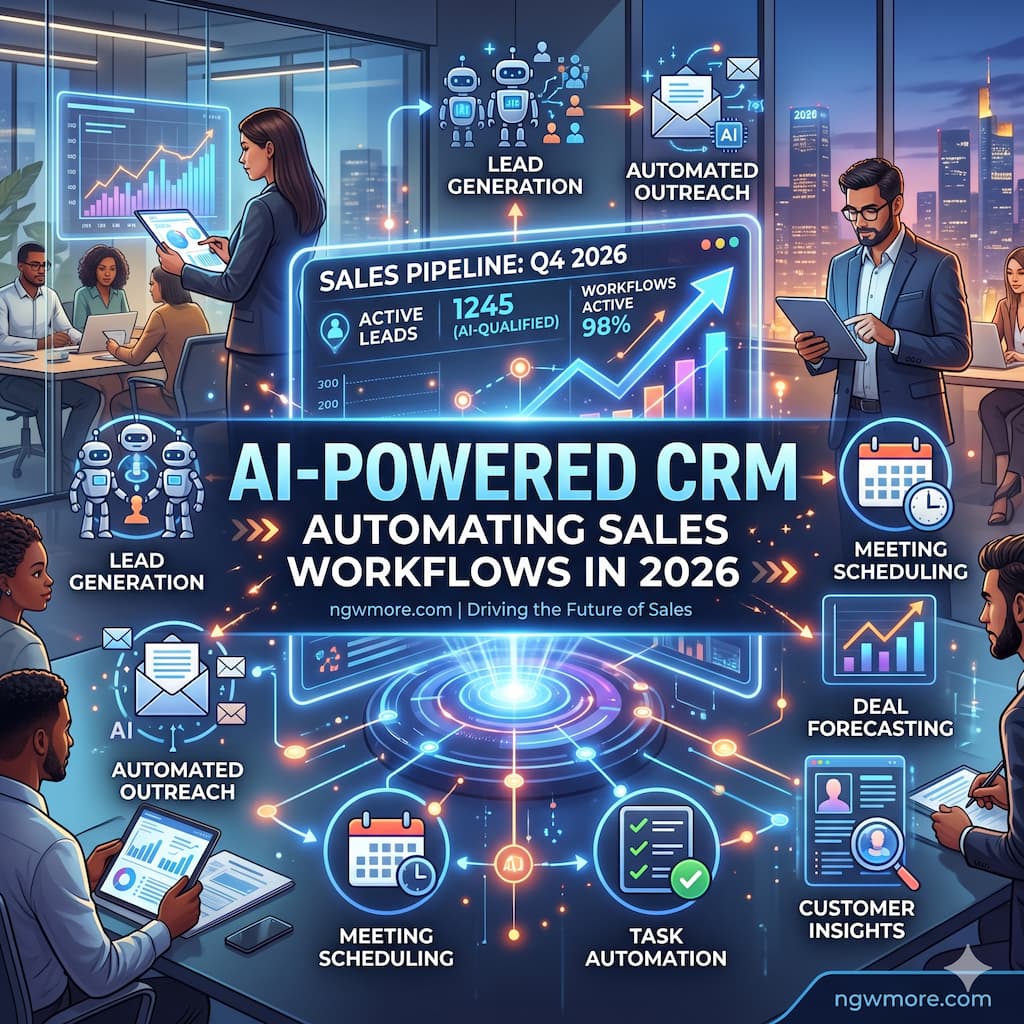
AI-Powered CRM: Automating Sales Workflows in 2026
The contemporary sales landscape is operating under a relentless mandate. As we progress through May 2026, the historic paradigm of sales management—characterized by manual data entry, subjective pipeline forecasting, and fragmented outreach execution—has been permanently dismantled. Sales organizations are no longer struggling with the administrative friction of updating fields, logging client phone calls, or manually sorting through cold leads.
The global corporate consensus of 2026 has established a new operational baseline: Sales infrastructure must be autonomous, predictive, and real-time. At the absolute core of this structural evolution is the AI-Powered Customer Relationship Management (CRM) ecosystem.
For the digital entrepreneurs, e-commerce administrators, and technological growth strategists within the ngwmore.com community, velocity is the ultimate metric for scaling a brand. Whether you are running a high-ticket B2B consulting firm, managing an international SaaS subscription portfolio, or coordinating an active affiliate matrix on a TikTok Shop, manual administration represents capital destruction.
By transitioning away from static data repositories and deploying an integrated layer of Agentic CRM Architecture, modern enterprises are achieving something that was previously impossible: expanding their sales pipeline exponentially while removing human error, compressing closing cycles by over 55%, and unlocking unprecedented customer lifetime value (LTV).
1. The 2026 CRM Landscape: From System of Record to Autonomous Co-Pilot
To successfully scale your sales infrastructure in 2026, you must first understand the technological leap that has redefined the modern CRM.
- The Legacy Era (The System of Record): For decades, CRMs functioned simply as sophisticated digital filing cabinets. They relied entirely on human sales representatives to manually input data after a meeting, update deal stages, and set manual reminders. If a representative was tired, busy, or unorganized, the CRM data became corrupt, inaccurate, and useless for executive forecasting.
- The Modern Era (The Autonomous Co-Pilot): In 2026, the CRM operates as a living, breathing neural network. It executes ambient data collection, listening into active sales calls via voice APIs, parsing email sentiment, analyzing clickstream interactions on your storefront, and updating the database autonomously without a single keystroke from your sales team.
  LEGACY CRM WORKFLOW (Manual & Fragmented)
  [Sales Call Occurs] ──► [Rep Manually Logs Notes] ──► [Manual Stage Update] ──► [Static Email Follow-up]

  2026 AI CRM WORKFLOW (Ambient & Agentic)
  [Live Call Ingest] ──► [Real-Time Sentiment Analysis] ──► [Auto DB Updates] ──► [Hyper-Personalized Outreach]
According to comprehensive 2026 enterprise sales benchmarks, sales teams utilizing fully integrated AI-powered CRMs spend 70% less time on administrative bureaucracy and achieve an average 42% lift in quota attainment compared to teams stuck on legacy, non-agentic sales stacks.
2. Core Pillars of 2026 Sales Automation
Scaling your sales capabilities today requires integrating four primary technological pillars into your CRM architecture.
I. Ambient Data Harvesting and Interaction Ingestion
Data entry is dead. In 2026, an AI CRM connects natively to your entire communication perimeter.
- The Technology: When a sales representative hops onto a virtual video call or a cellular line, the CRM’s embedded Natural Language Processing (NLP) engine parses the audio stream in real-time.
- The Automation: It extracts the core pain points, identifies explicit timeline commitments, captures pricing objections, notes competitor mentions, and maps this unstructured data directly into clean, structured database fields instantly. It generates perfect meeting summaries, updates deal health scores, and drafts contextual follow-up emails before the call connection has even terminated.
II. Predictive Intent Scoring and Dynamic Pipeline Prioritization
Chasing cold leads is the single largest drain on corporate sales energy. 2026 CRMs utilize Multi-Signal Intent Scoring to ensure your representatives only talk to buyers who are actively exhibiting high-conviction purchasing patterns.
- The Mechanism: The AI tracks a prospect’s cross-platform digital footprints—such as opening a specific case study link three times within 48 hours, downloading a technical whitepaper, reviewing a pricing page, or interacting with your brand’s video assets on social networks.
- The Outcome: The CRM aggregates these signals, calculates a real-time conversion probability index, and dynamically shifts high-intent accounts to the top of the sales representative’s daily dashboard, explicitly telling them who to contact, when to call, and what specific angle to pitch.
III. Generative Hyper-Personalization and Autonomous Outreach
Generic, blast email templates no longer work in 2026. Consumers have developed total immunity to un-optimized automated sequences. AI-powered CRMs overcome this by utilizing Generative Hyper-Personalization.
- Context-Aware Execution: Instead of sending a cookie-cutter email, the CRM’s generative agent queries the prospect’s LinkedIn profile, reads their company’s recent press releases, analyzes their internal technology stack, references their historical support ticket logs, and crafts a highly tailored, deeply empathetic message that addresses their exact structural bottlenecks. The outreach looks, feels, and reads as if it were meticulously drafted by a seasoned human researcher.
IV. Real-Time Conversational Battlecards (In-Call AI Coaches)
The role of the AI CRM does not end before a phone call starts; it sits right on the call alongside the representative as an invisible executive coach.
- The Process: During a live negotiation, if a prospect introduces a difficult technical hurdle or mentions a specific competitor’s discount model, the CRM’s live audio parsing engine recognizes the threat instantly.
- The Action: Within 300 milliseconds, it flashes a highly targeted Conversational Battlecard on the representative’s screen, providing them with the exact data points, positioning framework, and case study references needed to overcome the objection smoothly without breaking the conversational flow.
3. The 2026 AI CRM Stack: Top Platforms by Architecture
To effectively modernize your sales pipeline on ngwmore.com, your organization must deploy specialized, data-unified software. The marketplace in 2026 is led by powerful enterprise platforms:
| Platform | Best For | Standout 2026 AI Feature |
| Salesforce Einstein 1 | Hyperscale Enterprises | Data Cloud Integration: Seamlessly unifies unstructured legacy databases with live AI agents for absolute forecasting precision. |
| HubSpot Smart CRM | High-Growth Scaleups | Breeze AI: An incredibly intuitive, agentic suite that automates content creation, lead enrichment, and customer success handoffs seamlessly. |
| Gong.io / Close AI | Revenue Intelligence | Interaction Deep Mapping: Transcripts every call and email to map underlying team performance, churn risks, and deal slippage. |
| Attio / Clay | Data-Driven Tech Teams | Programmable Workflows: Allows developers to build custom, API-driven CRM layouts utilizing real-time open-web scraping parameters. |
4. Operationalizing the AI Pipeline: A 3-Step Scaling Blueprint
Transitioning your enterprise from a passive, manual database to an automated, high-velocity AI sales engine requires a systematic, architecturally sound roadmap.
Step 1: Establish Absolute Data Liquidity
An AI model is only as powerful as the data pipelines feeding it. You must eliminate data silos across your organization. Connect your marketing automation stack, your e-commerce billing engines (such as Shopify or Stripe), your product usage databases, and your customer support desks directly into your CRM core via secure webhooks. This provides the AI with a comprehensive, 360-degree view of your customer lifecycle, minimizing the risk of miscalculated intent scores.
Step 2: Configure Your Agentic Handoff Corridor
Do not attempt to automate human emotional intelligence completely out of high-ticket sales loops. While AI agents are unmatched at processing data, enriching leads, and managing tier-1 scheduling tasks, final enterprise conversion and relationship building require human empathy and trust curation. Build a highly fluid communication loop:
[Inbound Lead Captured] ──► [AI Enricher & Intent Scorer Filters Profile] ──► [Autonomous Agent Nurtures via Contextual Emails] ──► [AI Schedules Meeting Directly into Human AE's Calendar]
When an inbound lead enters your ecosystem, the CRM’s data enrichment agents automatically pull their company size, current revenue tier, and technological stack from open-web registries. The AI initiates a hyper-personalized nurturing conversation. The moment the prospect exhibits buying behavior, the CRM launches its scheduling agent, books a direct meeting link on your human Account Executive’s calendar, and delivers a complete, summarized briefing dossier within seconds.
Step 3: Implement Automated Contract and Revenue Lifecycle Management
Once a deal crosses the finish line, the CRM shouldn’t stop thinking. Connect your sales pipeline directly to your legal and financial operational layers. When a deal shifts to “Closed-Won,” the AI CRM should autonomously generate a compliant enterprise service contract, route it to the client via secure digital signature platforms, trigger an onboarding invoice within your accounting software, and alert your customer success team with a customized implementation guide.
5. Critical Challenges: Navigating the 2026 Risks
Scaling your business infrastructure with an AI CRM requires continuous, vigilant governance. If left unmonitored, an automated pipeline can introduce significant operational vulnerabilities:
- The Trap of Generative Fatigue: If your CRM’s outreach agents are misconfigured, they can flood your market prospects with an excessive volume of synthetically perfect emails. This can backfire, driving domain penalties, spam flags, and brand alienation. Ensure human sales directors audit your generative templates weekly to preserve genuine brand authenticity and distinct tone parameters.
- The Data Privacy and Sovereignty Hurdle: Under the strict global enforcement of the EU AI Act, GDPR, and localized consumer data protection frameworks in 2026, recording sales calls, parsing emails, and scraping digital intents requires explicit, ironclad compliance. Ensure your CRM infrastructure features transparent consent-capturing screens and clear disclosure parameters to protect your enterprise from regulatory drawdowns.
- Algorithmic Model Drift: Sales environments are highly dynamic; consumer trends shift, and macro competitor pricing changes. An AI model trained on historical 2025 sales data can miscalculate lead values if a sudden market disruption occurs in 2026. Implement continuous model training cycles to keep your pipeline logic perfectly aligned with real-time economic conditions.
6. The Digital Synergy: The ngwmore.com Competitive Advantage
For the technology leaders, digital publishers, and multi-platform innovators tracking trends on this blog, mastering an AI-powered CRM represents the ultimate operational leverage.
When your sales infrastructure is completely decoupled from manual administration, your corporate agility hits terminal velocity. You can deploy a targeted content marketing push on a Monday morning, let your CRM agents enrich and filter hundreds of inbound leads by Tuesday afternoon, run autonomous conversational outreach campaigns by Thursday evening, and lock in high-converting enterprise contracts by Friday afternoon—all without ever adding bloated, expensive internal administrative headcount.
In a digital business ecosystem governed by computational execution, the brand that processes context and automates data the fastest is the brand that commands the market.
Read More⚡ Edge Computing and AI: Scaling Business Infrastructure
Conclusion: The Sovereign Revenue Machine
The integration of artificial intelligence into CRM systems has successfully transformed sales from an unpredictable, human-dependent craft into a precise, scalable, and highly automated science. The ability to listen to the ambient signals of buyers—to parse their sentiment, forecast their needs, and deliver hyper-personalized outcomes at scale—has permanently redefined how modern businesses grow.
For the ngwmore.com community, the direction of the market is undeniable: Transition your brand away from legacy systems of record and construct an integrated, autonomous revenue machine. By deploying ambient data collectors, setting up crisp agentic handoff loops, and securing your workflows with strict data compliance parameters, you eliminate operational drag and accelerate your growth curve exponentially.
The sales pipeline of the future is writing its own notes, scoring its own leads, and executing its own deals. Is your enterprise running on the new software?