
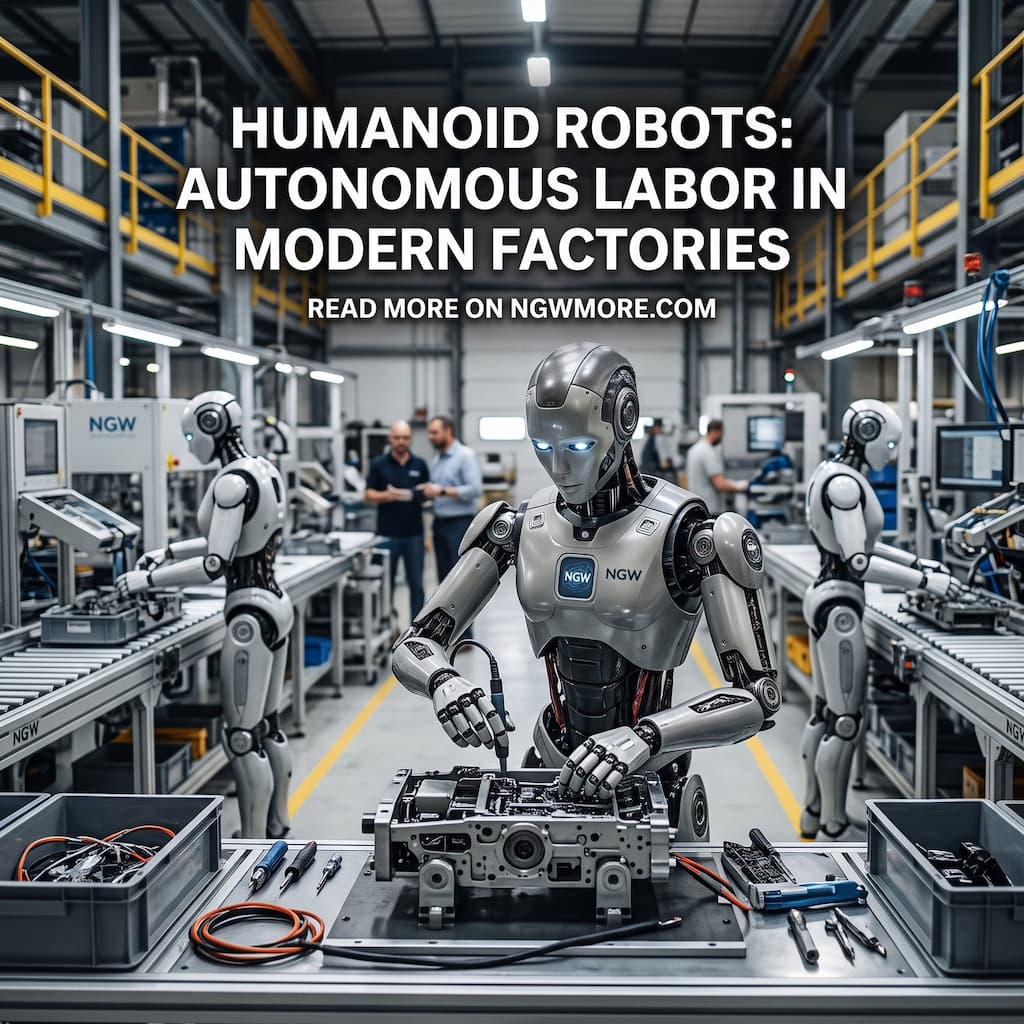
Humanoid Robots: Autonomous Labor in Modern Factories
For over half a century, industrial automation has defined the cutting edge of manufacturing efficiency. High-throughput assembly plants across the globe have deployed fixed robotic arms, automated guided vehicles (AGVs), and autonomous mobile robots (AMRs) to weld automotive chassis, palletize heavy goods, and transport materials across warehouse floors. These traditional industrial machines delivered remarkable speed and repeatability, but they operated under a strict physical constraint: rigid environmental specialization.
Traditional industrial robots require structured, highly predictable environments. Installing a stationary robotic arm or a wheeled transport bot typically requires millions of dollars in factory retooling: installing physical safety cages, laying magnetic floor tracks, rebuilding conveyor belts, and redesigning factory floors entirely around the machine’s narrow mechanical envelope.
Yet, human society has spent centuries designing manufacturing facilities, logistics hubs, tools, staircases, and assembly lines specifically tailored for a single physical form factor: the human body.
When manufacturing lines require flexible operations—such as navigating tight mezzanine stairwells, manipulating delicate wiring harnesses, picking irregularly shaped parts from unorganized bins, or switching between completely different assembly tasks on short notice—traditional automation fails. These dynamic roles have historically remained dependent on human manual labor.
Today, global industrial manufacturing faces unprecedented structural labor shortages, rising operational costs, and aging demographic curves across major industrial economies.
To bridge this operational boundary and automate complex, unstructured industrial workflows, applied robotics and artificial intelligence are executing a massive physical leap: General-Purpose Humanoid Robots.
Humanoid robots combine bipedal locomotion, multi-articulated anthropomorphic hands, advanced spatial vision, and multimodal AI foundation models. Rather than requiring factories to adapt to machines, humanoid robots adapt directly to human-centric factories—operating legacy tools, navigating standard industrial spaces, and delivering flexible, autonomous labor directly to modern assembly lines.
This post analyzes the architectural mechanics of industrial humanoid robotics, evaluates end-to-end vision-language-action (VLA) neural control planes, compares traditional industrial automation against humanoid robotics, and examines the digital cloud server infrastructure required to host high-consequence robotic fleet telemetry on ngwmore.com.
1. The Manufacturing Bottleneck: The Limits of Fixed Automation
To understand why manufacturing executives and industrial automation leaders are deploying humanoid platforms, one must examine the critical limitations of legacy robotic infrastructure.
The Brownfield Factory Dilemma
The overwhelming majority of global manufacturing facilities are “brownfield” sites—established plants designed decades ago around human workers, narrow doorways, vertical stairways, and manual assembly benches.
Completely rebuilding an active automotive or electronics assembly plant to accommodate specialized automation requires massive capital expenditures and months of catastrophic production downtime. Humanoid robots solve the brownfield integration challenge by slotting directly into existing human workstations without requiring facility overhauls.
The Dexterity and Manipulation Deficit
While stationary robotic arms excel at high-speed repetitive tasks like spot welding or spray painting, they lack general-purpose dexterity.
Connecting small automotive wiring harnesses, operating manual power tools, manipulating flexible fabrics, or sorting non-standardized industrial components requires fine tactile sensing and multi-fingered hand articulation.
Fixed automation lacks the adaptive sensory-motor intelligence required to handle variable, deformable materials.
The Reprogramming and Retooling Friction
Reconfiguring a traditional industrial robot for a new product line requires specialized robotic engineers, custom mechanical end-effectors, and weeks of low-level kinematic reprogramming.
In modern manufacturing environments driven by custom ordering, just-in-time logistics, and rapid product turnover, the downtime and engineering costs of retooling fixed automation eliminate operational margins.
Humanoid robots eliminate these friction points by combining universal physical mobility with software-defined task versatility.
2. Structural Mechanics: The Engineering Anatomy of an Industrial Humanoid
A production-grade industrial humanoid robot is a triumph of mechatronics, dynamic control theory, and high-performance computing.
The physical platform operates across four primary engineering subsystems:
The Humanoid Robotic Subsystem Stack
- Layer 1: Structural Kinematics & Advanced Actuation: High-torque density electric actuators, harmonic drive gearings, planar motor linkages, and cycloidal gearboxes providing 30 to 50+ degrees of freedom (DoF).
- Layer 2: Tactile Anthropomorphic End-Effectors: Multi-articulated hands featuring integrated force-torque sensors, micro-cameras, and high-resolution tactile arrays on fingertips for fine object manipulation.
- Layer 3: Spatial Perception & Sensor Fusion: Multi-camera vision arrays, solid-state LiDAR sensors, time-of-flight (ToF) depth cameras, and inertial measurement units (IMUs) providing real-time 3D spatial awareness.
- Layer 4: High-Power On-Board Edge Compute: Ruggedized, liquid-cooled neural processing units (NPUs) and system-on-chip (SoC) accelerators executing real-time kinematic control loops and vision inference at the device edge.
1. Actuation and Bipedal Dynamic Locomotion
Walking on two legs through dynamic factory environments—across wet floors, uneven metal grates, ramps, and obstacle-laden pathways—requires continuous whole-body dynamic balancing.
Unlike early humanoid robots that relied on rigid, energy-intensive zero-moment point (ZMP) algorithms resulting in slow, robotic shuffling, modern humanoids use Reinforcement Learning (RL) and Model Predictive Control (MPC).
High-torque electric actuators at the hips, knees, and ankles constantly adjust torque output at millisecond intervals, allowing the robot to absorb unexpected physical bumps, carry heavy payloads (typically 15 to 25 kg per arm), and navigate complex terrain with natural, human-like fluid gait dynamics.
2. Multi-Fingered Dexterous Manipulation
The true test of industrial utility lies in the robot’s hands. Modern humanoid end-effectors feature 5-fingered designs with 12 to 20+ degrees of freedom per hand.
Equipped with tactile sensor arrays on the fingertips, humanoid hands measure contact pressure, detect micro-slips in real time, and adjust gripping force dynamically—allowing the robot to handle delicate electronic components without crushing them, as well as securely grip heavy industrial power tools.
3. Cognitive Intelligence: The Rise of Vision-Language-Action (VLA) Models
The major breakthrough propelling humanoid robotics out of research laboratories and onto real-world factory floors is the convergence of generative artificial intelligence and physical robotics: Embodied AI.
Historically, robots required hardcoded kinematic paths for every single movement. If a target part shifted two inches to the left, the robot failed.
Modern industrial humanoids utilize Vision-Language-Action (VLA) foundation models (such as Google’s RT-2/RT-Trajectory and specialized industrial robotic foundation models).
How Embodied AI Operates
- Multimodal Perception: High-resolution cameras capture the surrounding visual workspace in real time.
- Natural Language Semantic Understanding: Factory supervisors provide high-level, human-language commands (e.g., “Inspect the bin on table 4, pick up the defective radiator hose, and place it in the quarantine rack”).
- Autonomous Trajectory Generation: The VLA model translates visual tokens and text instructions directly into generalized motor action tokens—generating continuous, collision-free joint trajectories to complete the task dynamically without requiring a single line of custom code.
By training on millions of hours of simulated and real-world teleoperation datasets through imitation learning and reinforcement learning, humanoid robots develop generalizable manipulation primitives that transfer seamlessly across different factory tasks.
4. Structural Optimization Ledger: Traditional Industrial Robots vs. Humanoid Platforms
Evaluating the operational, structural, and financial parameters that separate legacy fixed automation from next-generation humanoid robots illustrates why factory operators are integrating general-purpose humanoids into modern manufacturing workflows.
Environmental Adaptability & Facility Retooling
- Traditional Industrial Automation: Highly rigid. Requires dedicated safety cages, clean flat floors, fixed conveyor tracks, and extensive facility retrofitting.
- General-Purpose Humanoid Robots: 100% adaptable. Directly navigates stairs, doorways, narrow aisles, and human workstations with zero facility modifications.
Task Versatility & Generalization
- Traditional Industrial Automation: Single-purpose. Designed exclusively for one repetitive task (e.g., dedicated welding, stamping, or linear palletizing).
- General-Purpose Humanoid Robots: Fully software-defined. Can perform component kitting in the morning, quality control inspection at midday, and machine tending during night shifts.
Tooling and Equipment Compatibility
- Traditional Industrial Automation: Demands custom, highly expensive robotic end-effectors and specialized electronic tooling interfaces.
- General-Purpose Humanoid Robots: Natively operates standard human power tools, hand drills, cart handles, touchscreens, and physical switches.
Deployment Velocity & Programming Lifecycle
- Traditional Industrial Automation: Weeks to months of physical engineering, custom wiring, PLC programming, and safety fencing certification.
- General-Purpose Humanoid Robots: Hours to days. Configured via natural language instructions, visual demonstration, and software fleet updates over-the-air.
5. Real-World Factory Deployments: Humanoids on Active Assembly Lines
Major industrial giants—including automotive manufacturers like BMW, Mercedes-Benz, and Tesla, alongside global logistics operators—are actively deploying humanoid robots into pilot and commercial production lines:
Automotive Stamping and Sheet Metal Kitting
In automotive manufacturing, moving large, stamped sheet metal parts between stamping presses and laser-cutting stations requires spatial flexibility.
Humanoid robots pick up heavy sheet metal panels, inspect them for stamping defects using machine vision, and load them directly into automated computer numerical control (CNC) machines, handling high-mix, low-volume automotive variants seamlessly.
Logistics Warehousing, Tote Moving, and Pallet Depalletization
Unloading irregularly packed shipping containers, moving standardized plastic totes between conveyor belts, and sorting packages on warehouse mezzanines are physically demanding, injury-prone tasks.
Humanoids walk autonomously into truck trailers, lift totes weighing up to 25 kg, and place them onto moving sorting lines—operating continuously through graveyard shifts.
Electronics Assembly and Wire Harness Routing
Threading delicate automotive and aerospace wiring harnesses through tight vehicle door frames requires both visual precision and tactile feedback.
Humanoid robots use dual-arm coordination to hold wire clips with one hand while pressing fasteners securely into chassis holes with the other, verifying correct seating through tactile pressure feedback.
Automated Quality Inspection and Non-Destructive Testing
Equipped with thermal sensors, high-definition optical zoom cameras, and ultrasonic probes, humanoid robots walk along finished assembly lines to perform automated non-destructive testing (NDT).
They inspect paint finish quality, verify panel gaps, check bolt torques using digital torque wrenches, and log data directly into enterprise resource planning (ERP) databases.
6. Systemic Operations: Digital Infrastructure for High-Throughput Robotic Telemetry
Deploying, managing, and orchestrating large fleets of industrial humanoid robots across multi-facility enterprise manufacturing plants demands an underlying digital server infrastructure that prioritizes high availability, low latency, and zero-downtime execution. Modern robotic fleet management platforms process continuous, high-consequence data streams—ranging from multi-axis joint torque readouts, battery thermal state telemetry, and real-time 3D spatial LiDAR point clouds to high-definition video feeds for remote teleoperation interventions and over-the-air (OTA) neural network weight updates.
If an enterprise fleet control tower, automated task-dispatch gateway, or factory telemetry monitoring portal experiences database configuration drift, network packet loss, or server downtime during an active manufacturing shift, the consequences are immediate. Robotic fleet coordination stalls, spatial mapping synchronizations drop, automated emergency stop safety webhooks fail to execute, and entire assembly lines grind to a halt.
To eliminate this operational friction, progressive industrial robotics engineering teams and digital platform developers deploy highly optimized, zero-downtime server architectures.
These infrastructure layers continuously monitor active API endpoints, encrypted telemetry database write paths, and high-throughput real-time streaming nodes, ensuring processing response times stay locked within sub-millisecond thresholds regardless of concurrent fleet size.
Maintaining an unassailable infrastructure perimeter is vital to eliminate bandwidth bottlenecks, protect proprietary robotic motion policies, and preserve platform trust, driving peak structural execution across enterprise portals and hosting domains like ngwmore.com.
7. The Future Horizon: Digital Twins and Sim-to-Real Policy Transfer
The scaling of humanoid robots in industrial manufacturing is heavily powered by Sim-to-Real training pipelines in physics-accurate Digital Twins:
- Physics Simulation Environments: Using high-fidelity simulation engines (such as NVIDIA Omniverse and Isaac Sim), roboticists instantiate photorealistic, physics-accurate virtual replicas of entire factory floors.
- Massive Parallel Reinforcement Learning: Thousands of virtual humanoid instances train concurrently in the digital twin, running through millions of simulated years of trial-and-error training in a single day—mastering complex tasks like recovering from slips, handling diverse object shapes, and navigating crowds.
- Zero-Shot Policy Transfer: Once a task policy reaches near 100% success rates in simulation, the neural model is compiled and transferred directly to physical humanoid hardware on the factory floor, enabling robots to perform new industrial tasks on day one without physical training downtime.
Read More⚡ Vertical SaaS: Modernizing Legacy Industry Operations
Conclusion: The Era of Software-Defined Autonomous Labor
Humanoid Robots are not an experimental novelty; they represent the inevitable, logical convergence of mechanical engineering, advanced artificial intelligence, and physical automation. The legacy paradigm of forcing human society to rebuild its physical infrastructure around rigid, specialized machines is an obsolete model that is being permanently replaced by flexible, general-purpose autonomous labor.
The future of industrial manufacturing belongs entirely to the visionary plant managers, robotic engineers, and data-driven platform networks that master the orchestration of humanoid robotic fleets today.
By combining bipedal dynamic locomotion, multi-fingered dexterous manipulation, vision-language-action intelligence, and zero-downtime cloud infrastructure perimeters, the international technology and manufacturing communities are building an unassailable foundation for global industrial productivity.
As actuator manufacturing scales, battery energy densities climb, and embodied AI foundation models mature, humanoid robots will become standard infrastructure across every major manufacturing facility—permanently establishing Humanoid Robots as the essential engine powering autonomous labor in modern factories worldwide.
Hosting computationally intensive robotic telemetry engines, processing real-time system data streams, validating cloud-scale automation platforms, and managing ultra-secure global server frameworks requires world-class, zero-downtime infrastructure. Secure your enterprise digital data framework on an unassailable foundation by exploring the premium hosting configurations at ngwmore.com.