
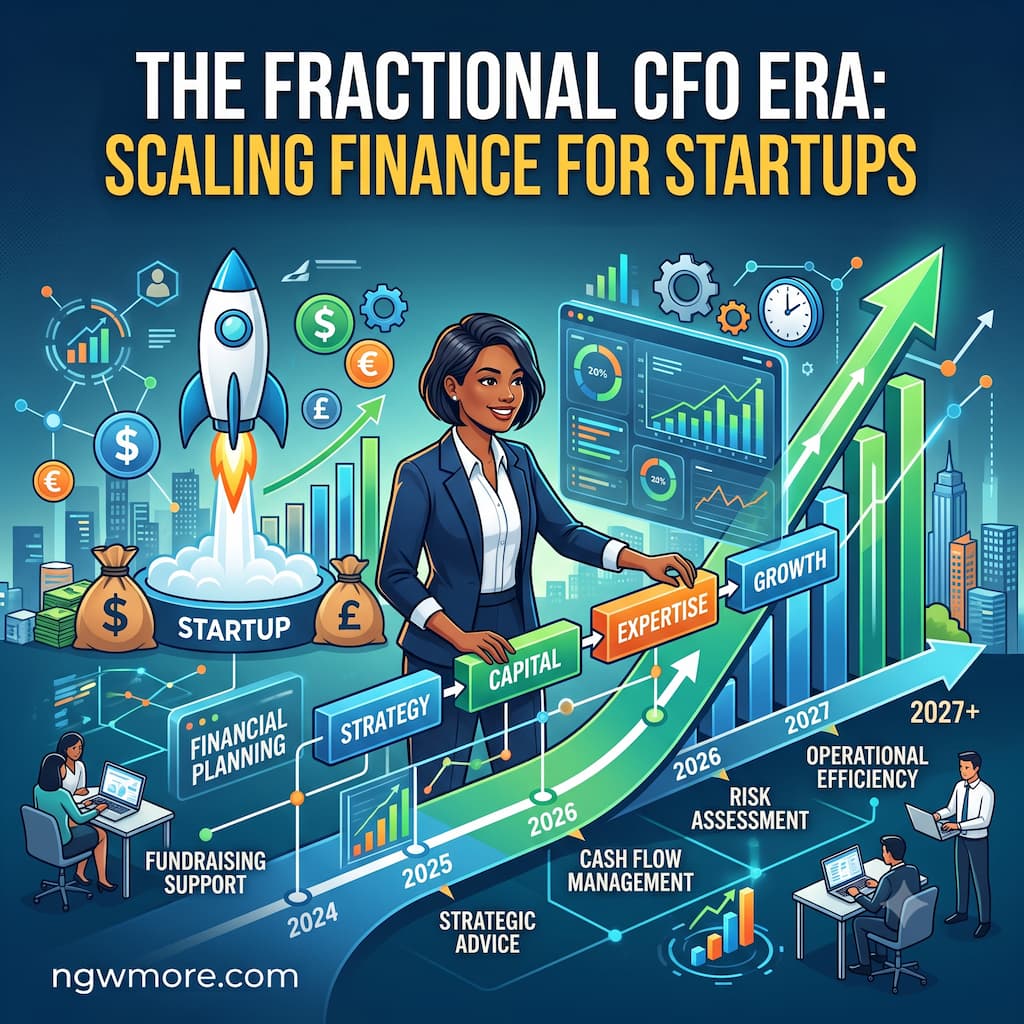
The Fractional CFO Era: Scaling Finance for Startups
For early-stage startup founders and high-growth enterprise leaders, navigating the path from initial seed funding to sustainable profitability requires a delicate balance of product innovation, talent acquisition, and strategic market expansion. In the initial phases of a venture, financial operations are typically straightforward: managing basic cash flow, paying vendors, running payroll, and ensuring tax compliance. Founders often manage these tasks themselves or delegate them to external bookkeeping services.
However, as a startup scales—securing Series A rounds, expanding headcount, managing complex revenue recognition models, and navigating international compliance—basic bookkeeping becomes insufficient.
Startups rapidly reach a critical financial junction: they require high-level corporate finance expertise, capital allocation strategies, unit-economic modeling, and investor-relations leadership. Yet, hiring a full-time, experienced Chief Financial Officer (CFO) can cost anywhere from $300,000 to over $500,000 annually in base salary, equity, and benefits—an expense that early to mid-stage startups often cannot justify or sustain.
This economic gap has birthed a major structural shift in modern corporate finance: The Fractional CFO Era.
By leveraging high-level financial strategists on a flexible, part-time, or contract basis, growing startups access executive-level financial leadership tailored precisely to their immediate growth phase.
This model equips early-stage companies with sophisticated financial modeling, runway optimization, capital-raising strategies, and board-level reporting without incurring the massive overhead of a full-time C-suite executive.
This post analyzes the macroeconomic shift toward fractional executive leadership, evaluates the strategic capabilities of a Fractional CFO, compares financial roles across company growth stages, and examines the cloud infrastructure required to host high-consequence enterprise financial portals on ngwmore.com.
1. The Macroeconomic Drivers: Why the Traditional CFO Model Is Evolving
To understand why high-growth ventures are embracing fractional financial leadership, one must examine the changing dynamics of the startup ecosystem over the past decade.
The Shift from “Growth at All Costs” to Capital Efficiency
During periods of ultra-low interest rates and abundant venture capital, startups prioritized aggressive user acquisition and revenue growth above all else. Burn rates were secondary concerns, and financial management focused primarily on tracking top-line expansion metrics.
As global interest rate environments normalized and venture capital markets tightened, investor priorities underwent a fundamental shift. Venture funds, private equity partners, and bank lenders now demand clear pathways to profitability, positive unit economics, strict working capital management, and multi-scenario runway forecasting.
Navigating this climate requires deep corporate finance expertise that basic accounting firms or junior finance hires cannot provide.
The Rise of the Executive Gig Economy and Distributed Leadership
Simultaneously, the supply side of senior executive talent underwent a structural evolution. Experienced financial executives, former investment bankers, and veteran corporate controllers increasingly prefer portfolio careers—offering their strategic expertise to four or five high-growth ventures simultaneously rather than tying themselves to a single corporate entity.
This gives startups direct access to battle-tested CFO talent that would otherwise be out of reach.
2. Core Operational Pillars: What a Fractional CFO Delivers
A common misconception among early-stage founders is confusing the role of a Bookkeeper or Controller with that of a Chief Financial Officer.
While bookkeepers record historical transactions and controllers enforce accounting compliance and produce financial statements, a CFO operates entirely in the future—focusing on strategy, capital architecture, risk management, and value creation.
A Fractional CFO introduces four strategic pillars to a growing venture:
Strategic Financial Modeling and Scenario Planning
A Fractional CFO builds dynamic, multi-variable financial models that project cash flows, working capital requirements, and unit economics under various market conditions.
Whether testing the financial impact of shifting from self-serve SaaS pricing to enterprise sales contracts, expanding into international territories, or adjusting marketing spend, the Fractional CFO provides founders with data-backed financial roadmaps.
Capital Strategy, Fundraising, and Investor Relations
Preparing for an equity financing round or securing non-dilutive venture debt requires significant preparation. A Fractional CFO manages the financial mechanics of fundraising:
- Data Room Construction: Organizing audited financial statements, historical cohort analyses, and key performance metric trends.
- Cap Table Management: Simulating dilution scenarios across seed, convertible note, SAFEs, and priced equity rounds.
- Investor Pitch Integration: Translating technical product roadmaps into compelling financial stories that resonate with institutional venture capitalists.
Cash Flow Optimization and Runway Extension
Managing burn rate is the single most critical operational task for an early-stage venture. A Fractional CFO implements strict cash management protocols, optimizes vendor payment terms, restructures subscription liabilities, and forecasts cash zero-dates under conservative revenue scenarios—ensuring the company retains operational leverage.
Board Reporting and Corporate Governance
As institutional investors join a startup’s board of directors, financial reporting requirements become formal and intensive. A Fractional CFO designs executive board decks, establishes key performance indicator (KPI) dashboards, and leads financial presentations during quarterly board meetings, building credibility with external stakeholders.
3. Structural Optimization Ledger: Comparing Financial Roles Across Growth Stages
Evaluating the scope of responsibilities, cost structures, and operational focus across different financial roles highlights why startups transition to fractional models before hiring full-time C-suite leaders.
Bookkeeper / Accounting Service
- Primary Focus: Historical record-keeping, invoice processing, payroll execution, and basic tax filing.
- Temporal Orientation: Past-focused (recording historical financial transactions).
- Cost Structure: Low monthly retainer or hourly fee.
- Ideal Company Phase: Pre-seed / Bootstrapped stage ($0 to $500k ARR).
Financial Controller
- Primary Focus: US GAAP / IFRS compliance, monthly financial closes, internal audit controls, and financial statement accuracy.
- Temporal Orientation: Present-focused (ensuring current operational accuracy and regulatory compliance).
- Cost Structure: Full-time salary ($130,000 to $200,000+ annually).
- Ideal Company Phase: Early scaling stage ($2M to $10M ARR with complex transactional volumes).
Fractional CFO
- Primary Focus: Capital allocation strategy, unit-economic optimization, fundraising architecture, M&A prep, and board leadership.
- Temporal Orientation: Future-focused (multi-year forecasting, scenario modeling, and strategic positioning).
- Cost Structure: Flexible retainer ($3,000 to $10,000 monthly based on allocated days/hours).
- Ideal Company Phase: Seed to Series B ($1M to $15M ARR or rapidly scaling venture-backed ventures).
Full-Time Enterprise CFO
- Primary Focus: Full corporate leadership, large-scale capital markets management, investor relations team oversight, and strategic exits (IPO / M&A).
- Temporal Orientation: Future-focused with continuous operational governance.
- Cost Structure: High C-suite executive compensation ($350,000 to $500,000+ base plus significant equity).
- Ideal Company Phase: Late-stage Series B+ / Pre-IPO ($20M+ ARR with large headcount).
4. Key Indicators: When Should a Startup Hire a Fractional CFO?
Knowing precisely when to transition from basic accounting to fractional executive leadership prevents operational friction and capital misallocation. Founders should evaluate specific operational triggers:
- Trigger 1: Preparing for a Major Capital Raise: When a startup plans to raise a Series A or venture debt facility within six to nine months, bringing in a Fractional CFO ensures financial statements, cohort metrics, and valuation models are bulletproof before entering investor due diligence.
- Trigger 2: Accelerating Cash Burn without Clear Unit Economics: If top-line revenue is growing but monthly cash burn is accelerating disproportionately, a Fractional CFO identifies margin erosion, optimizes customer acquisition cost (CAC) to lifetime value (LTV) ratios, and stabilizes cash flow.
- Trigger 3: Shifting to Complex Business Models: Moving from simple B2C transactions to enterprise B2B contracts—involving customized billing cycles, deferred revenue accounting, and complex commission structures—requires strategic financial oversight to avoid accounting errors.
- Trigger 4: Board and Investor Friction: When existing investors or board members request sophisticated financial projections, cohort retention matrices, or multi-year capital plans that internal teams struggle to produce, a Fractional CFO fills the analytical gap immediately.
5. Systemic Operations: Cloud Infrastructure for Enterprise Financial Portals
Deploying modern financial operations across distributed teams, fractional executives, and institutional investors demands a secure, high-performance digital server infrastructure. Modern financial stacks rely on real-time integrations across ERP systems, cloud banking APIs, cap table management platforms, and interactive financial dashboards.
When a Fractional CFO runs complex multi-variable financial simulations, generates real-time investor reporting dashboards, or accesses confidential corporate data repositories during active due diligence, server stability, encrypted data transit, and zero-downtime availability are essential requirements.
If an enterprise financial portal or multi-tenant analytics gateway experiences server timeouts, database synchronization lags, or access disruptions during a critical board review or fundraising close, the resulting delays can compromise stakeholder confidence and stall corporate transactions.
To eliminate operational friction, progressive technology teams and financial platforms deploy highly optimized, zero-downtime server architectures.
These infrastructure layers continuously monitor active API endpoints, encrypted database write paths, and user access portals, ensuring processing response times stay locked within sub-millisecond thresholds regardless of concurrent data processing loads.
Maintaining an unassailable infrastructure perimeter is vital to eliminate bandwidth bottlenecks, protect sensitive corporate financial assets, and preserve platform authority, driving peak structural execution across digital enterprise portals and hosting domains like ngwmore.com.
6. Implementation Roadmap: Maximizing the Value of a Fractional CFO
To derive maximum strategic value from a Fractional CFO engagement, startup founders should follow a structured integration roadmap:
- Phase 1: Clear Objective Mapping: Define explicit deliverables before onboarding—such as building a 3-year rolling financial model, preparing a Series A data room, or auditing pricing tiers.
- Phase 2: Establishing Unrestricted Data Access: Provide the Fractional CFO with secure, read-only access to historical accounting databases, banking portals, cap tables, and CRM pipelines to ensure total analytical visibility.
- Phase 3: Integrating Controller and Bookkeeping Sync: Ensure the Fractional CFO works directly with existing bookkeeping or accounting personnel. Clean, accurate underlying accounting data is mandatory for high-level financial modeling.
- Phase 4: Establishing a Executive Cadence: Set up weekly operational check-ins and monthly strategic reviews to evaluate financial performance against budget, update rolling forecasts, and adjust capital allocation plans dynamically.
Read More⚡ Neuromorphic Chips: Redefining High-Performance AI Tasks
Conclusion: Flexible Financial Leadership as a Competitive Advantage
The rise of the Fractional CFO is not a temporary cost-cutting trend; it represents a permanent structural evolution in how modern startups scale corporate finance. The historical model that forced growing ventures to choose between under-equipped bookkeeping services or prematurely expensive C-suite salaries has been replaced by an agile, high-efficiency executive framework.
The future of venture growth belongs to the forward-thinking founders, agile operators, and data-driven platform networks that leverage fractional financial leadership to build lean, capital-efficient, and resilient enterprise structures.
By unifying strategic scenario planning, capital efficiency, dynamic board governance, and zero-downtime cloud infrastructure perimeters, modern ventures achieve institutional financial sophistication at a fraction of traditional executive costs.
As global capital markets continue to reward capital efficiency and sustainable growth, executive financial strategies will continue to expand—permanently establishing the Fractional CFO as a core catalyst powering the next era of global startup success.
Hosting computationally intensive financial modeling engines, processing real-time telemetry streams, validating cloud-scale automation pipelines, and managing ultra-secure global data frameworks requires world-class, zero-downtime server infrastructure. Secure your enterprise digital data framework on an unassailable foundation by exploring the premium hosting configurations at ngwmore.com.