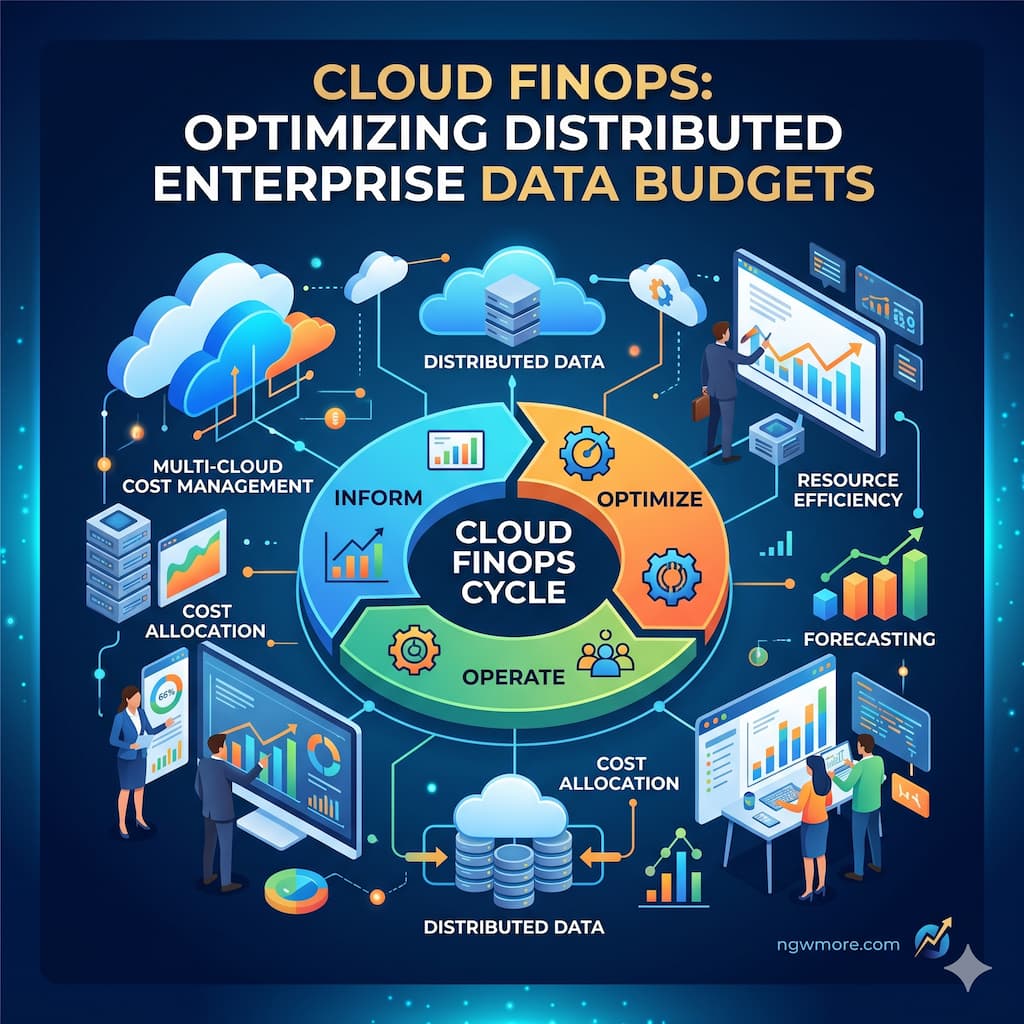
Cloud FinOps: Optimizing Distributed Enterprise Data Budgets
The financial architecture of enterprise computing has reached an inflection point defined by decentralized operational sprawl and uncontrolled operational expenditure. For decades, corporate technology infrastructure was governed by predictable capital expenditure (CapEx) frameworks. IT directors engineered centralized on-premises data centers, provisioned hardware arrays based on multi-year maximum utilization projections, and negotiated long-term, fixed-cost software licenses. Financial oversight was a rigid, trailing administrative process managed via annual accounting reviews and static hardware depreciation schedules.
The wholesale migration of global enterprise networks to multi-cloud topologies and distributed data architectures has shattered this traditional, predictive model.
Modern enterprise data lifecycles run across geographically fragmented micro-datacenter arrays, hybrid cloud pipelines, and hundreds of independent cloud services—including Amazon Web Services (AWS), Microsoft Azure, Google Cloud Platform (GCP), and Snowflake data lakehouses.
In this decentralized ecosystem, technology procurement has shifted from a centralized procurement chain to an edge-driven operational expenditure (OpEx) pipeline.
Every software engineer, data scientist, and automated workflow possesses the decentralized authority to provision compute instances, spin up distributed data analytics clusters, and initiate high-throughput cross-border storage queries with a single command line or API call.
Relying on legacy financial tracking structures under this high-velocity, elastic paradigm introduces severe systemic vulnerabilities. Traditional, trailing quarterly billing reviews leave corporate finance blind to active cost anomalies, unoptimized resource configurations, and cloud consumption drift.
This tracking latency results in massive over-provisioning waste, unexpected cloud invoice spikes that erode operating margins, and severe organizational friction between engineering squads and financial stakeholders.
To eliminate this operational friction, minimize structural cloud waste, and secure an absolute operational margin moat, progressive technology enterprises are deploying Intelligent Cloud FinOps Control Planes.
Far from a basic spreadsheet template or an incremental cost dashboard, building a modern enterprise-grade FinOps architecture combines high-throughput multi-cloud billing telemetry ingestion, automated cloud policy-as-code validation, non-linear cloud cost forecasting models, and automated resource remediation engines directly into the unified enterprise IT governance core.
1. The Core Paradigm Shift: From Reactive Cost Cutting to Real-Time Cloud Financial Engineering
To build a highly resilient cloud operational core capable of scaling distributed data applications safely across multiple sovereign boundaries, Chief Information Officers (CIOs), Chief Financial Officers (CFOs), and engineering directors must fundamentally alter their underlying architectural design philosophy. The enterprise must shift from lagging, retrospective cloud bill analysis to continuous, real-time value orchestration and resource optimization.
- Legacy Cloud Cost Management: Functions within a reactive topology. Corporate finance teams inspect consolidated cloud invoices weeks after the billing period concludes, attempting to identify cost overruns and manually assigning engineering squads to clean up unutilized computing resources long after the financial leakage has occurred.
- The Automated Cloud FinOps Core: Reconfigures this framework entirely. It establishes a continuous, real-time data orchestration layer that unifies live multi-cloud billing APIs, granular resource utilization telematics, application performance metrics, and enterprise budget allocations into an active, centralized observability engine.
By executing automated pattern scanning, multi-dimensional unit economics analysis, and programmatic policy validation right at the consumption boundary, intelligent FinOps networks permanently eliminate financial risk latency.
The cloud treasury team moves past its historical role as a passive manual auditor. The software infrastructure evolves into an active strategic armor engineered to predict consumption anomalies, track cost-per-business-metric ratios, and optimize cross-cloud resource configurations weeks before an operational distortion hits the balance sheet.
2. Core Pillars of an Enterprise-Grade Distributed Cloud FinOps Stack
Constructing a production-grade Cloud FinOps and distributed data budget optimization platform capable of scaling safely across multi-tenant enterprise cloud networks requires a robust technology layer anchored by four foundational engineering pillars.
Pillar I: High-Throughput Billing Telemetry Ingestion and Granular Data Normalization
The absolute precision of any predictive cloud cost allocation model and its capacity to prevent budget overruns depend entirely on the volume, granularity, and real-time ingestion velocity of the data pipelines feeding its processing loops.
Systems architects deploy automated real-time data orchestration pipelines connected straight to cloud provider billing engines (via AWS Cost and Usage Reports, Azure Consumption APIs, and GCP BigQuery billing exports), kubernetes orchestration hubs, and distributed data warehouse logs. The ingestion factory normalizes unstructured, multi-format financial and operational telemetry into a standardized, low-latency data schema. This continuous data harvest feeds a centralized, enterprise-grade FinOps Feature Store that unifies raw usage events into a single, uncorrupted source of truth for both online real-time cost allocation and offline predictive simulation loops, completely preventing data mapping anomalies.
Pillar II: Policy-as-Code FinOps Engines and Automated Data Tagging Enforcements
Modern multi-cloud corporate operations require navigating an intricate maze of overlapping department cost centers, microservice architectures, and dynamic geographic scaling zones that change dynamically across cloud environments.
Enterprise technology teams deploy optimized Policy-as-Code FinOps Engines built on advanced logical validation frameworks and programmatic resource tagging controls. The optimization core processes thousands of distinct infrastructure metadata points simultaneously—including active container tags, department ownership identifiers, environment states (production vs. non-production), and live data transit trajectories. The engine applies these programmatic rules to execute real-time cost-attribution mapping, isolate untagged rogue instances instantly, and enforce correct budgeting parameters as new cloud resources are initialized, eliminating the risk of unallocated cloud waste across complex international digital systems.
Pillar III: Stochastic Cloud-Spend Simulators and Multi-Variable Capacity Stress Testing
Maintaining an unassailable financial and operational perimeter requires the corporate technology core to continuously evaluate its systemic resilience against sudden, catastrophic shifts in consumer request velocities or unoptimized infrastructure application deployments.
The infrastructure integrates advanced Stochastic Simulation Engines that run millions of continuous, automated cloud-spend and capacity stress tests over the prospective global infrastructure matrix concurrently. The system models how organizational cash runway boundaries, infrastructure performance metrics, and multi-cloud budget allocations would perform under severe operational and demand disruptions: an abrupt global consumer traffic spike, an unoptimized application loop deployment that initiates endless recursive cloud functions, a sudden price adjustment by a primary cloud provider, or a massive expansion of distributed analytical data lakehouse queries. If a simulation reveals that a potential software architecture path risks pushing cloud consumption above defined budgetary thresholds, the platform generates automated optimization alerts, allowing system architectures to adjust structural deployment paths proactively.
Pillar IV: Real-Time Early Warning Systems (EWS) and Automated Lifecycle Remediation
Waiting for traditional monthly corporate billing charts or trailing quarterly infrastructure audits to isolate data transmission leaks or over-provisioned database clusters exposes the enterprise to massive, unhedged operational cost windows during periods of rapid application acceleration.
Operations groups deploy an automated Early Warning System (EWS) connected straight to live cloud performance data streams and metric trackers across all international business units. The framework monitors organizational consumption behaviors continuously against adaptive risk-threshold parameters.
If the analytical engine isolates an uncharacteristic anomaly—such as a non-linear spike in cross-region data egress volumes within an analytics staging platform combined with an uncharacteristic drop in user request velocities across that same corridor—it triggers an immediate automated intervention playbook.
The system bypasses manual validation queues, programmatically downgrades or terminates the under-utilized computing nodes via automated serverless scripts, and flags the specific infrastructure code repository for direct developer remediation. Concurrently, the platform builds an unassailable, immutable ledger log of every single resource modification and cost saving adjustment, generating an active audit trail that guarantees absolute operational traceability.
3. High-Performance Optimization: The Cloud FinOps Metric Ledger
Transitioning an enterprise technology framework from uncoordinated manual cloud spreadsheet tracking to an automated, scaled corporate Cloud FinOps architecture fundamentally redefines an organization’s administrative efficiency and structural cost metrics.
| Performance Parameter | Legacy Cloud Asset Management | Scaled Intelligent FinOps Core |
| Cost Allocation Latency | Weeks of trailing post-period manual collation | Real-time, instant sub-second calculation loops |
| Resource Tagging Accuracy | Fragmented; high volume of unallocated or untagged assets | Absolute; machine-enforced policy-as-code tracking |
| Infrastructure Waste Mitigation | Opaque estimates; high exposure to idle over-provisioning | Total optimization; automated right-sizing loops |
| Capacity Procurement Style | Reactive ad-hoc buying; unoptimized on-demand usage | Proactive; data-driven committed use optimization |
| Cloud Budget Efficiency | High capital leakage; unpredictable billing shocks | Maximized margins, slashing infrastructure waste up to 35% |
4. Operational Implementations: Cloud FinOps in Active Enterprise Spheres
Evaluating how advanced Cloud FinOps and data budget optimization platforms perform under complex, real-world corporate data and engineering scenarios highlights their critical role in maximizing operational efficiency and safeguarding shareholder value.
Real-Time Cross-Region Data Egress Optimization and Anomaly Defusal
Consider a major multinational digital logistics and supply chain enterprise that coordinates extensive analytical data pipelines and real-time tracking streams across multiple global data center regions simultaneously. The operational lifecycle relies heavily on streaming petabytes of telemetry data between distributed database clusters, cloud object storage repositories, and central analytical lakehouses. Suddenly, a change in application configurations or an unoptimized automated batch job initiates an unexpected recursive loop, causing terabytes of raw uncompressed historical records to transfer across distinct sovereign cloud regions within hours.
Under traditional, slow-moving financial review structures, this sudden cross-region data transfer spike would go unnoticed until the next consolidated multi-cloud billing invoice arrives weeks later. By the time the accounting department isolates the massive cloud cost spike, the enterprise has already incurred hundreds of thousands of dollars in unhedged cross-region data egress fees, directly eroding operating income.
The intelligent enterprise completely neutralizes this systemic threat by anchoring its multi-cloud fabric to an automated Cloud FinOps control plane. The platform monitors machine telemetry logs, cloud data movement streams, and billing APIs continuously.
The moment the machine learning anomaly engine isolates the uncharacteristic data egress velocity, it calculates the projected budget impact instantly.
The platform executes an automated adaptation playbook: it programmatically triggers an API call to throttle the specific unoptimized data replication pipeline, migrates the analytical query load to a localized data caching zone, and notifies the engineering leads with exact system code line references. This real-time response keeps the global infrastructure fully aligned with corporate data budgets, prevents expensive invoicing shocks, and protects enterprise capital from regulatory and operational leakage.
Proactive Commitment Optimization and Reserved Capacity Engineering for AI Stacks
A hyper-scale digital platform and artificial intelligence aggregator manages thousands of automated training models, distributed microservices, and continuous integration pipelines across multiple cloud provider zones globally. Because the platform executes computationally intensive machine learning model retraining and large-scale vector lookups daily, its underlying cloud compute requirements and GPU cluster allocations are highly volatile, creating massive financial forecasting challenges for the corporate treasury division.
The corporation stabilizes its technology operating margins and eliminates infrastructure waste by anchoring its core processing clusters to an automated cloud-spend simulation and procurement engine. The platform connects directly to active container registries, cloud resource pools, and central financial ledgers via secure enterprise connectors.
Using advanced multi-variable predictive modeling running continuously, the system projects future cloud compute requirements and utilization baselines weeks ahead with high mathematical precision.
If the model projects that upcoming product deployment waves will establish a sustained computing floor over the next 12 months, the system automatically coordinates an optimization execution.
The engine programmatically secures optimal cloud provider savings agreements—such as AWS Savings Plans or Google Cloud Committed Use Discounts (CUDs)—locking in lowest possible pricing structures while dynamically offloading transient workloads to spot instance markets automatically. This predictive lifecycle management optimizes capital utilization, prevents expensive on-demand billing over-reliance, and ensures complete cost stability as the international business scales.
5. Security Architecture for Hardened Cloud Financial Optimization Planes
Centralizing global multi-cloud billing credentials, integrating live enterprise infrastructure configuration APIs, tracking predictive resource consumption models, and automating remediation pathways introduces intense data privacy and infrastructure security requirements. Because advanced Cloud FinOps platforms command the direct administrative authority to modify cloud environments, alter resource configurations, and interface with sensitive financial tracking logs, they represent top-tier targets for advanced persistent threat actors, corporate espionage rings, and sophisticated infrastructure exploitation networks.
Implementing Secure Access Controls and Least-Privilege Optimization Pathways
To enforce automated infrastructure optimization scripts and right-sizing playbooks safely without introducing security structural vulnerabilities or exposing the enterprise cloud core to unauthorized lateral access, organizations must implement an ironclad security architecture.
Systems architects deploy strict Role-Based Access Control (RBAC) and attribute-based security parameters directly across the FinOps control interface. The automated remediation scripts execute within highly restricted, read-write isolated API permission blocks configured with absolute least-privilege configurations. The engine is legally barred from accessing application data payloads or user privacy parameters, limiting its system footprint strictly to metadata tracking, infrastructure scaling adjustments, and non-destructive resource optimizations. All automated infrastructure actions must pass through strict cryptographic signature checks before cloud providers execute the code adjustments, protecting systemic infrastructure integrity from tampering at all times.
Hardening the FinOps Analytics Center via Enclave Isolation and Audited Quorums
Because the centralized Cloud FinOps analytics framework commands the absolute authority to analyze multi-cloud data budgets, modify infrastructure-as-code boundaries, alter automation thresholds, and update organizational billing rules, accessing this engine requires extreme security constraints.
- Enclave Isolation: Isolate the entire quantitative modeling core, optimization engines, and API configuration consoles inside a strict Zero-Trust Network Access (ZTNA) envelope. Every developer account, system administrator terminal, and internal software integration must clear continuous multi-factor authentication, rigorous automated behavioral risk screening, and endpoint device posture assessments before gaining access to the platform dashboard. The core processing data stores must execute within hardware-isolated Confidential Computing Enclaves equipped with hardware-level memory encryption, keeping all enterprise infrastructure insights completely insulated from external data exploitation or internal insider threats.
- Audited Quorums: Corporate technology boards must guarantee that any structural alteration to global budget spend limits, modification of automated system termination playbooks, or authorization of programmatic cost rules requires concurrent cryptographic confirmation from a distributed quorum of verified engineering and financial security officer keys across completely isolated network environments, preventing single points of system vulnerability from compromising the data infrastructure core.
6. Structural Convergence: Adhering to Global Cloud Cost Attribution Standards
Scaling a comprehensive Cloud FinOps and distributed data budget architecture across international corporate lines requires absolute alignment with an evolving framework of international enterprise governance, institutional accounting mandates, and data optimization methodologies.
The FinOps Framework and FinOps Open Cost & Usage Specification (FOCUS)
The adoption of the FinOps Foundation’s open-source engineering standards and the widely adopted FinOps Open Cost & Usage Specification (FOCUS) marks a massive evolution in international cloud financial management. Historically, managing billing data across distinct cloud providers was a highly fragmented operational nightmare. Each cloud vendor utilized completely independent naming conventions, distinct data schemas, and proprietary terminology for identical structural concepts (e.g., AWS “Unblended Cost” vs. Google Cloud “Cost Before Credits”), forcing enterprise analytics systems to run computationally intensive, fragile data translation mappings.
 [AWS Billing Log] \
 [GCP Billing Log]  ──> Automated FOCUS Normalization Engine ──> [Unified Common Data Schema]
 [Azure Billing Log]/
Implementing the unified FOCUS data specification eliminates this structural engineering friction. The framework forces all multi-cloud billing logs, container tracking metrics, and infrastructure data lakes to normalize into a singular, common open-source data schema and uniform definition taxonomy.
This architectural alignment enables the enterprise optimization engine to evaluate unit economics with absolute accuracy, build cross-provider optimization dashboards without experiencing schema skew, and project global software asset utilization with total consistency.
Aligning the enterprise data core to the FOCUS standard transforms multi-cloud billing files into highly actionable, structured data assets—allowing financial data engineers to write uniform, high-performance optimization scripts that reduce administrative data overhead up to 50% and secure absolute cost visibility across all global operational lines.
Read More⚡ Network Detection: Scaling Secure Enterprise Data Hubs
Conclusion: Orchestrating the Unassailable Cloud FinOps Engine
The deployment and scaling of a modern, data-driven Cloud FinOps and distributed enterprise data budget management architecture is not an optional optimization update for global enterprises and multi-cloud technology organizations; it is a fundamental technological requirement to navigate tomorrow’s hyper-connected, high-velocity economic arena. The historical strategy of managing multi-million-dollar cloud portfolios and distributed engineering budgets through slow, human-centric spreadsheets and trailing monthly invoice reviews—while tolerating massive over-provisioning waste, manual data mapping friction, and volatile billing shocks—is an unsafe operational approach that invites capital stagnation, margin compression, and structural integration failure.
By engineering an integrated, forward-looking software fabric built on high-throughput multi-cloud telemetry ingestion pipelines, automated policy-as-code validation frameworks, stochastic cloud-spend stress testing engines, and real-time automated remediation playbooks, progressive enterprise leaders transform their cloud functions from passive tracking logs into high-performance strategic weapons.
Ultimately, the definitive advantage in the global commercial ecosystem belongs entirely to the visionary enterprise leaders that can evaluate risks, optimize digital structures, and deploy capital as fast as the market moves—mastering advanced predictive Cloud FinOps frameworks to drive secure, highly efficient, and market-leading global scale across any operational horizon.
Deploying computationally intensive cloud billing normalization engines, high-throughput financial data lakehouses, real-time capital structure optimization models, and ultra-secure automated asset protection frameworks requires world-class, zero-downtime server infrastructure. Secure your company’s digital cloud optimization engine on an unassailable infrastructure foundation by exploring the premium enterprise hosting configurations at ngwmore.com.