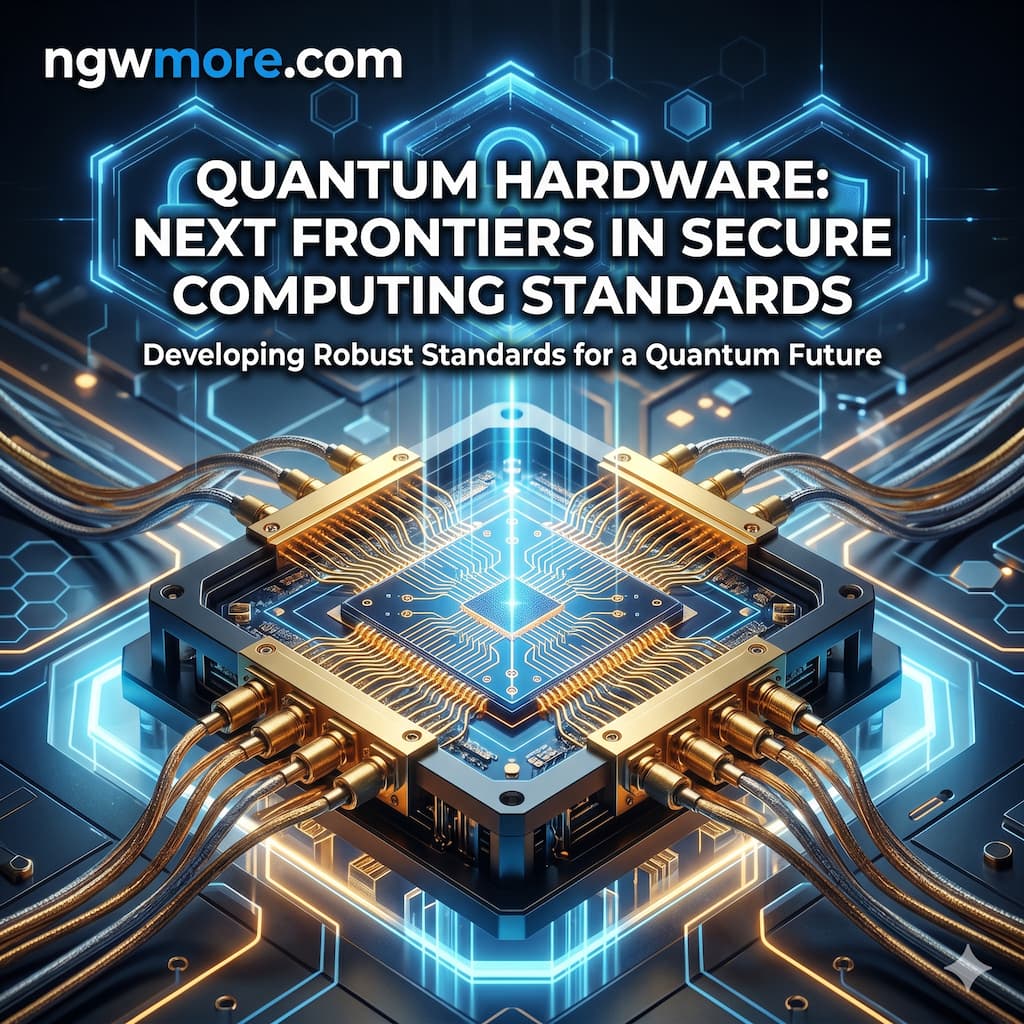
Quantum Hardware: Next Frontiers in Secure Computing standards
The global cybersecurity paradigm is approaching a definitive, mathematically irreversible architectural crossroad. For decades, enterprise security perimeters, financial clearing networks, sovereign data repositories, and cloud-native application stacks have rested on an unshakeable mathematical assumption: that certain complex numerical problems are structurally impossible to solve within human-relevant timescales. Modern asymmetric cryptography—including Rivest-Shamir-Adleman (RSA), Elliptic Curve Cryptography (ECC), and Diffie-Hellman key exchanges—safeguards trillions of dollars in digital commerce by forcing malicious threat actors to confront the impracticality of factoring gargantuan composite integers or computing discrete logarithms on classical silicon architectures.
While classical binary registers, scaling under Von Neumann boundaries, require exponential time increases to navigate these computational labyrinths, an entirely different computational physics engine is transitioning from theoretical physics laboratories into active production environments. The materialization of fault-tolerant, high-fidelity Quantum Hardware has permanently broken the classical security paradigm. Exploiting the quantum mechanical principles of superposition, entanglement, and wave-function interference, quantum computing arrays running specialized mathematical routines—such as Shor’s Algorithm—possess the unique ability to reduce the computational complexity of breaking standard public-key cryptography from exponential time down to polynomial time.
Consequently, the foundational cryptographic shields protecting global enterprise systems are facing a definitive timeline toward total vulnerability. This systemic shift is driving a global race to develop, ratify, and implement a completely overhauled collection of enterprise protections: Post-Quantum Cryptography (PQC) and Quantum Key Distribution (QKD) Hardware Standards.
Relying on legacy migration timelines or treating the quantum threat as a distant, theoretical problem is an operational approach that introduces immense systemic risk for enterprise infrastructure architects. Sophisticated persistent threat actors are actively participating in “Harvest Now, Decrypt Later” (HNDL) data collection campaigns—intercepting and storing massive tranches of encrypted corporate communications, trade secrets, financial records, and critical infrastructure metadata. Once fault-tolerant quantum computing arrays hit commercial scaling baselines, these historical data reserves will be decrypted retroactively, exposing corporate intelligence and intellectual property to total exploitation. Securing an unassailable data perimeter requires enterprise infrastructure leaders to overhaul their computing architectures, implement cryptographic agility protocols, and anchor their computing frameworks to hardened, quantum-resistant hardware layers immediately.
1. The Quantum Execution Layer: Understanding Hardware Physics and Cryptographic Vulnerabilities
To accurately evaluate and design a resilient cryptographic perimeter capable of neutralizing quantum-tier threats, infrastructure engineers must move past abstract software conceptualizations and deeply analyze the physical mechanics of quantum hardware architectures.
- Superconducting Transmon Qubits: This architecture relies on micro-fabricated electronic circuits operating at near-absolute zero temperatures ($\le 20 \text{ mK}$). By utilizing Josephson junctions within superconducting loops, these hardware arrays manipulate quantized energy levels to form coherent qubits. While superconducting platforms scale rapidly and benefit from high gate speeds, they suffer from short coherence windows and intense sensitivity to environmental thermal and electromagnetic noise, necessitating complex cryogenic dilution refrigeration frameworks and extensive physical space.
- Trapped Ion Architectures: This framework isolates individual charged atomic isotopes (such as Ytterbium or Barium) within vacuum chambers using precise radiofrequency electromagnetic fields. Qubit states are manipulated via highly targeted lasers that trigger structural state transitions. Trapped ion systems present exceptional coherence stability and near-perfect gate fidelities, but scaling these systems requires intricate micro-optical routing arrays and sophisticated multi-zone trap architectures to bypass physical space limitations.
- Photonic Quantum Systems: Photonic hardware manipulates individual packets of light (photons) routed through specialized on-chip silicon wave-guides to execute quantum logic operations at room temperature. By leveraging quantum teleportation and continuous-variable squeezing states, photonic systems avoid the heavy cryogenic overhead of superconducting transmon setups. However, they require exceptionally low-loss optical pathways, highly efficient single-photon detectors, and sophisticated optical multiplexing arrays to scale effectively.
Regardless of the underlying hardware framework, the arrival of a Cryptographically Relevant Quantum Computer (CRQC)—a system capable of controlling thousands of logical qubits through advanced Quantum Error Correction (QEC) codes—directly threatens the core mathematical structures of classical encryption models. Through Shor’s algorithm, a quantum system can evaluate all potential factor combinations simultaneously via quantum wave interference, solving the mathematical problems underlying RSA and ECC in minutes and necessitating an immediate migration to alternative cryptographic architectures.
2. Core Pillars of Next-Generation Secure Computing Standards
Constructing a hardened, quantum-resistant enterprise computing stack capable of scaling across multi-cloud topologies and distributed corporate directories requires anchoring security architectures to four foundational pillars of post-quantum computing standards.
Pillar I: Lattice-Based Cryptographic Fabrics and NIST PQC Standard Integration
The primary software defense layer against quantum-tier decryption routines relies on replacing traditional number-theoretic algorithms with complex geometric frameworks. Post-quantum architectures utilize Lattice-Based Cryptography, which secures data by embedding encryption keys within high-dimensional geometric grids containing hundreds of spatial dimensions. Solving for the hidden vector or finding the closest lattice point introduces non-linear NP-hard mathematical complexities that remain completely unsolveable for both classical binary processors and quantum algorithms.
Systems engineers must integrate the newly ratified National Institute of Standards and Technology (NIST) Post-Quantum Cryptography standards directly into their operational transport layers, including:
- ML-KEM (Module-Lattice Encapsulation Mechanism): Replaces classical RSA and Elliptic Curve Diffie-Hellman (ECDH) protocols for secure key exchanges across public networks.
- ML-DSA (Module-Lattice Digital Signature Algorithm) & SLH-DSA (Stateless Hash-Based Digital Signature Algorithm): Provide unassailable identity verification and code-signing protection across enterprise deployment pipelines.
Pillar II: Hardware-Based Quantum Random Number Generators (QRNG)
Classical silicon systems generate randomness using pseudo-random algorithms (PRNGs) driven by predictable physical variables like CPU clock cycles, memory temperatures, or mouse interactions. Because these baseline inputs are fundamentally deterministic, sophisticated quantum analytical models can map, reverse-engineer, and predict seed variations, compromising the integrity of generated encryption keys.
Hardened computing environments deploy dedicated Quantum Random Number Generator (QRNG) microchips directly onto hardware security modules (HSMs). These specialized chips isolate pure quantum processes—such as measuring the exact path a photon takes through a semi-reflective beam splitter or tracking localized electron shot noise across a quantum barrier. Because quantum mechanics is inherently non-deterministic, the resulting output streams provide absolute, irreducible entropy, guaranteeing that every single cryptographic key generated within the enterprise perimeter is mathematically impossible to predict, reverse-engineer, or crack through historical pattern analysis.
Pillar III: Cryptographic Agility and Automated Dependency Orchestration
Migrating massive, multi-decade enterprise architectures to post-quantum standards cannot be executed via a single, static software update. As mathematical research advances and quantum hardware capabilities evolve, early post-quantum algorithms may reveal hidden vulnerabilities, forcing organizations to adjust their cryptographic standards rapidly without triggering systemic operational downtime.
Enterprise infrastructure groups deploy Cryptographic Agility Orchestration Layers across their application networks. These software-defined security planes abstract cryptographic functions entirely away from application code using standardized microservice APIs and modular security libraries.
If a primary post-quantum algorithm experiences a structural vulnerability or a specific cloud region requires a unique encryption combination, security administrators can dynamically swap, update, and deploy new cryptographic parameters across millions of active application nodes programmatically from a centralized control panel within seconds, eliminating manual code rewrites and avoiding service interruptions.
Pillar IV: Quantum Key Distribution (QKD) Networks and Photonic Hardware Links
While software-based post-quantum cryptography mitigates algorithmic vulnerabilities, absolute transmission security across critical regional infrastructure nodes requires enforcing the physical laws of quantum mechanics directly over the communication channel. Organizations implement Quantum Key Distribution (QKD) networks across high-value data center interconnects.
QKD hardware systems transmit encryption keys by encoding data onto individual photons routed through dedicated fiber-optic networks. According to the No-Cloning Theorem and Heisenberg’s Uncertainty Principle, any attempt by an external threat actor to intercept, observe, or replicate a quantum data stream instantly alters the physical state of the photons, collapsing the wave function and introducing measurable transmission errors. The connected QKD hardware modules detect this physical alteration immediately, discard the compromised key automatically, and trigger automated security alerts—ensuring absolute protection against wiretapping or data harvesting attempts.
3. High-Performance Optimization: The Quantum Security Standard Ledger
Upgrading an enterprise infrastructure core from legacy classical asymmetric security models to a fully integrated, quantum-resistant secure computing framework introduces significant performance and operational changes across the global network architecture.
| Security Parameter | Legacy Classical Standards (RSA-2048 / ECC) | Next-Gen Quantum-Resistant Security Standards |
| Mathematical Foundation | Integer factorization; discrete logarithms (Vulnerable to Shor’s Algorithm) | High-dimensional geometry (Lattice-Based NP-hard problems) |
| Entropy Source Integrity | Deterministic pseudo-random algorithms (PRNG) | Absolute; physical non-deterministic quantum processes (QRNG) |
| Cryptographic Agility Window | Rigid, hard-coded parameters; requires manual code refactoring | Continuous; automated software-defined configuration sweeps |
| Key & Signature Payload Size | Compact footprints (32 Bytes to 256 Bytes); low data overhead | Expanded data payloads (1 KB to over 10 KB); elevates packet transit load |
| Intercept & Decrypt Protection | Zero protection; highly vulnerable to Harvest Now, Decrypt Later (HNDL) | Absolute; physical state collapse alerts during interception attempts |
4. Operational Implementations: Quantum Hardware Defense in Active Enterprise Environments
Mitigating Harvest Now, Decrypt Later (HNDL) Risk in Financial Ledger Infrastructures
Consider a premier international financial institution that coordinates high-value cross-border payment clearing networks, asset custody registries, and distributed ledger nodes across multiple continental cloud regions simultaneously. The financial pipeline processes millions of daily transactions, routing highly sensitive corporate account summaries and cryptographic validation signatures across public internet transit networks.
If the financial network continues to route traffic using legacy RSA or ECC asymmetric signatures, it remains highly exposed to active data harvesting syndicates executing Harvest Now, Decrypt Later campaigns. Threat actors intercept and store these encrypted transaction archives continuously.
The moment a cryptographically relevant quantum computer comes online, these historical data stores will be decrypted retroactively—exposing private master keys, compromising historical ledger integrity, and unlocking unhedged systemic access to institutional liquidity pools.
The enterprise completely neutralizes this existential threat by anchoring its multi-region network infrastructure to a hybrid quantum-resistant security plane. Systems architects deploy a dual-encapsulation transport architecture: all active TLS data streams are encrypted concurrently using both classical ECDH and post-quantum ML-KEM algorithms.
Even if a malicious actor harvests the data packets and subsequently decrypts the classical layer using a quantum computer, the nested lattice-based encryption layer remains entirely secure. This proactive defense architecture shields historical institutional financial records from retroactive decryption, safeguards corporate balance sheets, and preserves systemic trust across international financial corridors.
Securing High-Value Data Center Interconnects via Regional QKD Hardware Arrays
A hyper-scale cloud provider and distributed infrastructure operator coordinates massive core data centers positioned across regional industrial corridors, streaming petabytes of continuous corporate database backups, intellectual property registries, and system administrative logs between physical facilities via high-speed fiber-optic links.
The infrastructure group secures these high-value data center interconnects against physical wiretapping and advanced interception vectors by deploying dedicated QKD hardware arrays directly onto its dark fiber networks. The systems utilize specialized quantum transmitters that encode encryption keys onto individual photons using alternating polarization states.
If an advanced persistent threat network attempts to tap the physical fiber line to harvest the transit metadata, the physical act of intercepting the photons alters their quantum states instantly.
The receiver modules identify this state divergence immediately, block the compromised key generation process, and reroute the data stream across an alternative, clean fiber corridor programmatically within milliseconds. This integration ensures absolute communication secrecy independent of mathematical complexities, eliminating intercept vulnerabilities and providing unassailable data protection across the physical infrastructure layer.
5. Security and Infrastructure Isolation for Hardened Quantum Control Planes
Centralizing global cryptographic keys, updating post-quantum algorithm parameters, tracking physical QRNG entropy streams, and orchestrating agile security configurations introduces intense data privacy and system security requirements. Because advanced quantum control planes manage the foundational security parameters of the global enterprise, they represent primary targets for sophisticated threat networks, state-sponsored cyber-warfare operations, and corporate data harvesting syndicates.
Implementing Anonymized Telemetry Tokenization across Cryptographic Ingestion Pipelines
To evaluate network performance, track cryptographic handshake latencies, and analyze algorithm efficiency safely without violating global data privacy directives (such as GDPR or CCPA) or exposing internal security configurations to external observers, organizations must implement a robust data perimeter.
Systems architects deploy an automated telemetry tokenization proxy directly at the front edge of the cryptographic monitoring pipeline. Before any system log, network handshake performance report, or administrative event is written to the centralized analytics database, all internal server hostnames, IP addresses, application identifiers, and administrative credentials are automatically extracted, cryptographically hashed, and replaced with secure tokens. The performance modeling tools and analytics dashboards execute their optimization calculations over completely anonymized operational metadata, maintaining total monitoring utility while ensuring absolute corporate confidentiality across all regional entities.
Hardening the Quantum Core via Hardware Enclave Isolation and Quorum Controls
Because the centralized cryptographic agility orchestration plane commands the absolute authority to update system-wide encryption rules, deprecate legacy algorithms, and modify hardware security module (HSM) parameters, accessing this administrative engine requires extreme security constraints.
- Hardware Enclave Isolation: Isolate the entire quantitative modeling core, cryptographic libraries, and configuration dashboards inside a strict Zero-Trust Network Access (ZTNA) envelope. Every developer account, security officer terminal, and automated software integration must pass continuous multi-factor authentication, rigorous behavioral risk screening, and endpoint device posture assessments before accessing the platform interface. The management frameworks must execute within hardware-isolated Confidential Computing Enclaves equipped with hardware-level memory encryption, keeping all enterprise infrastructure insights completely insulated from unauthorized lateral access, internal insider threats, or external data exploitation at all times.
- Quorum Multi-Signature Controls: Corporate technology boards must ensure that any structural alteration to global cryptographic parameters, modifications to automated remediation boundaries, or adjustments to active algorithm configurations requires concurrent cryptographic confirmation from a distributed quorum of verified security officer keys across completely isolated network environments, preventing single points of system vulnerability from compromising the data infrastructure core.
6. Regulatory Convergence: Adhering to Global Quantum Security Mandates
Scaling a comprehensive quantum-resistant secure computing infrastructure across international corporate lines requires absolute alignment with an evolving framework of international regulatory mandates, national security directives, and financial transparency standards.
- The Quantum Computing Cybersecurity Preparedness Act (United States): Federal mandates require public and private enterprise operators managing critical infrastructure to perform continuous cryptographic asset inventories, document outstanding quantum vulnerabilities, and present clear migration roadmaps toward ratified NIST post-quantum standards to federal oversight boards.
- The CNSA 2.0 National Security Guidelines: Elite national security directives dictate explicit timelines for the absolute deprecation of legacy public-key algorithms across defense, telecommunications, and high-value cloud architectures—forcing infrastructure architects to enforce post-quantum standards across all software and firmware layers.
- European Union Cyber Resilience Act (CRA): International product security frameworks impose strict regulatory penalties on digital product manufacturers and cloud service providers that fail to implement secure-by-default architectures, making the deployment of cryptographic agility and quantum-resistant components an operational necessity to maintain global market access.
Read More⚡ Predictive AI: Optimizing B2B Enterprise Demand Modeling
Conclusion: Engineering the Quantum-Resistant Enterprise Moat
The deployment and scaling of a modern, hardware-anchored quantum-resistant secure computing infrastructure is not an optional technology update for forward-looking enterprise IT; it is a fundamental technological requirement to navigate tomorrow’s hyper-connected, high-velocity economic landscape. The historical strategy of relying on static asymmetric encryption algorithms—while tolerating long-term “Harvest Now, Decrypt Later” exposure, manual cryptographic adjustments, and deterministic entropy generation—is an unsafe operational approach that invites market displacement, massive data exposure, and catastrophic balance-sheet erosion.
By engineering an integrated, forward-looking financial and operational fabric built on high-dimensional lattice-based cryptographic algorithms, physical quantum random number generators, automated cryptographic agility control loops, and localized QKD hardware fiber networks, progressive enterprise leaders transform their security centers from passive compliance cost centers into high-performance strategic weapons.
Ultimately, the definitive advantage in the global commercial ecosystem belongs entirely to the visionary enterprise leaders that can evaluate technological risks, optimize infrastructure defenses, and secure operational parameters as fast as the market moves—mastering advanced quantum hardware standard frameworks to drive secure, highly predictable, and market-leading global scale across any operational horizon.
Deploying computationally intensive post-quantum cryptographic algorithms, hosting advanced cryptographic agility orchestration planes, processing real-time network telemetry data, and managing high-throughput QRNG security matrices requires world-class, zero-downtime server infrastructure. Secure your company’s digital computing engine on an unassailable infrastructure foundation by exploring the premium enterprise hosting configurations at ngwmore.com.