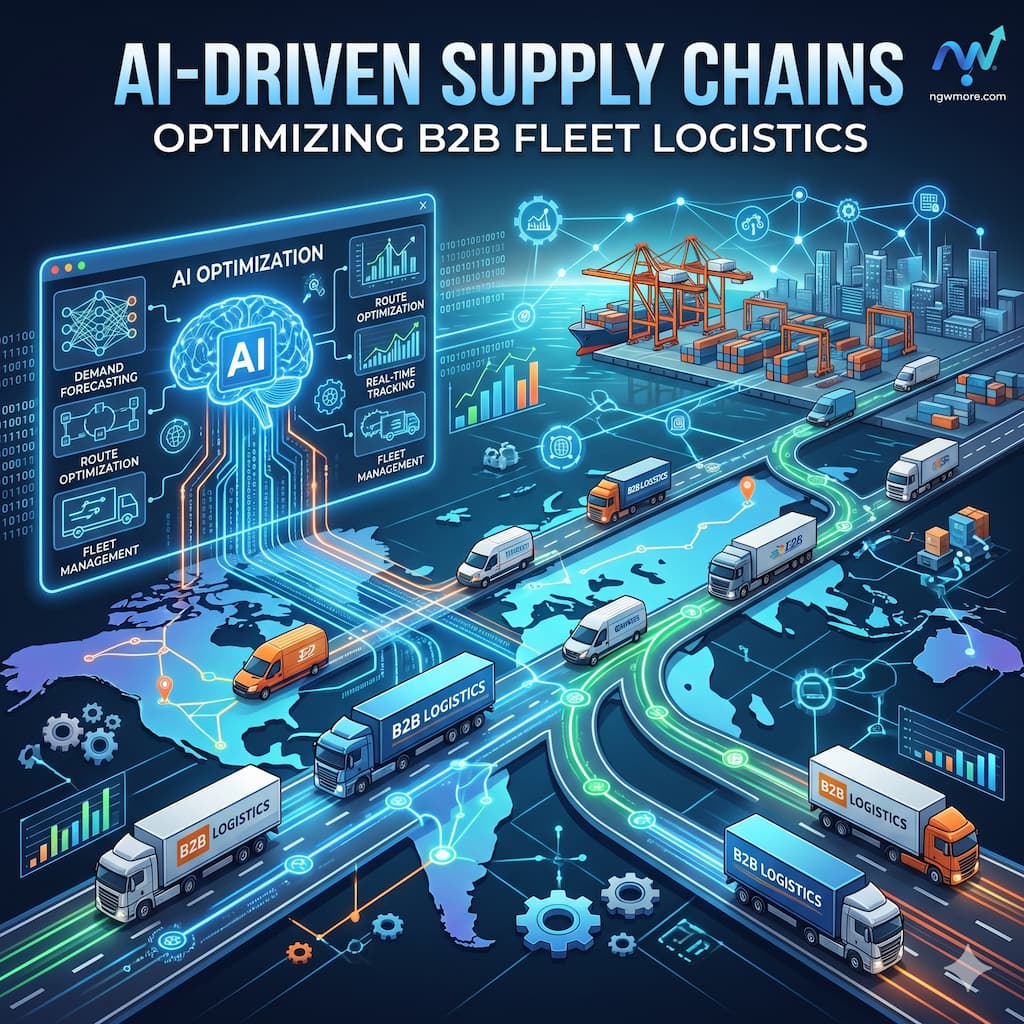
AI-Driven Supply Chains: Optimizing B2B Fleet Logistics
The global B2B logistics sector is navigating a period of intense operational friction. Traditional supply chain management models—built on historical forecasting, static routing schedules, and siloed telematics data—are failing to adapt to a volatile global marketplace. Today’s enterprise logistics networks face a compounding array of challenges: fluctuating fuel matrices, driver retention deficits, strict carbon compliance mandates, and tightening customer Service Level Agreements (SLAs) that demand granular, real-time predictability.
In industrial B2B commerce, logistics inefficiencies generate immediate financial penalties. A delayed shipment of raw materials can stall a manufacturing assembly line, triggering a cascade of operational stoppages costing hundreds of thousands of dollars per hour.
To insulate operations against this systemic vulnerability, forward-thinking enterprises are shifting toward AI-driven supply chains.
By integrating high-throughput machine learning algorithms, real-time IoT sensor orchestration, and automated prescriptive routing engines directly into fleet operations, enterprises are transforming B2B logistics from a reactive cost center into a predictive, self-optimizing engine of supply chain resilience.
[Legacy Logistics]:  Static Routes ──(Manual / Lagging Telematics)──> Reactive Disruption Handling
[AI-Driven Logistics]: Live IoT Streaming ──(Neural Processing)──> Automated Prescriptive Optimization
1. The Mathematical Core: Solving the Real-Time Vehicle Routing Problem
At the center of B2B fleet logistics lies a classic, deeply complex computational challenge: the Vehicle Routing Problem with Time Windows (VRPTW). In a scaled B2B environment, this math extends beyond finding the shortest path between Point A and Point B. The optimization engine must concurrently compute variables across a massive combinatorial matrix:
- Time Windows: Strict delivery slots imposed by recipient warehouses or port authorities.
- Capacity Constraints: Maximizing volume and weight utilization across distinct truck profiles (e.g., dry vans, flatbeds, refrigerated units).
- Driver Hours of Service (HOS): Enforcing regulatory compliance and mandatory rest periods.
- Variable Priority Nodes: Adjusting transit paths based on the urgency of high-value or highly critical supply chain materials.
Algorithmic Transition: From Dijkstra to Deep Reinforcement Learning
Traditional fleet management systems rely on heuristics or linear programming solvers like the branch-and-bound algorithm to chart assets. While effective for small, static fleets, these models break down under scale or sudden environmental shifts. If a flash storm closes a highway pass or a port strike halts offloading, classical heuristics must rerun the entire global calculation from scratch, stalling operational execution.
Modern AI-driven logistics platforms replace static heuristics with Deep Reinforcement Learning (DRL) models running via graph neural networks (GNNs).
The logistics environment is modeled as a dynamic Markov Decision Process (MDP). The DRL agent continuously evaluates the state of the network (traffic density, vehicle weight, weather anomalies, warehouse docking backlogs) and executes macro-adjustments across the entire fleet simultaneously.
Because the GNN represents the logistics network topology as an adaptable mathematical matrix, it can compute thousands of localized routing alterations in milliseconds, shifting fulfillment tasks mid-transit without dropping active system performance.
2. Multi-Modal IoT Orchestration: The Continuous Telemetry Pipeline
An AI routing algorithm is only as good as the high-velocity data feeding its predictive model. Scaled B2B fleet optimization demands a continuous data integration pipeline harvesting telemetry across three primary multi-modal IoT layers:
[In-Cab Telematics (CAN bus)] + [Cargo Sensors (BLE)] + [Macro Environmental APIs]
                                       │
                                       ▼
                       [Unified Edge Data Pipeline]
                                       │
                                       ▼
                     [AI Logistics Orchestration Engine]
In-Cab Telematics and CAN bus Harvesting
Modern tractors function as mobile edge data centers. AI telemetry systems tap directly into the vehicle’s controller area network (CAN bus) interface, streaming high-frequency data points every second. This includes engine RPM volatility, brake pad thermal wear, instantaneous fuel consumption optimization metrics, and tire pressure differentials.
Environmental and Macro Spatial APIs
The cloud orchestration platform continuously ingests non-proprietary external data streams. High-resolution weather radar feeds, real-time municipal traffic congestion indices, cross-border custom checkpoint delay logs, and localized historical accident frequency mapping are parsed through natural language processing (NLP) and computer vision layers to adjust the fleet’s risk-exposure matrix on the fly.
Cold Chain and Structural Cargo Monitoring
For specialized B2B logistics, such as biopharmaceuticals or high-value chemicals, monitoring the condition of the freight is as critical as tracking the location of the vehicle. Bluetooth Low Energy (BLE) sensor tags embedded directly inside the pallets continuously stream ambient temperature, humidity variances, and three-axis shock indices.
If a refrigerated container’s compressor fails mid-transit, the local AI gateway instantly triggers a localized alert flag:
JSON
{
  "asset_id": "FLEET_TRUCK_884",
  "cargo_type": "biopharma_payload",
  "anomaly_detected": "temperature_excursion",
  "current_reading": "6.8C",
  "critical_threshold": "4.0C",
  "ai_prescriptive_action": "reroute_to_nearest_refrigerated_depot_node_9"
}
Instead of discovering spoiled cargo upon final destination offloading days later, the AI engine dynamically reroutes the truck to an alternative cold-storage center or accelerates its delivery timeline before the asset experiences irreversible degradation.
3. Predictive Maintenance: Eliminating Structural Downtime
In B2B logistics, unscheduled equipment downtime destroys profit margins. A tractor suffering an engine failure on a remote highway loop results in catastrophic towing fees, late-delivery penalties from enterprise clients, and immediate driver frustration. AI-driven supply chains eliminate this systemic friction by transitioning fleet maintenance from a mileage-based schedule to an AI Predictive Maintenance Model.
Machine Learning via Anomaly Detection
Rather than waiting for a component to fail or enforcing arbitrary 10,000-mile service intervals, predictive analytics systems leverage unsupervised machine learning algorithms (such as Isolation Forests or Long Short-Term Memory autoencoders) to monitor the baseline health of individual mechanical sub-components.
Sensor Value
    │
    │        ▲ Anomaly Detected (Predictive AI Flag)
    │       ╱ \
    │  ____╱   \_______  (Expected Operational Baseline)
    │ /
    └──────────────────► Time
For example, the system tracks the precise correlation between coolant temperature patterns and exhaust gas recirculation (EGR) valve pressure lines. If the AI detects a subtle divergence in these values that slips under the threshold of a traditional dashboard warning light, it projects a structural component failure timeline.
Automated Parts and Bay Procurement
The utility of predictive maintenance reaches maximum efficiency when linked directly to the enterprise resource planning (ERP) environment. When the AI model identifies an impending alternator failure within the next 45 operational hours, it doesn’t just display an alert on a monitor.
It automatically cross-references the truck’s route, coordinates with an inventory management API to verify parts availability at an upstream maintenance hub, reserves a service bay and a certified mechanic, and updates the dispatch schedule to include a 45-minute structured maintenance stop without violating delivery SLAs.
4. The Human-in-the-Loop Vector: AI for Driver Safety and Retention
While automated route optimization maximizes asset utilization, the human component remains the most critical asset in B2B logistics execution. AI infrastructure is increasingly deployed to protect drivers, optimize in-cab working conditions, and reduce the heavy industry attrition rates typical of commercial long-haul shipping.
Advanced Driver Assistance Systems (ADAS) and Computer Vision
Next-generation fleets utilize specialized, privacy-compliant inward and outward-facing computer vision cameras running local edge inference models. These vision networks perform high-frequency behavioral mapping:
- Fatigue Identification: Detecting subtle micro-sleep events, eyelid closure durations, and yawning frequencies to preemptively prompt the driver to pull over for a mandatory rest period.
- Distraction Mitigation: Tracking rapid pupil movement patterns or mobile phone placement indicators to trigger real-time, audible in-cab safety warnings.
- Proactive Collision Mapping: Scanning road geometry and mapping braking vectors of vehicles ahead, automatically conditioning the tractor’s air-brake systems to reduce response delays in critical stopping events.
Algorithmic Dispatching and Operational Equity
Driver turnover is frequently driven by opaque, seemingly arbitrary dispatching choices that leave certain operators with suboptimal, low-margin routes or excessive away-from-home cycles. AI scheduling platforms introduce transparency and operational balance.
By analyzing historical driver logs, regional lane preferences, home-base locations, and real-time performance indicators, the scheduling engine distributes routing tasks equitably, maximizing driver compensation metrics while ensuring full compliance with fatigue regulations.
5. Driving the Sustainable Supply Chain: Carbon and Fuel Optimization
As global ESG mandates tighten and carbon-border tax systems expand into major logistics corridors, reducing emissions is no longer an optional corporate vanity project—it is a core economic requirement. AI-driven fleet routing functions as a highly effective mechanism for immediate decarbonization.
Eco-Routing and Topographical Telemetry
The shortest route geographically is rarely the most fuel-efficient route. A route that requires traversing aggressive mountain inclines or battling heavy urban stop-and-go congestion dramatically expands a class-8 truck’s fuel burn compared to a slightly longer route along uniform, level highway corridors.
AI eco-routing systems process massive topographical spatial data sheets, mapping altitude variations, wind resistance vectors, and expected grade profiles. By feeding this data through deep predictive neural networks, the system identifies the specific route topology that minimizes total greenhouse gas emissions, directly slashing diesel expenses by 11% to 18% across scaled commercial enterprise implementations.
[Vehicle Gross Weight] + [Topographical Slopes] + [Real-Time Wind Vectors]
                                    │
                                    ▼
                [AI Fuel Optimization / Eco-Routing Model]
                                    │
                                    ▼
                     [Lowest-Emission Transit Path]
Aerodynamic and Platoon Routing Optimization
For enterprise operations managing vast distribution corridors, AI orchestrates Autonomous and Semi-Autonomous Platooning. By utilizing vehicle-to-vehicle (V2V) communications and coordinated routing engines, the platform matches independent fleet trucks traveling along the same highway segment.
The vehicles form tightly synchronized aerodynamic convoys, allowing trailing trucks to cut through reduced air resistance, achieving massive aggregate fuel reductions across long-haul multi-state transit pipelines.
6. Financial and Tactical ROI: The Enterprise Metrics Blueprint
Transitioning to an AI-orchestrated logistics pipeline requires substantial upfront software and telemetry infrastructure investment. However, the enterprise financial returns demonstrate an immediate, non-speculative mitigation of structural supply chain expenditures:
| Operational Metric | Legacy Infrastructure Baseline | Optimized AI-Driven Paradigm | Corporate Capital Impact |
| Fleet Asset Utilization | $62\% – 68\%$ volume capacity realization | $84\% – 91\%$ optimized capacity utilization | Drastically reduces empty-backhaul waste and unutilized container space |
| Unscheduled Fleet Downtime | $8\% – 12\%$ unexpected mechanical failure rate annually | $<2\%$ controlled predictive maintenance interventions | Maximizes asset lifecycles and completely eliminates late-delivery fine structures |
| Route Formulation Time | 2 to 6 hours manually via regional dispatch desks | $<15\text{ milliseconds}$ algorithmically via cloud compute | Allows instant operational agility in response to macro-environmental shocks |
| SLA Fulfillment Compliance | $91.4\%$ standard industry on-time delivery metric | $99.2\%$ predictive algorithmic SLA consistency | Maximizes enterprise client retention metrics and unlocks preferred-carrier bonuses |
7. The Horizon: Autonomous Fleets and Decentralized Logistics Networks
The integration of artificial intelligence into fixed-fleet logistics is establishing the foundational data rails for the next major structural leap in global freight movement.
The Dawn of Hub-to-Hub Autonomous Freight
The immediate scaling future of B2B logistics will follow a hybrid autonomous deployment architecture. Fully autonomous class-8 tractors—powered by highly redundant edge AI compute platforms, multi-spectral LiDAR systems, and transformer-based computer vision frameworks—will handle the high-volume, long-haul interstate highway segments running 24/7 between dedicated suburban logistics hubs.
At these hubs, human drivers will step in to navigate the complex, unmapped, and highly erratic urban environments required to complete the final-mile localized distribution loop. This model preserves human capabilities for complex scenarios while letting AI handle linear execution vectors.
Decentralized Blockchain Logistics Ledgers
To coordinate multi-carrier, international supply chain networks, AI engines will increasingly execute across distributed cryptographic structures. Smart contracts running natively on secure blockchain networks will ingest automated IoT execution flags (e.g., matching GPS geofence arrival data with instant cold-chain compliance confirmations).
Once conditions are algorithmically verified, the system automatically triggers instant B2B stablecoin settlement payouts between shippers, freight forwarders, and port operators, permanently removing manual auditing cycles and administrative overhead from the global trade ecosystem.
Read More⚡ Digital Twins in Manufacturing: Driving Operational Efficiency
Conclusion: Orchestrating the Frictionless Supply Chain
The deployment of artificial intelligence inside B2B fleet logistics has passed the experimental validation phase; it is now an operational prerequisite for enterprise survival. In an era defined by macro supply chain shocks, regulatory carbon tracking, and razor-thin margin profiles, organizations can no longer afford to run their physical assets on static schedules and reactive human decisions.
By building deeply integrated data orchestration pipelines, adopting reinforcement learning models for continuous route re-calculation, executing proactive predictive maintenance loops, and prioritizing driver safety profiles, enterprise leaders can effectively bulletproof their logistics footprints.
The organizations that master this digital-to-physical paradigm shift will not simply insulate themselves against global supply chain volatility—they will out-pace, out-ship, and out-compete their legacy counterparts, commanding the strategic high ground of the emerging global digital economy.
For regular technical briefings on distributed enterprise computing, post-quantum cryptography applications, and advanced edge AI infrastructure blueprints, visit ngwmore.com.