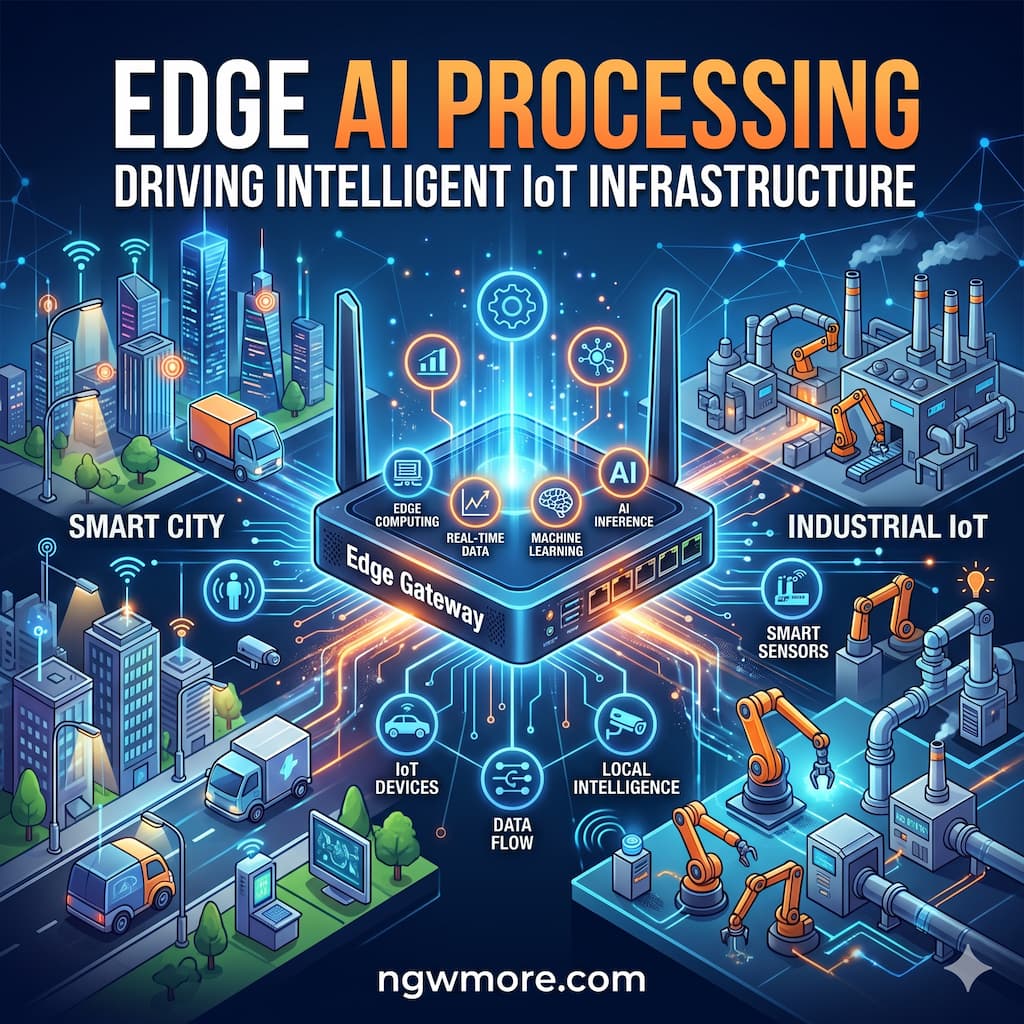
Edge AI Processing: Driving Intelligent IoT Infrastructure
The traditional cloud-centric architecture that has powered the Internet of Things (IoT) for the past decade is hitting a hard physical limitation. In the early days of connected ecosystems, the blueprint was simple: deploy low-cost, relatively “dumb” sensors at the edge, harvest raw environmental or operational data, stream that entire data pipeline over a network, and rely on centralized hyperscale data centers (such as AWS, Google Cloud, or Azure) to execute machine learning inference and analytical processing.
This centralized topology is no longer sustainable. The exponential explosion of high-bandwidth enterprise IoT deployments—such as smart city surveillance networks, autonomous industrial robotics, connected medical arrays, and automated grid infrastructure—is generating petabytes of unstructured telemetry daily.
Streaming this ocean of raw information back to a distant cloud infrastructure introduces structural problems: prohibitive network bandwidth costs, severe latency bottlenecks, dependency on unstable network connections, and systemic cybersecurity vulnerabilities.
[Legacy IoT]:  Raw Data Stream ──(High Bandwidth / High Latency)──> Central Cloud Engine
[Edge AI Compute]: Local Data ──(Microsecond Inference)──> Real-Time Local Automated Action
The solution is a paradigm shift known as Edge AI Processing. By embedding high-performance artificial intelligence accelerators directly into localized edge gateways and IoT endpoint hardware, enterprises can execute complex machine learning inference natively. Data is transformed into actionable intelligence at the exact point of creation.
Here is the definitive architectural and engineering guide to how Edge AI is driving the next generation of intelligent, autonomous IoT infrastructure.
1. The Core Hardware Architecture: Accelerating Edge Inference
Executing deep neural networks (DNNs) on highly constrained edge devices requires a radical departure from standard x86 or ARM CPU processing models. CPUs are optimized for sequential processing. AI inference, however, requires massive parallel matrix multiplication workloads.
To run intelligence locally without melting the thermal budget or draining power grids, modern intelligent IoT infrastructure relies on a specialized class of silicons:
Application-Specific Integrated Circuits (ASICs)
These are custom chips engineered from the ground up for a singular mathematical task: accelerating neural network execution. Prominent examples include Google’s Edge TPU (Tensor Processing Unit) and Hailo’s AI processors. By baking specific matrix-multiplication pipelines directly into the silicon hardware, ASICs deliver staggering Tera-Operations Per Second (TOPS) metrics while consuming mere fractions of a watt.
Neuromorphic Computing & TinyML Microcontrollers
At the extreme edge—such as battery-powered industrial vibration sensors or remote environmental monitors—the infrastructure leverages advanced microcontrollers running TinyML architectures. Emerging neuromorphic processors mimic the biological structure of the human brain’s synapses, firing only when data thresholds change. This architecture enables continuous, on-device AI inference operating within an ultra-low power envelope of less than 1 milliwatt (1 mW).
Field-Programmable Gate Arrays (FPGAs)
For infrastructure environments where AI models must be continuously updated or reconfigured post-deployment (such as aerospace or evolving telecommunication routers), FPGAs provide a programmable silicon fabric. Engineers can rewire the hardware layout at the logic-gate level via software updates, optimizing execution paths for shifting algorithm variations without requiring physical chip replacements.
2. Advanced Software Optimization: Compressing Models for the Edge
You cannot simply take an unoptimized, 100-billion-parameter cloud-hosted Large Language Model or a dense computer vision network and drop it onto an industrial edge gateway. It would instantly trigger memory overflows and stall the device.
To bridge the gap between heavy computational models and resource-constrained edge hardware, AI engineers deploy advanced model compression and optimization frameworks, primarily utilizing compilation engines like Apache TVM, TensorFlow Lite, and ONNX Runtime.
[Dense Cloud Model] ➔ [Quantization / Pruning] ➔ [Edge Compiler (TVM)] ➔ [Optimized Edge Binary]
Post-Training Quantization (PTQ)
Most cloud models are trained using 32-bit floating-point precision to preserve granular mathematical accuracy. Quantization compresses the model by mapping these complex weights down to lower-precision formats, such as 16-bit floats or 8-bit integers. While reducing mathematical precision sounds risky, when implemented correctly, it shrinks the physical model footprint by up to 75% and slashes memory bandwidth requirements, with less than a 1% degradation in real-world inference accuracy.
Structural Pruning and Weight Sparsification
During training, neural networks naturally develop redundant pathways—synapses and neurons that contribute negligibly to the final classification outcome. Structural pruning algorithms systematically scan the trained model, identify these low-utility weight matrices, and delete them entirely from the execution graph. This creates a highly “sparse” model architecture that executes significantly faster on parallel edge processors.
Knowledge Distillation
In this optimization workflow, a large, computationally heavy deep learning model (the “teacher”) is utilized to train a highly compact, stripped-down neural network architecture (the “student”). The student model is algorithmically guided to replicate the behavioral outputs and prediction accuracy of the teacher, packing institutional-grade intelligence into a lightweight software package built specifically for edge deployment.
3. Real-Time Latency and the Autonomy Vector
In critical enterprise IoT infrastructure, latency is not a minor inconvenience; it is a vector that defines operational safety.
Consider an autonomous haulage truck operating in a deep-surface mining pit, or an automated robotic arm performing high-speed precision welding on an automotive assembly line. If a sensor detects an anomaly or a human obstruction, the system cannot afford to wait 200 milliseconds to route video frames over a cellular network to a cloud server, wait for processing, and pull back a command to halt. The latency loop must be measured in single-digit microseconds.
- Step 1: High-Frequency Ingestion (Microseconds) – Edge sensors (LiDAR, high-speed optical cameras, thermal arrays) stream raw telemetry directly into the local processor’s unified memory space.
- Step 2: Local Inference Execution (Sub-10ms) – The optimized neural network running natively on an AI ASIC processes the multi-modal data streams simultaneously.
- Step 3: Anomaly / Object Detection (Instant) – The model identifies a critical parameter breach or spatial hazard with zero reliance on external network validation.
- Step 4: Deterministic Actuation (Microseconds) – The edge gateway bypasses network stack delays, signaling physical machine relays or safety brakes directly via deterministic industrial protocols like EtherCAT or CAN bus.
4. Edge Architecture Blueprint: Centralized vs. Decentralized Intelligence
Deploying Edge AI requires engineering a strategic balance between localized compute nodes and centralized cloud coordination. The relationship between these structural paradigms can be mapped across clear technical vectors:
| Architecture Attribute | Centralized Cloud Framework | Intelligent Edge AI Framework |
| Data Transmission Costs | Prohibitively high; requires continuous streaming of raw telemetry | Ultra-low; only processed anomalous metadata or aggregated summaries leave the site |
| Inference Latency | Variable (50ms – 500ms+); dependent on network jitter and routing | Deterministic (<5ms – 15ms); completely independent of network health |
| Operational Resiliency | Zero; internet outages or cloud downtime completely cripple localized operations | Complete; edge nodes retain full operational autonomy during structural blackouts |
| Data Privacy & Compliance | High risk; sensitive corporate, medical, or civil data crosses public networks | Inherent security; raw biometric, proprietary, or video data never leaves local hardware boundaries |
The Architectural Takeaway: The goal of Edge AI is not to erase the cloud entirely. Instead, it creates an efficient structural equilibrium: the edge handles real-time, instantaneous operational execution and data filtering, while the cloud is preserved for long-term trend analysis, historical data aggregation, and continuous global macro-model retraining.
5. Security, Privacy, and Data Minimization Frameworks
As regulatory bodies globally enforce strict privacy frameworks (such as GDPR, CCPA, and evolving national data security mandates), streaming raw data from physical spaces into cloud systems presents immense legal and financial liabilities. Computer vision is a prime example: streaming video feeds from a smart hospital or an aerospace factory to an external server exposes patient identities and proprietary manufacturing processes to interception risks.
Edge AI establishes an ironclad security architecture through Data Minimization.
Because the neural networks execute locally, a smart security camera can ingest raw video, process it to detect security breaches or evaluate workflow efficiencies, and immediately delete the raw frames from volatile memory. The only information that ever exits the device via the network is an encrypted cryptographic metadata string (e.g., {"event": "unauthorized_entry", "timestamp": 1779732000}). Raw identities, biometric features, and faces are never written to disk or transmitted over the air, structurally neutralizing the threat of cloud intercept hacks or man-in-the-middle network attacks.
6. Distributed Intelligence: Federated Learning at the Edge
One of the historical engineering challenges of Edge AI was training models. If data stays locked on decentralized edge nodes, how does the collective AI model learn from edge experiences to improve over time? The solution is an advanced machine learning architecture called Federated Learning.
[Central Cloud: Master AI Model]
       ▲                 ▲
       │ (Encrypted Model Updates Only)
       │                 │
[Edge Device 1]   [Edge Device 2]  <-- Local Training on Local Raw Data
In a Federated Learning ecosystem, a base model is initialized in the cloud and dispatched to thousands of distributed edge IoT devices (such as a fleet of connected medical imaging machines or smart agricultural tractors). Each individual edge node processes its highly localized real-world data and uses that fresh input to perform a mini-training loop locally.
Crucially, the edge devices do not send that raw data back to the cloud. Instead, they export only their newly updated model weights and gradients via encrypted channels. A centralized orchestration server receives these decentralized model modifications from thousands of units, aggregates them using sophisticated statistical algorithms (like Federated Averaging), and fuses them into a smarter, globally optimized master model.
This master update is then pushed back out to the edge devices over-the-air (OTA). The ecosystem grows collectively smarter every day, while maintaining absolute data sovereignty at every individual endpoint.
7. The Future: Autonomous Infrastructure in the Era of Edge AI
Looking toward the horizon, the marriage of Edge AI processing and IoT infrastructure will lay the foundation for autonomous, self-healing urban and industrial systems.
Self-Optimizing Smart Cities
Future smart grids will not simply report power outages to a central control room. Edge AI microprocessors embedded inside power transformers will analyze phase anomalies in real time, predict localized transformer failures before they happen, and autonomously re-route electrical currents across microgrids to isolate hazards and prevent city-wide blackouts.
Closed-Loop Edge Bio-Arrays
In healthcare, wearable and embedded medical arrays running TinyML will monitor patient biometric telemetry continuously. Rather than waiting for a critical event to alert a remote server, these local devices can execute real-time closed-loop therapeutics—such as micro-adjusting insulin delivery speeds or regulating pacemaker rhythms instantly in direct response to predictive heart-rate variability indicators.
Automated Predictive Logistics
In global supply chains, smart shipping containers equipped with edge computing nodes will autonomously monitor environmental variables, shock factors, and vibration profiles. They will run real-time decay-modeling algorithms for perishable or highly sensitive pharmaceuticals, dynamically interacting with transport networks to request route prioritizations or temperature adjustments on the fly, completely eliminating human operational oversights.
Read More⚡ Generative AI in LegalTech: Transforming Contracts
Conclusion: Engineering the Intelligent Edge
Edge AI Processing represents a fundamental technological evolution in the topology of enterprise computing. By transforming IoT endpoints from passive, network-dependent data harvesters into self-contained, highly accelerated analytical engines, companies can achieve unprecedented levels of execution speed, operational resiliency, data privacy, and structural cost efficiency.
As specialized silicon continues to scale down in cost and power usage while scaling up in computational throughput, the enterprise competitive arena will inevitably move to the edge. The companies, infrastructure developers, and system architects who build their ecosystems on decentralized, real-time intelligence will not just optimize their daily workflows—they will lead the deployment of the self-contained, intelligent infrastructure systems defining the global digital economy.
For regular research papers, enterprise technology blueprints, and technical breakdowns of cloud-to-edge engineering architectures, visit ngwmore.com.