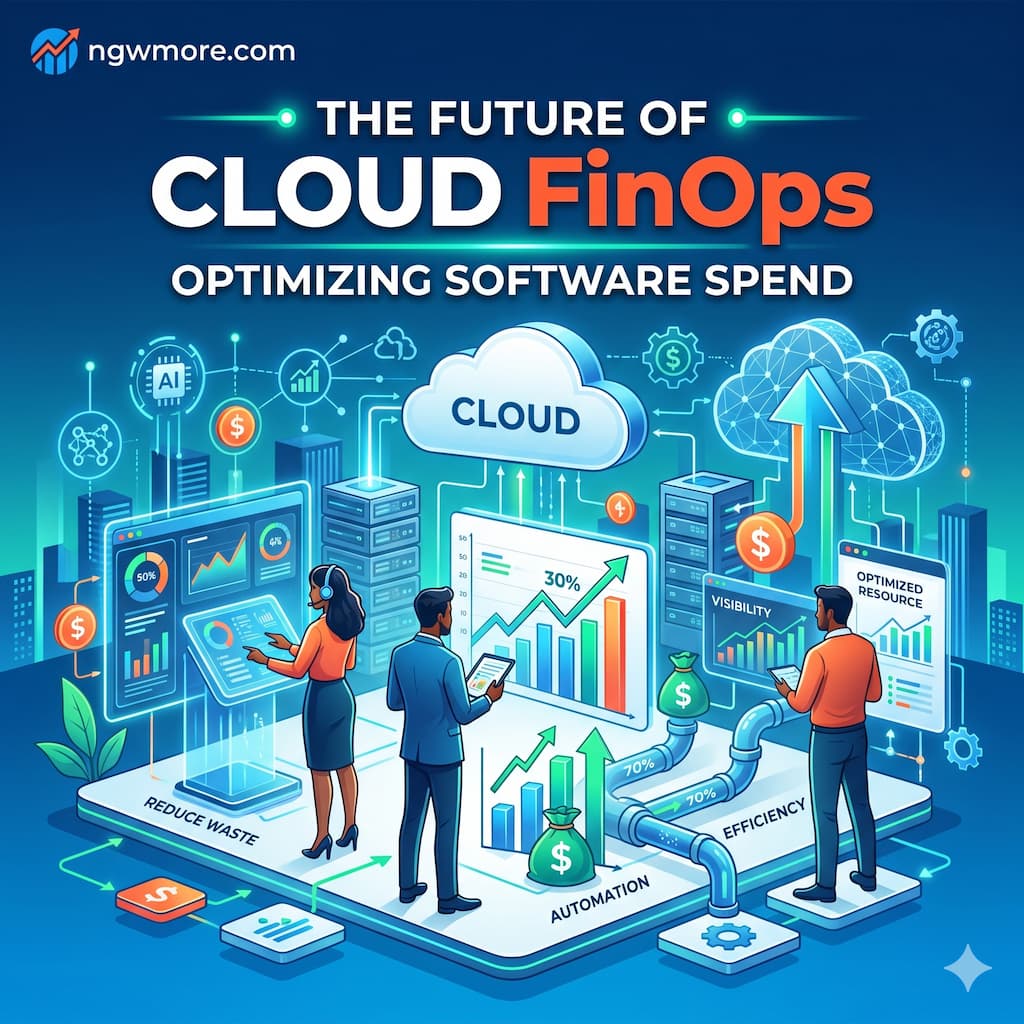
The Future of Cloud FinOps: Optimizing Software Spend
The economics of cloud computing have broken their architectural boundary. As we pilot our enterprises through May 2026, the era of unconstrained, growth-at-all-costs infrastructure scaling has officially ended. Over the past several years, the global shift toward containerized microservices, multi-region database replication, large language model (LLM) fine-tuning loops, and autonomous multi-agent pipelines has yielded unprecedented computing power. However, it has simultaneously introduced an unsustainable corporate liability: algorithmic cloud bill inflation.
For too long, engineering organizations treated cloud scaling as a purely technical challenge. If a production environment encountered a performance bottleneck or processing spike, the default solution was to dynamically provision more virtual instances, expand memory allocation tiers, or scale out storage boundaries. Because this auto-scaling infrastructure operated far removed from financial treasury oversight, companies routinely woke up to catastrophic, multi-six-figure cloud expenditure surges.
For the digital entrepreneurs, web platform leads, and cloud architects anchoring their footprints to the insights of the ngwmore.com ecosystem, capital efficiency is an absolute core philosophy. We design server systems on networks like ngwhost.com to eliminate computational latency, remove processing choke points, and maximize throughput workloads.
Applying this exact same engineering discipline to your financial infrastructure requires a total transition from primitive, retrospective budget tracking to a fully unified, predictive, and software-driven operations matrix: Modern Cloud Financial Operations (FinOps).
      THE 2026 CLOUD FINOPS INTEGRATION FRAMEWORK
┌─────────────────────────────────────────────────────────┐
│     CONTINUOUS MULTI-CLOUD TELEMETRY INGESTION          │
│   (AWS CloudWatch, Google Cloud Monitoring, Azure Monitor)│
└────────────────────────────┬────────────────────────────┘
                             │
                             ▼
┌─────────────────────────────────────────────────────────┐
│           COGNITIVE FINOPS ORCHESTRATION ENGINE         │
│  * Automated Unit Economic Mapping ($ per Active User)  │
│  * Sub-Millisecond Server Right-Sizing & Dormancy Isolation│
│  * Programmatic Commitments & Spot Instance Swaps       │
└────────────────────────────┬────────────────────────────┘
                             │
                             ▼
┌─────────────────────────────────────────────────────────┐
│      MAXIMIZED MARGIN EXTRACTION & RUNWAY ELONGATION     │
└─────────────────────────────────────────────────────────┘
By bringing advanced data liquidity and predictive automation directly onto your infrastructure ledger, cloud expenditure transitions from an unpredictable overhead threat into a highly optimized, fully programmable asset. This comprehensive 2026 intelligence brief delivers a deep technical breakdown of the modern FinOps stack, details advanced architectural rightsizing strategies, and provides an actionable operational roadmap to maximize your platform’s margins while scaling infrastructure velocity exponentially.
1. The 2026 Financial Metamorphosis: From Retrospective to Agentic Real-Time FinOps
To successfully deploy a FinOps framework within a scaling technology enterprise today, you must first dismantle outdated assumptions regarding cloud cost optimization. The alignment of infrastructure performance and corporate financial metrics can be mapped across three distinct structural generations:
- The Post-Mortem Spreadsheet Era (The Past): Retrospective cost tracking. At the end of every calendar month, an accounting associate downloaded a massive, convoluted CSV invoice from a cloud service provider (CSP). The team manually categorized line items over several days, searching for historic waste patterns. By the time a cost discrepancy was isolated, the underlying capital drag had already compromised the company’s operating margin for weeks.
- The Cloud Cost Dashboard Era (The Transition): Passive monitoring tools. Platforms introduced cloud cost management software (such as Cloudability or Vantage) that ingested cost telemetry via read-only APIs, displaying interactive charts and alerting engineering leads when expenditures exceeded a predefined threshold. While powerful, this era remained fundamentally passive, requiring manual human review to approve architectural updates and implement rightsizing recommendations.
- The Agentic FinOps Era (2026): The current global benchmark. Cloud optimization operates as an Autonomous, Event-Driven Financial Core. Powered by advanced reasoning engines natively linked to infrastructure infrastructure as code (IaC) files and cloud billing APIs, the system does not wait for human intervention. It continuously parses live operational telemetry, automatically models unit economics down to specific feature API calls, and programmatically rewrites infrastructure configurations in real-time to maintain absolute financial health.
According to global cloud allocation data recorded this quarter, technology enterprises utilizing fully integrated agentic FinOps architectures experience an average 35% reduction in wasted cloud compute capacity and expand their net trailing margins by over 18%, completely outperforming competitors who rely on disconnected, human-monitored optimization routines.
2. Core Pillars of the 2026 Cloud FinOps Architecture
Scaling a borderless digital platform while protecting your company’s balance sheet requires integrating four foundational technological pillars directly into your platform’s financial and system architectures.
I. Granular Unit Economic Allocation and Telemetry Ingestion
Traditional cloud accounting fails because it reports costs in aggregate—telling a CFO how much a cluster cost in total, but completely hiding the underlying feature profitability. Modern FinOps solves this by establishing strict Unit Economic Architecture.
- The Technical Execution: By tying cloud billing pipelines directly to active customer telemetry (utilizing tracing tools like OpenTelemetry linked to your central data lake), the AI maps the exact computing cost of individual actions—calculating the exact cloud cost to support a singular active user session, process an invoice, or run a database query.
- The Strategic Unlock: This granularity allows product directors to understand the true margins of specific customer tiers or platform features, allowing them to adjust pricing models dynamically before infrastructure drag can trigger cash-flow deficits.
II. Sub-Millisecond Autonomous Server Right-Sizing and Dormancy Isolation
One of the most profound drivers of cloud expenditure waste is the presence of over-provisioned and completely dormant virtual computing units.
- The System Blind Spot: Engineering teams frequently spin up massive, memory-heavy staging clusters or experimental sandbox environments to test a new product launch, then neglect to de-provision the infrastructure when the sprint finishes.
- The Automated Mitigation: 2026 FinOps platforms run continuous, ambient capacity sensing. The AI monitors real-time CPU utilization patterns, memory IOPS, and network traffic. If a container or instance cluster drops below a 5% utilization threshold for more than 48 hours, the agentic engine automatically executes an automated infrastructure update—safely snapshotting the data state, tearing down the idle resources, or migrating the processing workloads to highly optimized, lower-cost burstable instances without manual technician intervention.
III. Algorithmic Commitment Management and Spot Instance Swaps
Cloud service providers reward long-term financial predictability by offering deep discounts (up to 72%) through Savings Plans and Reserved Instances (RIs) in exchange for a committed level of computing usage over a 1-to-3-year horizon. However, manually predicting these commitments across a dynamic, fast-changing startup environment presents an immense quantitative risk.
- The Quant Engine: Modern FinOps infrastructures deploy Continuous Portfolio Rebalancing Algorithms.
- The Performance Optimization: The software continuously evaluates your multi-cloud compute footprint. It automatically handles the buying, selling, and swapping of partial reserved instance positions on secondary provider marketplaces to match live application demands. Concurrently, for non-critical, fault-tolerant background workloads (such as analytical data batching or media rendering pipelines), the AI programmatically bids on spot instance markets, capturing extreme cost discounts on underutilized cloud capacity while maintaining structural safety nets.
IV. Continuous Infrastructure as Code (IaC) Financial Linting
Waiting for resources to be deployed to live production servers to discover that a configuration is financially unoptimized introduces unnecessary capital drain to your scaleup.
- The Upstream Guard: Modern technical architectures integrate FinOps tracking straight into the developer’s deployment pipeline via IaC Financial Linting Hooks.
- The Action: The second an engineer commits an infrastructure modification script (such as a Terraform or AWS CloudFormation file) to the code repository, the FinOps agent automatically scans the file. It reverse-engineers the resource parameters, calculates the direct trailing cost impact against your corporate budget matrices, and attaches an automated financial analysis to the pull request. If the code introduces a non-compliant or un-optimized cost spike, the system blocks the deployment pipeline until an infrastructure lead authorizes the operational variance.
3. The 2026 FinOps Software Plane: Elite Cloud Optimization Tools
Transforming your cloud footprint from an unmonitored cost-center into an agile, highly predictable competitive moat requires connecting your container and billing pipelines to context-aware management software. The 2026 landscape features elite optimization platforms:
| Platform Category | Leading 2026 Platforms | Core Portfolio Utility | Standout Engineering Advantage |
| Agentic Cloud FinOps | Vantage / Kubecost Enterprise / Anodot | Multi-cloud cost allocation, Kubernetes micro-pod tracking, & real-time anomaly discovery | Sub-Second Anomaly Isolation: Programmatically alerts engineers to unexpected runtime spend surges within minutes of an occurrence. |
| Infrastructure Orchestration | Terraform Cloud / Pulumi Business | Cloud state mapping, automated policy enforcement, & IaC linting | Policy-as-Code Enclaves: Enforces rigid corporate financial boundaries directly at the repository deployment phase. |
| FinOps native Cloud Hubs | Cast AI / Spot by NetApp | Automated Kubernetes autoscaling, spot instance swapping, & rightsizing | Continuous Autopilot Execution: Autonomously restructures active cluster sizes live in production with zero downtime. |
4. Tactical Blueprint: Executing an Optimized Software Spend Strategy
Transitioning your technology organization away from reactive financial analysis and constructing an automated, data-driven cloud FinOps engine requires a systematic, architecturally sound roadmap.
Step 1: Maximize End-to-End Multi-Cloud Ingestion Liquidity
An advanced optimization engine’s financial precision is fundamentally bounded by the visibility and completeness of its input telemetry streams. You must eliminate your data silos. Establish direct API connections and real-time open-telemetry webhooks connecting your primary cloud billing consoles (AWS CUR, Google Cloud Billing Export), container orchestration planes (Kubernetes, Amazon EKS), application monitoring dashboards (Datadog, New Relic), and primary database logs into a centralized, highly secure Unified Infrastructure and Financial Data Lake. This provides your FinOps models with an unobstructed, 360-degree stream of truth representing your true computing realities.
Step 2: Establish an Active, Shared Cloud Unit Economics Matrix
Do not allow your development teams to operate in total isolation from the financial consequences of their code designs. Implement a structured Shared Unit Economics Framework within your regular engineering sprint reviews.
Configure your tracking dashboards to translate raw, abstract server nomenclature into recognizable corporate business markers. Instead of showing an engineer a chart detailing “Amazon EC2 m6i.4xlarge compute hour consumption values,” present them with metrics showing the exact “Cloud infrastructure spend per active application check-out transaction.” By aligning engineering goals directly with core business margins, you cultivate an internal culture of natural financial accountability and highly disciplined software design.
                    [Raw Infrastructure Cost Telemetry]
                                    │
                                    ▼
                    ┌──────────────────────────────┐
                    │   FinOps Transmutation Layer │
                    └───────────────┬──────────────┘
                                    │
           ┌────────────────────────┴────────────────────────┐
           ▼                                                 ▼
┌──────────────────────────────┐                  ┌──────────────────────────────┐
│  Outdated Engineering View   │                  │   Modern Business Outcome    │
├──────────────────────────────┤                  ├──────────────────────────────┤
│ "Amazon EC2 m6i.4xlarge      │                  │ "Cloud infrastructure spend  │
│  compute hour consumption"   │                  │  per active user checkout"   │
└──────────────────────────────┘                  └──────────────────────────────┘
Step 3: Implement Zero-Trust Automated Scaling and Cost Guardrails
As your FinOps optimization loops transition into automated execution phases, protecting your platform’s operational availability from over-aggressive cost-cutting parameters becomes an absolute priority. Enforce strict Zero-Trust Infrastructure Safeguards:
- Set up hard horizontal and vertical auto-scaling ceilings within your container clusters to guarantee that a sudden, viral retail traffic spike can always access the necessary computing resources, completely unencumbered by cost-saving rules.
- Mandate multi-signature cryptographic authorization tokens for any automated script attempt to modify or shut down high-priority production database clusters.
- Maintain a secure, segregated infrastructure buffer layer on reliable hosting arrays like ngwhost.com to guarantee that your core, non-negotiable consumer-facing applications remain 100% stable independent of background microservices optimization experiments.
5. Critical Risk Management: Navigating the 2026 FinOps Pitfalls
Operating a highly automated, software-driven corporate capital stack requires a highly defensive risk-management posture to insulate your enterprise from severe downside traps:
- The Hazard of the Over-Optimization Service Crash: If an autonomous FinOps model is calibrated with overly aggressive, non-linear capital-saving parameters, it can programmatically compress server container allocations too tight during periods of quiet traffic. If your application encounters an unpredicted, high-velocity API transaction surge immediately following a down-scaling event, the restricted container layer can experience sudden resource exhaustion, leading to cascading software drops and catastrophic user churn. Cost optimization must always prioritize systemic platform stability over raw margin percentages.
- Navigating the Hidden Costs of Multi-Cloud Data Egress: In an effort to dodge vendor lock-in and optimize resource costs across multiple alternative provider platforms, companies frequently spread their processing workloads across independent cloud ecosystems (e.g., running analytics on Google Cloud while maintaining core transactional databases on AWS). However, routing massive, multi-terabyte files continuously across separate cloud perimeters triggers intense, non-linear Data Egress Fees. A strategy designed to capture minor compute savings can accidentally generate a massive net deficit on your monthly billing lines. Meticulously architecture your cross-cloud routing to minimize data travel.
- The Danger of Disregarding Hidden SaaS Subscription Lock-Ins: While optimization attention is naturally dominated by massive infrastructure giants like AWS or Microsoft Azure, scaling technology tech brands frequently hemorrhage massive capital through unmonitored, overlapping SaaS application subscription seats. A startup can easily find itself carrying thousands of automated monthly user licenses for developer platforms, security monitoring hubs, and marketing trackers that ex-employees abandoned months ago. Your financial team must run automated monthly identity audits to instantly de-provision orphaned software seats, keeping your operational perimeter completely lean.
6. The Systems Synergy: Building High-Availability Financial Networks
For the advanced cloud systems developers, full-stack database architects, and technology visionaries who anchor their platforms and enterprise applications to the ngwmore.com ecosystem, the structural design of an integrated cloud FinOps architecture is deeply intuitive.
When you configure an enterprise server topology, scale an international web layout, or manage a high-traffic database network on ngwhost.com, you do not tolerate single points of failure. You don’t leave your system architecture vulnerable to an isolated computing crash, a localized network drop, or an un-monitored processing leak. You design with comprehensive, mathematical redundancy: you utilize load balancers to distribute database traffic smoothly, deploy isolated container instances across multiple geographic data zones to handle processing spikes effortlessly, and maintain secure, multi-region database mirrors to ensure that if a critical server cluster drops offline, the broader network continues to perform flawlessly without data loss or asset corruption.
Deploying an integrated Cloud FinOps Optimization Architecture is simply extending that exact same systemic, multi-layered structural redundancy to your company’s balance sheet and financial capital stacks:
- Your In-Line Unit Economic Trackors and IaC Financial Linting Hooks operate as your high-velocity edge nodes, parsing, filtering, and optimizing incoming resource configurations with absolute fluid precision before cost leaks can manifest.
- Your Algorithmic Commitment Portfolio Managers and Multi-Cloud Telemetry Data Lakes act as your resilient core database systems, instantly compounding, rebalancing, and protecting your active capital reserves, completely insulated from human operational latency or individual forecasting blind spots.
- Your Zero-Trust Scaling Ceilings and High-Availability Hosting Buffers behave as your secure, enterprise-grade system firewalls, silently optimizing your operating margins, shielding your digital brand from performance degradations, and ensuring absolute corporate velocity against changing global macroeconomic demands.
By mastering this integrated configuration, you strip away balance sheet vulnerabilities, eliminate structural cash drag, and position your digital brand to scale at terminal velocity while retaining absolute, sovereign control over the global enterprise you built.
Read More⚡ AI-Powered Predictive Analytics for Supply Chain Scale
Conclusion: Securing the Capital Efficiency Victory
The era of passive financial tracking and bloated cloud allocations has run its course. In a hyper-competitive global marketplace defined by rapid technological adaptation and instant corporate fulfillment requirements, forcing your scaling technology brand to rely on click-by-click manual invoice sorting and historical infrastructure guessing games is a recipe for operational failure and margin erosion.
The path to sustainable enterprise scalability requires an absolute embrace of autonomous, predictive, and data-liquid software architecture applied directly to your cloud infrastructure ledger. By unifying your multi-source billing and performance feeds via high-performance cloud data lakes, linking your optimization telemetry directly into your repository pipeline cores, enforcing rigorous project-level unit economic tracking, and prioritizing multi-model strategic backtesting, you completely remove risk, friction, and human operational latency from your financial expansion loops entirely.
The digital assets of the global economy are scaling at an unprecedented pace. Build your financial perimeter with absolute architectural precision, protect your cap table fiercely, and let your enterprise scale to global heights on your own terms.