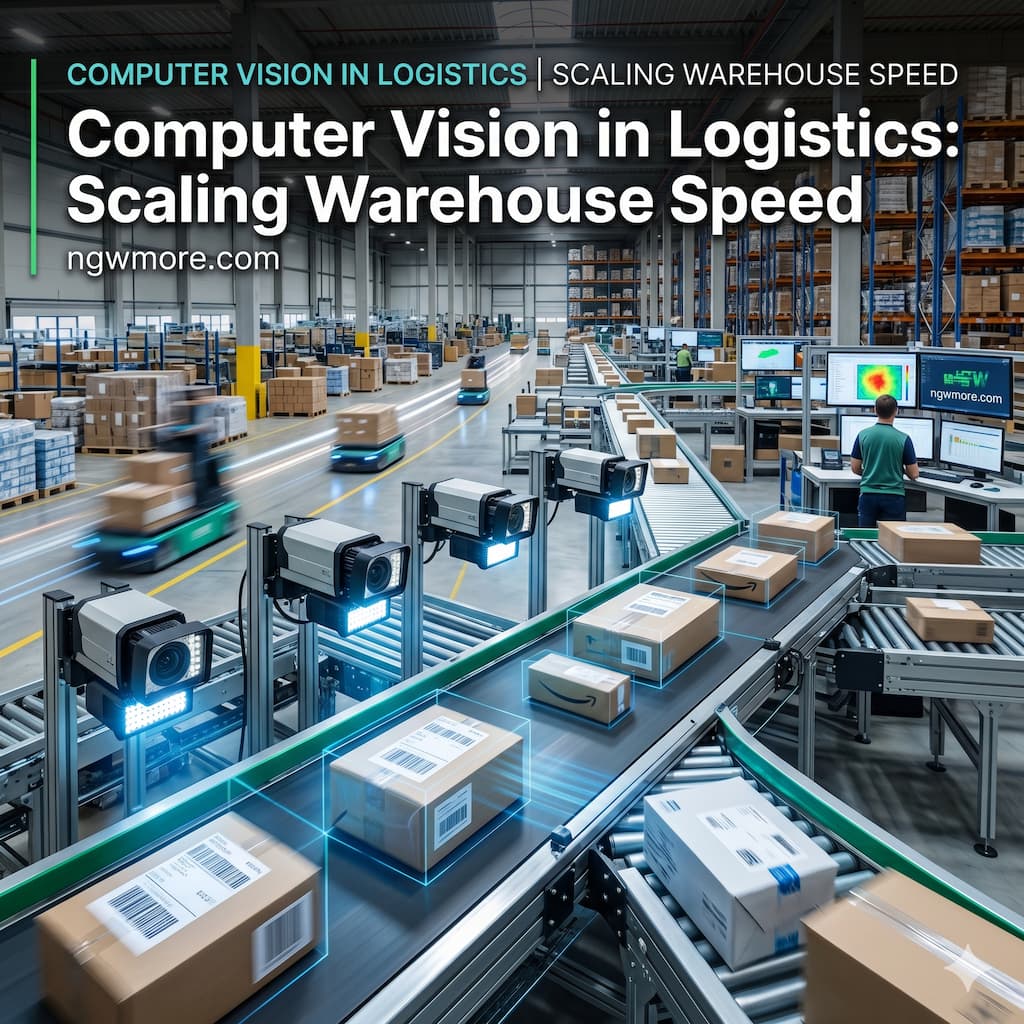
Computer Vision in Logistics: Scaling Warehouse Speed
The global supply chain matrix has collided with an absolute efficiency mandate. As we race through May 2026, logistics networks, fulfillment hubs, and international e-commerce ecosystems are facing unprecedented throughput pressures. The historic model of warehouse management—defined by manual barcode scanning, paper-trail inventory verification, human-driven quality audits, and episodic physical audits—has become a catastrophic operational bottleneck. In a globalized digital marketplace where customer expectations are measured in sub-hour delivery loops, processing delays are no longer just inefficiencies; they are direct threats to enterprise survival.
Historically, automating warehouse floor velocity meant investing tens of millions of dollars into rigid, heavy physical automation infrastructure—such as massive conveyor sorters, fixed automated storage and retrieval systems (AS/RS), and sprawling robotic tracking frameworks. For many mid-sized enterprises, fast-growing digital agencies, and agile e-commerce brands, the sheer capital expenditure and structural inflexibility of these systems made them an impossibility.
In 2026, the paradigm has shifted permanently. The solution driving modern supply-chain acceleration is the transition from blind physical sorting to Intelligent, Spatial Edge Sensing. Powered by advanced neural networks, high-density edge computing hardware, and real-time open spatial video meshes, businesses are building automated logistics networks. Modern fulfillment centers are deploying Autonomous Computer Vision Systems that transform standard, low-cost security camera networks into real-time operational processing layers, allowing facilities to track 100% of inventory movements, instantly eliminate sorting errors, and scale warehouse velocity exponentially with zero human data entry.
1. The 2026 Spatial Evolution: From Passive Scanning to Ambient Intelligence
To successfully exploit the power of computer vision in logistics today, you must first dismantle the concept of traditional, linear tracking. The evolution of inventory monitoring across fulfillment environments can be categorized into three distinct structural waves:
- The Barcode and RFID Era (The Past): The era of localized manual input. Every product movement required a physical human operator to stand over an item, position a laser gun or handheld terminal over a printed code, and trigger a scan pulse. If a barcode was smudged, torn, or facing the wrong directional angle, the pipeline stalled, forcing manual overrides and data tracking lag.
- The Static Sensor Era (The Transition): Fixed portal arrays. Facilities positioned high-cost industrial cameras or RFID gates over dedicated choke points along internal conveyor layouts. While this automated tracking at specific intersections, the system remained completely space-blind—the moment a pallet left the rigid conveyor track and was picked up by a forklift operator, the tracking stream went dark until the item arrived at the final shipping bay.
- The Ambient Spatial Era (2026): The current global benchmark. Warehouses operate on a Continuous Spatial Knowledge Mesh. Powered by multimodal vision-language-action (VLA) models running natively on decentralized edge computing nodes, the environment itself continuously processes reality. The system tracks every product, pallet, forklift, and parcel from the sub-second it exits the delivery truck, tracing its precise geometric location through 3D warehouse airspace without requiring a single manual barcode scan event.
  LEGACY WAREHOUSE INGEST (Manual & Linear)
  [Pallet Arrives] ──► [Manual Clipboard Audit] ──► [Handheld Barcode Scan] ──► [Delayed Database Update]

  2026 COMPUTER VISION GRID (Ambient & Continuous)
  [Continuous Video Stream Ingestion]
                │
                ▼
   ┌────────────────────────────────────────┐
   │    Autonomous Spatial Vision Core      │ ──► [Instant Dynamic Dimensioning & Volumetrics]
   ├────────────────────────────────────────┤
   │ * Multi-Camera Real-Time Object Sync   │ ──► [Automatic Predictive Put-Away Routing]
   │ * Ambient Label & Damage Assessment    │ ──► [Self-Correcting Algorithmic Inventory Logs]
   └────────────────────────────────────────┘
According to comprehensive 2026 global supply chain automation data, the market deployment for enterprise computer vision systems has scaled exponentially to become a baseline operational framework for modern logistics infrastructure. Leading facilities report that moving from manual data inputs to spatial edge sensing allows handling docks to double their hourly processing velocity while eliminating inventory tracking shrinkage errors completely.
2. Core Pillars of the 2026 Warehouse Vision Architecture
Constructing a self-directed, un-hackable spatial logistics sensing engine requires integrating four foundational technological layers into your enterprise operations stack.
I. Real-Time Multi-Camera Object Tracking and Hand-off Logic
A single camera view is inherently limited by physical line-of-sight constraints. If a package passes behind a structural support column or is temporarily blocked by a forklift, a single-camera tracking model loses the target’s identity, corrupting the inventory ledger.
- The 2026 Solution: Modern vision platforms utilize Multi-Camera Re-Identification (Re-ID) Graph Networks.
- The Execution: As a parcel or pallet moves through your facility, individual video nodes extract unique geometric signature hashes, color profiles, structural text stamps, and tracking paths. The system passes these spatial tokens smoothly across adjacent cameras via decentralized hand-off logic. Even if an item is moved across thousands of square feet of warehouse floor space, split among different picking carts, or relocated to dark storage tiers, the AI retains its absolute structural identity without relying on localized battery-draining physical tracking devices.
II. Automated Dynamic Dimensioning and Volumetric Analysis
Traditional cargo profiling requires packages to pass through heavy mechanical scaling portals or undergo manual measurement grids to verify spatial weights and volumes before loading onto outbound vehicles.
- The Vision Alternative: In 2026, inline camera modules execute Instant Volumetric Profiling. As parcels move at high speeds down any standard picking line, the AI tracks the package contours in three dimensions simultaneously.
- The Optimization Output: The algorithm calculates the precise length, width, height, and surface volume metrics of every unit instantly within a sub-millisecond inference window. The platform cross-references this dimensional profile against available outbound shipping container volumes and courier rate brackets, optimizing vehicle payload placement and completely preventing unexpected dimensional-weight billing adjustments from international shipping lines.
III. Ambient Label OCR Parsing and Real-Time Damage Assessment
High-velocity incoming inventory sorting is regularly choked by processing anomalies—such as wrinkled labels, misprinted destination codes, or structural transit damage to the exterior shipping containers.
- The Cognitive Audit: 2026 spatial systems run continuous, multimodal quality checks. As an item passes through the receiving bay, the AI reads multi-language handwritten scripts, parses crumpled shipping labels using advanced optical character recognition (OCR), and cross-references the invoice tracking parameters against the central ERP ledger.
- The Damage Trap: Concurrently, the neural network analyzes the container surface for tears, crushing, leaks, or punctures. If a defect is isolated, the system instantly logs a visual proof artifact, tags the specific supplier profile, puts a temporary hold on the receipt ledger, and routes the damaged parcel to a QA lane before it can pollute deep storage locations.
IV. Ergonomic Safety Monitoring and Hazard Isolation
Scaling warehouse processing speeds must never come at the expense of human physical safety. Vision infrastructures function as a real-time, ambient safety shield for your frontline operational personnel.
- The Behavioral Guard: The edge neural networks continuously audit spatial interactions between heavy machinery and warehouse team members. The AI monitors forklift velocities, identifies if operators are driving with elevated payloads, and instantly flags blind-spot proximity risks.
- The Intervention: If an associate enters an active machinery corridor without mandatory high-visibility clothing, or if an ergonomic tracking layer spots an individual executing improper, high-risk heavy lifting postures, the system triggers real-time localized audio warnings or autonomously halts the approaching equipment before a physical workplace injury can occur.
3. The 2026 Logistics Vision Stack: Enterprise Engines to Know
Transforming your logistics layer from an opaque, manual cost-center into an agile, predictive competitive advantage requires connecting your camera infrastructures to context-aware spatial software. The current 2026 landscape features highly specialized tools:
| Platform Category | Leading 2026 Platforms | Core Portfolio Utility | Standout Vision Advantage |
| Spatial Warehouse Intelligence | Vimaan / Covariant.ai | Autonomous inventory counting, slotting verification, & pallet auditing | 99.9% Inventory Precision: Autonomously audits miles of deep industrial warehouse racks using drone or forklift-mounted vision modules. |
| Edge Hardware Infrastructure | NVIDIA Jetson Thor / Intel Geti | Processing multi-stream video lines at extreme low-latencies natively on the floor | Localized Inference Core: Executes deep neural network computations directly at the camera node without cloud data round-trips. |
| Enterprise Operations Matrix | Palantir Foundry / Manhattan Active WMS | Supply chain mapping, picking orchestration, & predictive fulfillment loops | Ontological Integration: Unifies real-world spatial vision data points seamlessly with existing enterprise resource databases. |
4. Tactical Roadmap: Operationalizing Spatial Computer Vision
Transitioning a logistics organization away from manual barcode habits and constructing a fully automated, vision-driven warehouse acceleration engine requires a systematic, architecturally sound blueprint.
Step 1: Maximize On-Premises Network Liquidity and Standardize Edge Power
An autonomous computer vision system’s analytical capacity is fundamentally bounded by the resolution and processing speed of its video pipelines. Before deploying tracking algorithms, you must eliminate localized network latency bottlenecks. Upgrade your facility’s camera arrays to high-definition IP camera nodes positioned at sweeping, unobstructed vantage points over receiving, slotting, picking, and dispatch lines. Route these feeds straight into localized, ruggedized edge computing servers equipped with modern tensor-processing accelerators. This allows your models to execute deep spatial analysis directly on-site, isolating your core tracking logic from external cloud internet connection drops.
Step 2: Establish the “Vision-to-WMS” API Orchestration Bridge
Do not allow your computer vision data to sit isolated inside an independent surveillance monitoring dashboard. Link your vision processing engine directly into your primary Warehouse Management System (WMS) and enterprise ERP software via ultra-fast, low-latency API webhooks. Configure your workflow parameters so that the moment the spatial cameras track a forklift placing a pallet onto a specific high-tier rack, the system autonomously triggers a database update event, instantly logging the precise slotting coordinate without requiring the operator to touch an input console.
[Pallet Set onto Storage Rack] ──► [Edge Camera Registers Spatial Coordinates] ──► [AI Instantly Solves Item ID & Slotting Location] ──► [WMS Ledger Automates Update Event]
Step 3: Implement Zero-Trust Identity Guardrails and Anonymization
Because a high-performance computer vision system requires scanning continuous video streams across your entire operational surface, maintaining strict adherence to employee data privacy regulations and international labor compliance codes is an absolute requirement.
- The Privacy Shield: Configure your spatial ingestion layers to execute Real-Time Edge Blur Anonymization.
- The Separation: The neural networks should convert human forms into stylized skeletal spatial nodes or anonymized vector bounding blocks. The system evaluates pure spatial trajectories, behavioral safety compliance, and package handling velocities while completely stripping out personal facial features and non-essential biometric data, cultivating a high-trust workspace focused strictly on systemic efficiency.
5. Critical Risk Management: Navigating the Spatial Pitfalls
Scaling an operational infrastructure with autonomous spatial software requires continuous, data-backed governance to protect your enterprise from unique physical and digital vulnerabilities:
- The Hazard of Occular Occlusion and Visual Blind Spots: No matter how advanced a neural network is, it cannot track what it cannot physically see. If a facility’s lighting profiles are uneven, or if loose packaging materials, hanging banners, or massive stacked equipment lines obstruct camera viewpoints, tracking gaps will emerge, resulting in phantom inventory allocations. Engineering teams must run weekly camera calibration sweeps and enforce strict floor cleanliness guidelines to keep visual corridors completely clear.
- The Vulnerability of Physical Label Adversarial Attacks: As digital logistics networks increasingly rely on automated vision to parse outbound destinations, security leads must guard against real-world data corruption tactics. Malicious actors or fraudulent shipping operations can print specialized, high-contrast adversarial patterns onto packaging surfaces. These visual exploits are designed to confuse character recognition models, tricking your sorting mechanisms into routing high-value items to incorrect geographic addresses. Implement rigorous multi-factor verification checks.
- Managing Model Degradation and Camera Drift: Over months of heavy industrial warehouse operations, persistent building vibrations from heavy heavy machinery, structural dust settlement on lens covers, and slight physical camera shifts can cause subtle alignment variations. This physical drift can compromise the pixel-to-coordinate tracking math of your spatial engines. Your technical operations team must execute automated nightly software re-indexing routines to verify that your camera nodes maintain absolute spatial alignment with your real-world floor maps.
6. The Digital Synergy: The ngwmore.com Competitive Architecture
For the advanced full-stack systems developers, infrastructure engineers, and digital growth strategists who anchor their brand footprints to the insights of ngwmore.com, the implementation of computer vision in logistics is a natural extension of software engineering best practices.
When you architect a high-performance cloud application network or an international server cluster on ngwhost.com, you do not rely on slow, manual human checks to verify if data packets are moving safely between routing targets. You implement automated logging scripts, set up continuous telemetry monitors, and configure real-time exception catchers to isolate and eliminate performance drops long before they disrupt client execution layers.
Applying autonomous computer vision to your warehouse floor operations is simply extending that exact same continuous, high-velocity network packet tracking to physical real-world assets:
- Your Inbound Edge Cameras and Instant OCR Scanners operate as your high-velocity edge nodes, parsing and filtering raw incoming data streams with absolute fluid precision.
- Your Multi-Camera Graph Re-Identification Networks act as your resilient, distributed database systems, maintaining absolute transactional state integrity across thousands of moving variables without data loss.
- Your Automated Volumetric Analyzers and Real-Time Safety Monitors behave as your secure, enterprise-grade system firewalls, silently optimizing your operating margins, shielding your physical infrastructure from throughput bottlenecks, and ensuring absolute operational defensibility against market demands.
By mastering this integrated physical-to-digital configuration, you strip away operational tracking drag, eliminate warehouse human infrastructure vulnerabilities, and position your brand to scale at terminal velocity while retaining absolute, sovereign control over the global enterprise you built.
Read More⚡ AI Customer Onboarding: Scaling User Acquisition 2026
Conclusion: Securing the Fulfillment Victory
The era of manual barcode scanning has run its course. In a hyper-competitive global marketplace defined by relentless speed and instant customer fulfillment requirements, forcing modern logistics personnel to rely on click-by-click manual data entry is a recipe for operational failure and margin erosion.
The path to sustainable supply chain scalability requires an absolute embrace of autonomous, edge-computed spatial design. By unifying your video feeds via high-performance edge computing nodes, linking your vision telemetry directly into your central WMS core, enforcing rigorous data anonymization protocols, and prioritizing continuous structural calibration, you remove risk, friction, and human data latency from your operational expansion loops entirely.
The physical assets of the global digital economy are moving at unprecedented velocities. Is your fulfillment architecture engineered to track them at the speed of thought?