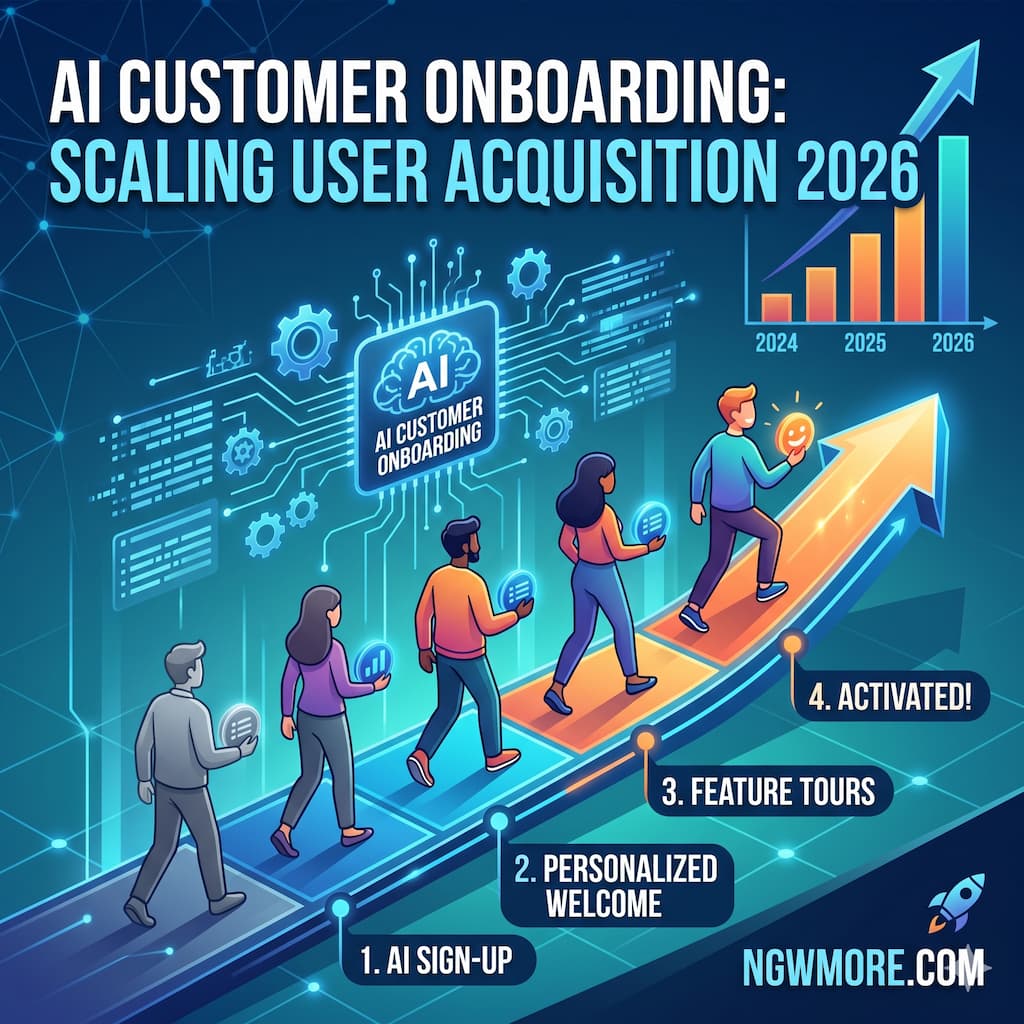
AI Customer Onboarding: Scaling User Acquisition 2026
The economics of user acquisition have undergone a brutal paradigm shift. As we navigate through May 2026, the traditional growth-hacking playbooks of the early 2020s have hit an absolute wall. Skyrocketing ad costs across digital ad networks, coupled with heightened consumer privacy frameworks, mean that getting a user to visit your storefront, click a landing page, or sign up for a trial account has never been more expensive.
Yet, the most significant threat to corporate growth isn’t top-of-funnel acquisition cost—it is activation latency.
Historically, companies spent millions driving traffic to their platforms, only to lose up to 70% of those newly acquired users during the initial onboarding sequence. Complex setups, long form fields, confusing user interfaces, and generic, linear tutorials create immediate cognitive friction. In a digital economy where attention spans are measured in milliseconds, if a user does not experience the core value of your product—the definitive “Aha! moment”—during their very first session, they churn permanently.
For the digital entrepreneurs, SaaS founders, and e-commerce growth strategists within the ngwmore.com community, speed to value is the ultimate variable for scaling enterprise metrics. The solution driving modern growth is the transition from rigid, static setups to AI-Powered Customer Onboarding.
By deploying Agentic Onboarding Pipelines, modern enterprises are achieving what was previously impossible: automating user onboarding at a massive scale while delivering completely individualized, dynamic, and hyper-personalized customer experiences that compress time-to-value (TTV) to near zero, boost product adoption by over 45%, and turn cold sign-ups into long-term brand advocates.
1. The 2026 Shift: From Static Flows to Adaptive UX
To successfully scale user activation today, you must dismantle the concept of the standard, one-size-fits-all onboarding sequence. The evolution of digital onboarding can be mapped across three distinct generations:
- The Linear Era (The Past): The traditional welcome wizard. Every single user, regardless of their industry, technical proficiency, or specific business goals, was forced through the exact same sequence of generic tooltip bubbles and tutorial videos. This rigid framework actively causes user drop-off.
- The Segmented Era (The Transition): Form-based branching. Upon initial login, users completed a basic intake survey asking, “What is your role?” or “What is your primary goal?” The platform then filtered them into one of three or four pre-built, static content tracks.
- The Adaptive Agentic Era (2026): The modern standard. The onboarding infrastructure functions as a living, breathing conversational partner. It executes Real-Time Behavioral Synthesis, dynamically morphing the layout, the feature highlights, the copy, and the assistance modules on the fly based on the user’s immediate actions, sentiment, and context.
  LEGACY ONBOARDING PIPELINE (Rigid & High-Dropoff)
  [Sign Up] ──► [Generic 7-Step Tooltip Tour] ──► [Empty Dashboard] ──► [User Churns out of Confusion]

  2026 ADAPTIVE PIPELINE (Autonomous & Immediate Value)
  [Ambient Intake] ──► [AI Synthesizes Ideal UX] ──► [Contextual Copilot Guide] ──► [Instant "Aha!" Moment]
According to 2026 user engagement metrics, enterprises utilizing fully integrated AI onboarding engines spend 50% less on retargeting campaigns because their initial product activation rates scale exponentially.
2. Core Pillars of AI-Native Customer Onboarding
Scaling user acquisition through onboarding in 2026 requires integrating four primary technological pillars into your product growth stack.
I. Ambient Intake and Zero-Form Enrichment
The longest, most tedious part of any onboarding flow has traditionally been the initial data collection form. Asking a new user to manually input their company size, current tech stack, revenue tier, and industry constraints introduces massive drop-off risk.
- The Technology: 2026 onboarding engines utilize Ambient Data Enrichment APIs.
- The Mechanics: The moment a user registers using a corporate email address, background AI workers crawl open-web professional registries, corporate websites, and public technical graphs in real-time. Within seconds, the AI enriches the user profile with dozens of structural data points, completely bypassing the need for manual form submission and allowing the platform to present a tailored environment from the very first click.
II. Dynamic Semantic Interface Morphing
Once the user profile is enriched, the interface itself must adapt. In 2026, a user interface shouldn’t be hard-coded; it should be fluidly generated by a specialized rendering engine guided by machine learning.
- Contextual UI Generation: If the system detects that a new sign-up is a non-technical marketing manager looking to build an automation funnel, the CRM and dashboard interface dynamically hides complex developer tabs, terminal configurations, and raw API keys. Instead, it highlights intuitive, visual drag-and-drop elements and surfaces tailored templates. If the next sign-up is a principal engineer, the UI automatically reverts to an advanced, code-first presentation layer.
III. In-App Conversational Copilots and Intent Trapping
When users encounter a roadblock during setup, they rarely open a traditional support ticket—they simply close the browser tab. AI onboarding engines eliminate this chokepoint through Embedded Context-Aware Copilots.
- The Behavior Tracking Engine: Instead of waiting for a user to type a question into a help widget, the AI monitors live micro-behaviors. If a user hovers over an integration button for more than 15 seconds, moves their cursor erratically near the exit button, or encounters a data validation error twice, the internal conversational agent steps in seamlessly: “Hey Sarah, I noticed you are setting up our Stripe webhook. Click here, and I’ll configure the endpoint URL for you automatically.”
IV. Automated Value Delivery (Synthetic Data Injectors)
The primary reason users abandon a trial account is the “Cold Start Problem”—staring at a blank dashboard with zero data, zero metrics, and zero visible utility.
- The AI Solution: 2026 platforms utilize Generative Data Ensembles. The moment a user defines their business objectives, the AI injects highly realistic, personalized synthetic data or pulls real sandbox information into the dashboard graphs. This immediately visualizes what the platform looks like at full operational scale, delivering a powerful psychological “Aha! moment” before the user has even wired up their production databases.
3. The 2026 AI Onboarding Stack: Premier Platforms
To transform your user onboarding from a static administrative flow into an automated, high-converting customer engine, you must move away from generic single-feature plugins and deploy specialized, context-aware growth ecosystems. The current 2026 landscape features highly advanced options:
| Platform Category | Leading 2026 Platforms | Ideal Core Use Case | Standout AI Feature |
| Growth & Personalization | Appcues AI / Userpilot Breeze | B2B SaaS platforms & enterprise digital product layers | Predictive Friction Scoring: Flags specific UI components causing user churn before they trigger actual uninstalls. |
| Data Enrichment Core | Clay / Clearbit Agentic | Hyper-targeted account enrichment & automated tiering | Semantic Web Scraping: Pulls real-time company goals, engineering changes, and recent hiring trends instantly. |
| Conversational Support | Intercom Fin / Paradox Growth | High-volume conversational triage & interactive tutorials | Autonomous Walkthrough Generation: Crafts dynamic, custom interactive product guides on demand based on live chat text. |
| Product Analytics AI | Mixpanel Spark / Amplitude AI | Multi-channel user journey mapping & cohort analysis | Auto-Insight Synthesis: Generates text descriptions detailing exactly where specific cohorts drop out during onboarding. |
4. Operationalizing the AI Onboarding Engine: A 3-Step Roadmap
How do you transition your business from a passive web flow into a high-velocity, automated customer onboarding system this year? Follow this systematic deployment roadmap:
Step 1: Establish Your Structural Activation Metrics
Before plugging in AI models, you must define the exact quantitative parameters that signal a successful onboarding. Analyze your historical user logs to find the inflection point where a customer transitions from an unengaged trial user to a highly active, retained platform advocate.
The Metric Anchor: For example, if you are running an e-commerce infrastructure tool, your activation metric might be: “The user successfully connects 1 store and generates 3 automated product descriptions within their first 24 hours.” This becomes the target coordinate that your AI onboarding agents are engineered to drive users toward at all costs.
Step 2: Configure Your Fluid Handoff Protocol
Do not automate human touch entirely out of your enterprise onboarding lifecycle. While AI agents are unmatched at data enrichment, layout customization, and handling basic FAQs, closing high-value accounts requires human relationship building and strategic engineering consultation. Implement an optimized, high-converting handoff architecture:
[User Signs Up via Corporate Email] ──► [AI Enriches Profile & Identifies High-Value Enterprise Account] ──► [AI Customizes Sandbox Environment] ──► [AI Connects Direct Meeting Link to dedicated Customer Success Manager]
When a high-value corporate profile enters your pipeline, the AI engine instantly customizes a bespoke enterprise sandbox workspace loaded with industry-specific mock metrics. Simultaneously, the onboarding copilot presents a smooth calendar interface, booking a strategy call with a dedicated human Customer Success Manager to solidify the relationship.
Step 3: Implement Privacy-First Governance Guardrails
Ensure your automated user onboarding pipeline respects global data protection laws. Under the full enforcement of the EU AI Act, GDPR, and localized digital identity updates in 2026, capturing user behavior and executing automated profile enrichment requires absolute transparency. Give users a clear, upfront option to view what information has been enriched, ensure all personally identifiable information (PII) is encrypted during processing loops, and maintain an option for manual, non-automated onboarding configurations.
5. Critical Risks: Managing the 2026 Growth Pitfalls
Scaling user acquisition with automated pipelines requires continuous, data-driven governance. If left unmonitored, an autonomous onboarding flow can generate significant business risks:
- The Paradox of Over-Automation: If your platform’s onboarding feels completely sterile, mechanical, and hyper-optimized by machines, users will struggle to form a genuine emotional connection with your brand. Use AI to eliminate administrative friction (such as data entry and manual scheduling) so your platform can clear the path for your core values and human brand identity to shine through.
- The Hallucination of User Intent: Machine learning models can occasionally miscalculate a user’s primary business objective based on a single unusual click or ambiguous email prefix. If the AI incorrectly clamps the user’s interface into a restrictive, unwanted feature track, it creates intense user frustration. Always provide an easy, 1-click Reset Interface button allowing users to override the AI’s structural assumptions instantly.
- Systemic API Latency Bottlenecks: If your onboarding flow is dependent on multiple third-party enrichment APIs to render the initial dashboard, any latency spike in those external networks will freeze your user experience, causing immediate bounce drops. Implement asynchronous processing models—let the user enter a beautiful, fast-loading baseline dashboard immediately, and seamlessly layer on the enriched elements as the background queries settle.
6. The Digital Synergy: The ngwmore.com Competitive Advantage
For the technology architects, growth leads, and agency operators scaling digital brands on this blog, mastering AI-powered customer onboarding represents the ultimate strategic competitive advantage.
When your activation layer is decoupled from manual human input, your business agility expands exponentially. You can launch a brand-new marketing push across multiple international acquisition channels on a Monday, let your background data agents enrich and organize thousands of incoming sign-ups by Tuesday afternoon, allow your adaptive interface engine to serve custom-tailored product environments to disparate cohorts by Thursday evening, and witness a massive surge in net trailing margins by Friday afternoon—all without adding single-dollar costs to your internal administrative payroll.
In a global digital ecosystem governed by computational efficiency, the brand that transforms inbound traffic into activated, high-yielding platform users the fastest is the brand that captures the market.
Read More⚡ Predictive Maintenance: Scaling Industrial Efficiency with AI
Conclusion: Securing the Activation Victory
The traditional welcome wizard has run its course. In the hyper-competitive marketplace of 2026, forcing modern users through static, un-optimized onboarding menus is a recipe for user churn and capital waste.
The path to sustainable user acquisition requires an embrace of fluid, autonomous financial and software engineering design. By unifying your customer data vectors via open APIs, deploying adaptive, self-morphing user interfaces, setting up automated sandbox data injectors, and securing your workflows with transparent privacy frameworks, you strip away activation friction and accelerate your platform’s growth curve.
The global digital audience is clicking your sign-up links every single second. Is your onboarding architecture built to capture their value instantly, or are you letting them slip away?