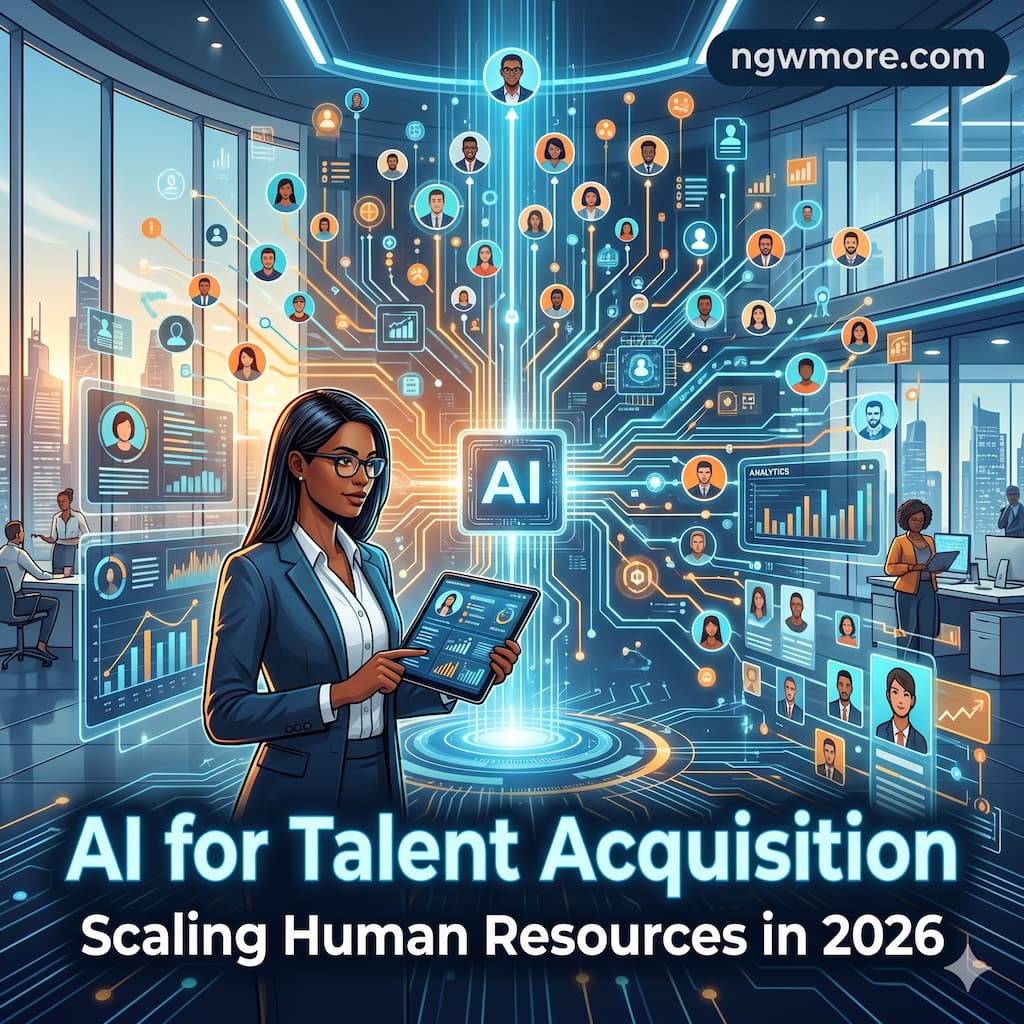
AI for Talent Acquisition: Scaling Human Resources in 2026
The global war for talent has entered an entirely new operational theater. As we progress through May 2026, organizations are facing a complex demographic paradox: a persistent shortage of highly specialized technical talent, coupled with an unprecedented volume of inbound applications fueled by automated, AI-assisted job application tools. For human resource executives, enterprise recruiters, and the digital entrepreneurs within the ngwmore.com community, legacy recruiting frameworks have fundamentally broken down under this administrative load.
Relying on manual resume screening, traditional keyword-based applicant tracking systems (ATS), and episodic interview scheduling is no longer just inefficient—it is a threat to corporate growth. In 2026, market leaders do not treat recruiting as a manual matching game; they treat it as a high-velocity, data-intelligent pipeline. At the absolute core of this structural evolution is AI-Powered Talent Acquisition.
By transitioning away from rigid, rule-based screening and deploying an integrated layer of Agentic HR Infrastructure, modern enterprises are achieving something that was previously impossible: scaling their hiring operations exponentially while simultaneously removing human bias, compressing time-to-hire by over 60%, and drastically improving candidate experience.
1. The 2026 Paradigm Shift: The “Autonomous Candidate” Collision
To successfully scale your human resource infrastructure this year, you must first understand the technological reality defining the 2026 labor market.
The Rise of the AI Job-Seeker
The widespread availability of consumer-facing AI career agents means that candidates are no longer searching for jobs manually. A single job-seeker in 2026 can deploy a personal AI agent that scans corporate career boards, instantly customizes their resume and cover letter to match a company’s specific semantic requirements, and submits hundreds of verified, highly tailored applications across multiple platforms overnight with a single click.
The HR Counter-Offensive: Agentic Screening
This explosion in application volume has rendered traditional, keyword-matching ATS software obsolete. If a system only filters for specific words like “Kubernetes” or “SEO Optimization,” candidate AI agents easily reverse-engineer those triggers, flooding human recruiters with thousands of optimized yet unqualified profiles.
The enterprise response in 2026 is the deployment of Agentic HR Screening. Powered by specialized, high-reasoning language models, these modern AI recruiters do not match keywords. They execute deep Semantic Mapping—analyzing the qualitative context of a candidate’s historical career progression, reading between the lines of project descriptions, evaluating public GitHub commits or portfolio assets, and assessing true capability rather than text formatting.
2. Core Pillars of AI-Native Talent Acquisition
Scaling human resource capabilities in 2026 requires integrating four primary technological pillars into your talent acquisition stack.
I. Predictive Sourcing and Passive Talent Mapping
The best candidates are rarely actively browsing job boards. In 2026, AI excels at Ambient Talent Sensing.
- The Process: AI sourcing agents continuously crawl open-web ecosystems, professional networks, academic registries, and industry-specific forums (such as Stack Overflow or Kaggle).
- The Intelligence: By mapping micro-signals—such as a developer interacting with a specific open-source repository or a marketing specialist publishing a highly granular case study—the AI builds dynamic, predictive profiles. It alerts your internal team: “This candidate has an 82% probability of open-mindedness toward new career opportunities based on recent professional transitions within their current firm.”
II. Dynamic Conversational Triage and Onboarding
First impressions matter. In 2026, the moment an application hits your ecosystem, an autonomous conversational agent engages the candidate in real-time. These are not basic, linear selection trees; they are deeply contextual, empathetic conversational partners.
- Autonomous Triage: The AI interviews the candidate regarding complex operational parameters, answers highly specific questions about your company’s internal engineering stack or corporate culture, maps scheduling availability across global time zones, and manages background check initializations instantly, ensuring zero drop-off in your candidate funnel.
III. Automated Skills Assessment and Virtual Sandbox Evaluation
Verifying actual competence is a major hurdle in remote-first hiring environments. 2026 has witnessed the total stabilization of AI-Generated Sandbox Environments.
Instead of sending generic, easily cheated multiple-choice tests, candidate profiles trigger the autonomous creation of a specialized, localized coding sandbox or a mock marketing campaign simulation. The AI monitors how the candidate interacts with the challenge in real-time, analyzing their problem-solving methodology, structural logic, and velocity, rather than just evaluating the final output code.
IV. Explainable AI (XAI) and De-Biased Selection
The biggest barrier to scaling automated recruiting has historically been the risk of algorithmic bias. Early AI models inadvertently mimicked the historical biases of human hiring managers.
In 2026, enterprise talent acquisition relies on Explainable AI models utilizing SHAP (SHapley Additive exPlanations) architectures. The AI does not just output a “Hire” or “Reject” score; it maps out a transparent, auditable breakdown detailing exactly which technical skills, experience markers, and behavioral traits informed the recommendation, allowing human HR directors to verify structural fairness at a glance.
3. The 2026 Talent Acquisition Stack: Top Tools by Category
To effectively modernize your human resource infrastructure on ngwmore.com, your organization must abandon single-feature software and transition to an interconnected, AI-native talent operating system.
| Platform Class | Leading 2026 Platforms | Ideal Core Use Case | Standout AI Feature |
| Talent Intelligence Engines | Eightfold.ai / SeekOut | Enterprise-wide talent mapping & internal mobility | Global Talent Graph: Calibrates internal skills gaps against a real-time dataset of 1B+ global profiles. |
| Conversational Recruiting | Paradox (Olivia) / Phenom | High-volume conversational triage & scheduling automation | Behavioral Attunement: Adjusts conversational tone and prompt velocity based on candidate engagement. |
| SaaS/SMB Smart ATS | Ashby / Greenhouse AI | Rapid growth scaling for mid-market tech startups | Automated Pipeline Orchestration: Seamlessly pushes validated candidates from sourcing to offer letter. |
| Cognitive Assessment | HackerRank AI / Mercer Mettl | Verified technical competence & sandbox testing | Dynamic Plagiarism & Logic Analysis: Assesses unique problem-solving workflows while flagging AI assistance. |
4. Operationalizing the AI Pipeline: A 3-Step Tactical Roadmap
How do you implement an AI-powered talent acquisition engine within your business workflow this year? Follow this systematic deployment plan:
Step 1: Unify the “Skills Architecture”
Before turning on automation, your organization must map its internal skills directory. Connect your internal performance review logs, project management tools, and current team competencies into your Talent Intelligence Engine. This allows the AI to learn exactly what an elite performer looks like within your specific corporate ecosystem, creating a customized, data-driven ideal candidate avatar.
Step 2: Establish an Automated Handoff Corridor
Do not automate human empathy away from the hiring process. While AI agents are unmatched at processing high-volume, tier-1 data tasks, final culture curation and relationship closing require human emotional intelligence. Build a seamless communication loop:
[Candidate Applies via AI Agent] ──► [Agentic Semantic Screening & Sandbox Test] ──► [AI Summarizes Profile & Handsoff to Human Recruiter]
When a candidate successfully passes the automated conversational screening and sandbox verification parameters, the system instantly packages an analytical dossier, highlights their unique strengths, alerts your internal recruiting director, and books a direct meeting on their calendar within seconds.
Step 3: Implement “Sovereign” Data Guardrails
Ensure your talent acquisition stack complies with modern data tracking rules. Under the full enforcement of the EU AI Act and global data sovereignty mandates in 2026, using high-risk automated decision-making engines requires strict compliance. You must give candidates explicit transparency that an AI is participating in the evaluation process, and provide an instant, frictionless path to opt for human review if requested.
5. Critical Risks: Navigating the 2026 Pitfalls
Scaling human resource structures with artificial intelligence requires continuous, vigilant governance. If left entirely un-monitored, an automated pipeline can create deep operational vulnerabilities:
- The Hallucination Trap: While advanced models are incredibly sophisticated, they can still occasionally misinterpret highly niche, emerging technology acronyms. Human talent leads must run weekly quality audits on rejected candidate logs to ensure the AI’s internal reasoning loops remain perfectly aligned with real-world technical realities.
- The Candidate Backlash: If your recruiting pipeline feels entirely mechanical, sterile, and cold, elite passive talent will walk away from your brand. Use AI to handle the administrative bureaucracy (scheduling, data entry, initial screening) so that your human HR professionals have more time to have genuine, deep, and impactful conversations with top-tier prospects.
- The “Ghost” Candidate Profile: Automated application bots can occasionally generate hyper-optimized, entirely fake developer profiles designed to bypass initial security screenings. Ensure your skills assessment layer includes mandatory, secure identity verification parameters before moving candidates down the executive interview loop.
6. The Digital Synergy: The ngwmore.com Competitive Leverage
For the technology innovators, digital creators, and agency builders tracking trends on this blog, mastering AI-powered talent acquisition represents the ultimate operational shortcut.
When your human resource infrastructure is decoupled from manual administration, your business velocity accelerates exponentially. You can spot an expansion opportunity in a new international market on a Monday morning, configure an automated passive sourcing campaign by Tuesday afternoon, run 500 prospects through a conversational screening loop by Thursday evening, and lock in an elite, verified local executive by Friday afternoon—all without ever adding costly, specialized internal administrative overhead.
In a modern business landscape governed by computational speed, the enterprise that builds the smartest human infrastructure the fastest is the enterprise that wins the market.
Read More⚡ Natural Language Processing: The Future of Business AI
Conclusion: The Era of Scaled Human Potential
AI-powered talent acquisition has successfully democratized elite global recruiting capabilities. The ability to scan millions of professional data vectors, accurately verify technical capability in automated sandboxes, and orchestrate high-converting candidate experiences is no longer a luxury exclusive to global conglomerates with multi-million dollar human resource budgets. The technology has decentralized the asset.
For the ngwmore.com community, the choice is definitive: Transition your corporate architecture from a reactive hiring model to an integrated, predictive talent pipeline. By constructing a specialized sourcing stack, automating your low-leverage scheduling workflows, and enforcing absolute transparency via explainable AI models, you remove human friction and structural bias from your growth equation entirely.
The global talent network is moving at unprecedented velocity. Is your business scaling its human infrastructure to match the speed of the future?